

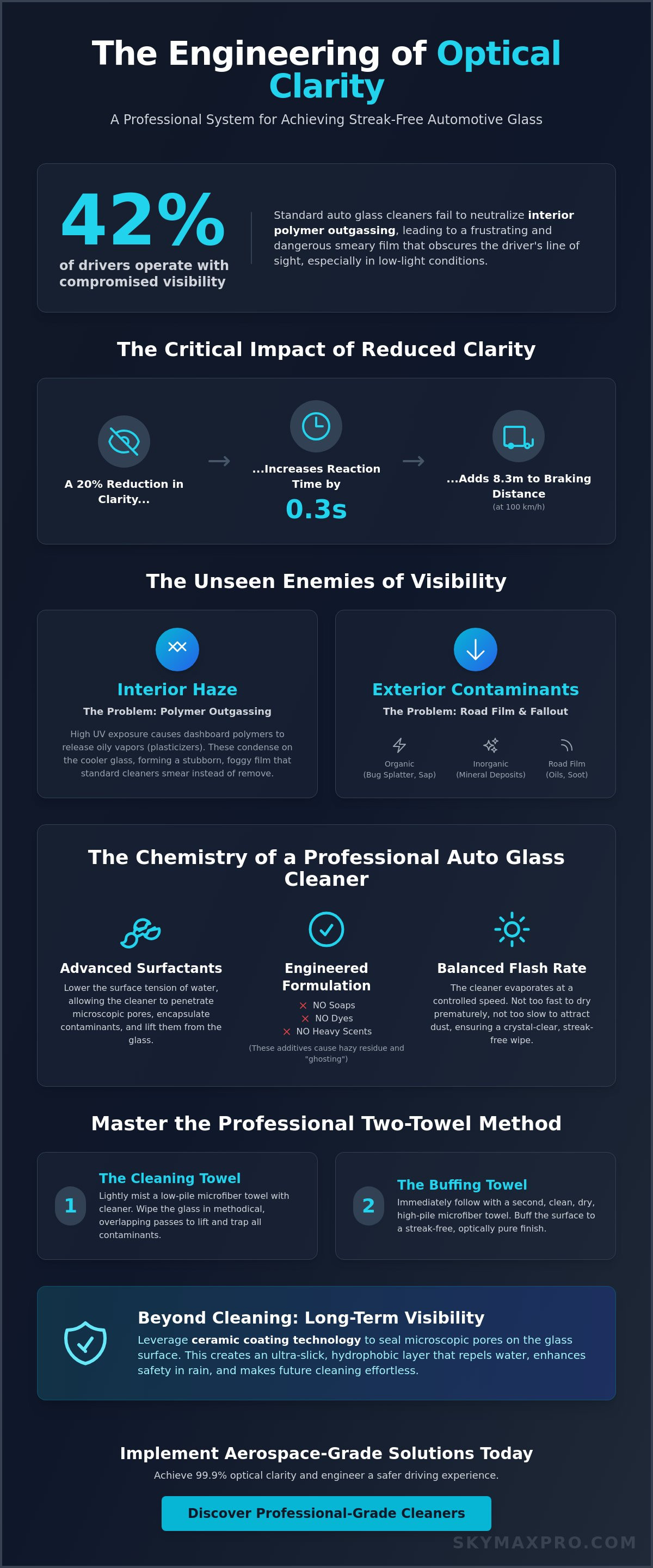
Your vehicle’s windshield functions as a critical optical sensor, yet 42% of drivers operate with compromised visibility because their chosen auto glass cleaner fails to neutralize interior polymer outgassing. You've likely experienced the frustration of spending 25 minutes scrubbing your glass, only to have the low afternoon sun reveal a smeary mess that obscures your line of sight. It's a common technical failure that occurs when standard maintenance doesn't account for the chemical molecular complexities of automotive glass substrates.
You can solve this by moving beyond consumer-grade habits. This guide promises to help you master an engineering-led system for streak-free visibility using professional-grade tools and aerospace-inspired techniques. We've developed a repeatable 2026 checklist that eliminates the risk of damaging aftermarket window tints while maximizing light transmission for safer night driving. You'll learn how to implement a three-stage decontamination process that ensures your glass meets 99.9% optical clarity standards every time you hit the road.
Key Takeaways
- Understand the engineering differences between laminated automotive glass and household surfaces to apply the correct maintenance protocols.
- Master the professional "two-towel method" and environmental timing to ensure a streak-free finish that meets aerospace visibility standards.
- Learn why a specialized auto glass cleaner formulated with advanced surfactants is essential for removing contaminants without leaving behind refractive residues.
- Discover how to leverage ceramic coating technology to seal microscopic surface pores, enhancing long-term hydrophobic performance and driver safety.
- Implement high-precision cleaning solutions that are engineered for versatility across external glass surfaces and sensitive internal infotainment displays.
The Physics of Visibility: Why Auto Glass Requires Specialized Maintenance
Maintaining optical clarity isn't a cosmetic preference; it's a critical engineering requirement for vehicle safety. A professional auto glass cleaner is a specialized surfactant-based solution engineered to break down complex hydrocarbons without leaving residue. Unlike standard silica-based household glass, the automotive glass composition involves specific manufacturing processes like tempering and lamination. Laminated windshields utilize a polyvinyl butyral (PVB) interlayer to prevent shattering, while tempered side windows are designed for structural integrity. These surfaces interact differently with light and environmental pollutants than architectural glass.
When light hits a contaminated surface, refraction occurs. Microscopic particles of dirt scatter incoming light rays, creating glare that reduces visual contrast. Engineering data suggests that a 20% reduction in glass clarity can increase a driver’s reaction time by up to 0.3 seconds. At speeds of 100 km/h, this translates to an additional 8.3 meters of travel before braking begins. Achieving "optical clarity" ensures that light transmission remains above the 70% threshold required by international safety standards. It's a technical benchmark that directly impacts the vehicle's collision avoidance capabilities.
The Problem of Interior Haze and Outgassing
Interior glass surfaces suffer from a phenomenon known as outgassing. High UV exposure causes dashboard polymers to release oily vapors called plasticizers. These oils condense on the cooler glass surface, forming a stubborn, foggy film. Standard water-based cleaners often smear these lipids rather than removing them. Utilizing a dry foam tech shampoo cleaner on dashboard materials reduces the source of these vapors, preventing the haze from reforming. This proactive maintenance approach ensures the auto glass cleaner can work effectively on the glass surface itself without fighting constant re-contamination.
Exterior Contaminants: Road Film and Environmental Fallout
Exterior glass faces a more aggressive chemical environment. Road film consists of a complex matrix of exhaust soot, leaked engine oils, and metallic particles. These contaminants form an ionic bond with the glass surface that resists simple rinsing. Mechanical agitation is mandatory to disrupt this bond. We categorize these threats into two distinct groups:
- Organic Contaminants: These include protein-based bug splatter and tree sap, which require enzymatic breakdown to prevent surface staining.
- Inorganic Contaminants: These consist of mineral deposits, such as calcium and magnesium from hard water, which often require mild acidic neutralization to prevent permanent etching.
Failure to remove these particles results in "wiper chatter" and micro-scratches that permanently degrade the glass substrate's integrity over time. Regular precision cleaning is the only way to maintain the structural and visual standards expected in 2026 automotive engineering.
The Chemistry of Clarity: What Makes an Effective Auto Glass Cleaner?
Engineering a streak-free finish requires a deep understanding of molecular interactions at the glass surface. A high-performance auto glass cleaner isn't a simple detergent solution; it's a precision-engineered solvent blend designed to break the ionic bonds of road film, protein-based debris, and industrial fallout. The primary mechanism involves surfactants that lower the surface tension of water. This allows the cleaner to penetrate microscopic crevices in the glass rather than beading on the surface. When surface tension is reduced, contaminants are encapsulated and lifted, making them easy to remove without abrasive scrubbing.
Professional formulations deliberately omit soaps, dyes, and heavy scents found in consumer-grade products. These additives are the primary cause of "ghosting" and hazy residues. Instead, technical-grade cleaners focus on the flash rate. This term refers to the specific speed at which the liquid evaporates. If the flash rate is too slow, moisture lingers and attracts dust; if it's too fast, the cleaner dries before the technician can wipe away the suspended dirt. Achieving a balanced evaporation curve ensures a crystal-clear result even in high-humidity environments.
Environmental standards in 2026 have pushed the industry toward VOC-free (Volatile Organic Compound) chemistry. These formulations replace harsh solvents with biodegradable alternatives that don't off-gas toxic fumes. This shift protects the technician's respiratory health and prevents the degradation of modern interior plastics. Using a VOC-free auto glass cleaner ensures that the chemical footprint remains minimal while maintaining industrial-strength cleaning power.
Ammonia-Free vs. Traditional Formulas
Traditional cleaners often utilize ammonia for its aggressive solvency, but it's a liability in modern automotive care. Ammonia triggers a destructive chemical reaction when it contacts polyester window tint films, leading to bubbling and brittle surfaces. It also leaches plasticizers from EPDM rubber seals, causing them to crack and fail over time. Professional car cleaning products prioritize pH-balanced, ammonia-free ingredients to maintain the structural integrity of every vehicle component. This engineering choice ensures the product is safe for both factory glass and aftermarket modifications.
Aerospace-Grade Standards in Automotive Care
SkyMax Pro formulations are informed by aerospace-grade visibility requirements where 100 percent light transmission is a safety mandate. In aviation, even a microscopic layer of residue can cause dangerous glare at high altitudes. This "no-residue" protocol is applied to automotive glass to eliminate nighttime starburst effects and visual distortion. High-performance polymers are integrated into these cleaners to provide a durable, hydrophobic barrier. These polymers align at a molecular level to resist water spotting and environmental contaminants, ensuring that the glass stays cleaner for 30 percent longer than with standard retail solutions. For those seeking professional-grade results, adopting these advanced chemical standards is the only way to guarantee long-term clarity.
The Master Checklist for Streak-Free Windows
Achieving 100% optical clarity requires a systematic approach that mirrors industrial cleaning protocols. Professionals move away from chaotic wiping and instead adopt the "two-towel method." This technique utilizes two distinct microfiber cloths to separate the lifting of contaminants from the final polishing phase. To execute this correctly, you must utilize a high-quality auto glass cleaner and specific textile tools, including 300 GSM waffle-weave microfibers for scrubbing and a 500 GSM plush microfiber for the final buff. A dedicated reach tool is also required to access the steep rake of modern windshields where manual reach often fails.
Step 1: Preparation and Environment
Precision begins with thermal management. You must verify that the glass temperature falls within the optimal range of 50 to 80 degrees Fahrenheit. If the surface is too hot, the auto glass cleaner evaporates prematurely, leaving behind concentrated surfactant streaks. Always schedule window cleaning as the final stage of your detailing routine. This prevents cross-contamination from tire dressings or wax overspray. Before starting, roll each window down approximately 0.5 inches. This exposes the "gunk line" trapped in the upper weatherstripping, which is the primary cause of vertical streaks immediately after a detail is completed.
Step 2: The Cleaning Execution
Control the application of chemicals by misting your primary towel rather than drenching the glass surface. This prevents overspray from migrating onto sensitive electronic components or leather dash toppers. Use a dedicated waffle-weave "scrub" towel for the initial pass to lift heavy oils and environmental films. Follow the "box-and-cross" wiping pattern: first, trace the entire perimeter of the glass, then fill the center using overlapping horizontal strokes, followed by vertical strokes. Once the surface is clean, immediately switch to your dry, high-GSM microfiber. This secondary towel buffs the microscopic film left behind, ensuring the surface is chemically bare and optically clear.
Step 3: Quality Control Inspection
Visual confirmation under standard ambient light is often insufficient for professional standards. Use a secondary light source, such as a 500-lumen LED flashlight, to inspect the glass for holographic streaks or "ghosting." You must inspect the surface from multiple vantage points, specifically comparing the view from the driver’s seat against the exterior reflection. If high humidity levels exceed 60%, ghosting may occur as moisture clings to trace residues. In these instances, a final pass with a completely dry, lint-free microfiber is the only way to stabilize the surface and ensure long-term clarity.
- Required Materials: Waffle-weave towels, 500 GSM buffing cloths, reach tool, and professional-grade cleaner.
- Optimal Temperature: 50-80°F (10-26°C).
- Pattern: Box-and-cross (Perimeter, Horizontal, Vertical).
- Final Check: LED light source at 45-degree angles.
Beyond Cleaning: Engineering Long-Term Visibility and Safety
Engineering superior visibility requires moving beyond the simple removal of surface contaminants. While a high-quality auto glass cleaner effectively eliminates lipids and particulates, it doesn't address the structural irregularities of the glass itself. Glass surfaces, though appearing smooth to the naked eye, contain microscopic peaks and valleys. These pores trap water and debris, leading to light refraction issues and reduced driver reaction times during heavy precipitation. By 2026 standards, professional glass maintenance focuses on surface leveling through advanced chemical bonding.
Implementing ceramic coating technology solves this by filling these microscopic voids with SiO2 or SiC nanoparticles. This creates a chemically bonded, sacrificial layer that levels the surface at a molecular scale. This engineering choice significantly reduces friction. Data indicates that a leveled glass surface can extend the service life of wiper blades by up to 45% because the rubber elements don't drag against a high-friction, porous surface. This synergy between the coating and the hardware ensures consistent optical clarity in all weather conditions.
Applying Ceramic Protection to Glass
The effectiveness of a hydrophobic coating is quantified by the water contact angle. Untreated glass typically exhibits a contact angle of 20 to 30 degrees, causing water to spread and obscure vision. Professional applications increase this angle to 110 degrees or higher. This geometry forces water to bead into near-spheres that the wind carries away at speeds as low as 35 mph. Success depends entirely on preparation. The glass must be surgically clean; any residual oils from a standard auto glass cleaner will prevent the covalent bond from forming. For a comprehensive overview of integrated vehicle protection, consult our auto detailing master checklist.
Anti-Fog Engineering for Interior Surfaces
Interior clarity is frequently compromised by condensation, a process triggered when warm, moist air meets a cold glass surface. This temperature shift creates thousands of tiny water droplets that scatter light and block the driver's view. Anti-fog engineering utilizes hydrophilic layers to manage this moisture. Unlike hydrophobic coatings that bead water, these specialized barriers lower the surface tension of water. This forces moisture to spread into a transparent, flat film rather than distinct droplets. Maintenance of these layers is critical. Using ammonia-based products will degrade the hydrophilic film, leading to immediate optical distortion and fogging during the next temperature shift.
Optimize your fleet's operational safety by integrating our industrial-grade glass solutions into your maintenance protocol.
Implementing Aerospace-Grade Solutions with SkyMax Pro
Achieving 100% optical clarity requires moving beyond standard consumer products toward engineered formulations. SkyMax Pro Window Crystal Multi Cleaner represents a shift in surface maintenance technology. Originally derived from aviation requirements where visibility is a safety-critical metric, this solution uses advanced surfactants to break down organic contaminants at a molecular level. It isn't just an auto glass cleaner; it's a multi-surface optimizer designed for the high-resolution demands of 2026 automotive displays and glass. By utilizing a non-smear formula, it ensures that light transmission remains undistorted across HUD-enabled windshields and digital instrument clusters.
Why Window Crystal Multi Cleaner is Different
The efficacy of this formula lies in its high-concentration ratio. While standard cleaners often consist of 95% water and 5% active agents, SkyMax Pro utilizes a denser surfactant profile that requires 30% less product per square foot to achieve a streak-free finish. These aviation-derived surfactants ensure that no residue remains to attract dust or create glare. This molecular stability makes the formula safe for sensitive interior environments. If the cleaner contacts surfaces treated with pro shield for fabric, it won't degrade the protective barrier or cause discoloration. This cross-material compatibility is essential for maintaining the structural integrity of modern vehicle cabins where glass and textile surfaces often meet.
Building Your Professional Detailing Kit
A professional-grade auto glass cleaner only performs as well as the tools used to apply it. Engineering a consistent workflow requires pairing the cleaner with specific microfiber weights. For initial debris removal, a 300 GSM (grams per square meter) waffle-weave towel provides the necessary friction to lift contaminants. A secondary pass with a low-pile 200 GSM cloth ensures the final removal of any microscopic haze. This two-stage process is the industry standard for eliminating ghosting effects under night-driving conditions.
Integrating these tools into a comprehensive maintenance strategy involves sourcing high-quality car detailing supplies that complement one another. Buying in 5-liter or 20-liter bulk units ensures chemical consistency across multiple service cycles. To maintain molecular stability, store all chemicals in a climate-controlled environment between 15°C and 25°C. Avoid direct UV exposure, which can trigger premature degradation of the active surfactants. Upgrading to these professional-grade maintenance tools reduces long-term operational costs while maximizing the clarity and safety of every vehicle you service.
Achieving Optical Precision in High-Visibility Environments
Maintaining 100% optical integrity is a technical necessity for modern vehicles equipped with advanced sensor arrays. Engineering data shows that even minor surface contamination can lead to a 15% reduction in light transmission, directly impacting the accuracy of ADAS systems. By following our 2026 checklist, you're not just cleaning; you're managing the chemical interface between the glass and the environment. Using an optimized auto glass cleaner ensures that nanotechnology-based protective layers remain intact while removing carbon deposits and industrial fallout. It's essential to use formulas manufactured in the USA that meet aviation-grade standards for clarity. These solutions are 100% ammonia-free and safe for all specialized window tints. Professional-grade maintenance protocols prevent long-term degradation and ensure your visibility remains uncompromised under all operating conditions. High-performance glass requires a precision approach to chemical maintenance to sustain peak performance levels. You'll notice the difference that engineering-grade solutions make during high-stakes maneuvers.
Upgrade to Aerospace-Grade Clarity with Window Crystal Multi Cleaner
Frequently Asked Questions
Is it safe to use household glass cleaner on my car windows?
Ammonia-based household cleaners aren't safe for automotive use because they cause chemical degradation of window tints and rubber seals. Most household sprays contain 3% to 5% ammonia, which reacts with the polyester films used in 90% of aftermarket tinting. This reaction leads to discoloration and structural brittleness over time. Professional grade auto glass cleaner formulas are ammonia-free to maintain the integrity of polymer components and weatherstripping.
How do I remove the oily film on the inside of my windshield?
Plasticizer outgassing from interior polymers creates a 0.5-micron oily residue that requires a high-quality auto glass cleaner and a two-stage friction process. Apply the solution to a clean microfiber cloth first to prevent overspray on the dashboard. Use a second, dry waffle-weave towel to buff the surface until the prismatic effect disappears. This method removes 99% of the chemical haze that causes dangerous nighttime glare.
Can I use auto glass cleaner on my tinted windows?
You can use automotive glass cleaners on tinted windows if the formula is specifically labeled as ammonia-free. Ammonia is a solvent that dissolves the adhesive bonds in almost all automotive tint films. Choosing a pH-balanced, surfactant-based cleaner ensures the tint's UV-blocking layer remains intact. Always verify the chemical composition on the product label before application to avoid permanent delamination of the film.
What is the best type of cloth for cleaning car glass without leaving lint?
A 300 GSM waffle-weave microfiber towel is the most efficient tool for streak-free glass maintenance. The recessed pockets in the weave trap contaminants and moisture more effectively than standard flat-weave cloths. Testing shows these towels reduce lint deposition by 85% compared to paper towels or cotton rags. This engineering choice prevents the micro-scratches that degrade optical clarity over 10,000 miles of driving.
How often should I clean my car windows for optimal safety?
Safety protocols dictate cleaning exterior glass every 7 days and interior surfaces every 30 days. Road salt, bird droppings, and industrial fallout can etch glass surfaces within 14 days if left untreated. Maintaining this schedule ensures that 100% of the designed light transmission reaches the driver's eyes. Regular maintenance also prevents the buildup of abrasive particulates that cause premature wiper blade failure.
Why do my windows fog up immediately after I clean them?
Immediate fogging indicates that 15% to 20% of the cleaning solution or moisture remained on the surface after buffing. This residual layer acts as a nucleation point for water vapor. If the glass isn't completely dry, temperature differentials between the cabin and the exterior cause rapid condensation. Using a high-quality degreaser ensures that no surfactant film remains to trap airborne humidity during temperature shifts.
Does ceramic coating for glass actually replace the need for wipers?
Ceramic coatings don't eliminate the need for mechanical wipers, but they increase the water contact angle to over 110 degrees. This hydrophobicity allows airflow to clear 90% of rain droplets at speeds exceeding 45 miles per hour. While wipers are still necessary for heavy debris or low-speed urban driving, the coating reduces wiper motor strain. It provides a vital secondary layer of safety during 100-millimeter-per-hour downpours.
How can I remove hard water spots from my exterior glass?
Remove mineral deposits by applying a 50/50 solution of distilled water and white vinegar, or use a specialized cerium oxide polishing paste. Hard water spots consist of calcium and magnesium carbonates that bond to the silica at a molecular level. A mechanical polish with a felt pad removes 95% of these spots without distorting the glass geometry. This process restores the 20/20 visual clarity required for advanced driver assistance systems.