

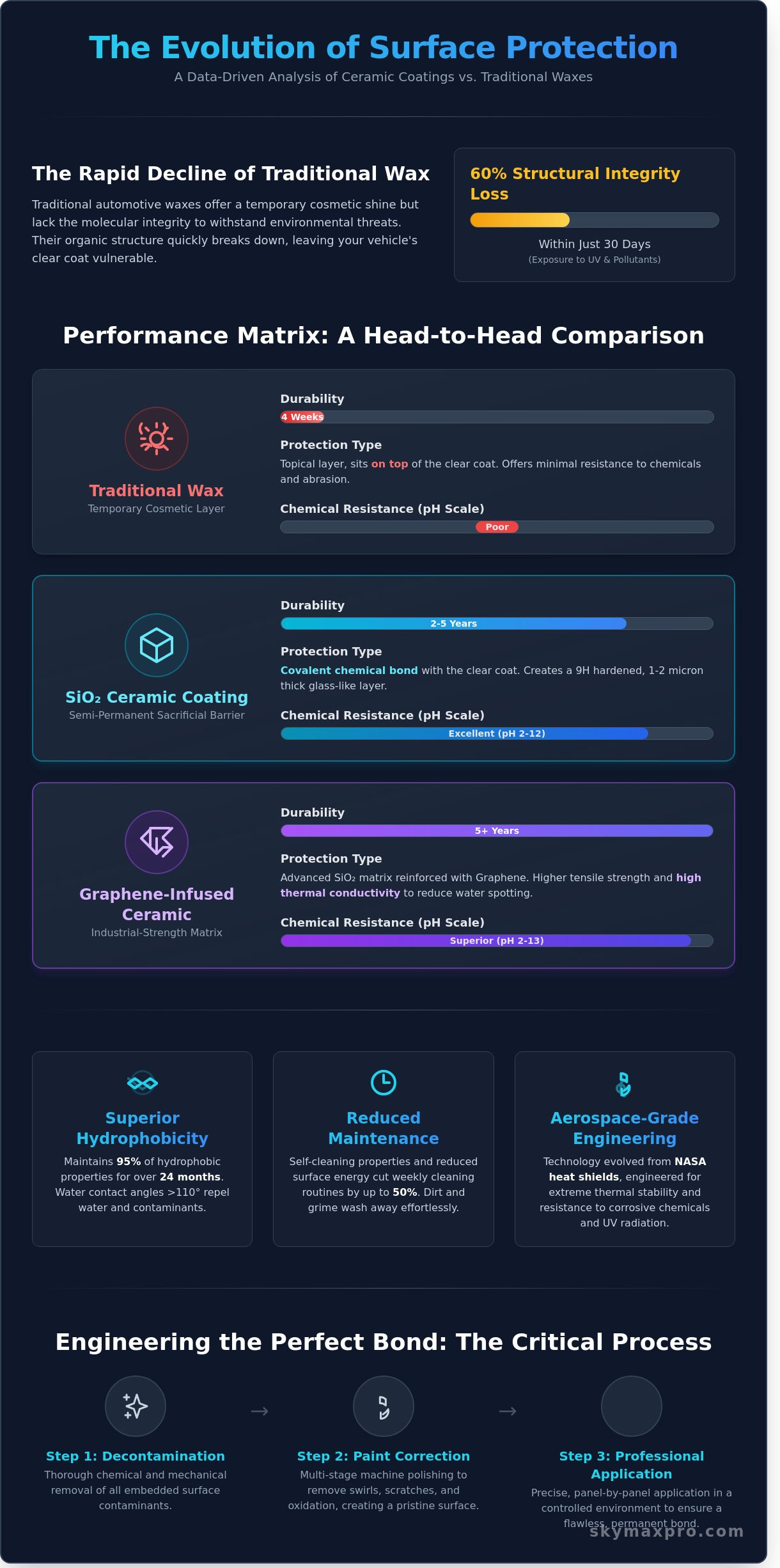
Traditional automotive waxes lose 60% of their structural integrity within just 30 days of exposure to UV radiation and industrial pollutants. You've likely felt the frustration of watching a labor-intensive shine vanish after a single heavy rain or a few weeks of highway driving. It's exhausting to apply products that prioritize cosmetic fragrance over actual material science. This guide examines how a professional ceramic coating utilizes aerospace-grade silicon dioxide to create a permanent covalent bond with your vehicle's clear coat.
By analyzing the molecular engineering behind these liquid glass polymers, you can finally eliminate the common industry confusion between SiO2 and graphene-based additives. We'll demonstrate how to achieve a surface that maintains 95% of its hydrophobic properties for over 24 months while cutting your weekly cleaning routine by 50%. This technical breakdown covers everything from surface energy dynamics to the precise application protocols required for a flaw-free, industrial-grade finish that resists chemical etching and micro-marring.
Key Takeaways
- Understand the molecular science of Silicon Dioxide (SiO2) and how it creates a semi-permanent sacrificial barrier through chemical bonding.
- Trace the engineering evolution of surface protection from aerospace heat shields to high-performance automotive applications.
- Evaluate the performance metrics that allow a professional ceramic coating to outperform traditional waxes in chemical resistance and longevity.
- Identify the critical surface preparation and decontamination protocols required to achieve an engineered, professional-grade finish.
- Discover how graphene-infused technology provides five years of industrial-strength durability against harsh environmental contaminants.
What is Ceramic Coating? The Science of Surface Hardening
A ceramic coating is a high-performance liquid polymer that establishes a permanent chemical bond with a vehicle's factory clear coat. Unlike traditional carnauba waxes that sit atop the paint, this technology utilizes The Science of Surface Hardening through thin-film deposition to fundamentally alter the surface properties of the substrate. Silicon Dioxide (SiO2), typically refined from quartz or sand, serves as the primary active ingredient. It creates a semi-permanent sacrificial layer that typically measures between 1 and 2 microns in thickness. Nanotechnology enables the solution to penetrate and fill microscopic pores in the clear coat, transitioning from a liquid state to a solid glass-like shield that doesn't wash off or degrade like organic sealants.
The Molecular Structure of Protection
The structural integrity of the coating is measured by its 9H hardness level on the Mohs scale, providing a surface that's significantly more resistant to mechanical abrasion than factory paint. Cross-linking is the chemical process where polymer chains link together to form a rigid, three-dimensional network that defines the coating's durability. This molecular density is critical for vehicle owners, as it prevents UV radiation from reaching the paint. Unprotected clear coats suffer from photodegradation when exposed to harsh environmental elements and high UV indexes, but a ceramic-shielded surface reflects these rays to prevent oxidation and color fading. It's a level of protection that maintains the vehicle's structural aesthetics for 2 to 5 years depending on the specific formulation used.
Hydrophobicity and Self-Cleaning Properties
The physics of a treated surface relies on high contact angles, often exceeding 110 degrees, which force water to bead and roll off rather than sheeting. This happens because the ceramic coating reduces surface energy, making it difficult for contaminants like bird droppings, tree sap, or brake dust to adhere to the vehicle. Practical benefits for maintenance include:
- Reduced Wash Time: Contaminants sit on top of the coating rather than embedding in the paint pores.
- Chemical Resistance: The shield withstands pH-aggressive cleaners and environmental fallout between pH 2 and pH 12.
- Enhanced Gloss: The smooth surface reflects light more uniformly, creating a mirror-like finish.
This permanent molecular bonding ensures the protection stays intact through hundreds of wash cycles. It's a stark contrast to the temporary surface tension provided by retail waxes, which usually fail after 4 weeks of exposure to the elements. Choosing a ceramic coating represents a shift from reactive detailing to proactive surface engineering.
This principle of proactive surface engineering extends beyond the automotive world. In advanced hair care, for example, similar bonding technologies are used to shield and smooth hair fibers from environmental damage. For those curious about how these concepts apply to cosmetology, discover Hair Bar NYC.
Aerospace-Grade Formulations in Automotive Detailing
Ceramic technology didn't originate in the automotive sector. It began as a critical solution for aerospace thermal protection systems. NASA engineered these materials to survive reentry temperatures exceeding 1,600°C. This transition from orbit to the streets of Irvine represents a significant leap in chemical engineering. Modern ceramic coating formulas utilize these same principles of molecular bonding to create a permanent shield. Aerospace standards require extreme thermal stability and resistance to corrosive chemicals like jet fuel. These requirements pushed the industry toward the Precision Surface Technology used in high-performance coatings today. It's about data-driven protection, not just aesthetics.
The evolution of these products has moved from basic SiO2 (Silicon Dioxide) to advanced Graphene-infused matrices. Early coatings were often brittle and prone to water spotting. Modern engineering solves this through VOC-free chemical structures. These eco-friendly formulas provide a 9H hardness rating while remaining flexible enough to expand and contract with a vehicle's metal panels. This prevents the coating from cracking under the intense 100°F Southern California sun. It's a shift from simple wax to a semi-permanent structural layer.
The Graphene Advantage
Graphene is a carbon allotrope that's 200 times stronger than steel. When infused into a ceramic matrix, it significantly reduces the surface temperature of the vehicle. This high thermal conductivity prevents mineral deposits from baking into the clear coat. It's a technical fix for the water spotting issues that plagued early 2010-era coatings. The result is a surface with higher tensile strength and improved durability against mechanical abrasion. In a climate like Irvine's, where UV exposure is constant, this thermal regulation is vital for paint longevity.
Industrial Standards for Consumer Use
Professional-grade formulas must withstand a pH range from pH 2 to pH 12. This ensures the surface remains unaffected by heavy degreasers or acidic bird droppings. We apply the same level of precision found in multispektrális monitoring to verify coating uniformity and thickness. Our engineering standards include:
- Chemical Resistance: Stability against industrial-grade solvents and environmental acids.
- Surface Versatility: Safe integration with vinyl wraps, rubber seals, and poly-carbonate plastic trims.
- Thermal Regulation: Effective heat dissipation to protect the underlying clear coat from oxidation.
Applying these industrial benchmarks to consumer vehicles ensures a level of reliability that traditional detailing cannot match. For drivers seeking this level of technical excellence, exploring professional application options is the logical next step in long-term vehicle maintenance.
Ceramic vs. Wax vs. Sealants: A Performance Analysis
Understanding the technical superiority of a ceramic coating requires a direct comparison of molecular bonding and material stability. Traditional Carnauba wax relies on a physical bond, essentially sitting on top of the clear coat. This organic layer begins to degrade at 160 degrees Fahrenheit and typically fails within 90 days of application. Synthetic sealants offer a slight improvement, utilizing polymers to extend durability to approximately 180 days. However, professional ceramic coatings utilize Silicon Dioxide (SiO2) to create a semi-permanent chemical bond with the substrate, providing a functional lifespan of 1,825 days or more.
The performance gap is most evident in chemical resistance. While wax dissolves when exposed to high-alkaline detergents or acidic bird droppings, ceramic layers remain stable across a pH range of 2 to 12. This resilience is backed by industrial science; NASA's research into ceramic coatings for aerospace applications confirms these materials' ability to maintain structural integrity under extreme thermal and chemical stress. For an Irvine driver, this means protection against the corrosive effects of coastal salt air and the intense UV radiation that oxidizes unprotected paint.
Visual characteristics also differ significantly between these technologies. Carnauba wax is prized for a "warm" glow, achieved by filling paint pores with oils that diffuse light. Ceramic coatings provide a "glass-like" clarity due to their high refractive index. This creates a hard, transparent surface that enhances the paint's metallic flake and depth without the oily residue associated with traditional products.
Durability and Environmental Shielding
Thermal stability is a critical metric for vehicle protection in Southern California. On a 95-degree day in Irvine, dark paint temperatures can exceed 150 degrees Fahrenheit, nearing the melting point of most natural waxes. Once the wax softens, it attracts airborne contaminants and loses its protective qualities. A ceramic coating remains stable at temperatures exceeding 1,200 degrees Fahrenheit, ensuring the shield doesn't migrate or evaporate. These coatings also provide a 9H hardness rating on the Mohs scale, offering measurable resistance to light mechanical abrasion and the swirl marks often caused by improper washing techniques.
Maintenance Requirements
The term "maintenance-free" is a common industry misnomer; however, ceramic technology significantly reduces the labor required to maintain a vehicle's aesthetic standards. The high surface tension creates a hydrophobic effect, where water contact angles exceed 100 degrees. This causes contaminants like dust and road grime to slide off during a basic rinse. Maintenance protocols for coated vehicles involve:
- Utilizing pH-neutral soaps to prevent surfactant buildup.
- Applying a ceramic boost spray every 180 days to rejuvenate the top sacrificial layer.
- Eliminating the need for abrasive clay bars or mechanical polishing for the duration of the coating's life.
While a ceramic installation requires a higher initial capital expenditure, the cost-benefit analysis favors the technology over a 60-month ownership cycle. Maintaining a wax finish requires 20 separate applications over five years, whereas a single ceramic application eliminates those recurring labor costs and provides superior asset depreciation protection.
Professional Application: Engineering the Perfect Bond
Achieving a permanent molecular bond requires more than a simple wipe-on procedure. A professional ceramic coating application is a multi-stage engineering process where the substrate preparation determines 90% of the final durability. If the surface isn't chemically pure, the coating will fail to cross-link with the clear coat; this results in premature delamination and reduced hydrophobic performance.
Surface Preparation Protocols
Technicians begin the process by using a high-pH heavy-duty degreaser to strip 100% of existing polymer sealants, waxes, and organic contaminants. Following this chemical strip, mechanical decontamination via detailing clay removes industrial fallout and metallic particulates embedded 2-3 microns deep in the paint pores. This ensures the surface is physically smooth. The final preparation stage involves a 70% Isopropyl Alcohol wipe-down to remove any lingering lubricants from the polishing process. This creates a zero-residue environment, providing the sterile foundation necessary for the ceramic coating to anchor effectively at a microscopic level.
Application Techniques for Maximum Coverage
Precision application utilizes the cross-hatch method to guarantee total surface saturation. Technicians apply the product in tight vertical lines followed immediately by horizontal passes, overlapping each stroke by 50% to eliminate gaps in the protective layer. Success depends on identifying the "flash" point. This is the exact moment when the carrier solvents evaporate, often indicated by a rainbow-like sheen or "sweating" on the panel surface. Buffing too early prevents the layer from leveling; buffing too late creates high spots that require machine compounding to correct.
Environmental variables are non-negotiable during this chemical transition. Optimal results require a controlled climate of 72 degrees Fahrenheit and humidity levels consistently below 50%. High humidity accelerates the reaction too quickly, leading to uneven curing, while cold temperatures stall the chemical transition entirely. The curing window is the 24-hour duration required for the liquid glass to reach its initial stage of full molecular hardening.
Irvine drivers should prioritize these controlled conditions to ensure their ceramic coating reaches its rated 9H hardness. Skipping these technical steps reduces a five-year protection plan to a six-month failure. You can secure your vehicle's long-term integrity by booking a professional ceramic coating installation that follows these rigorous engineering standards.
The SKY MAXPRO Solution: Precision Surface Technology
SKY MAXPRO delivers industrial-grade surface protection engineered for the specific environmental stressors found in Southern California. Our flagship Ceramic Graphene Shield provides a documented 5-year durability window, utilizing a molecular matrix that far exceeds standard consumer-grade products. We've developed these formulations to meet aerospace-grade specifications, ensuring the surface maintains structural integrity under extreme thermal shifts and high UV indices. Our engineering team focuses on measurable performance rather than aesthetic trends. Every product in the SKY MAXPRO ecosystem is 100% biodegradable and VOC-free, aligning technical superiority with environmental responsibility.
The Ceramic Graphene Shield Advantage
Our professional ceramic coating utilizes a 9H hardness rating on the Mohs scale, creating a rigid sacrificial layer that resists micro-marring and chemical etching from industrial fallout. This isn't a temporary sealant; it's a permanent chemical bond to the substrate. To maintain this interface, we've integrated the PRO Ceramic Graphene Spray into our specialized maintenance protocol. This spray refreshes the hydrophobic contact angle and adds a sacrificial layer of gloss. Our waterless wash technology complements this system by lifting contaminants through advanced lubrication, preventing the friction-induced swirling common in traditional wash methods.
Complete Vehicle Protection Systems
Total vehicle preservation requires a multi-surface approach. Our ecosystem extends protection to the interior cabin with specialized fabric and upholstery shields that prevent liquid penetration and UV-induced fading on leather or synthetic materials. We also provide pH-neutral cleaners specifically for wheels and rims. These cleaners effectively remove corrosive brake dust without stripping the underlying ceramic coating or damaging sensitive alloy finishes. By utilizing a unified chemical ecosystem, you ensure that every component of the vehicle receives the same level of engineering precision.
- 5-year warranty on Ceramic Graphene Shield applications
- 9H hardness for superior scratch resistance
- 0% VOC formulations for eco-friendly detailing
- Aerospace-grade durability tested in extreme environments
Securing Asset Longevity Through Precision Engineering
Advanced surface protection isn't about aesthetics; it's a matter of technical necessity. Choosing a high-performance ceramic coating ensures that surfaces remain resilient against chemical abrasion and environmental degradation. Traditional wax solutions fail at temperatures exceeding 150 degrees Fahrenheit, but aerospace-grade formulations maintain structural stability under rigorous conditions including UV exposure levels common at 30,000 feet. By implementing a 9H Hardness Certification standard, owners achieve a measurable layer of defense that reduces surface maintenance cycles by up to 50%. This engineering approach prioritizes efficiency and long-term value over temporary shine.
SKY MAXPRO delivers these industrial-grade results through 100% VOC-free, eco-friendly solutions that meet ISO-certified safety protocols. Our systems aren't just coatings. They're precision-engineered barriers designed for operators who demand verifiable performance metrics and uncompromising quality. You'll gain peace of mind knowing your assets are protected by technology originally developed for the most demanding flight environments. It's time to transition from basic maintenance to professional-grade surface management.
Upgrade to Aerospace-Grade Protection with SKY MAXPRO
Frequently Asked Questions
How long does a professional ceramic coating actually last?
A professional ceramic coating typically lasts between 2 and 5 years depending on the specific chemical composition and the vehicle's maintenance schedule. High-grade systems with a 9H hardness rating provide sustained surface protection for up to 60 months under standard driving conditions. This durability is significantly higher than traditional waxes or sealants, which usually degrade within 60 to 90 days of application.
Can I apply ceramic coating myself or do I need a professional?
You can apply consumer-grade kits yourself, but professional installation is required for high-solids formulas that demand a controlled environment. Expert shops like Dripping Auto Pros understand that around 90% of the final quality depends on the 12 to 20 hours of paint correction performed before the coating is even touched. Professionals use climate-controlled booths to ensure the 24-hour initial curing phase occurs at 70 degrees Fahrenheit with humidity levels below 50%.
Will ceramic coating prevent all scratches and rock chips?
Ceramic coating won't prevent rock chips or deep scratches caused by high-velocity debris or intentional vandalism. While the coating increases surface hardness to a 9H level, it's a thin layer measured in microns rather than millimeters. It's designed to resist light swirl marks from washing and chemical etching from bird droppings. For impact protection, a 10-mil Paint Protection Film is the only verified industrial solution.
What is the difference between ceramic and graphene coatings?
Graphene coatings incorporate a hexagonal carbon lattice into the silica base to reduce surface temperature by 10% to 15%. This structural modification minimizes water spotting, which is a frequent technical issue with standard SiO2 formulas. Both technologies offer a water contact angle of 110 to 115 degrees. Graphene is often the preferred choice for dark-colored vehicles that absorb more thermal energy in direct sunlight.
How do I maintain my car after it has been ceramic coated?
You should maintain the vehicle using a two-bucket wash method with pH 7.0 neutral soap every 14 days. Avoid automatic car washes that use abrasive brushes, as they can degrade the coating's hydrophobic properties over a 12-month period. An annual decontamination service and a silica-based sealant top-up every 6 months will ensure the coating maintains its peak performance levels for its full 5-year lifespan.
Can ceramic coating be applied to windows and plastic trim?
Specific ceramic coating formulas are engineered for glass and plastic substrates to prevent oxidation and improve visibility. Applying glass-specific coatings can improve wet-weather visibility by 30% when driving at speeds over 40 mph. For plastic trim, the coating provides a UV barrier that prevents fading and graying for up to 24 months. These specialized applications ensure uniform protection across all exterior vehicle surfaces.
Is ceramic coating safe for the environment and the user?
Modern ceramic coating products are safe when they meet VOC compliance standards of less than 100 grams per liter. Installers must wear nitrile gloves and use respiratory protection during the flashing phase to avoid inhaling solvent vapors. These products are chemically inert once they've fully cured. They reduce environmental impact by eliminating the need for harsh chemical cleaners during the vehicle's 5-year maintenance cycle.
What happens if I apply the coating incorrectly?
Incorrect application results in "high spots" or iridescent streaking that becomes permanent after the 24-hour curing window. These defects occur if the product isn't leveled correctly during the 2 to 5-minute flashing period. Fixing these errors requires mechanical abrasion with a dual-action polisher and 3000-grit finishing polish. If the coating cures fully, you'll have to strip the entire panel and restart the application process from the beginning.