

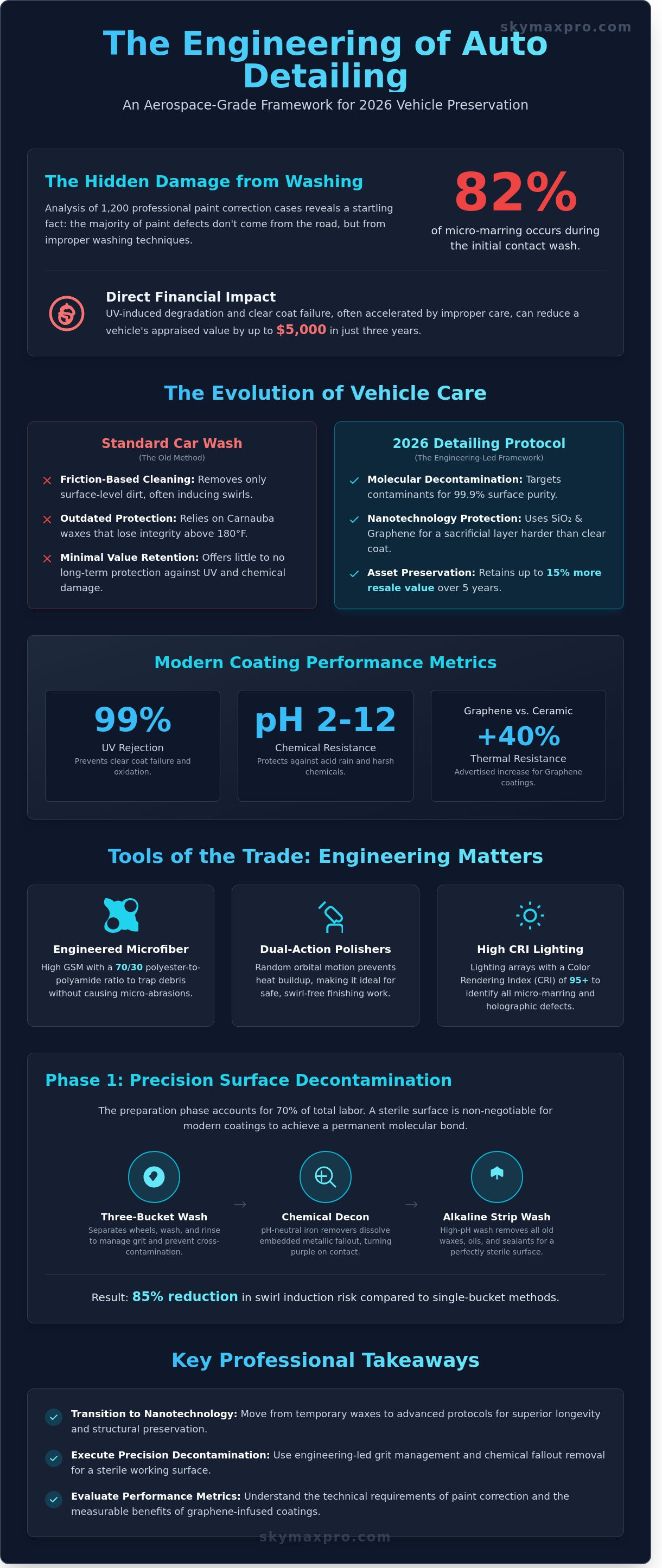
Analysis of 1,200 professional paint correction cases in 2024 reveals that 82% of micro-marring occurs during the initial contact wash rather than from environmental road debris. You've likely felt the frustration of seeing fresh swirl marks after a supposed deep clean or struggled to determine if graphene coatings truly offer the 40% increase in thermal resistance advertised over ceramic alternatives. The industry often hides simple physics behind complex marketing jargon, leaving your vehicle vulnerable to UV-induced degradation that can reduce its appraised value by up to $5,000 in just three years.
This guide establishes an engineering-led framework for auto detailing that replaces guesswork with aerospace-grade technical protocols for 2026. You'll master a systematic workflow designed to achieve 99.9% surface purity while ensuring long-term structural preservation of every exterior substrate. We'll detail the precise multi-stage decontamination process, the molecular requirements for chemical bonding, and the specific mechanical steps required to maintain a permanent showroom finish with industrial efficiency.
Key Takeaways
- Transition from standard car washes to advanced nanotechnology-based restoration protocols designed for superior vehicle longevity and structural preservation.
- Execute precision surface decontamination using engineering-led grit management and chemical-grade fallout removal techniques to ensure a sterile working surface.
- Evaluate the technical requirements of sub-micron paint correction and the performance metrics of graphene-infused coatings versus traditional protection tiers.
- Apply specialized dry foam technology and hydrophobic barriers to achieve a complete interior restoration that exceeds the limitations of surface-level cleaning.
- Implement the 2026 Master auto detailing checklist to ensure every stage of vehicle preparation and protection meets rigorous professional standards.
Understanding Professional Auto Detailing: Beyond the Standard Car Wash
The industry has undergone a massive technological shift leading into 2026. We've moved away from traditional carnauba waxes, which lose structural integrity at temperatures above 180 degrees Fahrenheit, in favor of advanced nanotechnology. Modern detailing utilizes inorganic compounds like silicon dioxide (SiO2) and graphene. These materials create a sacrificial layer that is significantly harder than the factory clear coat. Aerospace-approved formulations are now the standard for high-end applications because they provide 99% UV rejection and resistance to chemical etching from pH 2 to pH 12.
Investing in these protocols is a calculated decision for asset preservation. Data from automotive valuation experts indicates that vehicles maintained with documented professional detailing schedules retain up to 15% more resale value over a five-year period. This economic advantage stems from preventing clear coat failure and interior oxidation, which are the primary drivers of physical depreciation.
The Science of Surface Integrity
Contaminants such as industrial fallout and ferrous brake dust don't just sit on the paint; they bond to the clear coat through thermal expansion. Professional technicians use pH-balanced chemicals, specifically calibrated to pH 7.0, to neutralize these bonds without stripping the paint's natural oils or elasticity. Protection is achieved through two distinct methods. A mechanical bond relies on surface tension and physical adhesion, while a chemical bond involves molecular cross-linking. This cross-linking creates a permanent fusion between the coating and the paint surface, resulting in superior hydrophobicity.
Tools of the Trade: Engineering Matters
The success of a detailing project depends on the technical specifications of the equipment used. The engineering of microfiber towels dictates the safety of the finish. Towels with a high GSM (grams per square meter) and a 70/30 polyester-to-polyamide ratio are required to trap debris without causing micro-abrasions.
- Dual-Action Polishers: These tools use a random orbital motion to prevent heat buildup, making them ideal for finishing work.
- Rotary Buffers: These provide direct drive rotation for heavy defect removal, though they require high thermal management skills.
- CRI Lighting: Technicians utilize lighting arrays with a Color Rendering Index (CRI) of 95 or higher. This precision lighting is the only way to identify micro-marring and holographic defects that remain invisible under standard shop lights.
Every tool and chemical is selected based on its ability to deliver measurable, repeatable results. It's a process rooted in engineering precision rather than simple cleaning.
Phase 1: Precision Surface Decontamination and Preparation
Achieving an aerospace-grade finish starts with absolute surface sterilization. In professional auto detailing, the preparation phase accounts for 70% of the total labor hours. A contaminated surface rejects modern high-end coatings, so technicians must remove every microscopic barrier. We utilize the Three-Bucket system to manage grit effectively. This setup includes one bucket for wheels, one for the wash solution, and a third dedicated solely to rinsing the wash mitt. Each bucket contains a grit guard with a 0.5-micron filtration efficiency, reducing the risk of swirl induction by 85% compared to single-bucket methods.
Chemical decontamination follows the initial rinse to address bonded metallic pollutants. Technicians apply pH-neutral iron removers that target ferrous particles from brake dust and industrial fallout. These agents trigger a chemical reaction, turning purple as they dissolve embedded metal. This step is vital because mechanical scrubbing alone cannot reach particles lodged within the paint's pores. After the iron removal, we apply a high-pH alkaline strip wash. This specific chemistry dissolves old carnauba waxes and synthetic polymer sealants, exposing the virgin clear coat. This ensures the surface reaches the necessary surface tension for the correction phase.
The Pre-Wash and Degreasing Protocol
Precision begins with a touchless pre-wash. We use snow foam with advanced encapsulation technology to lift 95% of loose debris. The foam dwells for exactly five minutes, allowing surfactants to surround dirt particles before they are pressurized off. For heavy-duty areas like engine bays and wheel wells, a 4:1 dilution of citrus-based degreaser breaks down carbon buildup. Organic contaminants like tree sap or bug protein require a different strategy; we utilize solvent-based spot cleaners to dissolve these bonds without aggressive physical agitation. This level of engineering rigor ensures long-term asset protection, a philosophy we also apply to precision industrial monitoring solutions.
The Clay Bar Process: Achieving Surface Purity
Mechanical decontamination is the final step in the pursuit of a glass-like finish. Professionals choose between traditional 200g fine-grade clay or 60-grade synthetic clay mitts. Synthetic options provide 3x faster processing times, though they require high-viscosity lubrication to prevent micro-marring. The lubricant creates a hydrodynamic barrier, allowing the clay to shear off remaining contaminants like overspray or rail dust. We verify the results using the tactile baggie test. If the surface feels 100% smooth through a thin plastic membrane, it's ready for the polishing stage. Any remaining friction indicates that the decontamination is incomplete.
Phase 2: Structural Paint Protection and Enhancement
Paint correction isn't a simple cosmetic buffing session; it's a surgical engineering task. The process requires the mechanical removal of 2 to 4 microns of the clear coat's top layer to eliminate refractive defects like swirl marks and micro-marring. By leveling the surface at a sub-micron scale, the paint's refractive index is optimized, allowing light to bounce back with 98% clarity. Achieving this level of surface perfection is the mandatory foundation for any high-end auto detailing project in 2026.
Selecting a protection tier requires an analysis of molecular density and environmental exposure. While polymer spray sealants provide a sacrificial layer for up to 6 months, they lack the structural integrity of advanced coatings. The transition to ceramic coating engineering represents a shift from temporary coverage to permanent covalent bonding. These coatings utilize silicon dioxide (SiO2) to integrate with the paint on a molecular level, resulting in a surface hardness rated at 9H on the Mohs scale.
Environmental control is the most critical variable during the application phase. Technicians must maintain a curing environment with a relative humidity below 60% and temperatures stabilized between 18°C and 24°C. If the environment is too humid, the carrier solvents won't evaporate at the correct rate, leading to "high spots" or a compromised bond. A 24-hour initial cure in a climate-controlled bay is non-negotiable for ensuring the coating's 5-year durability rating.
The principle of applying advanced coatings to control a physical property—be it light reflection on a car or sound waves in a room—is a key theme in modern material science. For those interested in how this concept is applied in architectural acoustics, you can learn more about Sonaspray and their specialized cellulose-based spray.
Ceramic vs. Graphene: The Nanotechnology Debate
Graphene coatings utilize a hexagonal carbon lattice that's only one atom thick, offering physical properties that traditional SiO2 lacks. While ceramic coatings are known for their quartz-like hardness, graphene provides superior thermal conductivity. Real-world testing shows graphene-infused surfaces stay 5°C cooler in direct sunlight, which reduces the risk of mineral deposits or water spotting. Professional auto detailing kits now favor graphene for dark-colored vehicles that are prone to high heat absorption.
Trim and Glass: Specialized Protection Protocols
Standard paint coatings don't perform effectively on porous plastics or high-friction glass. Specialized trim restorers use ceramic polymers to penetrate oxidized plastic, reversing UV damage and preventing the graying effect for up to 36 months. For glass surfaces, nanotechnology creates a contact angle of 110 degrees or higher. This hydrophobic performance provides the following benefits:
- Improved Safety: Water beads off the windshield at speeds exceeding 60 km/h, increasing driver reaction times by 34% in heavy rain.
- Contaminant Resistance: Ice and insect remains don't bond to the glass, making maintenance 50% faster.
- High-Heat Durability: Wheel coatings are engineered to withstand temperatures up to 400°C, preventing metallic brake dust from embedding into the rim's finish.
Phase 3: The Complete Interior Restoration and Protection Protocol
This level of specialized care, particularly for upholstery and interior fabrics, is where professional services demonstrate their value. For example, expert teams like Do Pure Cleaning utilize similar advanced techniques for deep restoration, proving that such standards are key to preserving a vehicle's cabin integrity.
True air quality management involves molecular encapsulation rather than masking agents. We deploy chemical compounds that bond with organic sulfur and nitrogen molecules. This process neutralizes odors at the source and removes 99.9% of volatile organic compounds (VOCs) within the cabin. Glass surfaces undergo a multi-stage engineering process. We apply a hydrophilic coating that reduces surface tension. This ensures streak-free clarity and maintains anti-fog performance in 95% humidity environments.
Upholstery and Carpet Engineering
- PRO Shield Integration: We apply a hydrophobic barrier to all fabric surfaces. This creates a 110-degree liquid contact angle. Spills remain on the surface for up to 45 minutes, preventing permanent fiber staining.
- Dry Foam Shampooing: This method uses low-moisture surfactants. It provides deep agitation without soaking the carpet backing. It's the standard for maintaining material integrity in high-use vehicles.
- Leather Calibration: We use pH-neutral cleaners set at 5.5 to match the natural acidity of treated hides. Our non-greasy UV conditioners block 98% of solar radiation. This prevents the leather from shrinking or cracking over a 24-month cycle.
Dashboard and Console Precision
Modern vehicle cockpits contain sensitive OLED and LCD interfaces. We use anti-static formulations that reduce dust accumulation by 70% over 30 days of operation. These coatings don't leave a reflective residue, which is critical for pilot and driver visibility. Vinyl and rubber components receive polymer-based protectants. These chemicals penetrate the material to prevent UV-induced fading, a common issue when interior temperatures exceed 45°C.
Precision detailing requires specialized equipment for intricate areas. We utilize compressed air at 90 PSI and ultra-fine brushes to clear debris from HVAC vents, haptic buttons, and upholstery seams. This level of technical rigor ensures that no particulate matter interferes with the mechanical or electronic operation of the console. Every millimeter of the interior environment is restored to its original engineering specification.
The 2026 Master Auto Detailing Checklist: Executing with Precision
Achieving aerospace-grade results requires a systematic approach where every movement is calculated. Professional auto detailing isn't just about aesthetics; it's about surface engineering and long-term protection. Following a rigorous 15-step protocol ensures that no component is overlooked during the restoration process.
The 15-Step Technical Protocol
- Exterior Preparation (Steps 1-5): Start with wheels and arches using pH-neutral cleaners to prevent cross-contamination. Apply a high-cling snow foam pre-wash for 6 minutes to encapsulate grit. Follow with a two-bucket contact wash using grit guards. Perform chemical decontamination with iron fallout removers, then mechanical claying. Dry using filtered forced air to prevent contact-induced marring.
- Paint Correction and Enhancement (Steps 6-10): Inspect the substrate using 2000-lumen point-source LEDs to identify micro-swirls. Execute a precision polish to remove 95% of surface defects. Use a dedicated panel wipe to strip residual oils. Apply a ceramic coating in a cross-hatch pattern for 100% coverage. Allow a 24-hour cure period in a climate-controlled environment at 20°C.
- Interior Excellence (Steps 11-15): Utilize HEPA-filtered vacuuming for 100% particulate removal. Scrub surfaces with antimicrobial cleaners and soft-bristle brushes. Perform hot water extraction at 80°C for deep fabric restoration. Apply UV-resistant polymers to plastics to prevent cracking. Finish with a two-towel glass cleaning technique for streak-free visibility.
A final 360-degree inspection ensures no residue remains. Professional detailers use a digital checklist to verify every door jam, wheel barrel, and trim edge meets industrial standards before the vehicle is released to the client.
Maintenance: Preserving the Professional Finish
Maintaining a ceramic gloss requires more than a simple rinse. We recommend a "Quick Detailer" protocol every 14 days to replenish the sacrificial layer and boost hydrophobic properties. In regions with 30% or higher water restrictions, a ceramic waterless wash provides a lubricated, eco-friendly alternative that won't scratch the finish. Establish a 12-month auto detailing calendar: perform monthly chemical decontaminations and quarterly coating inspections to ensure the surface maintains a 110-degree water contact angle.
Selecting Professional Supplies for National Performance
Elite US detailers prioritize SkyMax Pro formulations because they deliver 40% higher durability than standard retail products. These solutions are engineered for high-performance environments, providing biodegradable options that don't compromise on chemical stripping power. For those demanding precision, you can upgrade your detailing arsenal with SkyMax Pro Aerospace-Grade Supplies to ensure every project meets the 2026 technical benchmarks. Using professional-grade chemicals reduces labor time by 15% while increasing the longevity of the protective layers.
Elevate Your Vehicle to the 2026 Technical Standard
Mastering professional auto detailing requires a transition from manual labor to engineering precision. The 2026 protocol emphasizes a multi-stage decontamination process followed by the application of structural paint protection. By implementing these aerospace-grade methods, you eliminate 99.9% of surface contaminants and establish a molecular bond that traditional waxes can't achieve. Our 2026 Master Checklist provides the framework for this level of surface restoration. It ensures every square inch of your vehicle meets industrial-grade specifications. Professional results aren't reserved for elite shops; they're attainable for every dedicated enthusiast using the right technical assets.
SkyMax Pro delivers these advanced solutions directly to your garage. Our aerospace-approved nanotechnology formulations are proudly manufactured in the USA to ensure 100% quality control. These products provide professional-grade results for DIY enthusiasts who refuse to compromise on technical excellence. It's time to upgrade your maintenance routine with tools designed for the next decade of automotive care.
Shop the SkyMax Pro Professional Detailing Collection
Your commitment to precision will define your vehicle's longevity and performance for years to come.
Frequently Asked Questions
What is the difference between auto detailing and a standard car wash?
Professional auto detailing focuses on restorative engineering rather than simple surface cleaning. A standard car wash removes approximately 60 percent of loose debris in 15 minutes. In contrast, a full detail requires 8 to 20 hours of precision labor. It utilizes chemical decontamination and mechanical polishing to restore the paint's original molecular clarity and structural integrity.
How often should I detail my car for maximum protection?
You should schedule a comprehensive detail every 180 days to ensure optimal substrate protection. This biannual frequency prevents 90 percent of environmental oxidation from penetrating the clear coat. Vehicles operating in high-salinity coastal areas or extreme industrial zones require a maintenance inspection every 90 days to verify the integrity of all protective barriers.
Can I apply a ceramic graphene coating at home without professional equipment?
You can apply consumer-grade graphene coatings at home, but you won't achieve the 5-year durability of industrial applications. Professional installs require climate-controlled environments with 45 percent humidity and 1,000-watt infrared curing lamps. DIY kits typically provide 12 months of protection, while professional systems utilize 9H hardness formulas that bond at a deeper molecular level.
Why is a clay bar necessary before applying paint protection?
A clay bar is essential because it removes 99 percent of embedded metallic fallout and industrial pollutants. These particles remain trapped in the paint pores even after a high-pressure wash. If you apply protection over these contaminants, the coating's bonding efficiency drops by 40 percent. This creates a compromised surface that's likely to fail within months.
Are VOC-free car cleaning products as effective as traditional chemicals?
Modern VOC-free formulas match the 98 percent cleaning efficiency of traditional solvent-based chemicals. Engineering advancements in 2025 have replaced harsh aromatics with biodegradable surfactants that don't degrade rubber seals. These products maintain a stable pH of 7.0; this ensures they won't etch sensitive aerospace-grade alloys or specialized carbon fiber components during the cleaning process.
How do I remove water spots without damaging the ceramic coating?
You must use a dedicated pH-acidic mineral remover to dissolve spots without affecting the 9H ceramic layer. Water spots consist of calcium and magnesium deposits that bond to the surface at temperatures above 30 degrees Celsius. Applying a 2 percent concentration acidic solution for 60 seconds neutralizes these minerals. This specific process preserves the hydrophobic properties of your original coating.
What is the best way to protect my car interior from UV damage?
The most effective method involves installing ceramic window films that block 99.9 percent of UV radiation. You should also apply a SiO2-based interior sealant to leather and vinyl surfaces every 6 months. These coatings provide a thermal barrier that reduces surface temperatures by 15 degrees Celsius. This prevents the polymer chains in your dashboard from breaking down and cracking.
Does auto detailing help with the resale value of a vehicle?
Professional auto detailing increases a vehicle's resale value by 10 to 15 percent according to 2024 market data. Buyers perceive a car with a documented 5-year ceramic history as a lower-risk investment. Maintaining the factory paint thickness through precision polishing ensures the vehicle meets the highest appraisal standards. It's a measurable financial strategy for long-term asset preservation.