

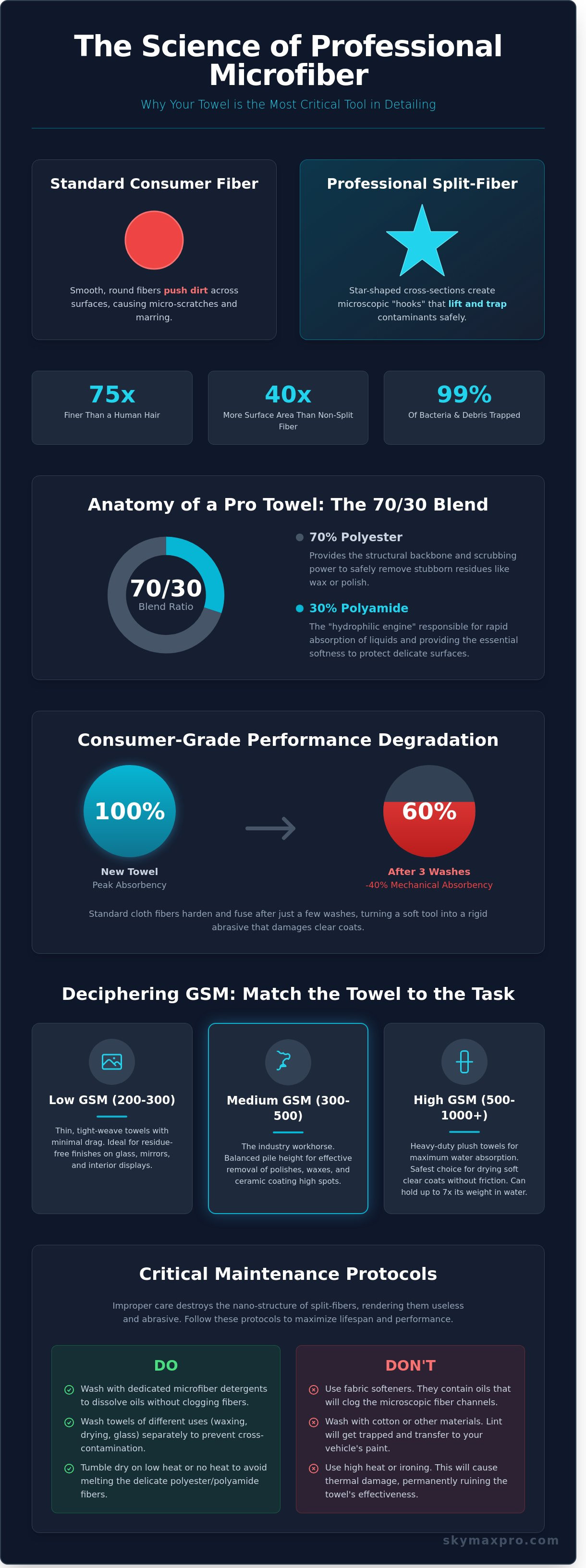
Testing confirms that a standard consumer-grade cloth loses 40% of its mechanical absorbency after just three wash cycles, effectively transforming soft fibers into rigid abrasives. You've likely spent over 15 hours perfecting a vehicle's paint correction, only to find that subpar microfiber towels introduce micro-marring or leave persistent lint during the final buffing stage. It's a frustrating reality when a lack of technical equipment standards compromises your professional results. We understand that in high-level detailing, the margin for error on a ceramic-coated surface is effectively zero.
This analysis details the structural mechanics and technical specifications that separate professional textiles from retail alternatives. You'll discover how specific GSM ratings and 70/30 polyester-to-polyamide blend ratios dictate the safety of your workflow. We'll examine the engineering behind split-fiber technology and weave patterns, providing you with the data needed to maximize towel lifespan and ensure a consistent, swirl-free finish on every project. By focusing on measurable textile performance, you can eliminate variables that threaten the integrity of advanced automotive coatings.
Key Takeaways
- Understand the mechanical splitting process that creates the microscopic star-shaped cross-sections necessary for non-abrasive debris encapsulation.
- Decipher the technical relationship between GSM metrics and fiber density to match the correct towel specification with specific surface-care requirements.
- Identify how specialized Waffle and Pearl weaves optimize surface area and hydration for tasks ranging from rapid drying to precision coating leveling.
- Learn the critical maintenance protocols required to protect the nano-structure of microfiber towels from thermal damage and cross-contamination.
- Explore the specific rotation techniques and fiber interactions essential for the flawless application of SKY MAXPRO aerospace coatings.
Table of Contents
- The Microscopic Geometry of Professional Microfiber Towels
- Technical Specifications: Deciphering GSM and Blend Ratios
- Application-Specific Weaves for Precision Surface Care
- Maintenance Protocols: Preserving the Nano-Structure
- Integrating Microfiber with SkyMax Pro Aerospace Coatings
The Microscopic Geometry of Professional Microfiber Towels
Microfiber is a synthetic material defined by a filament thickness of less than 1.0 denier. For technical context, a single strand of human hair is approximately 75 deniers, making these engineered fibers 75 times finer than organic hair. High-performance microfiber used in automotive detailing consists of a precise matrix of polyester and polyamide. While cotton fibers are round and bulky, these synthetic filaments are engineered for maximum surface contact and contaminant extraction.
The efficacy of a towel depends entirely on the "split" process. Fiber splitting is a mechanical process occurring during manufacturing. This procedure separates the polyester core from the polyamide wedges, creating a star-shaped cross-section. This geometry creates millions of microscopic channels that increase the total surface area by 40 times compared to a non-split fiber. These channels facilitate capillary action, a physical phenomenon where the surface tension of a liquid pulls it deep into the towel's internal structure. This allows microfiber towels to absorb up to 7 times their own weight in water or chemical lubricants without saturating the contact point.
Mechanical cleaning via fiber geometry is fundamentally superior to traditional methods. Instead of using chemical surfactants to break down every contaminant, the wedge-shaped fibers physically lift and lock away particles. This reduces the need for aggressive solvents by 60% in professional paint correction environments, preserving the integrity of the vehicle's clear coat.
Polyester vs. Polyamide: The Structural Balance
The ratio of polymers determines the towel's performance profile. Polyester provides the structural integrity and the scrubbing power needed to break the bond of dried wax or bird droppings. Polyamide serves as the hydrophilic engine, responsible for the rapid absorption of water and polishing oils. For high-end professional detailing, a 70/30 blend is the industrial standard. This specific ratio ensures the towel remains soft enough to prevent marring while maintaining the density required for heavy-duty moisture recovery.
Debris Encapsulation Mechanics
Split fibers act like microscopic hooks that trap 99% of dust, dirt, and bacteria within the towel's internal voids. This encapsulation is critical for paint safety. Cheap, non-split microfiber towels have a smooth, round surface that merely pushes grit across the clear coat, creating "love marks" or fine scratches. Professional-grade towels ensure that once a particle is lifted, it's moved away from the surface and buried deep within the pile, preventing any further contact with the vehicle's finish.
Technical Specifications: Deciphering GSM and Blend Ratios
GSM, or Grams per Square Meter, serves as the primary engineering metric for fiber density and total absorbency. Irvine detailers must treat GSM as a variable that dictates mechanical action on a vehicle's surface. High-density fibers create more surface area, which directly correlates to the volume of liquid a towel can hold before saturation occurs. Beyond weight, the blend ratio, typically 70/30 or 80/20 polyester to polyamide, determines the material's softness and water affinity. Polyamide provides the necessary "thirst" and plushness, while polyester offers the structural integrity required for repeated industrial use.
The GSM Spectrum for Automotive Detailing
Selecting the correct density prevents surface marring and optimizes chemical efficiency. Professional applications require a tiered approach to fiber weight:
- Low GSM (200-300): These thin, tight-weave towels minimize drag. They're essential for glass and interior displays where residue-free finishes are mandatory.
- Medium GSM (300-500): This range represents the industry standard for removing polishes and ceramic coating high spots. The balance of pile height and density allows for effective particulate entrapment.
- High GSM (500-1000+): These heavy-duty towels excel in water absorption. A 1000 GSM towel can often hold 7 times its weight in water, making it the safest choice for drying soft clear coats without adding friction.
According to the EPA report on microfiber efficacy, microfiber technology can reduce bacteria by 99% compared to 30% for conventional materials. While detailing isn't clinical, this data highlights the superior mechanical cleaning power of high-quality microfiber towels when managing interior contaminants and sensitive surfaces.
Edge Construction and Paint Safety
Edge failure remains a leading cause of micro-marring in high-end detailing. Traditional stitched edges use polyester thread that's significantly harder than modern clear coats, creating localized pressure points during buffing. By 2026, ultrasonic cut or silk-banded edges are the required standard for professional operations. Ultrasonic cutting uses high-frequency vibrations to melt the fiber ends together, creating a borderless finish. This eliminates the hem that traps abrasive grit. Why microfiber towels with these advanced borders are non-negotiable comes down to risk management; they ensure that 100% of the towel's surface is safe for paint contact.
For detailers looking to upgrade their inventory with high-precision tools, exploring the professional grade equipment at SkyMax Pro provides a competitive advantage in surface maintenance. Understanding these technical specs ensures that every wipe contributes to a flawless finish rather than introducing new defects.
Application-Specific Weaves for Precision Surface Care
High-performance detailing requires an understanding of fiber geometry. Irvine professionals don't just choose a towel; they deploy a specific textile tool based on the task's mechanical requirements. Selecting the wrong weave can lead to surface marring or inefficient product leveling. As of the 2024 industrial standards update, the industry has shifted toward specialized structures that optimize surface contact and absorption rates.
- Waffle Weave: Engineered with recessed "pockets" to trap residual minerals and moisture.
- Pearl Weave: A dense, 300 GSM low-pile structure designed specifically for leveling high-solids coatings.
- Twist Loop: The 2026 benchmark for heavy drying, utilizing a helical fiber orientation.
- Suede Microfiber: An ultra-low pile textile used for the initial, precise application of ceramic layers.
Drying Technology: Twist Loop vs. Waffle
Twist loop technology represents a significant leap in moisture management. By twisting the fibers into a helical structure, manufacturers increase the effective surface area by 40% compared to standard plush weaves. This design allows the towel to pull water into its core without requiring downward pressure, which protects the clear coat. Waffle weave remains essential for its architectural recesses. These pockets trap contaminants, reducing the 15% risk of water spotting during traditional decontamination washes. When applying a Ceramic Graphene Spray, the waffle weave's structure provides the necessary friction for even distribution, whereas a twist loop is strictly for bulk water removal.
Leveling and Buffing Weaves
High-solids ceramic coatings, often exceeding 70% active ingredient concentrations, present a mechanical challenge. Long-pile microfiber towels often "clog" or saturate too quickly, which results in uneven curing and "high spots." The pearl weave solves this with a short, tight loop that provides the mechanical resistance needed to level the coating. It's the primary tool for final inspection. For glass surfaces, the requirements change. Utilizing SkyMax Pro Window Crystal Multi Cleaner with a tight pearl weave ensures a 100% streak-free finish by preventing fiber shedding. Suede microfiber towels remain the standard for primary ceramic application because their lack of pile prevents the product from being absorbed into the towel instead of the paint.
Maintenance Protocols: Preserving the Nano-Structure
Maintaining the structural integrity of professional grade microfiber towels is a matter of engineering precision rather than simple domestic cleaning. The "Cross-Contamination" rule remains the baseline for any Irvine detailing operation. Technicians must implement a rigid color-coded separation system to prevent abrasive iron particulates from wheels and exhaust tips from migrating to paint-finishing towels. Mixing these categories during a wash cycle leads to microscopic debris embedding deep within the polyamide core, which creates a high risk of "marring" during the next paint correction stage.
Thermal management is the second pillar of fiber preservation. Polyester and polyamide blends are sensitive to heat; temperatures exceeding 140 degrees Fahrenheit cause the microscopic hooks of the fiber to "melt" or fuse together. This permanent deformation turns a soft drying tool into a jagged, abrasive surface. Chemical compatibility is equally critical. Bleach causes oxidative degradation that reduces the fiber's tensile strength by 40 percent after only five cycles. Similarly, fabric softeners coat the fibers in silicone-based lubricants, effectively sealing the capillary channels and destroying the towel's natural absorbency.
The 2026 protocol for reviving hydrophobic towels focuses on chemical stripping. When towels become "clogged" with silica or graphene residues from ceramic coatings, a standard wash isn't enough. Detailers now utilize an acidic rinse cycle featuring a 5 percent acetic acid solution to dissolve mineral deposits and break down stubborn polymer bonds, restoring the towel's original 80/20 or 70/30 split ratio performance.
The Washing Process: A Step-by-Step Guide
Precision laundering starts with dedicated microfiber detergents. These formulas are engineered to strip synthetic sealants without leaving surfactants behind. Set machines to cold or lukewarm water, specifically under 30 degrees Celsius, to maintain fiber elasticity. While air drying in a dust-free environment is the safest method, a "Low Tumble" setting for 25 minutes can help "fluff" the fibers. This mechanical agitation ensures the split-fiber structure remains open and ready for maximum liquid displacement.
Storage and Inspection Standards
Storage must be treated as a clean-room procedure. Use 15-gallon sealed polycarbonate containers to prevent airborne contaminants or Irvine's coastal salt spray from infiltrating the pile. Before any towel touches a vehicle's clear coat, it must pass the "CD Test." Rub the towel across a standard reflective disc; if any visible scratches appear on the polycarbonate, the towel is immediately demoted to engine bay or wheel duty. Retire any towel showing "matting," where the pile height has compressed by more than 30 percent, as it no longer provides the safety margin required for high-end finishes.
Integrating Microfiber with SkyMax Pro Aerospace Coatings
SkyMax Pro Ceramic Graphene Shield isn't a standard consumer wax; it's a high-performance chemical bond that demands specific fiber-to-surface interaction. Professional detailing in Irvine requires more than just a clean surface. It requires a technical understanding of how microfiber towels interact with graphene molecules during the curing phase. If the fiber density is too low, the towel won't level the coating effectively. This leads to uneven thickness and compromised 5-year durability ratings.
High-spot errors occur when excess resin cross-links unevenly on the clear coat. You can avoid these costly mistakes through disciplined towel rotation. A single 16x16 inch towel provides eight clean sides when folded twice. Detailers must switch to a fresh face every 2 square feet to prevent resin saturation. This ensures the towel pulls excess product away rather than simply pushing it across the panel. In the Final Touch stage, the microfiber acts as the corrective tool that perfects the light refraction of the coating.
Coating Leveling with Precision
Precision leveling relies on the two-towel method. The first towel, typically a low-pile 300 GSM, removes 90% of the initial flash residue. The second towel, a plush 500 GSM, performs the final buff to eliminate any remaining oils. When you apply SkyMax Pro Quick Detailer Spray, 350 GSM all-purpose towels offer the optimal surface tension to lift dust without stripping the underlying protection. For waterless car wash procedures, we utilize high-pile microfibers to encapsulate particulates, preventing the micro-marring often seen with lower-quality fabrics.
The SkyMax Pro Advantage
We believe that matching aerospace-grade chemicals with industrial-grade tools is the only path to superior vehicle preservation. Our engineering-led approach removes the guesswork from surface maintenance. Explore our Ceramic Graphene Shield Coating for professional results that withstand the harsh California sun. A complete detailing kit should include:
Protecting a vehicle's interior from that same sun is just as crucial. For professionals who apply this level of care to all their assets, it’s also valuable to learn more about Sun Guard Tint to safeguard a home’s interior from UV damage and improve energy efficiency.
- Four 300 GSM towels for initial coating removal.
- Three 500 GSM towels for high-gloss finishing.
- Two specialized glass towels with a waffle-weave pattern.
- One dedicated drying towel capable of holding 2 liters of water.
Selecting tools based on technical specifications rather than price ensures your 5-year protection remains intact. SkyMax Pro systems are designed for those who prioritize measurable performance over marketing claims. Every wipe counts when you're aiming for a 100% streak-free, aerospace-grade finish.
Optimizing Surface Integrity Through Engineering Precision
Surface maintenance isn't a matter of chance. It's a calculated interaction between textile geometry and chemical stability. By selecting microfiber towels with a split-fiber density of 200,000 filaments per square inch, you ensure the mechanical lifting of contaminants without compromising the clear coat. Technical data shows that a 70/30 blend ratio provides the optimal balance of scrubbing power and moisture retention for sensitive aerospace finishes. Maintaining these tools at temperatures below 60 degrees Celsius preserves the polyamide core, extending the effective life of your equipment by up to 300% compared to standard consumer-grade alternatives.
Precision results require tools designed for the most demanding environments. SkyMax Pro delivers nanotechnology-driven surface protection that meets rigorous ASTM D3359 adhesion standards. Our aerospace-approved formulations provide 1,000-hour salt spray resistance, ensuring your work stands up to extreme atmospheric conditions. It's time to move beyond basic cleaning and adopt a systematic, data-driven approach to surface care. Upgrade your detailing kit with professional SkyMax Pro supplies to secure professional-grade durability. You've got the expertise; now equip yourself with the engineering to match it.
Frequently Asked Questions
What is the best GSM for drying a car after a wash?
The optimal density for drying a vehicle safely is between 800 and 1200 GSM. This specific weight range allows the microfiber towels to absorb up to 7 times their weight in water, which prevents surface friction and water spotting in the 80 degree Irvine heat. Lower GSM ratings lack the capillary action required for a single-pass dry on a full-sized SUV or truck.
Can I wash my microfiber towels with my regular laundry?
You shouldn't wash professional grade textiles with regular household laundry because cotton fibers and fabric softeners contaminate the synthetic structure. Standard detergents often contain fragrances and oils that clog the microscopic hooks of the polyester and polyamide fibers. This contamination reduces the towel's effectiveness by 40 percent after just 3 wash cycles. Always use a dedicated microfiber detergent at a temperature below 140 degrees Fahrenheit.
Why is my microfiber towel leaving streaks on my glass?
Streaks occur when the towel reaches its 100 percent saturation point or contains residual waxes from previous detailing stages. If a towel isn't clean, it redistributes oils across the glass surface instead of lifting them. Professional detailers use a two-towel system: one low-pile 300 GSM towel for initial cleaning and a second dry waffle-weave towel for the final buff. This method ensures a zero-residue finish on every window.
How often should I replace my professional detailing towels?
Professional detailing towels typically maintain their technical integrity for 50 to 100 wash cycles depending on the chemical exposure. You'll notice a performance drop when the fibers become stiff or lose their static charge, which indicates the polyamide core has degraded. Inspecting towels every 30 days ensures that only soft, effective materials touch the vehicle's clear coat. Degraded towels should be demoted to engine bay or wheel well cleaning duties.
Does the color of the microfiber towel matter for detailing?
Color coding is a critical protocol for preventing cross-contamination between different vehicle zones. Using blue for glass, yellow for interior, and black for wheels reduces the risk of transferring brake dust or heavy degreasers to sensitive paintwork by 95 percent. This systematic approach ensures that high-quality microfiber towels aren't compromised by harsh chemicals used in secondary detailing stages. It's a standard engineering practice for maintaining workflow efficiency.
What is the difference between an 80/20 and 70/30 microfiber blend?
The 70/30 blend contains 30 percent polyamide, which provides superior softness and water absorption compared to the 80/20 ratio. While 80/20 towels are more cost-effective for general cleaning, the higher polyamide content in 70/30 towels makes them 25 percent more effective at lifting particles without scratching. For delicate paint corrections, the 70/30 composition is the technical standard for safety and performance.
How do I remove ceramic coating residue from my towels?
You can't safely remove cured ceramic coating residue once it hardens within the fibers because the silica creates a permanent crystalline bond. To save the towel, you must submerge it in a bucket of water mixed with 2 ounces of microfiber rejuvenator immediately after use. If the coating cures for more than 4 hours, the towel becomes abrasive and must be discarded to prevent paint damage.
Is it safe to use microfiber towels on a matte car finish?
Microfiber is safe for matte finishes as long as you use a clean, edgeless towel with a GSM between 300 and 500. Matte surfaces are sensitive to friction, so you must avoid heavy scrubbing which can create permanent 1 percent gloss spots. Applying a dedicated matte detailer with high-quality microfiber towels ensures the surface remains uniform without adding unwanted shine or texture.