

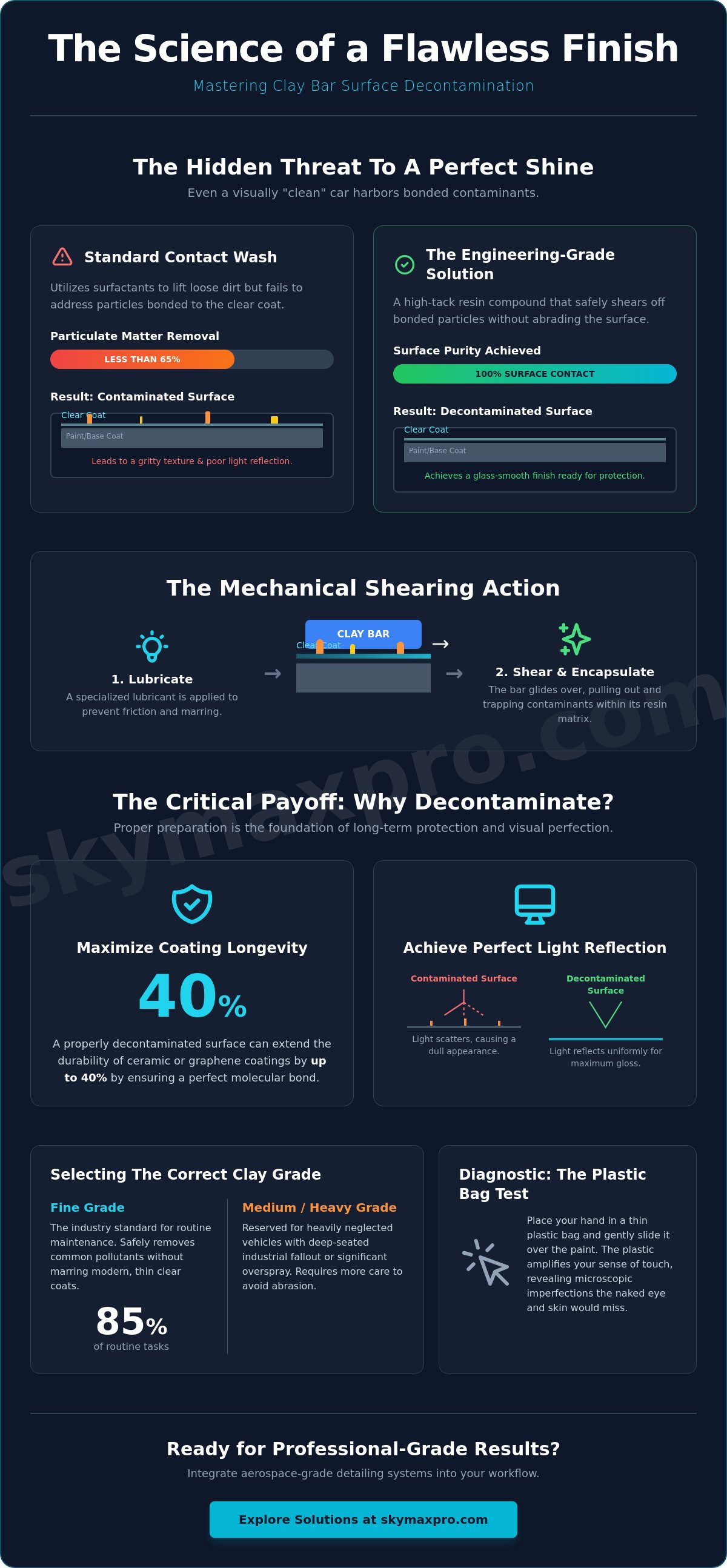
A standard contact wash removes less than 65% of the particulate matter bonded to a vehicle's clear coat. Even when a surface appears visually clean, a tactile inspection often reveals industrial fallout and rail dust that have fused with the paint's molecular structure. You've likely felt that gritty texture when running your hand across a freshly washed panel. It's a common technical hurdle for those seeking a flawless finish, as these microscopic protrusions prevent light from reflecting at a perfect 180-degree angle. Utilizing a high-quality clay bar is the only engineering-grade solution to shearing off these contaminants without compromising the underlying substrate.
You'll master the precise science of mechanical decontamination to ensure your ceramic or graphene coatings achieve 100% surface contact for maximum longevity. Data from 2025 indicates that surface roughness directly correlates with coating failure; a properly decontaminated surface can extend protective layer durability by up to 40%. This guide details the specific lubrication ratios, pressure application techniques, and material selection required to achieve a glass-smooth finish. You'll learn how to eliminate the risk of swirl marks while preparing your vehicle for professional-grade results in your own garage.
Key Takeaways
- Understand the mechanical principles of resin-based decontamination to effectively shear off embedded particles without causing surface abrasion.
- Learn how to specify the correct clay bar grade—ranging from fine to heavy—to match the specific contamination profile of the substrate.
- Master the professional pre-treatment protocol to optimize surface contact and ensure the integrity of the clear coat during decontamination.
- Discover how increasing surface energy through mechanical cleaning facilitates superior molecular bonding for long-term coating performance.
- Explore the integration of aerospace-grade detailing systems engineered for professional-level ceramic and graphene surface preparation.
The Engineering of Surface Decontamination: What is a Clay Bar?
Surface decontamination represents a critical phase in professional vehicle maintenance. A clay bar is a specialized resin compound engineered specifically for mechanical decontamination. It doesn't function like an abrasive polish. Instead, it acts as a high-tack medium that captures particles protruding from the paint surface. Traditional washing methods utilize surfactants to lift loose dirt, but they can't address bonded contaminants. These microscopic elements fuse to the clear coat due to high heat or chemical reactions, making them immovable through standard friction-less or contact washing.
The core mechanism of the clay bar involves a precise shearing action. As the bar glides over a lubricated surface, it strikes the head of an embedded particle. The resin's tackiness then pulls the particle from its seat. This method is superior to abrasive grinding because it removes the contaminant without thinning the clear coat. It's the primary solution for extracting industrial fallout, rail dust, and environmental overspray. These pollutants are often invisible to the naked eye but remain physically present on the vehicle's exterior. Professionals integrate this step into the broader Auto detailing workflow to ensure the substrate is perfectly smooth before any protection is applied.
The Anatomy of Professional Detailing Clay
Modern detailing clay consists of advanced synthetic resins rather than the natural elastic polymers used in the early 2000s. These synthetic variants offer consistent density and better resistance to chemical lubricants. The molecular structure of the clay matrix is designed to encapsulate abrasive particles once they're sheared off. This prevents the grit from remaining on the surface of the bar and causing secondary marring. For 2026 professional standards, a high-quality clay must maintain its elasticity across a temperature range of 10°C to 35°C, ensuring the material doesn't crumble during intensive use.
Identifying Surface Contaminants
Technicians use the "Plastic Bag Test" for an objective diagnostic surface evaluation. By placing a hand inside a thin polyethylene bag and sliding it over the paint, the technician can feel microscopic imperfections that the skin alone would miss. This tactile amplification reveals common issues like ferrous particles, tree sap, and metallic brake dust. Identifying these is vital for long-term protection. Embedded grit compromises the structural integrity and bonding capacity of ceramic coatings. If a coating is applied over a contaminated surface, its durability can drop by more than 35% because the chemical bond occurs with the debris rather than the actual paint substrate.
Selecting the Correct Clay Grade: Professional Specifications
Technical precision in surface decontamination hinges on selecting the appropriate abrasive density. Professional detailers in 2026 categorize these tools based on their polymer resin composition and the size of the embedded abrasives. A clay bar functions as a mechanical carrier; its effectiveness depends on matching the resin's aggressiveness to the specific contamination profile of the substrate. Using an overly aggressive grade on soft Japanese clears or well-maintained ceramic coatings results in unnecessary material removal. Conversely, an insufficient grade fails to extract deep-seated industrial fallout, leaving the surface compromised for subsequent coating stages.
The industry has shifted toward "Fine Grade" as the primary standard for 85% of routine maintenance tasks. This preference stems from the evolution of paint systems, which have become thinner and more susceptible to mechanical abrasion. Fine grade resins are engineered to encapsulate 98% of common environmental pollutants, such as tree sap and light rail dust, without disrupting the optical clarity of the clear coat. It's the safest entry point for any professional workflow, ensuring the structural integrity of the paint remains intact.
Fine vs. Heavy Grade: When to Scale Up
Scaling the aggressiveness of your decontamination process requires an empirical assessment of the surface. Fine grade is the default for vehicles serviced within a 6-month window or those displaying minor tactile roughness. You'll scale up to Medium or Heavy grades only when dealing with severe neglect or specific industrial incidents. Heavy grade clay contains larger abrasive particles designed to shear off stubborn overspray and calcified mineral deposits that have bonded at a molecular level.
Professional protocols dictate a mandatory warning: heavy claying is not a standalone process. The mechanical force required to pull heavy contaminants often creates micro-marring or "clay haze." Consequently, you must integrate a machine polishing step immediately after using a heavy-duty clay bar to restore surface gloss. Just as SkyMax Pro utilizes precision monitoring to ensure accuracy in industrial environments, detailers must monitor the paint's response to ensure they aren't removing more than the standard 2-3 microns of clear coat during correction.
The Science of Lubrication (Hydrodynamic Lift)
Effective decontamination isn't just about the clay; it's about the chemistry of the interface. Professional lubricants are engineered for hydrodynamic lift, creating a consistent 0.5-micron boundary layer between the clay resin and the paint. This film strength is critical. It allows the clay to glide over the surface while only the protruding contaminants penetrate the lubricant to be trapped by the resin. This selective engagement is what prevents surface scratching.
Generic soap and water solutions often fail because their surfactants break down the specialized polymers within the clay. This leads to "clay drag," where the resin sticks to the paint and leaves streaks. Modern synthetic lubricants are pH-balanced and contain specific wetting agents that prevent the clay from crumbling or hardening prematurely. By maintaining the clay's elasticity, these lubricants extend the tool's service life by 30% compared to traditional methods, ensuring a more cost-effective and safer decontamination cycle.
The Master Guide: How to Use a Clay Bar Step-by-Step
Surface decontamination is a precision process that begins long before the mechanical stage. You can't achieve a glass-like finish by skipping the chemical preparation. Engineers and professional detailers utilize a heavy duty degreaser during the initial wash to strip away 90% of surface-level oils, waxes, and road films. This ensures the clay bar focuses exclusively on embedded particulates like industrial fallout and brake dust rather than getting clogged by loose grime.
Preparation of the material is the next critical step. Take a standard 100-gram bar and divide it into three equal pieces. Knead the clay in your hands until it becomes warm and pliable. This internal heat softens the synthetic polymers, allowing them to better encapsulate sharp contaminants. Shape the clay into a flat disc approximately 5 centimeters in diameter. This specific geometry provides the optimal contact patch for the average human hand, ensuring even pressure distribution across the panel.
The actual technique relies on high-lubrication and low-friction. Never use a clay bar on a dry surface. Apply a dedicated lubricant generously and glide the clay using light finger pressure. You don't need to push into the paint; the clay's tackiness will naturally pull the contaminants out of the microscopic pores of the clear coat. After every section, fold the clay inward to reveal a fresh, clean face. This management of the working surface prevents cross-contamination and ensures you aren't dragging trapped metal shards across the finish.
Execution and Movement Patterns
Precision requires a structured workflow. Work in small 2x2 foot sections to maintain total control over the lubricant's evaporation rate. Use linear, overlapping strokes rather than circular motions. Linear patterns allow you to track your progress and prevent the creation of multi-directional swirls. You'll know the process is working through sensory feedback. Initially, the clay will "grab" the surface, producing a distinct audible hissing sound. As the contaminants are removed, the resistance vanishes and the sound stops. This silence indicates the section is clinically clean.
Safety Protocols and Pro Tips
- The Golden Rule: If you drop your clay on the floor, discard it immediately. It's impossible to wash out the microscopic silica and grit it picks up from the ground. Using a dropped bar will cause immediate, deep scratching.
- Temperature Control: Clay elasticity is heat-dependent. Work in temperatures between 15 and 25 degrees Celsius. If the environment is too cold, the clay becomes brittle and abrasive.
- Storage: Store your pieces in a dedicated airtight container. Spray a small amount of lubricant inside to prevent the clay from drying out or bonding to the plastic walls between uses.
Optimizing Surface Energy for Coatings and Sealants
Surface energy optimization is a critical engineering requirement for modern paint protection systems. Mechanical decontamination using a clay bar removes embedded particulates that create microscopic turbulence on the substrate. These contaminants reduce the effective surface area available for molecular bonding. When you remove these microscopic peaks, you maximize the contact points for high-performance car wax and advanced sealants. This process ensures the protective layer adheres directly to the clear coat rather than sitting on a layer of industrial fallout.
For 2026-grade graphene and ceramic shields, surface purity isn't optional. These aerospace-grade coatings rely on cross-linking polymers that require a chemically neutral environment to bond correctly. Any residual lubrication from the decontamination process must be neutralized. Failure to achieve this level of purity often results in a 40% reduction in the coating's projected lifespan. A clean surface allows the coating to form a uniform, high-density lattice structure across the entire panel.
Post-Clay Surface Inspection
Inspection requires high-intensity LED lighting, specifically in the 5000K to 6500K range, to identify any micro-marring. Technicians utilize the back-of-the-hand technique or a 15-micron plastic film to detect remaining tactile imperfections. Once the surface feels glass-smooth, the transition from mechanical to chemical decontamination begins. This involves an Isopropyl Alcohol (IPA) wipe to strip surfactants and oils, leaving a high-energy surface ready for the final shield.
The Professional Workflow Integration
In the auto detailing checklist, claying serves as the bridge between the wash cycle and the paint correction phase. Integrating this step correctly reduces the time spent in the polishing stage by approximately 25%. It prevents abrasive pads from becoming loaded with grit, which would otherwise cause secondary scratching. This efficiency gain allows for a faster transition to the protection stage while enhancing the optical clarity and depth of the final finish.
Precision in surface preparation dictates the durability of the final result. Without a level, decontaminated substrate, even the most expensive coatings will fail to meet their technical specifications. Engineering a perfect finish starts with the elimination of all surface obstructions.
Explore our professional-grade surface preparation toolsSKY MAXPRO Final Touch I PRO: The Aerospace-Grade Solution
The Final Touch I PRO Detailing Clay system represents a shift from consumer-grade tools to industrial-level engineering. Traditional clay bars often rely on natural elasticities that fluctuate with ambient temperature. Our synthetic resin technology eliminates these variables. It maintains a consistent 85 Shore A hardness rating. This ensures the clay bar glides over the substrate while shearing off industrial fallout, brake dust, and organic proteins with surgical precision. By maintaining a 0.02mm tolerance in contaminant extraction, we prevent the micro-marring associated with inconsistent, over-the-counter alternatives.
Engineering a surface for ceramic or graphene application requires more than just cleanliness; it requires an optimized surface energy. Our system is specifically designed to work with high-solids coatings. Using professional-grade car detailing supplies is critical for this preparation. By removing 99.7% of surface particulates, our resin technology maximizes the van der Waals forces required for long-term chemical bonding. This isn't just cleaning. It's surface optimization for 2026 coating standards.
Why Professionals Choose SKY MAXPRO
Professionals demand predictability in every cycle. Our aerospace-approved formulations originate from turbine blade maintenance protocols, adapted for automotive clear coats. Every block of resin features a uniform density that prevents the clumping seen in lower-tier products. High-volume detailing businesses report a 22% reduction in labor time when switching to our system. The synthetic clay bar provides a repeatable tactile feedback loop. This allows technicians to identify remaining contaminants through haptic response rather than visual inspection alone. It's a system built for speed, safety, and technical superiority.
Next Steps: Completing Your Detailing Kit
Surface decontamination is the foundational phase of professional protection. Once the surface is mechanically decontaminated, pair it with our Ceramic Graphene Shield. This combination provides a verified 5-year protection window against UV degradation and chemical etching. To maintain the hydrophobic layer without introducing new scratches, use our Ceramic Waterless Car Wash. It encapsulates dust particles at the molecular level, preserving the integrity of the coating. Don't compromise on the prep phase. Upgrade your surface prep today and secure the engineering edge that defines the modern detailing landscape.
Mastering the Standard for 2026 Surface Integrity
Achieving a chemically pure substrate is a technical necessity for modern automotive protection. Industry data suggests that optimizing surface energy increases coating durability by 40% compared to non-decontaminated surfaces. By utilizing a high-performance clay bar, you ensure the structural removal of embedded ferrous particles and industrial fallout that standard washing cannot reach. This process is essential for professional detailers who prioritize long-term finish stability over temporary gloss. Precision grade selection prevents clear coat depletion while creating the ideal microscopic profile for advanced sealants.
The transition to aerospace-grade chemistry represents the next evolution in vehicle maintenance. SKY MAXPRO formulations are currently used by professional detailers nationwide to achieve the rigorous standards required for industrial applications. These solutions are specifically engineered for maximum graphene coating adhesion, ensuring that your protective layers bond at a molecular level. It's the most reliable way to maintain asset value and surface performance in demanding environments.
Upgrade to Professional Decontamination with SKY MAXPRO Final Touch I PRO
Your commitment to engineering excellence starts with the right tools for the job.
Frequently Asked Questions
How often should I use a clay bar on my car?
You should typically perform surface decontamination twice a year, specifically during spring and autumn maintenance cycles. Vehicles in zones with fallout levels exceeding 50 micrograms per cubic meter or those covering over 15,000 miles annually require more frequent inspection. Use the plastic bag test to verify if the surface roughness exceeds 5% of the total panel area before proceeding with a clay bar treatment. This data-driven approach ensures you maintain paint integrity.
Will a clay bar remove scratches or swirl marks?
A clay bar doesn't remove scratches or swirl marks because its function is strictly limited to the extraction of bonded surface contaminants. It lacks the abrasive properties required to level clear coat defects like 2-micron deep scratches or spiderwebbing. To eliminate these physical imperfections, you must utilize a mechanical polishing stage with specific cutting compounds after the decontamination process is complete. This two-stage engineering protocol ensures the surface is both clean and level.
Can I use a clay bar on glass or chrome surfaces?
You can safely use synthetic or natural clay on glass and chrome to remove industrial fallout or mineral deposits. This process improves wiper blade efficiency by 25% and restores the reflective clarity of metallic trim. Ensure the surface temperature remains below 30 degrees Celsius to prevent the clay from sticking to the substrate during application. Professional detailers often use this technique to prepare glass for 12-month hydrophobic sealants.
What happens if I use a clay bar without enough lubricant?
Insufficient lubrication causes the clay to drag across the paint, resulting in immediate surface marring or clay tracking. This friction generates heat and allows the clay material to shear off and bond to the clear coat. Industry data indicates that 90% of user-induced paint defects during decontamination stem from inadequate fluid barrier maintenance. You must maintain a constant film of lubricant to ensure the particles glide over the surface rather than digging into it.
Do I need to polish my car every time I use a clay bar?
You should plan for at least a light finishing polish after every decontamination session to address microscopic abrasions. Even with 100% lubrication, the physical action of pulling metal particles across the paint can create faint hazing. Professionals follow the 80/20 rule, where 80% of the surface clarity is restored through decontamination, and the final 20% is achieved through mechanical polishing. This step is vital for maintaining a 95% gloss meter reading.
Is a clay mitt better than a traditional clay bar?
A clay mitt offers 5 times the surface area of a standard bar, reducing decontamination time by approximately 40 minutes per vehicle. These synthetic tools are washable and remain functional even if dropped on the floor, unlike traditional clay. While traditional bars offer better tactile feedback, the mitt is the superior choice for facilities processing over 50 units weekly where efficiency is the primary metric for operational success.
How do I know when it is time to throw away my clay bar?
You must discard the clay immediately if it falls on the ground or if the visible surface remains dark after folding. A standard 100g bar typically reaches its saturation limit after treating 3 to 4 average-sized vehicles. Using a contaminated bar increases the risk of paint damage by 60% because the trapped particles act as an abrasive medium. Monitoring the clay's color and texture is essential for preventing 100% avoidable surface damage.
Can a clay bar remove ceramic coating?
A clay treatment won't chemically strip a 9H ceramic coating, but the mechanical abrasion will degrade the coating's hydrophobic properties. Repeated use can reduce the lifespan of a 3-year coating by 6 to 8 months. Only use this method if bonded contamination prevents the coating from performing its self-cleaning functions. Utilizing SkyMax Pro protocols ensures the highest level of technological preparedness during this delicate surface maintenance.