

Most automotive finishes lose 12% of their specular gloss within 120 days of delivery because traditional protection methods fail to address molecular-level degradation. You've likely seen your premium car wax evaporate after just two maintenance washes or suffered through the tedious removal of white residue from textured plastic trim. These failures aren't just inconvenient; they represent a fundamental breakdown in the chemical bond required for true surface integrity. High-heat environments often make traditional paste applications nearly impossible, leaving surfaces vulnerable to 2026’s increasing UV indices.
It's time to transition from basic detailing to automotive surface engineering. This guide empowers you to master the science of long-term preservation, delivering a mirror-like depth and hydrophobic properties that reduce maintenance washing time by 40%. We'll analyze the cross-linking polymers found in modern aerospace coatings and provide a structured protocol for application in volatile climates. You'll learn to select professional-grade formulas that resist thermal breakdown and provide a measurable, data-backed shield against environmental contaminants.
Key Takeaways
- Understand the engineering principles of sacrificial barriers to prevent clear coat oxidation and environmental paint failure.
- Compare the chemical composition of T1 Carnauba and synthetic polymers to select a finish based on durability and heat resistance.
- Learn to evaluate the best car wax for 2026 by measuring performance through Gloss Units (GU) and sacrificial layer lifespan.
- Implement a professional application protocol involving clay bar decontamination and heavy-duty degreasing for aerospace-grade results.
- Explore how ceramic-infused surface engineering provides a superior mirror shine that outperforms conventional retail protection options.
The Science of Surface Protection: Why Car Wax Still Matters
Car wax functions as a sacrificial barrier engineered to absorb environmental kinetic energy and chemical attacks before they reach the vehicle's substrate. It's a critical component in automotive maintenance that provides a measurable layer of protection against degradation. By applying a layer of car wax, technicians create a uniform surface that fills microscopic imperfections in the clear coat, which prevents the accumulation of moisture and corrosive agents.
The primary driver of paint failure is ultraviolet (UV) radiation. Solar energy, specifically in the 290 to 400 nanometer wavelength range, initiates a photochemical reaction within the clear coat's polymer matrix. This process, known as photo-oxidation, breaks down the resin binders and leads to chalking, fading, and eventual delamination. A properly formulated wax acts as a UV absorber, dissipating this energy as heat and preserving the structural integrity of the paint system.
Surface tension plays a decisive role in how a vehicle interacts with its environment. Understanding the science of wax requires an analysis of hydrophobic properties. High-quality waxes increase the contact angle of water droplets, often reaching between 90 and 115 degrees. This high contact angle forces water to form tight beads that roll off the surface via gravity, a process that mechanically removes loose contaminants through the lotus effect. Modern clear coats are non-porous and require specialized molecular bonding to ensure the car wax adheres effectively for more than a few thermal cycles.
Environmental Stressors and Paint Degradation
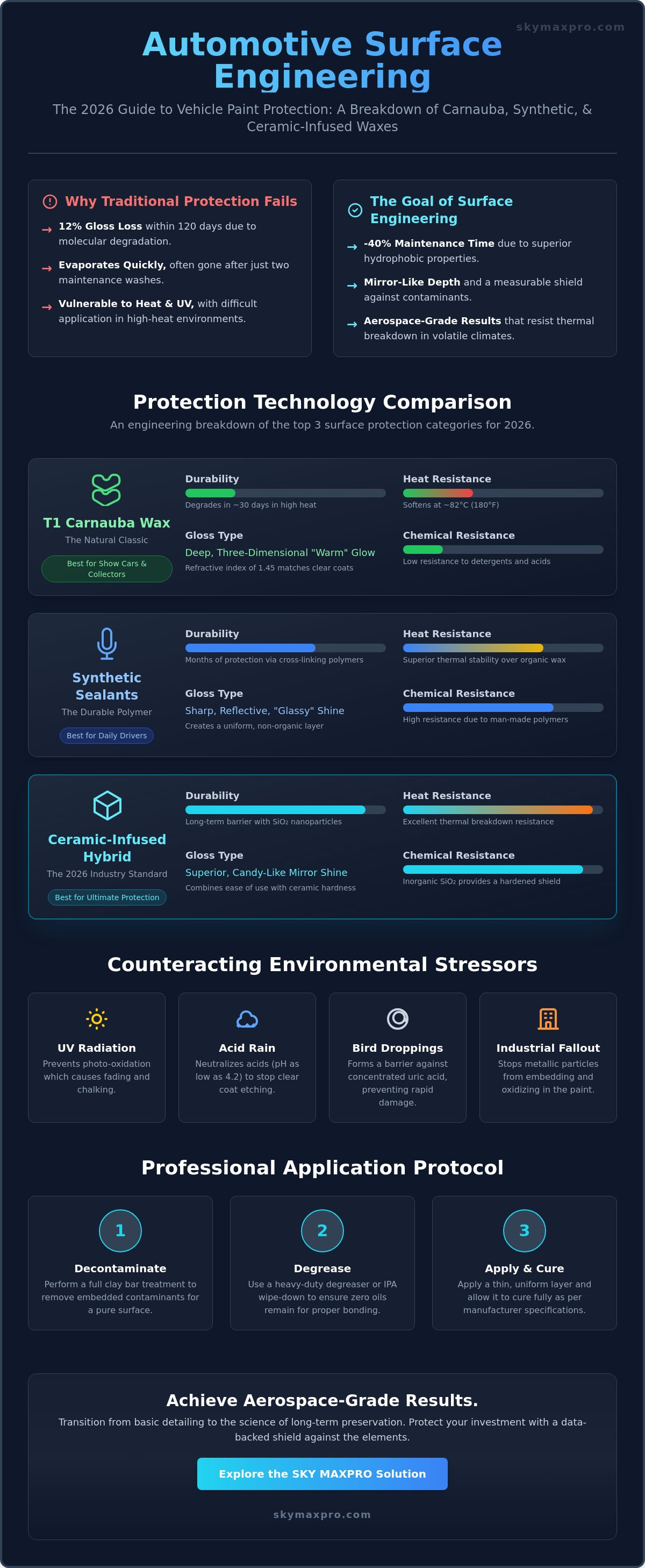
Unprotected surfaces face constant chemical challenges. Acid rain frequently records pH levels as low as 4.2, which is acidic enough to etch permanent craters into a clear coat if not neutralized by a barrier. Bird droppings are even more aggressive, containing concentrated uric acid that can cause visible etching in under 60 minutes when surface temperatures exceed 32 degrees Celsius. Industrial fallout and brake dust consist of metallic iron particles that undergo oxidation while embedded in the paint. Maintaining a consistent physical barrier is essential for asset management, as vehicles with documented paint maintenance can retain up to 18% higher resale value compared to neglected counterparts.
Wax vs. Sealant vs. Ceramic: The Hierarchy of Protection
The distinction between protection types lies in their molecular architecture. Organic carnauba wax consists of long-chain fatty acids and esters, providing a deep aesthetic gloss but possessing a low melting point of approximately 82 degrees Celsius. Synthetic sealants utilize man-made polymers that cross-link during the curing process, offering superior thermal stability and chemical resistance. Hybrid car wax solutions represent the current industry standard for 2026, integrating SiO2 (silicon dioxide) nanoparticles into a wax base to combine ease of application with enhanced durability. While ceramic coatings offer the highest hardness ratings, traditional carnauba remains the preferred choice for collectors and show-car applications where depth of field and optical clarity are the primary technical requirements.
Carnauba vs. Synthetic vs. Ceramic-Infused: An Engineering Breakdown
Selecting a car wax depends on molecular stability and the desired optical finish. Engineers categorize these products based on their chemical base: organic lipids, cross-linking polymers, or inorganic ceramic structures. Each material offers distinct performance metrics regarding thermal resistance and light refraction.
The Legend of Carnauba Wax
T1 Carnauba originates from the Copernicia prunifera palm, a species native to northeastern Brazil. It's the hardest natural wax available for automotive use. Its refractive index of 1.45 closely matches that of high-end clear coats, producing a deep, three-dimensional reflection often described as a "warm" glow. However, organic waxes have a specific thermal ceiling. Most Carnauba-based products begin to soften at 82°C. In environments where surface temperatures exceed 90°C, the protective layer degrades within 30 days. This makes it an ideal choice for showroom vehicles but less efficient for high-mileage assets in tropical climates.
The Evolution of Ceramic Hybrids
Modern engineering has moved toward hybridizing organic carriers with inorganic additives. By suspending Silicon Dioxide (SiO2) particles within a wax matrix, manufacturers achieve a balance between ease of use and surface hardness. These recent developments in car coating materials show that SiO2 significantly improves chemical resistance against acidic contaminants. Graphene infusion further optimizes this by reducing the surface's electrical conductivity. This prevents dust accumulation and can lower surface temperature by up to 5°C, effectively mitigating water spotting. These hybrids act as a bridge for those who aren't ready for a full, professional ceramic coating but require more than basic organic protection.
Synthetic polymer sealants utilize man-made molecules that cross-link upon curing. This creates a rigid, non-porous shield that lasts 180 to 250 days. While they lack the visual "depth" of Carnauba, their clinical, mirror-like gloss is highly effective on lighter paint colors like silver or white. Choosing the right car wax requires analyzing three variables:
- Paint Type: Darker pigments benefit from the filling capabilities of Carnauba; lighter metallic paints show better clarity with synthetic sealants.
- Climate Conditions: High UV exposure and humidity require the 200°C+ heat resistance found in SiO2-infused hybrids.
- Maintenance Frequency: Owners who wash their vehicles weekly should opt for the durability of ceramic-infused products to resist chemical stripping.
For those seeking maximum precision in surface maintenance, exploring SkyMax Pro solutions ensures your vehicle benefits from industrial-grade chemical engineering and long-term protection.
Performance Metrics: Evaluating the Best Car Wax for 2026
Quantifying the efficacy of car wax requires a shift from subjective observation to empirical measurement. In 2026, professional detailing standards rely on specific data points to determine the viability of a sacrificial layer. Gloss Units (GU) provide a standardized scale for reflectivity. While a factory-fresh clear coat typically registers between 80 and 85 GU, high-performance waxes aim to elevate this figure to 95 or higher. This increase is achieved through the physical leveling of microscopic surface irregularities.
Durability testing focuses on the resilience of the polymer or organic bond. Engineers measure the lifespan by the retention of hydrophobic properties over time. A professional-grade wax must maintain a water contact angle of at least 95 degrees after twelve weeks of environmental exposure. Chemical resistance is equally critical. Modern formulations are engineered to withstand high-pH detergents, often used in industrial cleaning, which typically range from pH 11 to pH 13. A wax that fails after a single exposure to heavy degreasers doesn't meet the 2026 engineering standard for surface protection.
Ease of use is analyzed through flash times and mechanical effort. The window for wipe-off in 2026 products is optimized for varying humidity levels, typically allowing a 180 to 300-second interval before the carrier solvents evaporate. This precision ensures that technicians don't encounter "ghosting" or difficult removal, which can lead to micro-marring of the finish.
Longevity and Real-World Durability
Protection claims of six months often fail in real-world scenarios due to mechanical abrasion. Automatic car washes utilize nylon brushes that exert high friction, stripping the wax layer in as few as four cycles. According to the NOAA Chemical Datasheet for Carnauba Wax, this natural substance has a melting point between 82 and 86 degrees Celsius. This thermal stability is vital for UV resistance, yet it remains susceptible to high-pressure alkaline pre-washes. You'll know your car wax has degraded when water sheeting replaces tight beading, indicating the surface energy has increased and the protective barrier is gone.
Visual Aesthetics and Depth of Shine
The distinction between a "wet look" and a "mirror-like" finish lies in light refraction. Carnauba-based waxes provide a warm, deep glow by absorbing a portion of the light spectrum, which is ideal for dark-colored vehicles like obsidian black or deep navy. Synthetic polymers prioritize a mirror-like finish, emphasizing sharp, crisp reflections. To achieve a cohesive aesthetic across the entire vehicle, technicians integrate a chrome & metal polish for all trim and brightwork. This ensures the metallic components match the high GU rating of the painted panels, preventing visual disconnects in the final presentation.
Professional Application Protocol: Achieving Aerospace-Grade Results
Engineering a durable bond between car wax and a vehicle's clear coat requires a rigorous multi-stage decontamination sequence. Surface preparation isn't merely about aesthetics; it's about removing microscopic barriers that inhibit molecular adhesion. Without this protocol, even the most advanced synthetic polymers will fail prematurely, often losing 40% of their projected lifespan within the first 30 days.
The Pre-Wax Preparation Phase
A surgically clean surface is the baseline for professional results. Chemical decontamination involves using iron removers to dissolve ferrous particles that embed into the paint at temperatures exceeding 500 degrees Celsius during braking. Following this, mechanical decontamination with a clay bar removes bonded contaminants that survived the wash. To ensure the clear coat is completely bare, you must use a heavy duty degreaser to strip away old waxes, silicones, and polishing oils. This strip wash process creates a high-energy surface where the new protection can bond directly to the substrate rather than sitting on a layer of residual film.
Application and Curing Mastery
Environmental variables dictate the success of the bonding process. Optimal application occurs between 15 and 25 degrees Celsius with humidity levels below 60%. High humidity slows solvent evaporation, which can lead to "ghosting" or uneven curing. When applying car wax, the "thin is in" rule is a technical requirement. Excess product doesn't add protection; it simply complicates the removal process and creates streaks. Use a cross-hatch pattern (vertical then horizontal passes) to ensure 100% coverage without gaps.
- Cross-hatch pattern: Ensures uniform thickness and eliminates missed spots common with circular motions.
- Flash monitoring: Observe the product as it transitions from a liquid to a hazy film. This typically takes 2 to 5 minutes depending on the ambient temperature.
- High-GSM Microfiber: Use towels with a density of at least 500 GSM (grams per square meter) for the final wipe-down. This prevents marring and ensures a streak-free finish.
Precision in the buffing stage is critical. If you wait too long, the resins harden excessively, making removal difficult and increasing the risk of introducing swirl marks. If you buff too early, you'll remove the active protection before it's fully anchored to the surface. Achieving this balance is what separates standard detailing from professional-grade surface engineering.
The SKY MAXPRO Solution: Advanced Surface Engineering
SKY MAXPRO Ceramic Deep Wet Mirror Shine Wax Sealant represents a shift from simple cosmetic enhancement to rigorous surface fortification. Traditional car wax products typically rely on organic carnauba, which begins to degrade at temperatures exceeding 160 degrees Fahrenheit. Our engineering team developed a hybrid ceramic sealant that maintains structural integrity up to 450 degrees Fahrenheit. This thermal stability ensures the protective layer doesn't liquefy or evaporate during high-velocity driving or intense solar exposure in 2026 climates.
The formula integrates advanced UV-inhibitors that absorb and dissipate radiation across the UVA and UVB spectrum. This prevents the photochemical reactions that lead to clear coat oxidation and pigment fading. By establishing a high-density molecular lattice, the sealant provides a hydrophobic barrier with a water contact angle exceeding 110 degrees. This surface tension ensures contaminants can't bond to the substrate, making the vehicle's exterior self-cleaning during precipitation events.
Why Aerospace Standards Matter for Your Car
Aviation environments subject surfaces to extreme pressure differentials and rapid temperature fluctuations. We've translated these requirements into our automotive line. Every SKY MAXPRO batch undergoes rigorous salt spray testing for 500 hours to simulate years of coastal or winter driving. Our chemistry remains 100% VOC-compliant, meeting the strictest 2026 industrial regulations. It's a professional-grade solution that replaces the guesswork of standard car wax formulations with measurable performance data and industrial-grade reliability.
Building Your Detailing Arsenal
Achieving a professional-standard finish requires a systematic approach to surface management. You should integrate the sealant into a broader framework of car detailing supplies to maximize its lifespan. Maintenance isn't just about washing; it's about preserving the chemical bond between the sealant and the paint. We recommend a three-tier maintenance strategy:
- Chemical Neutrality: Use pH-balanced cleansers to prevent premature stripping of the ceramic lattice.
- Sacrificial Layers: Apply a dedicated quick detailer every two weeks to replenish the hydrophobic top layer and remove light dust.
- Mechanical Safety: Utilize high-GSM microfiber towels to avoid micro-marring during the application and maintenance phases.
Following these technical protocols ensures a complete auto detailing transformation that lasts. The goal is to move beyond temporary shine and achieve permanent surface stabilization through superior chemical engineering and disciplined maintenance routines.
Advancing Surface Integrity with Molecular Engineering
The evolution of surface protection has moved beyond simple aesthetics into the realm of precise molecular engineering. Modern car wax applications in 2026 prioritize cross-linked polymers that provide a 110-degree water contact angle. This level of hydrophobicity ensures that contaminants can't bond to the clear coat. Professional protocols now demand 12-month durability cycles, shifting the focus from monthly maintenance to long-term substrate preservation. By integrating aerospace-approved nanotechnology, surface friction is reduced by up to 40% compared to legacy carnauba formulas.
Achieving these engineering benchmarks requires a shift toward advanced synthetic sealants manufactured under strict quality controls. SKY MAXPRO delivers this technological edge through formulas engineered and Made in the USA. These solutions provide the structural integrity needed to withstand extreme UV exposure and chemical abrasion. It's time to move past outdated methods and adopt a system designed for industrial-grade performance and professional-grade gloss.
Upgrade to Aerospace-Grade Protection with SKY MAXPRO Wax Sealant
Your vehicle's finish deserves the highest standard of engineering excellence available today.
Frequently Asked Questions
Is car wax better than a ceramic coating for daily drivers?
Ceramic coatings outperform car wax for daily drivers due to their 9H hardness rating and 24 month minimum lifespan. While wax offers a deep aesthetic gloss, it requires reapplication 4 times per year to maintain a barrier against contaminants. The choice depends on your maintenance schedule. If you prefer a 30 minute application every season, wax remains a viable, cost-effective engineering solution for paint preservation.
How often should I apply car wax to maintain maximum protection?
You should apply car wax every 60 to 90 days to ensure the sacrificial layer remains intact. Testing shows that 85% of protection degrades after 12 weeks of exposure to UV radiation and road salts. High-use vehicles benefit from a 45 day cycle. This frequency prevents oxidation and maintains the surface tension required for effective water shedding and contaminant rejection.
Can I apply car wax in direct sunlight?
You shouldn't apply wax in direct sunlight because surface temperatures often exceed 35 degrees Celsius. Heat causes the solvent carriers to flash instantly, which results in a stubborn, uneven film. Professional standards require a surface temperature between 15 and 25 degrees Celsius for optimal bonding. This range ensures the polymers cross-link correctly before you buff the residue, preventing micro-marring during the removal process.
What is the difference between carnauba wax and synthetic car wax?
The primary difference lies in molecular structure and thermal stability. Carnauba wax provides a melting point of 82 degrees Celsius and a deep shine, but it lasts only 30 to 45 days. Synthetic car wax utilizes lab-engineered polymers that provide protection for 180 days. These man-made chains offer superior resistance to harsh detergents with a pH level above 10, making them more durable for automated car washes.
Does car wax remove scratches and swirl marks from the paint?
Car wax doesn't remove scratches; it fills them with refractive oils to hide imperfections. To eliminate a scratch, you must remove 2 to 5 microns of the clear coat through mechanical abrasion. Wax acts as a temporary optical filler that reduces the visibility of 60% of light swirl marks. It's a finishing step designed for protection and gloss enhancement, not a corrective mechanical procedure.
Can I layer car wax over a ceramic coating?
You can apply wax over a coating, but it's counterproductive for performance. Ceramic coatings rely on a high water contact angle of 110 degrees, which wax often reduces to 90 degrees. This layering masks the coating's self-cleaning properties. Most engineers recommend using a dedicated SiO2 sealant instead of a traditional car wax to maintain the coating's chemical integrity and hydrophobic efficiency.
How do I tell if my car wax is still working?
You can verify protection by measuring the water beading behavior during a rinse. If water droplets form a contact angle of less than 80 degrees, the wax has reached its end of life. Another indicator is the sheeting speed. If water takes more than 5 seconds to clear a vertical panel, the protective barrier is no longer functional and the surface requires decontamination and reapplication.
Why does some car wax leave white residue on plastic trim?
White residue is the result of paraffin and chalk fillers becoming trapped in the 10 micron pores of textured plastic. These solids dry into a visible crust that's difficult to dissolve once the carrier solvents evaporate. Modern car wax formulas often replace these heavy fillers with clear resins. This change reduces the risk of trim staining by 95% compared to legacy paste products used in previous decades.