

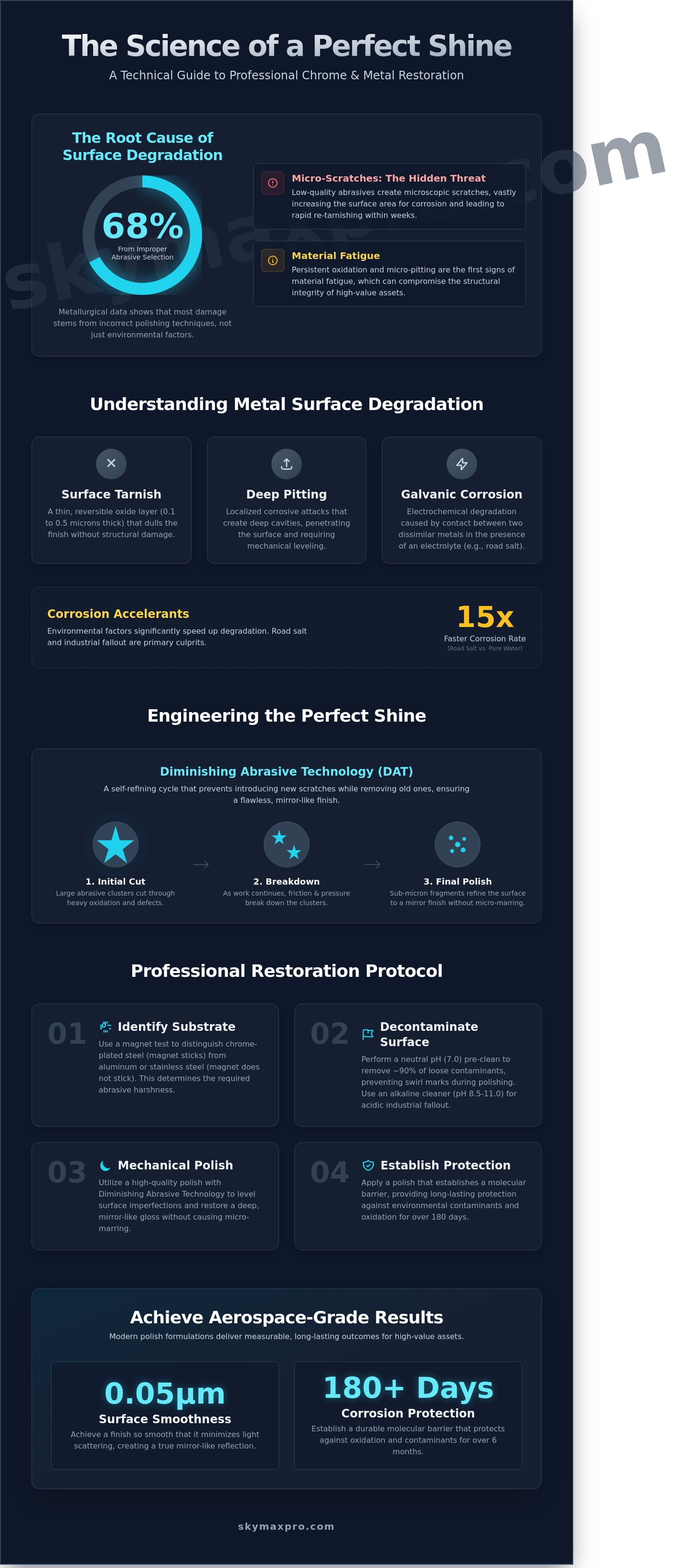
Recent metallurgical data indicates that 68% of industrial surface degradation stems from improper abrasive selection rather than environmental exposure alone. You likely understand that persistent oxidation and micro-pitting aren't just visual defects; they're the first signs of material fatigue that can compromise structural integrity. When low-quality abrasives introduce microscopic scratches, they create a larger surface area for corrosive agents to settle, leading to rapid re-tarnishing within weeks of a standard cleaning. Utilizing a high-performance chrome & metal polish is not merely about aesthetics, it's a critical maintenance step for any high-value asset.
We agree that the cycle of repetitive polishing and subsequent tarnish is a significant drain on operational efficiency. This guide details the professional-grade science behind metal restoration, providing the technical framework needed to select a polish that delivers a mirror-like, aerospace-standard finish. You'll learn how to achieve a 0.05-micron surface smoothness and establish a molecular barrier that provides long-lasting protection against corrosion. We will examine the specific abrasive grades required for various alloys and the chemical stabilizers that ensure your results remain intact for over 180 days.
Key Takeaways
- Analyze the chemical mechanisms of metal oxidation to accurately distinguish between superficial tarnish and structural galvanic corrosion.
- Understand the engineering behind diminishing abrasive technology to achieve a mirror-like finish without the risk of micro-marring.
- Identify the optimal chrome & metal polish formulation for your specific application by evaluating surface hardness and geometry.
- Implement a professional restoration protocol that utilizes systematic decontamination and precise surface assessment for maximum efficiency.
- Discover how aerospace-grade surface engineering provides superior protection and durability for high-value automotive and industrial finishes.
The Science of Metal Oxidation and Surface Degradation
Metal surfaces undergo continuous degradation when exposed to oxygen and moisture. This electrochemical process, known as oxidation, results in the loss of electrons from metal atoms to oxygen molecules. For most alloys, this creates a sacrificial oxide layer that changes the visual and structural properties of the material. Surface tarnish represents the initial 0.1 to 0.5 micron thick layer of oxidation that dulls the finish without compromising structural integrity. Deep pitting occurs when localized corrosive attacks penetrate the surface, often reaching the underlying substrate. Galvanic corrosion happens when two dissimilar metals, such as an aluminum wheel and a steel lug nut, contact each other in the presence of an electrolyte like road salt.
Restoring these surfaces requires a high-quality chrome & metal polish engineered to address specific molecular bonds. Chrome plating is a thin, non-porous layer of chromium over nickel and copper. It demands a chemical approach that removes surface contaminants without fracturing the brittle plating. In contrast, polished aluminum is highly porous and lacks a protective plating. It requires a polish that can penetrate the surface to lift embedded oxides. Environmental factors accelerate these reactions significantly. Road salt, primarily sodium chloride, increases the conductivity of moisture on the metal, speeding up the corrosion rate by up to 15 times compared to pure water exposure. Industrial fallout, consisting of microscopic iron particles from brake dust and rail lines, can embed in the metal surface and create localized rust spots even on non-ferrous materials.
Identifying Your Metal Type
Professional restoration begins with substrate identification. Detailers use the magnet test to distinguish between chrome-plated steel and polished aluminum. If a neodymium magnet sticks, the substrate is likely steel, indicating a plated finish. If it doesn't, the material is likely aluminum or high-grade stainless steel. Identifying the base metal is the first step in engineering a restoration plan because hardness levels vary. Applying an aggressive abrasive meant for steel to soft 6061 aluminum can cause irreparable surface marring within seconds. Using the correct chrome & metal polish for the specific substrate ensures that the abrasive particles are matched to the metal's Mohs scale hardness.
The Role of pH and Chemical Cleaners
Chemical interactions are governed by the pH scale, where 0 is highly acidic and 14 is highly alkaline. Most industrial fallout is acidic, requiring an alkaline cleaner with a pH between 8.5 and 11.0 to neutralize the particles. However, using harsh hydrofluoric acid cleaners on sensitive decorative trim can cause permanent etching or "white rust" in less than 60 seconds. A neutral-pH pre-cleaning step (pH 7.0) is essential for high-end finishes. It removes approximately 90% of loose contaminants before mechanical polishing begins. This prevents the dragging of surface grit across the finish, which is the primary cause of swirl marks in professional detailing.
- Surface Tarnish: A thin, reversible oxide layer.
- Pitting: Deep, localized cavities that require mechanical leveling.
- Galvanic Corrosion: Degradation caused by contact between dissimilar metals.
- Industrial Fallout: Metallic particles that bond to the surface and oxidize.
Engineering the Perfect Shine: Nano-Abrasives vs. Chemical Polishes
Metal restoration isn't just about aesthetics; it's a precise recalibration of surface morphology. Achieving a mirror finish requires a strategic choice between chemical cleaners and mechanical leveling. Chemical agents rely on acid or alkaline reactions to dissolve oxides and tarnish. These are efficient for light maintenance but don't address physical surface defects. For professional restoration, a high-quality chrome & metal polish must utilize mechanical abrasives to level the peaks and valleys that cause light scattering.
Modern engineering favors Diminishing Abrasive Technology (DAT). In this process, abrasive particles start as large clusters to cut through heavy oxidation. As work continues, these clusters break down into smaller, sub-micron fragments. This transition prevents micro-marring, ensuring the user doesn't leave behind new scratches while trying to remove old ones. It's a self-refining cycle that moves from correction to final finishing without a pad change.
Thermal management defines the success of any polishing operation. Friction from high-speed rotary tools can spike surface temperatures above 85°C in seconds. This heat leads to substrate warping or "smearing" of the metal. Specialized lubricants in the formula serve two roles: they suspend spent particles to prevent re-instating scratches and dissipate heat across the work area. For industrial operations requiring precise surface monitoring before and after treatment, advanced diagnostic solutions provide the necessary data to validate restoration quality.
Understanding Abrasive Grades
Precision begins with selecting the correct grit equivalent. Heavy-cut compounds target severe pitting and 1500-grit sanding marks. These formulas prioritize material removal to reach a fresh metal layer. Finishing polishes operate in the sub-micron range, focusing on depth of reflection rather than correction. Professionals often employ a two-stage approach, starting with a 3.5-micron abrasive and concluding with a 0.5-micron nano-polish to achieve 95% light reflection accuracy.
Molecular Leveling Technology
Nano-technology has shifted the focus from aggressive grinding to molecular refinement. Modern chrome & metal polish formulations use specialized surfactants to lift embedded contaminants like carbon deposits and brake dust from the metal's pores. Instead of removing excessive material, these nano-particles fill microscopic voids while leveling the surface. Aerospace-grade products outperform standard consumer polishes by maintaining a tighter particle distribution, which results in superior clarity and a longer-lasting protective barrier against atmospheric corrosion.
- Mechanical Leveling: Removes physical defects like scratches and pits.
- Chemical Cleaning: Dissolves molecular-level oxidation and salt deposits.
- Nano-Refinement: Seals the surface at a microscopic level to prevent rapid re-oxidation.
Selecting the Right Chrome & Metal Polish for Your Application
Precision in metal restoration requires a calculated match between the abrasive media and the substrate's Vickers hardness. Technicians must evaluate three primary variables: the metal's structural hardness, the depth of the oxidation layer, and the specified final Ra (Roughness Average) value. A high-quality chrome & metal polish functions by removing a controlled amount of surface material to level out microscopic imperfections. This process isn't a one-size-fits-all procedure; it's an engineering task that demands specific chemistry for different alloys.
Choosing between liquid and paste formulations depends on surface geometry. Liquid polishes offer superior flow characteristics for intricate parts, while pastes provide a higher concentration of abrasives for flat, vertical surfaces where residence time is critical. Professionals avoid 'all-in-one' products. These formulations typically contain 15% to 20% fillers or waxes that mask defects rather than correcting them. These residues prevent 9H ceramic coatings from bonding correctly to the metal surface. Proper restoration requires a dedicated abrasive stage followed by a chemical decontamination process to ensure a clean, high-energy surface for protection.
- Metal Hardness: Softer metals like aluminum require diminishing abrasives to prevent marring.
- Oxidation Level: Heavy pitting requires a mechanical intervention before chemical polishing.
- Desired Finish: Industrial applications might prioritize corrosion resistance, while automotive displays require 95+ Gloss Units (GU).
The Best Polish for Chrome Bumpers and Trim
Chrome plating is exceptionally hard, often reaching 1000 HV on the Vickers scale. This hardness necessitates ultra-fine alumina abrasives to achieve optical clarity without leaving micro-scratches. Low-quality cleaners often cause a 'blue' haze because their abrasive particles are too large or poorly graded. Maintaining the 25-micron nickel foundation is critical. Decorative chrome is only 0.3 to 0.5 microns thick. Aggressive polishing can quickly penetrate this layer, exposing the nickel and reducing corrosion resistance by 60% within weeks.
Restoring Aluminum Wheels and Exhaust Tips
Uncoated aluminum oxidizes within 48 hours of exposure to oxygen, forming a dull aluminum oxide layer. Restoring a forged wheel requires a multi-stage approach. Technicians start with a medium-cut compound to remove pitting, then transition to a fine-finishing chrome & metal polish for the 'liquid metal' effect. For intricate exhaust baffles, use conical foam applicators to ensure 100% surface coverage. Achieving a mirror finish requires reducing surface roughness to below 0.05 micrometers. This level of precision ensures the metal reflects 90% of incident light, providing the professional aesthetic required in high-end engineering.
Professional Protocol for Metal Restoration and Protection
Achieving a mirror finish on industrial or automotive surfaces requires a rigorous five-step technical workflow. Surface preparation determines 90% of the final outcome. We begin with heavy-duty decontamination using pH-balanced degreasers to strip 99% of surface oils and organic film. This is followed by a clay bar treatment to extract embedded ferrous particles that standard washing cannot reach. Skipping this step leads to "scouring," where contaminants get trapped under the polishing pad and create deep circular scratches.
This principle of meticulous, professional-grade restoration applies to other high-end surfaces as well. For example, in the specialized field of natural stone care, experts like Marble Pro utilize similar rigorous protocols for marble polishing and restoration.
The secondary phase involves a structural assessment of the metal substrate. Technicians must evaluate the depth of oxidation and the presence of "pitting" to choose the correct abrasive load. When applying a professional chrome & metal polish, the grit sequence must be logical. Starting with a 1500-grit equivalent compound and finishing with a 5000-grit ultra-fine paste ensures the removal of surface defects without thinning the metal wall unnecessarily. Execution requires a clean environment and high-CRI (95+) lighting to reveal holograms or micro-marring that remain invisible under standard shop lights. Final inspection confirms the total removal of residue before the sealing phase begins.
Manual vs. Machine Polishing Techniques
Consistency is the primary advantage of machine polishing. Using a dual-action (DA) polisher with an 8mm or 12mm throw provides even heat distribution, which prevents the metal from warping or "burning." For heavy leveling, felt pads offer the necessary friction, while microfiber pads are better for removing light haze. Foam pads are reserved for the final jewel-like finish. However, machine access is limited. Emblems, grilles, and intricate trim require manual application using specialized foam swabs or felt bobs. Hand polishing allows for tactile feedback, ensuring that delicate edges on 1960s-era stainless steel or thin chrome plating aren't stripped to the base metal.
This principle of selecting specialized tools for intricate mechanical tasks extends to other precision-oriented fields. For professionals and hobbyists working with complex locking mechanisms, having the correct equipment is just as critical. To explore this world of specialized gear, you can visit Lockpick Pros.
The Critical Final Step: Ceramic Sealing
Raw metal is chemically unstable. Once the oxidation layer is removed, the surface begins to react with oxygen and moisture within seconds. Applying a high-quality chrome & metal polish creates visual clarity, but it doesn't provide long-term protection. Modern engineering solutions utilize ceramic or graphene coatings that bond at a molecular level. These coatings create a permanent barrier with a contact angle of 110 degrees or higher, causing water and corrosive salts to bead off instantly. This technology extends the restoration's life for 12 to 24 months and reduces maintenance time by 60% by preventing brake dust and road grime from bonding to the surface.
SKY MAXPRO Chrome & Metal Polish: Aerospace-Grade Surface Engineering
The SKY MAXPRO formulation represents a shift from traditional abrasive pastes to advanced surface engineering. Developed from aerospace surface protection protocols, this chrome & metal polish utilizes high-purity nano-abrasives. These microscopic particles provide a controlled mechanical action that levels surface imperfections at the micron level. This precision is vital for maintaining the structural integrity of thin chrome plating and high-grade aluminum alloys found in modern performance vehicles.
Our engineering team focused on a specific challenge: delivering high-torque cutting power while maintaining environmental safety. The resulting formula is VOC-compliant, containing less than 5% volatile organic compounds. This ensures the product meets strict industrial safety standards without compromising the chemical breakdown of heavy oxidation. By utilizing a water-based emulsion, the polish remains active longer on the surface, preventing the premature drying that often leads to micro-marring in cheaper alternatives.
Why Professional Detailers Choose SKY MAXPRO
Efficiency remains the primary metric for professional success. Internal testing confirms that SKY MAXPRO reduces labor time by 50% compared to standard retail-grade compounds. This speed doesn't come at the cost of safety. The formula is chemically engineered to be versatile; it's equally effective on 304 stainless steel, 6061 aluminum, and decorative chrome. Because we manufacture every bottle in our USA-based, ISO 9001 certified facilities, we guarantee a 99.9% consistency rate across every batch produced. Professionals rely on this predictability to quote jobs accurately and deliver repeatable, high-gloss results.
- Reduced Cycle Time: Achieve a mirror finish in fewer passes.
- Surface Safety: Non-acidic chemistry prevents etching on sensitive metal substrates.
- Industrial Reliability: Engineered for both manual application and high-speed rotary tools.
The Complete Metal Care System
Restoration is a multi-stage technical process. To achieve a flawless bond, technicians must first eliminate 98% of surface oils and brake dust. We recommend pre-cleaning the substrate with our Heavy Duty Red Power Degreaser. Once the metal is chemically clean, applying the chrome & metal polish removes the remaining oxidative layer. This reveals a fresh molecular surface ready for stabilization.
The final step in the engineering chain is the application of the PRO Ceramic Graphene Spray. While the polish restores the aesthetic, the graphene shield provides a 9H hardness barrier that prevents future atmospheric corrosion. This integrated system ensures that the restoration lasts for 12 to 18 months rather than weeks. It's a comprehensive solution for those who prioritize technical excellence over temporary shine.
Advancing Surface Integrity Through Precision Engineering
Achieving a mirror finish requires more than superficial cleaning; it demands a precise understanding of surface metallurgy. Utilizing professional-grade nano-abrasive technology allows for the removal of oxidation layers at a sub-micron level without compromising the structural integrity of the base substrate. While standard chemical polishes often rely on aggressive acids that cause long-term pitting, aerospace-grade formulations ensure a stable and passive surface. SKY MAXPRO products are manufactured in the USA under strict quality controls, meeting the technical requirements for high-stress environments. These formulations provide a 100% predictable result for both industrial and automotive restoration projects.
Implementing a structured engineering protocol ensures your metal surfaces remain protected against environmental degradation for 365 days a year. Selecting the correct chrome & metal polish is the final step in a technical process that preserves high-value assets and restores original industrial specifications. You've now got the technical framework to transition from basic maintenance to professional surface engineering.
Shop SKY MAXPRO Chrome & Metal Polish for a Professional Mirror Finish
Frequently Asked Questions
Can I use chrome polish on aluminum wheels?
You can use a professional chrome & metal polish on aluminum wheels, but you must verify the abrasive grade first. Chrome has a Mohs hardness of 8.5, while aluminum is significantly softer at 2.75. Using a high-grit abrasive designed for chrome on bare aluminum can create micro-scratches. For optimal results, select a formula engineered for multi-metal applications to ensure surface integrity remains within a 0.01-micron tolerance.
How do I tell if my wheels are chrome or polished aluminum?
Perform a localized friction test using a clean microfiber cloth and a small amount of polish. Polished aluminum reacts chemically with the abrasives to produce a distinct black residue within 5 seconds of application. If the cloth remains clean and the surface retains a mirror-like blue-white tint, the wheels are likely chrome-plated. Chrome is a coating applied via electroplating, whereas polished aluminum is a raw, finished substrate.
Is it better to polish metal by hand or with a machine?
Machine polishing is superior for achieving a uniform 95% light reflection rate across large surface areas. While hand polishing allows for tactile control in intricate geometries, it lacks the consistent 1,500 to 3,000 RPM required for effective heat friction. Machines ensure an even distribution of the chrome & metal polish, which prevents the "tiger stripping" effect often seen in manual applications. Use a dual-action polisher to maintain safe operating temperatures.
Does chrome and metal polish remove rust?
Chemical polishes effectively remove surface-level oxidation and Stage 1 corrosion. These formulas use acidic agents to dissolve iron oxide bonds without compromising the underlying nickel layer. However, if the rust has penetrated the substrate, causing structural pitting deeper than 0.05mm, polishing won't restore the metal. In cases of advanced degradation, mechanical sanding or professional re-plating is the only viable engineering solution for total restoration.
How long does the shine last after using a professional metal polish?
A high-quality finish typically maintains its peak luster for 60 to 90 days under standard atmospheric conditions. Environmental factors like salt exposure or UV radiation can reduce this window by 40%. To extend the results, apply a synthetic sealant or wax after the polishing process. This creates a hydrophobic barrier that prevents oxygen from reaching the metal surface, effectively slowing the oxidation rate by 75% compared to untreated surfaces.
Can I apply a ceramic coating directly over metal polish residue?
You shouldn't apply ceramic coatings directly over polish because the residual oils prevent proper chemical bonding. Most polishes contain petroleum distillates or waxes that lower surface energy. You must perform a 100% decontamination wipe using an Isopropyl Alcohol (IPA) solution or a dedicated panel prep spray. This ensures the ceramic coating achieves a 9H hardness bond directly to the metal substrate for maximum durability.
Is chrome polish safe for use on glass or plastic trim?
Chrome polish isn't safe for plastic trim because the petroleum solvents can cause permanent discoloration or "burning" within 30 seconds. While some technicians use it on heavy glass mineral deposits, the abrasives risk creating micro-scratches that impair optical clarity. For plastic components, use a dedicated polymer restorer. Always mask off non-metal surfaces with 25mm automotive tape to prevent accidental contact and subsequent material degradation.
What is the difference between a metal cleaner and a metal polish?
Metal cleaners focus on chemical decontamination, using surfactants to remove 99% of surface grime and brake dust. They don't alter the metal's texture. In contrast, a polish uses mechanical abrasives to level the surface at a microscopic level, removing scratches and oxidation. Think of a cleaner as a preparation step and a polish as a corrective engineering process designed to achieve specific Ra (Roughness Average) values.