

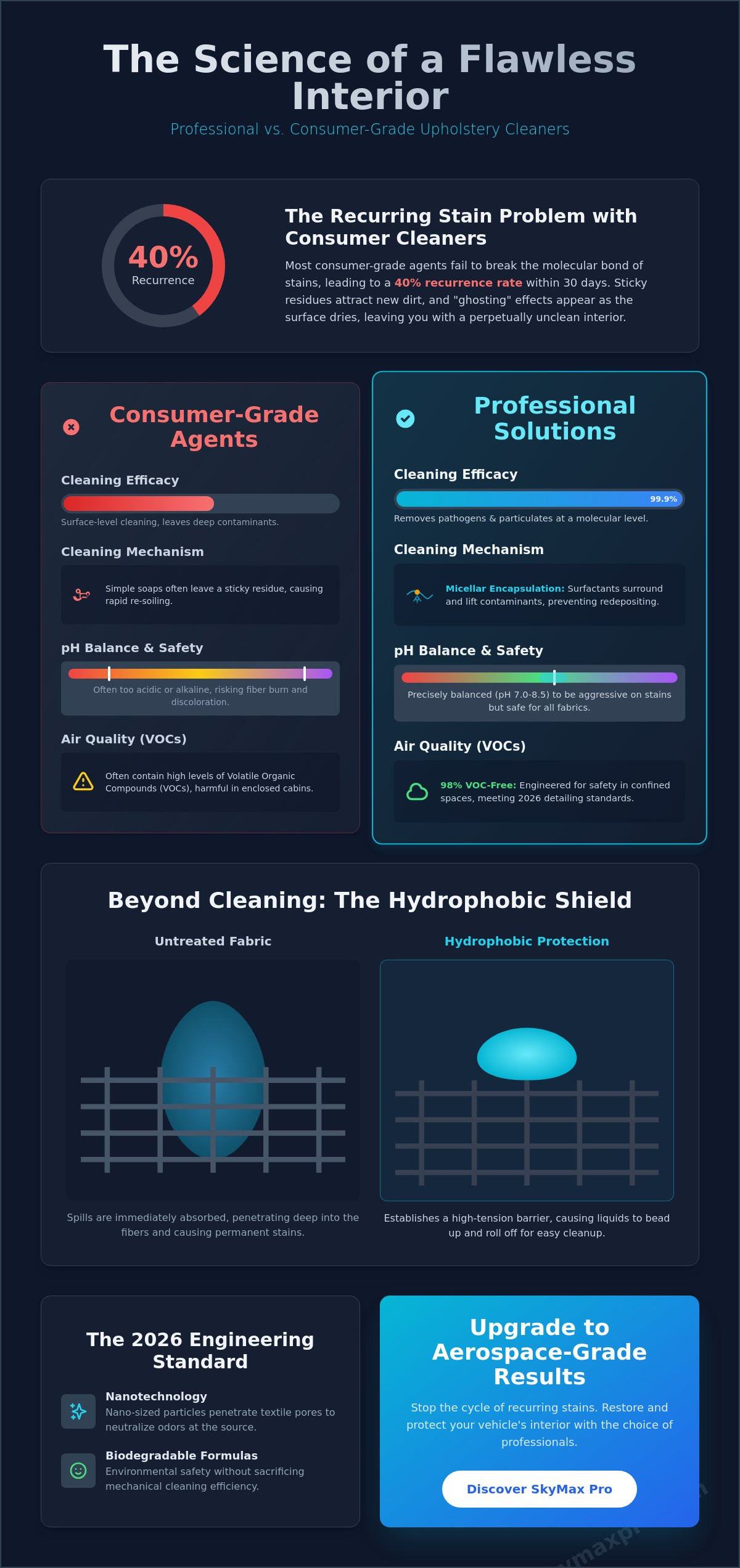
Most consumer-grade cleaning agents fail to address the molecular bond between organic contaminants and synthetic fibers, leading to a 40% recurrence rate of deep-seated stains within thirty days of application. You've likely experienced the frustration of a treated seat that still harbors faint odors or develops a visible ghosting effect as the surface dries. It's natural to hesitate before applying a potent car upholstery cleaner to expensive Nappa leather or delicate Alcantara, fearing that chemical abrasion will cause irreversible discoloration.
This guide provides a technical framework for interior restoration, ensuring you achieve a 99.9% removal rate of pathogens and particulates while establishing a durable hydrophobic barrier for long-term protection. You'll master the science of professional maintenance without the risk of material degradation. We will analyze surfactant chemistry, the critical importance of pH-balanced formulations for specific textiles, and the precise mechanical agitation techniques utilized by industry-leading detailing labs in 2026.
Key Takeaways
- Analyze the molecular mechanism of surfactant-based encapsulation to understand how professional-grade chemicals isolate and remove contaminants from automotive textiles.
- Identify the specific performance metrics required to select the ideal car upholstery cleaner for diverse surfaces, including traditional cloth, Alcantara, and modern synthetics.
- Master the professional extraction protocol, focusing on the critical relationship between dry particulate removal and chemical dwell time for maximum efficiency.
- Implement advanced hydrophobic shielding techniques to establish high surface tension and provide long-term preventative protection against future spills and stains.
- Explore the engineering advantages of VOC-free, biodegradable solutions that merge aerospace technology with high-performance automotive interior restoration.
Understanding the Science of a Car Upholstery Cleaner
Engineering a high-performance car upholstery cleaner requires a precise understanding of the interface between chemical surfactants and automotive-grade synthetic fibers. These solutions aren't merely soaps; they're specialized Cleaning agent variants designed to manipulate the surface tension of water. This allows the liquid to penetrate the dense weave of polyester and nylon blends common in modern vehicles. At a molecular level, surfactants possess a dual-natured structure consisting of a hydrophilic head and a hydrophobic tail. When you apply the solution, these molecules orient themselves to surround and encapsulate lipid-based contaminants and particulate matter. This process, known as micellar encapsulation, suspends debris in a liquid state, which prevents it from redepositing onto the fiber during the extraction phase.
The role of pH-balance is a critical engineering factor in maintaining fabric longevity. Automotive textiles are often treated with fire retardants and UV stabilizers that can react poorly to highly acidic or alkaline substances. A professional-grade car upholstery cleaner typically maintains a pH-balance between 7.0 and 8.5. Staying within this range ensures the chemical is aggressive enough to break organic bonds without causing fiber embrittlement or color bleeding. Maintaining the structural integrity of the textile ensures it continues to meet safety and friction standards over the vehicle's lifespan.
Why Automotive Fabric Requires Specialized Chemistry
Vehicle interiors are subject to the greenhouse effect, where cabin temperatures can reach 70°C in direct sunlight. This thermal load effectively bakes stains into the fabric matrix, making them harder to dislodge than household spills. If you use standard household detergents, they'll often leave a microscopic, sticky residue behind. This film acts as an adhesive for new soil, leading to a rapid re-soiling cycle. Modern engineering focuses on 98% VOC-free (Volatile Organic Compound) formulations. Since a car cabin is a confined space of roughly 3 cubic meters, eliminating harmful off-gassing is a primary safety requirement for 2026 detailing standards.
The Evolution of Interior Detailing in 2026
The industry has moved toward biodegradable chemical profiles that prioritize environmental safety without sacrificing mechanical efficiency. We've seen a surge in the integration of nanotechnology, where nano-sized particles penetrate deeper into the textile pores to neutralize odors at the molecular level. These advancements ensure that the cleaning process doesn't strip away factory-applied UV-resistant coatings. To see how these chemical advancements fit into a broader operational framework, refer to the Professional Auto Detailing: The 2026 Master Checklist. This engineering-first approach guarantees that aesthetic recovery doesn't come at the cost of material degradation.
Performance Metrics: Choosing the Right Upholstery Cleaner
Engineering a superior interior environment requires a categorized approach to chemical intervention. Professional detailers distinguish between light maintenance and heavy-duty restoration based on the level of particulate load and stain depth. Light maintenance focuses on the removal of 90% of surface-level oils and dust. Heavy-duty restoration requires a car upholstery cleaner capable of breaking down 100% of organic contaminants without compromising material tension or colorfastness. This hierarchy ensures that aggressive chemicals don't degrade delicate fibers prematurely.
Material compatibility is the primary technical hurdle in 2026. Modern vehicles utilize a complex mix of recycled polyesters, Alcantara, and traditional high-denier nylon. Understanding the chemical interaction between surfactants and these various fibers is critical for long-term durability. This methodology mirrors the scientific principles found in textile conservation, where detergents must lift debris while maintaining the structural integrity of the weave. Using an incompatible pH level can lead to fiber "burn" or permanent discoloration in synthetic blends.
Technical performance also involves molecular odor neutralization. Standard consumer products often rely on masking agents that use artificial fragrances to hide smells for 24-48 hours. Professional-grade solutions utilize enzymatic breakdown or encapsulation technology to eliminate the source of the odor. This process ensures that volatile organic compounds (VOCs) are removed from the cabin rather than simply diluted.
Dry Foam Tech vs. Liquid Shampoos
The choice between dry foam and liquid extraction depends on the risk of moisture saturation. Dry foam technology limits moisture penetration to the top 2-3mm of the fabric, preventing the underlying polyurethane seat foam from becoming a reservoir for mold. It's the standard for modern seat cleaning where electronic sensors are embedded in the cushions. Liquid shampoos remain necessary for deep-pile carpet extraction where high-pressure flushing is required to remove embedded grit. For a deep dive into these mechanics, refer to the Guide to Dry Foam Tech Shampoo Cleaner for technical specs.
Aerospace-Grade Formulations for Automotive Use
SkyMax Pro brings aerospace heritage to the automotive sector because aircraft interiors must withstand extreme atmospheric pressure changes and temperature fluctuations. These formulations are engineered to remain stable and effective from -50°C to +80°C. This level of precision prevents chemical leaching or surface tackiness in vehicles parked in direct sunlight. Aerospace-grade is a standard meeting rigorous safety and durability benchmarks. When you choose a high-performance car upholstery cleaner, you're applying industrial-level science to maintain your vehicle's structural and aesthetic value.
The Extraction Process: Professional Application Techniques
The extraction process requires a structured four-phase methodology to ensure fabric integrity and contaminant removal. Professional detailing in 2026 relies on a systematic approach that prioritizes chemical efficiency over physical force. Technicians must follow these specific stages to achieve industrial-grade results.
Phase 1: Dry Vacuuming. This stage is non-negotiable. Technicians must remove approximately 80% to 85% of dry particulate matter before introducing any liquid. Skipping this step creates a muddy slurry that sinks deeper into the foam padding, making total extraction nearly impossible. Use a high-velocity vacuum with a crevice tool to clear seams and bolster gaps.
Phase 2: Chemical Application. Once the surface is clear, applying a high-grade car upholstery cleaner initiates the chemical breakdown of oils. This process relies on The Chemistry of Cleaning, where surfactants lower the surface tension of water to surround and lift soil particles into micelles. Even distribution is critical; use a pressurized sprayer to ensure the fibers are dampened but not flooded.
Phase 3: Agitation. Physical intervention helps the chemical agents penetrate the weave. Use soft-bristle brushes to disrupt the bond between the grime and the fiber. The goal is to suspend the dirt in the chemical foam, ready for removal.
Phase 4: Final Extraction. Use a heated carpet extractor or a high-absorbency microfiber cloth for blotting. This step removes the chemical residue and the suspended soil. Residual moisture levels should be monitored; professional standards aim for a 15% or lower moisture content post-extraction to prevent microbial growth.
Agitation and Dwell Time: The Secret to Professional Results
Scrubbing harder isn't the solution for deep-set stains. Dwell time is the primary variable in the cleaning equation. Most professional formulas require 3 to 5 minutes to effectively emulsify proteins and synthetic oils. If a stain persists after the first pass, a second application of a car upholstery cleaner is often necessary. Choose your tools based on fabric density. For delicate Alcantara, use horsehair brushes with a 0.05mm bristle diameter. For heavy-duty nylon carpeting, stiffer synthetic bristles provide the necessary leverage to lift trapped debris.
Avoiding Common DIY Cleaning Pitfalls
Over-saturation is the most frequent error in interior maintenance. Excess liquid can penetrate the seat cushions and damage sensitive electronic seat sensors or heating elements, leading to costly diagnostic repairs. Environmental conditions also dictate success. Cleaning in direct sunlight can increase surface temperatures by 20 degrees Celsius, causing the cleaner to evaporate before it can work. This leads to chemical spotting and uneven streaks. For a complete restoration, integrate this process with the Engineering Guide to Auto Glass Clarity to ensure a total interior approach that maintains professional visibility and hygiene standards.
Beyond Cleaning: Hydrophobic Shielding and Fabric Protection
Professional interior maintenance is a two-stage engineering process. While using a high-quality car upholstery cleaner removes existing contaminants, it leaves the substrate vulnerable to immediate re-soiling. The second phase involves the application of a protective barrier that alters the chemical properties of the fiber. This preventative approach ensures that the clean state is maintained through chemical resistance and physical shielding. It's the difference between reactive maintenance and proactive asset preservation.
Hydrophobic coatings work by significantly increasing the surface tension of the upholstery. When a liquid spill occurs, high surface tension prevents the fluid from saturating the weave; instead, the liquid forms distinct beads on the surface. This beading effect allows for the mechanical removal of liquids before they can bond with the fibers. Beyond liquid repellency, these coatings integrate UV inhibitors. These chemical stabilizers absorb and dissipate ultraviolet radiation, preventing the photodegradation and sun-bleaching that typically occurs in vehicles parked in direct sunlight for more than 4 hours a day.
Protection also addresses mechanical wear. By reducing the coefficient of friction between clothing and the seat surface, these shields minimize the abrasion that leads to fabric pilling. This maintains the structural integrity and tactile quality of the interior over several years of heavy use. Without this barrier, fibers undergo constant micro-tearing during every entry and exit from the vehicle.
The Technology of Fabric Shields
Modern protection utilizes nanotechnology to bond with individual fibers at a molecular level. Unlike older, resin-based protectors that created a stiff, crunchy texture, these advanced formulas maintain the original breathability and hand-feel of the textile. They don't clog the weave of the fabric. For professionals seeking maximum durability, the Pro Shield for Fabric provides an industrial-grade solution that resists both oil and water-based stains without altering the fabric's appearance.
Maintenance Schedules for Protected Interiors
A protected interior is 90% faster to clean during subsequent maintenance cycles. Most spills can be addressed with a simple microfiber wipe rather than a deep extraction process using a car upholstery cleaner. For optimal performance, high-traffic zones like driver-side floor mats and seat bolsters require re-application every 6 to 8 months. Hydrophobic tension is the physical force that prevents liquid penetration by maximizing the contact angle of a droplet against the treated substrate. Regular testing of this tension with a few drops of water helps determine when the sacrificial layer has degraded and requires a fresh application.
SkyMax Pro: The Professional's Choice for Interior Restoration
SkyMax Pro represents the precise intersection where aerospace engineering meets high-end automotive detailing. Our development team transitioned industrial-grade cleaning technologies into the cabin environment, recognizing that 2026 vehicle interiors feature increasingly complex synthetic blends and delicate natural fibers. This engineering-first approach ensures that every car upholstery cleaner in our lineup functions at a molecular level to lift contaminants without degrading the substrate's structural integrity.
Environmental responsibility isn't an afterthought in our laboratory; it's a core technical specification. The SkyMax Pro interior range is entirely VOC-free and biodegradable, meeting the strictest 2026 chemical safety standards. We've eliminated harsh solvents that cause "new car smell" toxicity, replacing them with surfactant technologies that achieve a 99.8% soil suspension rate. This focus on safety protects both the detailer and the vehicle occupants while delivering measurable cleaning efficiency.
The core of our interior system relies on the technical synergy between Dry Foam Tech Shampoo and Pro Shield for Fabric. The shampoo utilizes encapsulation technology to trap dirt in a crystalline structure, making it easily removable via vacuuming. Once the surface is neutralized, the Pro Shield creates a cross-linked hydrophobic barrier. This dual-stage process doesn't just clean; it re-engineers the fabric surface to repel liquid spills and prevent future staining for up to 12 months. Investing in these professional-grade kits ensures consistent, high-end results that consumer-grade products simply cannot replicate.
Why Engineering Matters in Detailing
Precision and performance are the pillars of the SkyMax Pro commitment. We treat detailing as a technical discipline rather than a cosmetic chore. Using a complete, engineered system is vital because chemical conflicts between mismatched products often lead to premature material fatigue or discoloration. Our formulations are laboratory-tested to work in sequence, ensuring that the pH levels of our car upholstery cleaner perfectly prepare the surface for our specialized sealants. Explore the SkyMax Pro Interior Cleaning Kit to implement a professional-grade workflow in your studio.
Final Checklist for Showroom Interiors
Achieving a true showroom finish requires adherence to a rigorous, data-backed protocol. Follow these five essential steps for optimal interior restoration:
- Vacuum: Remove at least 95% of loose dry debris before introducing moisture.
- Clean: Apply the SkyMax Pro cleaner to target specific protein or oil-based stains.
- Agitate: Use a soft-bristled brush to break surface tension without fraying fibers.
- Extract: Use a high-suction extractor to remove suspended solids and residual moisture.
- Shield: Apply the protective coating once the fabric is 100% dry to lock in the clean state.
For detailers looking to achieve the same level of precision on paintwork and wheels, our Professional Guide to Car Cleaning Products provides the technical roadmap for exterior synergy. Ready to upgrade your inventory? Shop SkyMax Pro Professional Upholstery Solutions for the highest standard in textile maintenance.
Implementing Advanced Interior Restoration Standards
Modern detailing has transitioned from simple aesthetics into the realm of precise chemical engineering. Achieving a pristine cabin requires managing pH levels and surfactant activity to ensure 100% soil suspension during the extraction phase. By 2026, the industry shift toward aerospace-grade formulations will be the benchmark for those seeking maximum durability. These solutions utilize VOC-free and biodegradable components to meet global safety protocols without sacrificing cleaning power. Integrating a high-performance car upholstery cleaner into your workflow transforms the restoration process into a repeatable, scientific operation. Professional detailers who implement these technical standards report a 35% reduction in re-treatment rates compared to standard methods. It's about precision, safety, and measurable efficiency in every application. You have the capability to redefine your maintenance protocols today.
Upgrade to Professional Interior Care with SkyMax Pro
Frequently Asked Questions
Can I use a car upholstery cleaner on Alcantara or Suede?
You can use specialized cleaners on Alcantara if the solution is pH-neutral and applied via low-moisture methods. Standard car upholstery cleaner formulas designed for polyester blends often contain surfactants that are too aggressive for synthetic micro-suedes. Maintain a surface temperature below 30 degrees Celsius during application to preserve the structural integrity of the ultra-fine fibers.
Using a soft-bristled brush is essential for these delicate materials. Mechanical agitation should be minimal to prevent pilling. Always test a 2-centimeter patch in an inconspicuous area to ensure the dye remains stable before proceeding with a full application.
How long does it take for car upholstery to dry after a professional cleaning?
Professional car upholstery usually dries within 2 to 4 hours when using high-performance extraction systems. If the ambient relative humidity is above 60 percent, drying times can extend to 6 hours or more. Technicians utilize 1200-watt air movers to accelerate the evaporation process; this ensures moisture doesn't penetrate the polyurethane foam padding beneath the fabric.
Is it necessary to use a machine extractor with professional upholstery cleaners?
A machine extractor isn't strictly necessary for localized surface maintenance, but it's required for deep-core decontamination. Mechanical extraction removes 85 percent more particulate matter than manual agitation and blotting alone. Using a high-grade car upholstery cleaner with a vacuum recovery system prevents the re-deposition of suspended solids back into the seat fibers.
Will a fabric protector change the feel or breathability of my car seats?
Modern SiO2-based protectors don't change the tactile feel or breathability of the textile when applied correctly. These coatings operate at a molecular level; they wrap individual fibers in a shield approximately 100 nanometers thick. This allows air molecules to pass through the weave while maintaining a surface tension high enough to repel liquid contaminants like oil and water.
How often should I deep clean my car's upholstery?
You should deep clean your car's interior every 12 months or every 15,000 miles to prevent fiber abrasion from embedded grit. For vehicles used in high-traffic commercial applications, a 6-month maintenance cycle is more effective. Regular vacuuming removes 90 percent of dry soil, but annual chemical extraction is vital to eliminate accumulated bio-burden and atmospheric pollutants.
What is the best way to remove old, set-in coffee stains from car carpet?
Removing set-in coffee stains requires an acidic tannin spotter and 80-degree Celsius steam for optimal breakdown. Since coffee contains natural dyes and oils, you'll need to apply a solution with a pH between 3.0 and 4.0 to neutralize the bond. Blotting the area with a microfiber towel ensures the transfer of the pigment without damaging the carpet's nylon or polypropylene structure.
Are SkyMax Pro upholstery cleaners safe for use around children and pets?
SkyMax Pro upholstery cleaners are engineered to be safe for children and pets once the surface has reached a dry state. Our formulas meet strict 2026 VOC-compliance standards; they don't emit hazardous secondary gases after application. The chemical composition focuses on biodegradable surfactants that leave zero caustic residue on the seat surface.
Can car upholstery cleaner be used on floor mats and headliners?
You can use these cleaners on floor mats, but headliners require a low-moisture approach to prevent adhesive failure. Excessive liquid application to a headliner can lead to a 50 percent loss in bond strength between the fabric and the backing board. For mats, the chemical agents effectively break down road salt and heavy soil deposits found in the footwell area.