

Your vehicle's paint isn't just a color; it's a multi-layered engineering system designed to protect the substrate from environmental degradation. When oxidation sets in, the surface becomes porous and light scatters instead of reflecting, resulting in a frustrating, chalky appearance. Learning how to fix dull car paint at home requires more than a standard retail wax. It demands a systematic, professional-grade approach to surface decontamination and leveling that prioritizes clear coat integrity. With the DIY car care segment accounting for over 56% of market demand as of 2025, the technical tools for high-level restoration are now fully accessible to the home enthusiast.
It's understandable if you feel hesitant. Between the fear of damaging your finish with aggressive tools and the confusion caused by an endless array of consumer products, many owners settle for a faded vehicle. You deserve a mirror-like finish that provides long-term resistance against the elements. This guide provides a repeatable restoration protocol rooted in aerospace-inspired methods. We'll examine the technical steps of removing oxidation and applying high-performance protection, such as Ceramic Graphene Shield Coating, to ensure your results withstand UV damage and industrial fallout.
Key Takeaways
- Understand the chemical nature of paint oxidation and how to distinguish between surface-level degradation and irreversible clear coat failure.
- Master the multi-stage decontamination protocol necessary for how to fix dull car paint at home, ensuring the surface is free of embedded particulates before correction.
- Learn the engineering principles of paint correction to safely level the clear coat and restore the optical clarity of the vehicle's finish.
- Discover why traditional waxes are obsolete and how to implement molecular-level protection using aerospace-inspired ceramic graphene coatings.
- Establish a repeatable maintenance framework, including the 'Two-Bucket' wash method, to prevent future UV damage and mechanical swirl marks.
The Mechanics of Paint Oxidation: Why Car Paint Becomes Dull
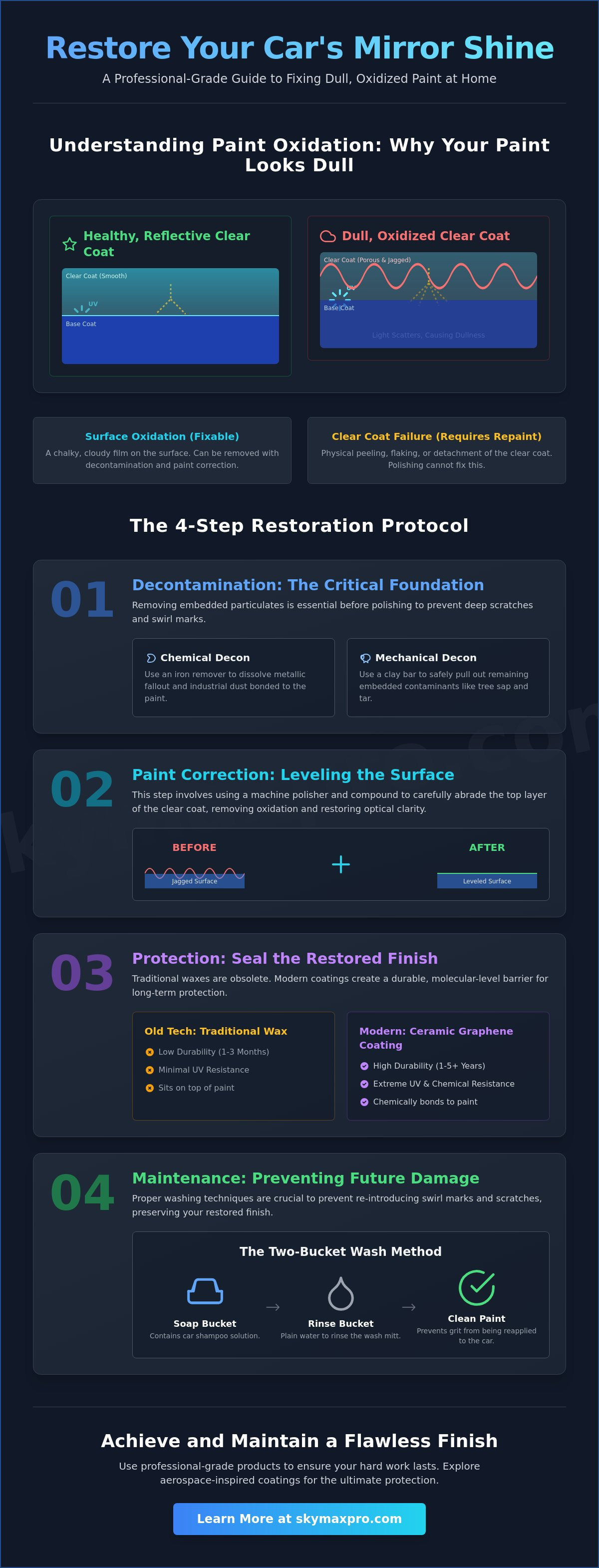
Automotive finishes are engineered to provide a high-gloss aesthetic while serving as a sacrificial barrier for the underlying metal substrate. The topmost layer, known as the clear coat, is a transparent polymer matrix designed to shield the pigment from environmental stress. However, this protection is not infinite. The Mechanics of Paint Oxidation involve a complex chemical reaction where the polymer chains in the clear coat lose structural integrity. This degradation occurs when the surface is exposed to oxygen and high-energy ultraviolet radiation, leading to a surface that is no longer smooth but microscopically jagged. Understanding these chemical shifts is the first step in learning how to fix dull car paint at home, as it allows you to distinguish between a surface that needs restoration and one that has reached terminal failure.
It's vital to identify the difference between surface oxidation and clear coat failure, also known as delamination. Surface oxidation appears as a cloudy or chalky film that can be mechanically removed. Clear coat failure, conversely, involves the actual peeling or flaking of the protective layer. Once the clear coat has physically detached from the base coat, no amount of polishing can restore it; the panel requires a professional repaint. Industrial fallout, such as rail dust and metallic particulates, along with hard water minerals, can accelerate this surface degradation by creating acidic environments that eat into the paint's molecular structure.
UV Radiation and Polymer Degradation
Ultraviolet light acts as a catalyst, providing the necessary energy to break the molecular bonds within the clear coat's resin. Oxidation is the loss of electrons during a chemical reaction with oxygen. This process transforms a stable, non-porous surface into a brittle, porous layer that scatters light instead of reflecting it. High ambient temperatures further accelerate these chemical kinetics. As surface temperatures rise, the rate of chemical aging increases, which is why vehicles in sun-exposed climates exhibit much faster rates of dulling compared to those in temperate regions.
Environmental Contaminants vs. True Oxidation
Surface dullness isn't always caused by chemical oxidation alone. Bonded contaminants like tree sap, bird droppings, and rail dust mimic the appearance of dull paint by creating a rough texture. To identify the specific issue, use the "sandpaper test." By sliding your hand over a clean, dry surface, you can feel microscopic protrusions that indicate bonded contaminants rather than smooth, oxidized paint.
- Mechanical Bonding: Particulates that have physically wedged into the paint pores.
- Chemical Etching: Acidic substances that have dissolved a portion of the clear coat.
- Optical Refraction: Surface irregularities that prevent a "mirror" reflection.
Washing alone cannot restore optical clarity because these contaminants are physically embedded. Many owners attempt to use retail "quick waxes" to solve the problem, but these products fail because they merely sit on top of the debris. They don't fix the underlying structural dullness. Learning how to fix dull car paint at home involves a transition from simple cleaning to a technical decontamination and leveling process that removes the damaged material entirely.
Surface Decontamination: The Critical Foundation of Restoration
Surface decontamination is the most overlooked phase in the process of how to fix dull car paint at home. Attempting to level the clear coat without removing bonded particulates is a critical engineering error. These contaminants, often invisible to the naked eye, become trapped between the polishing pad and the surface. They act as an unintended abrasive that causes severe swirl marks and deep micro-marring. A professional restoration requires a two-stage protocol to ensure the surface is chemically and mechanically sterile before any corrective work begins. This process ensures that you aren't simply grinding grit into the finish.
Environment control is the first step in successful preparation. You should always work in a shaded area with a surface temperature below 30 degrees Celsius. High temperatures cause chemicals to flash-dry, which can lead to staining or reduced effectiveness. You'll need a pH-neutral automotive shampoo, a high-quality iron remover, and dedicated microfiber towels to maintain a clean workspace. Establishing this controlled environment is essential for achieving the precision required for high-level paint restoration.
Chemical Decontamination and Iron Removal
Chemical decontamination targets metallic fallout and organic resins that standard washing cannot touch. Iron removers use specialized surfactants to dissolve brake dust that has embedded itself into modern automotive paint systems. This chemical reaction is often visible as the solution turns purple upon contact with ferrous particles. Additionally, utilizing a heavy duty degreaser ensures that previous waxes, silicones, and oils are completely stripped. This provides a "naked" surface, allowing subsequent restoration steps to bond directly to the clear coat. It's vital to wear gloves and eye protection when handling these specialized automotive chemicals to maintain safety protocols.
Mechanical Restoration with Detailing Clay
Mechanical restoration follows the chemical stage to address any remaining surface texture. A detailing clay bar is engineered to shear off bonded contaminants, such as industrial fallout and tree sap, that chemical cleaners leave behind. Proper lubrication is non-negotiable during this step. Without it, the clay will drag and create marring on the clear coat. Use light pressure and linear strokes to glide the clay across the lubricated panel. You should avoid circular motions to minimize the risk of multi-directional scratching. If you drop the clay bar, discard it immediately. It will have absorbed grit from the floor that can ruin your paint. For those following a strict protocol, utilizing a professional detailing master checklist ensures no part of the decontamination phase is bypassed. This mechanical step results in a glass-smooth finish that is finally ready for the leveling process required for how to fix dull car paint at home.
Paint Correction: Leveling the Clear Coat to Restore Shine
The core engineering objective of paint correction is the removal of a microscopic layer of compromised clear coat to reveal the pristine, non-oxidized paint beneath. To master how to fix dull car paint at home, you must view the clear coat as a finite resource that requires precise leveling rather than aggressive abrasion. This stage is where the optical clarity is restored by eliminating the surface irregularities that cause light scattering. By flattening the surface, you enable light to reflect uniformly, which creates the deep, mirror-like gloss associated with a professional finish.
Abrasive technology is categorized by the size and concentration of the grit particles within the medium. Compounds use larger, more aggressive abrasives to cut through heavy oxidation and deep scratches. Polishes utilize finer particles to refine the surface and enhance gloss. Managing kinetic energy is critical during this phase. Friction generates heat, and excessive thermal buildup can soften the clear coat to the point of structural failure or "burning" through to the base coat. You must monitor the surface temperature constantly to ensure you stay within safe operational limits.
Choosing the Right Abrasive Media
Selecting the appropriate media depends on the severity of the oxidation. Heavy compounds are reserved for surfaces that appear completely matte or chalky. Finishing polishes are used for minor hazing or as a follow-up to a compounding step. You should always employ the "test spot" method on a small, inconspicuous area. This allows you to verify that you're using the least aggressive method necessary to achieve the desired result. Polishing is the process of creating a perfectly flat surface that reflects light in a single, coherent direction.
Manual vs. Machine Application
While professional detailers often use rotary machines, enthusiasts can achieve high-level results through manual application or Dual Action (DA) polishers. When working by hand, dual-density foam applicators are essential for distributing pressure evenly across the panel. DA polishers are the preferred tool for home use because they simulate a hand motion while providing the necessary oscillation to level the paint safely. They significantly reduce the risk of heat-induced damage compared to high-torque rotary buffers. These machines are a core component of any comprehensive Exterior Detailing Kit designed for home restoration.
Maintaining consistent pressure is an ergonomic challenge. You should work in small, 2x2 foot sections to ensure uniform coverage. Overlapping your passes by 50% guarantees that no areas are left uncorrected. Using a steady, moderate pace allows the abrasives to break down properly and complete their work. This systematic approach ensures the surface is perfectly prepared for the final protective layer.
Aerospace-Grade Protection: Sealing the Restored Finish
Once the clear coat has been leveled and the optical clarity restored, the final engineering challenge is preservation. Traditional carnauba waxes are fundamentally obsolete for long-term oxidation prevention. These organic materials possess low thermal stability and begin to degrade at temperatures as low as 60 degrees Celsius, which a dark car panel easily reaches in direct sunlight. When executing the final stage of how to fix dull car paint at home, you must transition to synthetic, high-performance barriers. Modern ceramic coating technology offers a quantifiable advantage by creating a semi-permanent covalent bond with the paint, providing a level of durability that traditional products cannot match.
Graphene technology represents the current pinnacle of surface engineering. By integrating a honeycomb lattice of carbon atoms into the ceramic matrix, these coatings provide superior heat dissipation. This reduces the risk of water spotting by lowering the surface temperature of the panels. Additionally, graphene's high tensile strength creates a harder barrier against mechanical abrasion and chemical etching from bird droppings or industrial fallout. Utilizing a professional-grade Ceramic Graphene Shield Coating ensures that the restoration results last for years, not weeks.
The Evolution of Surface Protection
The lifespan of protective layers varies significantly based on their molecular structure. A standard wax provides approximately 30 days of protection, while polymer sealants may last up to six months. In contrast, nanotechnology coatings bond at a molecular level with the paint pores, offering protection for two years or more. This bond creates a highly hydrophobic surface. The resulting water-beading effect isn't just for aesthetics; it's a functional self-cleaning mechanism. As water rolls off the surface, it carries away loose contaminants, preventing them from bonding and causing future oxidation.
Applying Ceramic Graphene Shield at Home
The success of a coating depends entirely on the purity of the surface. Before application, you must use an Isopropyl Alcohol (IPA) wipe to remove any residual polishing oils or lubricants left behind from the correction stage. If these oils remain, the coating won't bond correctly and its lifespan will be severely compromised. Once the surface is chemically sterile, apply the coating using a specialized applicator in small, overlapping sections.
Curing is the final critical step. Most coatings require a 24-hour period of dry conditions to reach full structural hardness. During this time, the vehicle should remain in a controlled environment away from moisture and dust. For those seeking a complete restoration solution, the ceramic coating kit provides all the necessary components to achieve a professional bond and maximum durability. High-performance protection is the only way to ensure your hard work in learning how to fix dull car paint at home remains visible for the long term.
Secure the results of your surface restoration by applying a professional-grade Ceramic Graphene Shield Coating for unmatched UV resistance and hydrophobic performance.
Maintenance Engineering: Preventing Future Paint Fading
Restoration is a significant investment of technical labor. Maintenance engineering is the systematic protocol required to protect that investment from environmental degradation. The primary cause of recurring dullness is improper washing technique, which introduces mechanical micro-marring. The "Two-Bucket" method is the industry standard for eliminating grit recirculation. By utilizing one dedicated bucket for the wash solution and a secondary bucket for rinsing the wash mitt, you ensure that abrasive particulates are trapped at the bottom of the rinse container. This protocol is a fundamental component of the long-term strategy for how to fix dull car paint at home and maintain peak optical clarity.
Chemical selection is equally critical to surface longevity. High-pH detergents, such as common household dish soaps, are engineered to strip organic lipids. On automotive surfaces, these chemicals aggressively degrade the protective coatings and sealants you've applied. They can also accelerate the drying and cracking of rubber seals and plastic trim. Establishing a quarterly inspection schedule allows you to monitor the health of the sacrificial layer and address minor issues before they evolve into structural oxidation. This data-driven approach ensures the vehicle remains protected against UV radiation and industrial fallout.
The Chemistry of the Safe Wash
Understanding the pH scale is essential for coating integrity. A neutral pH of 7 is the ideal specification for maintenance shampoos. High-lubricity surfactants are designed to encapsulate dirt particles, lifting them away from the surface to minimize contact friction during the wash cycle. When drying the vehicle, mechanical contact should be minimized to prevent marring. Using filtered forced air or an ultra-plush microfiber towel with a "blotting" technique prevents the micro-scratching often caused by dragging a traditional chamois across the clear coat.
Topping the Coating: Gloss Maintenance
To maintain the hydrophobic properties and gloss of a restored finish, the sacrificial layer must be "recharged" periodically. Utilizing a ceramic-infused quick detailer spray provides an additional microscopic barrier that reinforces the base coating. This is particularly important for managing localized contaminants like bird droppings or bug remnants. These substances contain acidic compounds that can etch into the finish within hours of contact. Addressing these contaminants immediately with a quick detailer prevents permanent damage to the leveled surface. Following this repeatable maintenance framework is the final step in mastering how to fix dull car paint at home and ensuring the results endure for years.
- Frequency: Perform a safe wash every 1-2 weeks depending on exposure.
- Chemicals: Use only pH-neutral automotive shampoos and ceramic-compatible boosters.
- Inspection: Check for water-beading degradation every 90 days.
- Immediate Action: Remove acidic contaminants within 24 hours to prevent etching.
Engineering a Permanent Mirror Finish
Restoring a vehicle's optical clarity is a systematic engineering process rather than a cosmetic quick fix. Success depends on the rigorous application of a decontamination protocol and the precise leveling of the clear coat polymer matrix. By mastering how to fix dull car paint at home, you can achieve professional-grade results through disciplined surface correction and advanced chemical protection. Transitioning from obsolete waxes to aerospace-inspired graphene technology ensures that your surface restoration remains resistant to future UV-induced degradation and industrial fallout.
We provide high-performance solutions manufactured in the USA that utilize VOC-free, eco-friendly nanotechnology formulations. These professional-grade products are engineered to deliver measurable efficiency and long-term surface stability. Shop the SKY MAXPRO Ceramic Graphene Shield Kit for Professional Restoration Results and secure a finish that meets the highest industrial standards. You now possess the technical framework required to maintain a showroom-quality aesthetic indefinitely.
Frequently Asked Questions
Can I fix dull car paint without a machine?
Yes, manual restoration is possible using dual-density foam applicators and consistent mechanical pressure. While machine polishing is more efficient for large panels, hand polishing allows for greater precision in tight areas. Success in how to fix dull car paint at home by hand requires a systematic approach to decontamination and the use of high-quality abrasives to level the clear coat effectively. Consistent, overlapping strokes are necessary to ensure a uniform finish across the entire surface.
Is it too late to fix my car's paint if the clear coat is peeling?
Yes, if the clear coat is physically peeling or flaking, the paint has reached terminal delamination and cannot be restored through polishing. This condition indicates a total failure of the bond between the clear coat and the base pigment. Restoration techniques are only effective for surface-level oxidation. Once the clear coat has detached from the substrate, the affected panels require a professional repaint to restore structural integrity and aesthetic clarity.
What is the difference between car polish and car wax?
Car polish is an abrasive medium designed to level the clear coat, while wax is a sacrificial layer intended for protection. Polishing removes a microscopic layer of damaged paint to restore optical clarity and shine. Wax, or modern alternatives like Ceramic Deep Wet Mirror Shine Wax Sealant, fills minor pores and provides a temporary barrier against environmental contaminants. Unlike polish, wax does not remove any paint material and serves only as a topical shield.
How long does it take to restore faded paint at home?
A comprehensive restoration typically requires 6 to 12 hours of active labor depending on the vehicle's size and the severity of the oxidation. This timeframe includes the two-stage decontamination process, mechanical paint correction, and the application of a protective layer. Rushing the curing phase of a Ceramic Graphene Shield Coating can compromise the bond, so it's vital to allocate sufficient time for the chemical hardening process to complete in a controlled environment.
Will polishing my car remove deep scratches or just oxidation?
Polishing effectively removes surface oxidation and light swirl marks, but it won't eliminate deep scratches that have penetrated the clear coat. If a scratch is deep enough to catch a fingernail, it likely requires specialized touch-up paint or professional intervention. The engineering goal of polishing is to flatten the surface to improve light reflection. This process significantly reduces the visibility of minor defects while revealing the vibrant color of the healthy paint beneath.
Can I use dish soap to wash my car before restoring the paint?
You can use a high-pH soap only during the initial strip-wash phase to remove old waxes and surface oils. However, you should never use dish soap for regular maintenance after you've completed the restoration. For the preparation stage, a Heavy Duty Red Power Degreaser is a more precise engineering choice. It ensures the surface is chemically sterile before you begin the decontamination and correction steps required for how to fix dull car paint at home.
How often should I apply ceramic protection to prevent future fading?
You should apply a professional ceramic coating every 2 to 3 years, with periodic maintenance to reinforce the sacrificial layer. While traditional waxes fail within weeks, a Ceramic Graphene Shield Coating provides long-term UV resistance and thermal stability. Regular maintenance with a Quick Detailer Spray with Ceramic High Gloss Finish every few months will extend the life of the primary coating. This protocol effectively prevents recurring oxidation and maintains the mirror-like finish.
Does white paint oxidize differently than darker colors?
White paint oxidizes at the same chemical rate as darker colors, but the visual symptoms are less apparent because white reflects more light. On dark vehicles, oxidation appears as a distinct chalky cloudiness. On white vehicles, the dullness manifests as a loss of depth and a slightly yellowed or flat appearance. Regardless of the color, the technical process for how to fix dull car paint at home remains identical, requiring deep decontamination and mechanical leveling.