

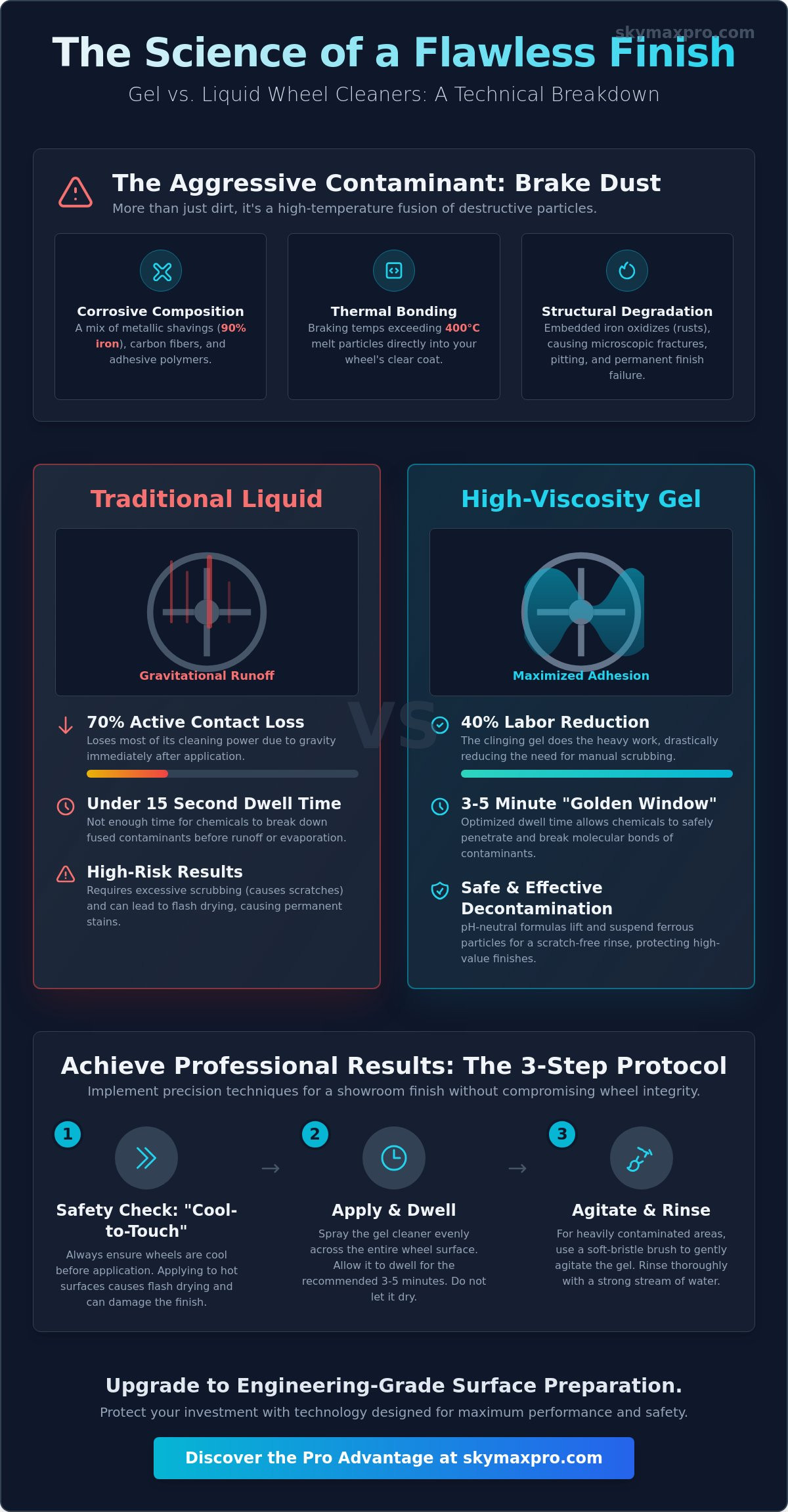
Traditional liquid cleaners lose up to 70% of their active surface contact within the first 15 seconds due to gravitational runoff. You've likely experienced the frustration of watching expensive product pool on the ground while metallic contaminants remain fused to your powder-coated rims. It's a fundamental failure of physics that forces unnecessary physical scrubbing and increases the risk of surface abrasion. By implementing a high-viscosity gel wheel & rim cleaner, you utilize chemical adhesion to ensure the formula remains exactly where the contamination exists.
This guide breaks down the molecular science of brake dust removal and the safety protocols necessary for high-value finishes. Precision is the standard. We'll analyze how gel technology reduces labor requirements by 40% while providing a protective barrier against chemical etching. You'll gain a comprehensive understanding of dwell-time optimization to achieve a showroom-clean finish without compromising the structural or aesthetic integrity of your wheels.
Key Takeaways
- Understand the molecular structure of brake dust and why standard detergents fail to break the thermal bond between metallic shavings and your wheel's clear coat.
- Discover how high-viscosity gel wheel & rim cleaner technology utilizes surface tension to maximize dwell time on vertical surfaces for superior contaminant suspension.
- Evaluate the performance and safety metrics of pH-neutral gel formulations against traditional aggressive acids to optimize your rim maintenance workflow.
- Implement the "Cool-to-Touch" protocol and precise application techniques to ensure chemical safety while achieving professional-grade restoration results.
- Learn why engineering-grade surface preparation is the critical prerequisite for long-term protection and the successful application of advanced ceramic coatings.
The Chemistry of Contamination: Why Brake Dust Destroys Rims
Automotive braking systems rely on friction to convert kinetic energy into thermal energy. This process generates temperatures exceeding 400 degrees Celsius during standard deceleration. The resulting byproduct, commonly known as brake dust, consists of a high-density mixture of carbon fibers, metallic shavings, and adhesive polymers. Unlike organic road grime, these particles act as microscopic projectiles. When they hit the wheel surface at high velocity, the residual heat allows them to melt into the clear coat; this creates a mechanical bond that resists standard friction-based cleaning. These particles often contain over 90% iron, making them highly reactive to environmental factors.
Standard surfactants found in car shampoo are engineered to encapsulate oils and loose debris. They don't have the chemical strength to break the molecular attachment of these metallic shards. Professional maintenance requires a deeper understanding of different types of cleaning agents to address the specific pH requirements and chelation processes needed for metallic removal. Without targeted chemical intervention, the contamination remains embedded, leading to long-term structural damage.
The Anatomy of Ferrous Contamination
Ferrous particles are jagged, microscopic metal shards that embed themselves into the porous structure of a wheel's finish. Once lodged, they begin an immediate oxidation process when exposed to moisture and oxygen. This reaction creates iron oxide, which expands and causes microscopic fractures in the protective coating. Over time, this leads to permanent pitting and structural degradation of the alloy. Industrial fallout refers to these airborne metallic contaminants that settle on surfaces and bond through electrostatic attraction and thermal fusion, requiring aggressive chemical intervention to safely extract.
Why Traditional Cleaners Fall Short
Low-viscosity liquid cleaners fail because they lack dwell time. On vertical wheel surfaces, gravity pulls thin liquids to the bottom of the rim within 15 seconds, preventing the chemical reaction from reaching completion. This leads to flash drying, where the active chemicals evaporate and leave behind concentrated residues that can cause permanent staining. A high-performance gel wheel & rim cleaner solves this by utilizing thixotropic properties. The gel clings to the vertical surface, allowing the active ingredients to penetrate the metallic bond for 5 to 10 minutes without drying. While a specialized gel wheel & rim cleaner provides the necessary contact time for chelation, traditional soaps only address surface-level contaminants, leaving the underlying ferrous shards untouched. This technological gap is why engineering-grade cleaners are essential for preserving high-value automotive finishes.
The Science of Gel Viscosity: Why Clinging Power Matters
The efficacy of a professional gel wheel & rim cleaner is defined by its rheological properties, specifically its viscosity. Unlike liquid-based solutions that succumb to gravity within 12 to 15 seconds of application, gel formulations are engineered as high-viscosity surfactants. These substances are designed to maximize vertical dwell time through superior surface tension. This physical characteristic ensures that the active chemical agents remain in direct contact with the substrate rather than pooling at the bottom of the rim barrel or running onto the workshop floor.
The physics of this process involves molecular adhesion. A gel cleaner utilizes thixotropic properties, meaning it remains stable and thick while at rest but becomes more fluid when agitated or sprayed. This allows for precise application. Aerospace-grade formulations take this a step further by ensuring chemical stability across varying thermal ranges. In high-performance environments, wheels can retain significant heat; a standard cleaner might flash-dry instantly, but a stabilized gel maintains its structural integrity to prevent caustic spotting. This engineering approach focuses on "suspension," where the gel matrix physically lifts brake dust and metallic oxides away from the finish, holding them in a semi-liquid state until they're rinsed away.
Maximizing Dwell Time for Chemical Reaction
The 180 to 300-second window is the critical phase for any decontamination process. This 3-5 minute "golden window" allows the cleaner to break the ionic bonds of stubborn brake dust. Because the gel clings to the vertical face of the wheel, it prevents the chemicals from reaching sensitive brake calipers and ceramic rotors too quickly, which reduces the risk of hardware corrosion. Operators can identify a successful reaction through visual cues, such as the gel transitioning from a clear state to a deep purple or red. This color change indicates that the pH-balanced thioglycolate agents have successfully complexed with iron particles. Implementing advanced maintenance protocols using these high-cling formulas ensures that chemical energy does the work, rather than aggressive mechanical scrubbing.
Encapsulation and Surface Safety
Surface safety is a byproduct of molecular encapsulation. Gel molecules act as a protective barrier, surrounding abrasive carbonized iron particles and preventing them from dragging across the clear coat during agitation. This high lubricity factor is essential for protecting polished, powder-coated, or anodized finishes that are susceptible to micro-marring. It's a technical reality that the relationship between viscosity and chemical concentration is linear; higher viscosity allows for a 25% increase in active surfactant density without the risk of premature evaporation or runoff. This ensures that every square centimeter of the wheel receives a consistent dosage of the cleaning agent, maintaining the finish's integrity over hundreds of cleaning cycles.
Gel vs. Liquid vs. Acid: Choosing the Right Rim Cleaner
Selecting a cleaning agent requires a balance between chemical potency and substrate integrity. Traditional acid-based cleaners rely on aggressive protonation to dissolve metallic oxides. While these work quickly, they carry a high risk of permanent etching on sensitive surfaces. Liquid cleaners often struggle with low viscosity, leading to premature runoff and chemical waste. A specialized gel wheel & rim cleaner solves these issues by utilizing thixotropic properties. The formula clings to vertical surfaces, allowing active ingredients to emulsify brake dust without the corrosive profile of hydrofluoric or phosphoric acids.
The industry misconception that "acid-free" means "weak performance" ignores the physics of dwell time. A pH-neutral gel that remains active on the surface for five minutes frequently outperforms an acid spray that dries or runs off in thirty seconds. Engineering focus has shifted from "melting" contaminants to safe, molecular-level suspension. Concentrated gels also provide superior cost-efficiency. A single professional-grade container can often be diluted at a 1:3 ratio, effectively tripling the volume of usable product and lowering the overhead cost per vehicle compared to ready-to-use liquid alternatives.
Material Compatibility Matrix
Delicate aftermarket finishes demand precise chemical selection. Anodized aluminum and carbon fiber components react poorly to high-alkaline degreasers; these chemicals cause cloudy oxidation or resin degradation almost instantly. Raw aluminum surfaces are vulnerable to permanent spotting if exposed to harsh solvents. When wheels are contaminated with organic debris, professionals must integrate specialized tree sap removal protocols. This ensures the surface is clear of sticky resins before the gel wheel & rim cleaner begins its work on inorganic brake dust.
The Professional Preference for pH-Neutral Gels
Professional detailers avoid acids to protect more than just the rim surface. Acidic runoff migrates into brake calipers, rotors, and lug nut seats, causing long-term hardware corrosion and hydrogen embrittlement in structural bolts. SkyMax Pro engineering prioritizes surface longevity by utilizing pH-neutral, biodegradable formulas. These gels offer a sustainable solution that meets modern environmental standards. By choosing a neutral gel, technicians ensure that the vehicle's braking components and suspension hardware remain free from chemical degradation, maintaining both the aesthetic and mechanical value of the asset over time.
Professional Application: How to Use Gel Wheel & Rim Cleaner
Thermal management is the primary safety protocol in wheel maintenance. Applying chemicals to a high-energy surface causes immediate flash evaporation. This chemical reaction leads to permanent etching on aluminum and clear-coated alloys. You must adhere to the "Cool-to-Touch" rule. Ensure the brake rotors and wheel surfaces have cooled to below 30 degrees Celsius before application. If the surface is too hot to hold your hand against for ten seconds, it's too hot for chemical cleaners.
Preparation and Initial Application
Professional results require a dry start. While many hobbyists pre-rinse, this creates a water barrier that dilutes the cleaning agents. Applying gel wheel & rim cleaner to a dry surface allows the high-viscosity formula to bond directly with brake dust and metallic fallout. This maximizes the dwell time and chemical efficiency.
- Systematic Spraying: Use a wide fan pattern to ensure 100% coverage. Start at the bottom of the wheel and move upward to prevent concentrated drip lines.
- Dwell Time: Allow the gel to sit for three to five minutes. You'll observe a color change as the formula reacts with iron particles.
- Drying Phase: Never allow the product to dry completely. Once the agitation is complete, use premium microfiber towels to dry the surface after the final rinse. This prevents mineral spotting from hard water.
Agitation and Detail Work
Mechanical agitation is necessary to break the static bond of road grime. The gel wheel & rim cleaner acts as a critical lubricant during this phase. It creates a low-friction barrier between the brush bristles and the wheel finish, which prevents micro-marring and swirl marks. Use a dedicated barrel brush to reach the inner rim. This area typically houses 85% of the total brake dust accumulation and requires deep cleaning to prevent long-term corrosion.
Pay specific attention to the lug nut wells and valve stems. These recessed geometries are hotspots for oxidation. Small, soft-bristled detailing brushes are the most effective tools for these tight tolerances. Integrating these steps into standardized auto detailing workflows ensures technical consistency across all four corners of the vehicle. Finish with a high-pressure rinse, starting from the top and working down, to flush all residual surfactants from the lug holes and brake calipers.
Beyond Cleaning: Protection and the SkyMax Pro Advantage
Effective wheel maintenance requires more than surface-level aesthetics. The SkyMax Pro PRO Safe ACID Gel Wheel & Rim Cleaner represents a shift from traditional detergents to chemical engineering solutions. This formula doesn't just lift dirt; it chemically targets ferrous particles and carbon deposits that bond to the wheel's clear coat. By utilizing specialized surfactants, the gel ensures maximum contact time on vertical surfaces, preventing the premature drying that often leads to staining or uneven cleaning results.
This deep decontamination process is the critical first step in surface engineering. To achieve a durable bond for a ceramic coating, the substrate must be free of all microscopic contaminants. If these particles remain, the protective layer's adhesion is compromised, often leading to failure within the first 90 days of application. Using a professional-grade gel wheel & rim cleaner ensures the surface is chemically receptive to nanotechnology-based sealants, maximizing the return on investment for protective treatments.
The Aerospace-Grade Difference
SkyMax Pro develops its formulas based on aviation-approved standards. These protocols are significantly more stringent than standard automotive requirements, focusing on material compatibility and structural safety. The formula is VOC-free and biodegradable, ensuring that high-performance cleaning doesn't come at an environmental or health cost. For commercial operations, SkyMax Pro provides 1-gallon bulk options. These containers are designed for high-volume environments, reducing plastic waste and optimizing the cost-per-vehicle for professional detailers and fleet managers who require consistent, industrial-grade results.
Sealing the Results
A clean wheel is a vulnerable wheel. Once the gel wheel & rim cleaner has removed the protective layer of road film and old waxes, you must apply a sealant to prevent immediate oxidation and metallic bonding. Graphene-infused coatings are the current industry standard for this task. These sealants provide several measurable benefits:
- Reduced Adhesion: Nanotechnology creates a high-density barrier that prevents brake dust from "biting" into the finish.
- Thermal Stability: Graphene coatings withstand the high temperatures generated by performance braking systems during heavy use.
- Easy-Clean Properties: Maintenance washes become 40% faster as contaminants slide off with minimal mechanical agitation.
To implement these professional standards in your workshop, browse the SkyMax Pro lineup for the full wheel care kit. Transitioning to an engineered maintenance routine ensures long-term asset protection and superior visual results that last through harsh driving conditions.
Optimizing Wheel Integrity Through Chemical Precision
Maintaining high-performance wheels requires more than basic aesthetics; it's a matter of structural preservation. Brake dust reaches temperatures exceeding 400 degrees Fahrenheit during heavy deceleration, causing metallic shards to embed into the clear coat. Transitioning to a high-viscosity gel wheel & rim cleaner ensures that active cleaning agents remain in contact with these contaminants for the necessary duration to break molecular bonds without damaging the underlying substrate.
SkyMax Pro leverages aerospace-approved nanotechnology formulations to provide a cleaning solution that's both aggressive on carbon deposits and safe for 100% of OEM and aftermarket finishes. Every bottle is manufactured in the United States under strict quality control protocols to ensure consistent chemical stability. By implementing these engineering-grade solutions, you eliminate the risk of surface pitting and permanent oxidation. Upgrade to Professional-Grade: Shop the PRO Safe ACID Gel Wheel & Rim Cleaner
Invest in the longevity of your vehicle's most critical contact points today and experience the results of industrial-strength engineering.
Frequently Asked Questions
Is a gel wheel cleaner safe for powder-coated rims?
Yes, pH-neutral gel formulas are safe for powder-coated surfaces because they don't contain corrosive acids. Powder coating involves a polymer resin baked at temperatures between 350 and 400 degrees Fahrenheit, creating a durable but sensitive finish. A balanced gel wheel & rim cleaner ensures the chemical integrity of this coating remains intact while effectively suspending iron particles.
How long should I let the gel cleaner sit on the wheels?
You should allow the gel to dwell on the surface for 3 to 5 minutes before rinsing. This specific timeframe allows the high-viscosity formula to chemically react with bonded brake dust without drying. If the ambient temperature exceeds 80 degrees Fahrenheit, reduce the dwell time to prevent the product from evaporating and leaving surfactant spots on the alloy.
Can I use a gel wheel and rim cleaner on my tires too?
Most gel cleaners are safe for rubber, though their chemical composition targets metallic iron rather than organic road film. While the surfactants will lift light surface dirt from the sidewalls, they won't deep clean the pores of the rubber like a dedicated APC (All-Purpose Cleaner). For tires with 100% browning or "blooming," a high-alkaline degreaser is a more efficient technical choice.
Do I need to scrub my wheels if I use a high-quality gel cleaner?
Mechanical agitation is necessary to achieve 100% decontamination of the rim surface. While a high-quality gel wheel & rim cleaner dissolves roughly 85% of iron deposits through chemical chelation, the remaining 15% of stubborn debris requires a soft-bristle brush. This physical contact ensures that contaminants trapped in the tight 90-degree angles of the spokes are fully dislodged.
What is the difference between an acid-based and a pH-neutral wheel cleaner?
Acid-based cleaners use a low pH (typically 1 to 3) to dissolve minerals, whereas pH-neutral cleaners (pH 7) utilize sodium thioglycolate for iron removal. Acidic solutions offer rapid results on neglected wheels but can etch 98% of sensitive finishes like bare aluminum or chrome. pH-neutral gels provide a safer engineering solution for modern clear-coated and painted wheels without risking surface oxidation.
Can I apply wheel cleaner to rims that are hot from driving?
No, you must wait until the wheel surface temperature is below 100 degrees Fahrenheit before application. Applying cold chemicals to a hot rotor or rim causes rapid evaporation and potential thermal shock to the metal. This results in permanent chemical staining. Wait at least 20 minutes after operation or use a digital thermometer to verify the surface is cool to the touch.
How often should I deep clean my wheels with a gel cleaner?
Deep cleaning should be performed every 2 to 4 weeks depending on your vehicle's mileage and brake pad composition. Vehicles using semi-metallic pads accumulate 40% more iron dust than those with ceramic alternatives. A bi-weekly maintenance cycle prevents these metallic particles from embedding into the clear coat, which significantly reduces the need for aggressive clay bar decontamination later.
Will a gel cleaner remove existing ceramic coatings from my rims?
A pH-neutral gel cleaner won't degrade a properly cured 9H ceramic coating. Most professional-grade coatings are engineered to withstand a chemical range of pH 2 to pH 12. Using a balanced gel actually maintains the coating's hydrophobic properties by removing abrasive iron particles that cause micro-marring. Avoid using heavy acidic cleaners, as they can weaken the coating's covalent bond over 5 to 10 wash cycles.