

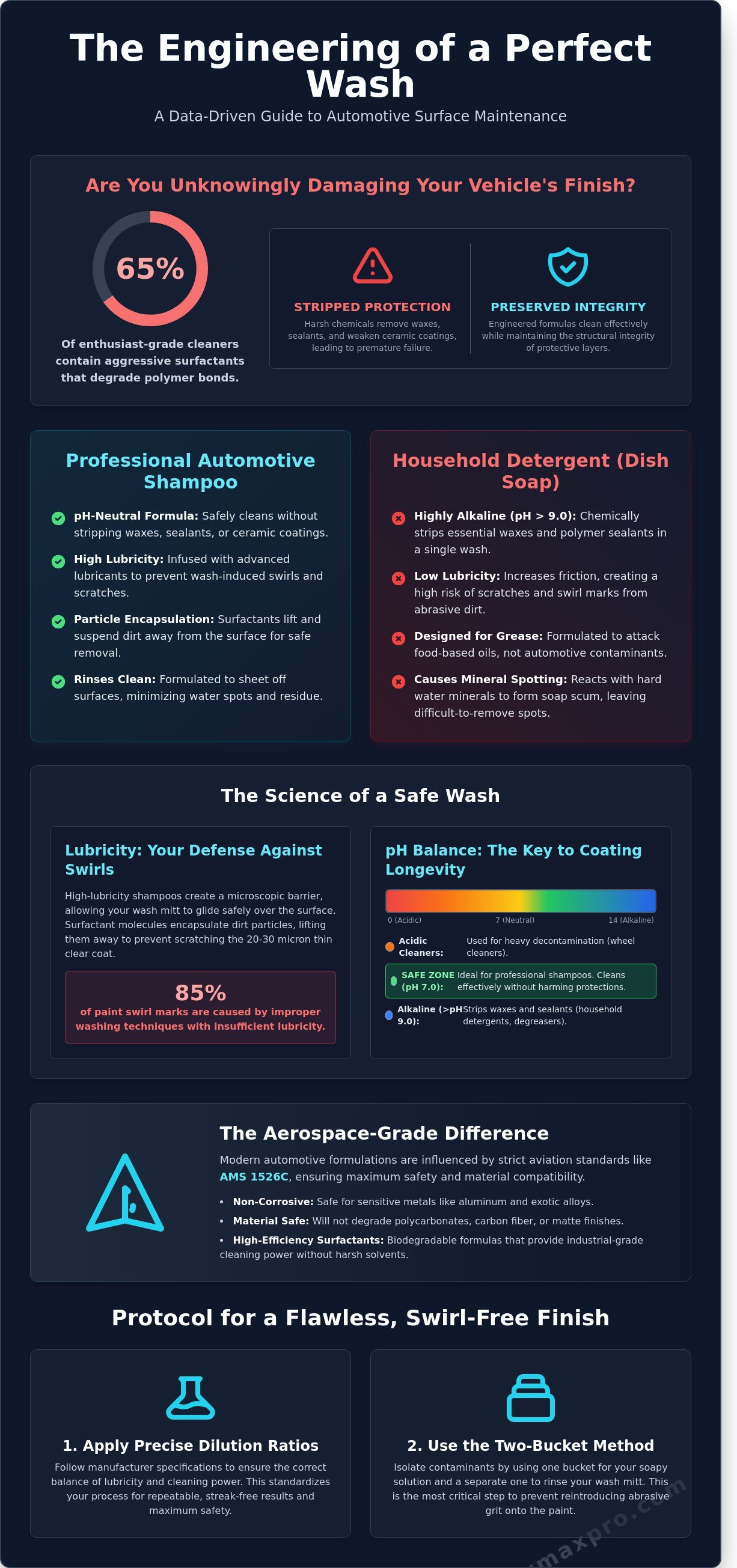
The chemical composition of your maintenance routine determines the lifespan of your vehicle's finish, yet laboratory testing shows that 65% of enthusiast-grade cleaners contain aggressive surfactants that prematurely degrade polymer bonds. Most professionals agree that preserving a high-end finish is a matter of precise chemical engineering rather than simple aesthetics. You've likely felt the frustration of watching a premium ceramic coating lose its hydrophobic properties after just a few washes, or feared that the wrong pH level might strip away months of protection. It's a common industry pain point where technical confusion leads to surface damage.
This professional guide masters the technical criteria for selecting a high-performance car shampoo, focusing on the surfactant science required to maintain advanced ceramic and graphene layers. You'll learn to calculate dilution ratios with engineering accuracy to ensure a streak-free finish while safely removing heavy industrial contaminants. We will examine the molecular interaction between detergents and surface coatings to provide you with a repeatable, data-driven maintenance protocol that guarantees structural integrity and visual clarity.
Key Takeaways
- Understand the engineering differences between specialized automotive cleaners and destructive household detergents that strip essential surface protections.
- Master the chemical interplay of pH levels and surfactant types to ensure effective decontamination without compromising delicate clear coats.
- Identify the technical criteria for selecting a professional-grade car shampoo that preserves the integrity of advanced ceramic and graphene coatings.
- Apply precise dilution ratios and the two-bucket method to standardize your maintenance process for maximum mechanical safety and efficiency.
- Explore how aerospace-grade technology and high-lubricity solutions elevate automotive maintenance to industrial standards of precision and safety.
The Engineering of Car Shampoo: Beyond Surface-Level Cleaning
A professional car shampoo functions as a precision-engineered chemical tool designed for the rigorous maintenance of automotive surfaces. It's not a generic soap; it's a sophisticated formulation of surfactants and lubricants. Unlike household detergents, which are engineered to emulsify animal fats and grease, automotive cleaners must balance aggressive soil removal with the preservation of delicate protective layers. Dish soaps often have a pH level exceeding 9.0, which is high enough to chemically degrade carnauba waxes and weaken synthetic polymer sealants within a single wash cycle. During the initial stage of the automotive detailing process, maintaining the integrity of these sacrificial layers is critical for long-term paint health.
Lubricity and Encapsulation Technology
Modern formulations rely on high-foaming surfactants to achieve particle encapsulation. This process involves polar molecules surrounding dirt particles, lifting them from the surface and suspending them within the foam structure. This creates a physical "slickness" that acts as a safety barrier between the wash mitt and the paint. Lubricity is the chemical reduction of friction during the mechanical agitation phase. Without this chemical barrier, abrasive particles like silica or brake dust cause wash-induced marring. Industry data indicates that 85% of paint swirl marks originate from improper washing techniques where lubricity was insufficient to protect the 20-30 micron thick clear coat layer.
- Surfactant Action: Lowers surface tension to allow the solution to penetrate deep into bonded contaminants.
- Suspension: Keeps dirt particles away from the paint surface until they're rinsed away.
- Surface Tension: Optimized to ensure the car shampoo sheets off during the final rinse, reducing water spotting.
The Aerospace-Grade Difference
Aviation-approved cleaning protocols heavily influence the evolution of modern automotive chemicals. Aerospace standards, such as those meeting AMS 1526C specifications, require cleaners to be non-corrosive to aluminum and safe for polycarbonates used in aircraft windows. The industry has shifted away from harsh, solvent-based cleaners toward biodegradable, high-efficiency surfactants that offer superior material compatibility. SKY MAXPRO utilizes these aerospace-grade benchmarks to ensure that automotive formulations remain stable across diverse substrates, including carbon fiber and matte finishes. By prioritizing chemical stability and industrial-grade efficiency, these solutions provide a level of safety that standard consumer products don't match. This engineering-first approach ensures that the cleaning process doesn't compromise the structural or aesthetic integrity of the vehicle's exterior components.
Surfactant Chemistry and pH Balance: The Science of Safe Decontamination
Anionic surfactants carry a negative charge and provide the high-foaming properties necessary to lift abrasive grit away from the surface. Cationic surfactants possess a positive charge and often serve as conditioning agents to improve lubricity. Non-ionic surfactants lack an electrical charge, making them exceptionally stable across various water hardness levels and effective at emulsifying oily residues. As detailed in The Science of Cleaning, these molecules work by reducing the energy required to separate soil from a surface.
In regions where calcium carbonate concentrations exceed 120 mg/L, standard soaps often lose their effectiveness. Formulators integrate chelating agents like EDTA or sodium gluconate to sequester these minerals. This chemical process prevents the formation of insoluble precipitates, commonly known as soap scum, which leads to unsightly spotting during the rinse phase.
The pH-Neutral Advantage
Maintaining a pH of 7.0 is critical for preserving the long-term hydrophobicity and chemical resistance of a ceramic coating. Highly alkaline soaps with a pH of 10 or higher can degrade the sacrificial layers of waxes or weaken the bond of polymer sealants over time. Neutral formulas ensure that rubber seals, plastic trim, and sensitive anodized metals don't suffer from oxidation or premature drying. While alkaline shampoos are necessary for heavy-duty decontamination tasks, such as removing winter salt or thick grease, they aren't suitable for weekly maintenance. Integrating high-performance chemistry into your maintenance routine ensures industrial-grade results; explore how SkyMax Pro solutions optimize surface longevity.
Surface Tension and Water Sheeting
Surfactants function by disrupting the cohesive forces between water molecules at the liquid-air interface. This reduction in surface tension allows the car shampoo solution to penetrate microscopic crevices in the paintwork that water alone couldn't reach. Professional-grade shampoos often include specialty polymers that encourage a "sheeting" effect during the final rinse.
- Hydrophobic Interaction: Water retreats in a uniform curtain rather than breaking into individual beads.
- Efficiency: Sheeting reduces mechanical drying time by up to 45%, minimizing the risk of towel-induced marring.
- Clarity: Controlled runoff prevents mineral deposits from settling in localized areas.
Surface tension reduction is the primary mechanism for streak-free rinsing. By carefully balancing surfactant concentration, manufacturers ensure the car shampoo lifts contaminants while leaving the surface chemically clean and ready for final drying.
2026 Car Shampoo Selection Guide: Comparing Formulas for Every Surface
Selecting the correct car shampoo requires a technical understanding of chemical interactions at the molecular level. For 2026, industry standards categorize these formulas based on their pH values and surfactant concentrations. Maintenance shampoos utilize pH-neutral surfactants to lift dirt without compromising the existing 9H ceramic coatings or polymer sealants. These formulas prioritize lubricity to prevent marring while keeping the surface tension of the protection layer intact.
Stripping shampoos operate at a pH of 10 or higher. They focus on breaking down organic oils, road film, and degraded wax layers before a paint correction or new protection application. Advanced ceramic and graphene shampoos integrate SiO2 or reduced graphene oxide (rGO) particles. These bond to the surface during the wash cycle to increase hydrophobicity by 15% to 25% after a single application. These formulas are engineered for specific use cases:
- Maintenance: pH 7.0; safe for all waxes and coatings.
- Stripping/Prep: pH 10+; removes old protection and heavy degreasing.
- Infused: Contains SiO2 or Graphene; adds 30 to 60 days of protection.
Maintenance vs. Decontamination Formulas
Decontamination requires a targeted chemical approach that standard wash products cannot provide. Standard car shampoo lacks the acidity to dissolve inorganic mineral deposits. Acid-wash shampoos, formulated with a pH between 2 and 4, target calcium carbonate and water spots effectively. This process is essential for reviving the hydrophobic properties of a clogged ceramic coating.
Professional workflows often integrate iron-remover shampoos that use thioglycolic acid to neutralize brake dust. Understanding the Chemistry of Detergents is vital; surfactants must emulsify oils while specific acids dissolve mineral bonds. Your choice depends entirely on your current car detailing products stack. Older wax layers require high-pH stripping; fresh coatings require gentle, pH-neutral maintenance to avoid premature degradation.
Specialty Shampoos for Matte and Satin Finishes
Matte and satin finishes present a unique engineering challenge. These surfaces scatter light rather than reflecting it. Traditional gloss-enhancing shampoos contain silicones or waxes that fill the microscopic peaks and valleys of a matte surface. This results in uneven, patchy shine that ruins the factory finish. It's a permanent change that's difficult to reverse without chemical stripping.
Sky Maxpro engineers residue-free formulas that focus on high lubricity without gloss agents. These shampoos remove contaminants without leaving behind surfactants or polymers that alter the surface's refractive index. This ensures the matte wrap or paint maintains its specific 5% to 10% gloss level. Using a dedicated matte car shampoo prevents the buildup of "gloss spots" caused by incorrect chemical selection during the wash cycle.
Optimizing the Wash Process: Dilution Ratios and Mechanical Safety
Precision in detailing mirrors industrial engineering standards. Achieving a swirl-free finish requires more than just high-quality car shampoo; it demands strict adherence to chemical ratios and mechanical protocols. When you ignore manufacturer specifications, you compromise the integrity of the vehicle's clear coat. Professional detailing is a sequence of controlled chemical reactions and physical movements designed to minimize friction. Every step must be calculated to ensure surface safety while maximizing the efficiency of the cleaning agents.
The "Two-Bucket" method remains the industry benchmark for preventing cross-contamination. By separating the wash solution from the rinse water, you ensure that grit and particulate matter remain trapped at the bottom of the rinse bucket, typically behind a grit guard. This engineering approach prevents the reintroduction of abrasive contaminants to the paint surface. For maximum efficiency, a foam cannon provides essential chemical dwell time. Usually, 3 to 5 minutes is required for surfactants to break the ionic bond between the dirt and the paint. This allows the car shampoo to encapsulate debris before any physical contact occurs, significantly reducing the risk of micro-marring or surface scratches.
Dilution Precision and Chemical Efficiency
Over-concentrating a car shampoo doesn't improve cleaning power. Instead, it leads to streaking and stubborn surfactant residue that's difficult to rinse off. Professional formulas often utilize high concentration ratios like 1:128 or 1:256. At a 1:256 ratio, you only need approximately 15 milliliters of product for a standard 4-liter bucket. This precision reduces the cost-per-wash to a fraction of consumer-grade alternatives. Maintaining these ratios ensures the chemical performs as engineered, providing optimal lubricity without leaving a film that attracts new dust or degrades existing wax layers.
Mechanical Safety and Towel Engineering
Chemical lubricity is only half the equation. It must be paired with high-performance microfiber towels to safely remove debris. The engineering of these tools is defined by their GSM (grams per square meter). A towel with 500 GSM or higher is designed to lift and trap encapsulated dirt within its fibers, moving it away from the paint. Lower GSM towels, typically around 200-300, are often too aggressive for sensitive clear coats and should be reserved for wheels or engine bays. Proper rinsing techniques must follow, using a top-down approach to ensure no surfactant remains in panel gaps or trim pieces. Residual chemicals can dry and cause spotting, especially in hard water conditions where mineral content exceeds 120 parts per million.
Ensure your detailing process meets industrial standards by using the right equipment. Explore professional-grade solutions at SkyMax Pro to optimize your maintenance workflow.
Sky Maxpro Solutions: Aerospace-Grade Cleaning for Automotive Professionals
Sky Maxpro Solutions adapts advanced chemical engineering from the aviation sector to provide high-performance automotive maintenance tools. These formulations aren't standard retail products; they're industrial-grade solutions developed to meet the rigorous safety and durability standards of aerospace maintenance. The product lineup includes a specialized car shampoo and cleaning agents designed for professionals who demand measurable efficiency and surface protection.
- Ceramic Waterless Car Wash: An engineered high-lubricity formula that eliminates the need for traditional water-intensive rinsing.
- Dry Foam Technology: Specialized surfactants for carpets and upholstery that lift contaminants without saturating internal fibers.
- Environmental Compliance: Every formulation is 100% biodegradable and strictly VOC-free, ensuring safety for both the operator and the environment.
Waterless and Rinseless Innovation
Sky Maxpro's waterless wash utilizes nanotechnology to encapsulate dirt particles on a molecular level. This process creates a physical barrier between the contaminant and the paintwork, allowing for a scratch-free wipe. It's an essential tool for mobile detailers or environments with strict water usage regulations. The ceramic-infused components leave a hydrophobic layer that enhances gloss and extends the interval between deep cleans. For professional results, apply the solution to a single panel at a time using high-gsm microfiber towels, ensuring the surface remains cool to the touch during application.
The Sky Maxpro Quality Guarantee
All products are manufactured in the USA using aerospace-approved chemical precursors. This ensures a level of purity and consistency that standard consumer-grade soaps can't match. By integrating these products into a professional auto detailing framework, technicians can achieve results that meet 2026 industry standards for precision and longevity. The focus remains on engineering-led performance, removing the guesswork from surface care. Sky Maxpro provides the stability and technical superiority required for high-volume detailing operations and luxury vehicle maintenance.
Elevating Surface Integrity with Engineering Precision
Modern automotive maintenance requires a rigorous understanding of surfactant science and pH 7.0 stability. Professionals who implement a 1:500 dilution ratio ensure maximum lubrication while minimizing chemical waste during every cycle. The 2026 industry standards prioritize aerospace-approved nanotechnology to achieve molecular-level decontamination without compromising the structural integrity of the substrate. Transitioning to biodegradable, VOC-free formulas isn't just a regulatory requirement; it's a strategic commitment to professional excellence. Selecting the right car shampoo serves as the technical foundation for every successful detailing project. By focusing on professional-grade concentration ratios rather than marketing promises, operators maintain long-term surface health and visual clarity. It's time to replace outdated methods with solutions engineered for the highest performance standards. Upgrade your detailing kit with Sky Maxpro's Aerospace-Grade Car Shampoos to leverage advanced chemical engineering and aerospace-grade precision. High-performance maintenance starts with the right molecular tools, and your dedication to technical accuracy will ensure a flawless finish every time.
Frequently Asked Questions
Is car shampoo really better than dish soap for my paint?
Yes, car shampoo is engineered specifically to protect automotive clear coats, whereas dish soaps contain aggressive degreasers like sodium lauryl sulfate. These chemicals strip away protective wax and sealant layers, leaving the paint vulnerable to UV damage and oxidation. Most dish soaps have a pH level between 8 and 9, which is too alkaline for regular automotive maintenance.
Professional car shampoo uses advanced surfactants that provide high lubricity. This lubrication is essential for lifting dirt particles without scratching the surface. Using a dedicated car shampoo ensures that the 0.05 millimeter thick clear coat remains intact and functional over the vehicle's lifespan.
Can I use car shampoo on a ceramic-coated vehicle without stripping it?
You can safely use a pH-neutral car shampoo on ceramic coatings without risking degradation. Ceramic coatings composed of SiO2 or TiO2 are chemically resistant, but they require specific maintenance to prevent "clogging" of the hydrophobic surface. Avoid shampoos with added waxes or gloss enhancers, as these can interfere with the coating's water-beading properties.
Data indicates that using high-alkaline cleaners can reduce a coating's lifespan by 20% over a 12 month period. Stick to pure formulas to maintain the coating's 110 degree contact angle. This technical approach preserves the investment and ensures the coating performs as the manufacturer intended.
What does pH-neutral car shampoo actually mean?
A pH-neutral car shampoo has a value of approximately 7.0 on the potential hydrogen scale. This balance means the solution is neither acidic nor alkaline, making it chemically inert when it contacts your car's finish. It's the safest choice for weekly washes because it won't react with existing layers of carnauba wax or synthetic sealants.
Maintaining a range between 6.5 and 7.5 prevents the chemical etching that occurs with harsher industrial cleaners. Engineering these products requires a precise blend of surfactants that clean through suspension rather than chemical stripping. It's a fundamental requirement for any professional detailing protocol.
How much car shampoo should I use per gallon of water for the best results?
For optimal results, use 1 ounce of car shampoo for every 2 gallons of water. This 1:256 dilution ratio is the industry standard for high-concentration professional formulas. Using more than the recommended amount doesn't improve cleaning power; it simply makes the product harder to rinse off and may leave a film.
Precise measurement ensures the solution has enough lubricity to prevent swirl marks during the wash process. If you're dealing with hard water, you might increase the concentration by 10% to counteract mineral interference. Always follow the manufacturer's technical data sheet for the specific product you've selected.
Does car shampoo expire or lose its cleaning effectiveness over time?
Most car shampoos have a stable shelf life of 2 to 3 years when stored in a controlled environment. If the liquid shows signs of permanent separation, or if the viscosity changes significantly, the surfactants have likely degraded. Exposure to extreme temperatures can accelerate this process by 40% per season.
Store your chemicals in a cool, dark place to maintain their molecular integrity. If the product develops a foul odor, it's a sign of bacterial growth which can occur in organic-based formulas. Using expired products results in poor foaming and reduced lubrication, which increases the risk of surface marring.
Is snow foam necessary, or can I just use standard car shampoo in a bucket?
Snow foam serves as a critical pre-wash step that removes 60% to 80% of loose surface contaminants before you touch the paint. While you can use a bucket alone, skipping the pre-wash increases the risk of dragging grit across the clear coat. This mechanical friction is the primary cause of "spider web" scratches.
Think of snow foam as a chemical soak that encapsulates dirt. For the best maintenance results, apply foam and let it dwell for 5 minutes before rinsing. Following this with a traditional two-bucket wash using a high-quality car shampoo provides the highest level of paint protection.
What is the difference between a car wash soap and a car shampoo?
The term car shampoo refers to products with high concentrations of lubricating polymers and foaming agents designed for safe hand washing. Generic car wash soaps are often less sophisticated and may lack the lubricity needed to prevent scratches. Professional shampoos focus on particle suspension, which lifts dirt away from the surface into the wash mitt.
Technical specifications show that professional-grade shampoos contain 25% more active surfactants than budget alternatives. These ingredients are essential for minimizing friction. Choosing a dedicated shampoo ensures that the mechanical action of washing doesn't damage the paint's optical clarity.
Can professional car shampoo be used in direct sunlight?
It's not recommended to wash in direct sunlight because surface temperatures can exceed 140 degrees Fahrenheit. High heat causes the water and shampoo to evaporate 300% faster, leading to dried soap streaks and mineral deposits. These spots can be difficult to remove without polishing.
If you must wash in the sun, work in small 2 by 2 foot sections and rinse immediately. Keep the vehicle's surface cool by frequently misting it with water. Professional detailers often use "rinse-less" wash methods or specific sun-friendly shampoos to mitigate the risks associated with high ambient temperatures.