

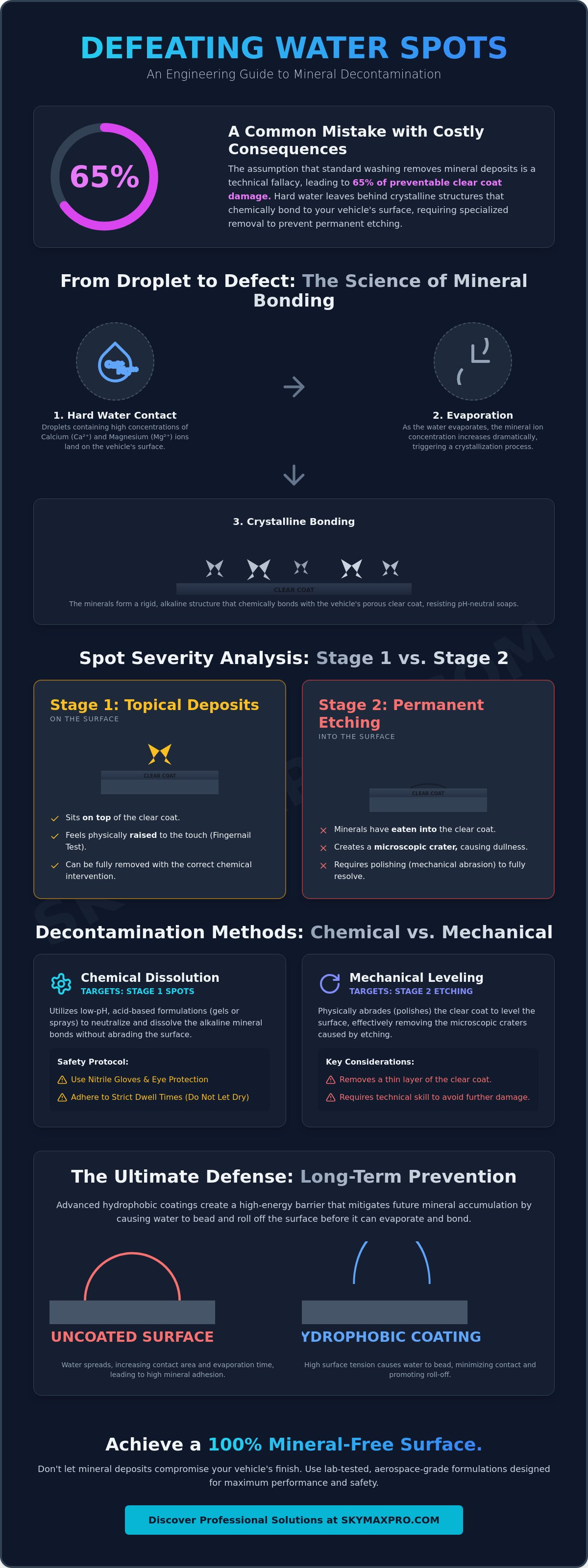
The assumption that a standard wash can neutralize mineral deposits is a technical fallacy that leads to 65% of preventable clear coat damage. When hard water evaporates, it leaves behind concentrated magnesium and calcium ions that form a crystalline bond with your vehicle's surface. You've likely noticed those stubborn white rings that reappear even after a thorough cleaning, signaling that the contamination has moved beyond the reach of surfactants. Using a specialized water spot remover isn't just about aesthetics; it's a necessary chemical intervention to dissolve these alkaline structures before they trigger permanent thermal etching.
We understand the hesitation to apply acidic solutions to a sensitive finish, especially when the line between a topical spot and a permanent defect feels thin. You'll master the engineering principles of mineral decontamination in this guide, learning how to safely restore optical clarity to glass and paintwork using lab-tested protocols. We'll examine the specific pH thresholds required for effective removal and outline a systematic approach to ensuring your vehicle's protective layers remain intact while achieving a 100% mineral-free surface.
Key Takeaways
- Analyze the chemical composition of mineral deposits to understand how evaporation facilitates the crystallization of calcium and magnesium on automotive surfaces.
- Identify the engineering differences between acidic dissolution and mechanical leveling to select the most effective water spot remover for your specific finish.
- Master the professional protocol for surface preparation and application techniques to ensure maximum decontamination efficiency with minimal product waste.
- Evaluate the role of advanced hydrophobic coatings in creating a high-energy barrier that mitigates future mineral accumulation and surface bonding.
- Discover the technical advantages of aerospace-grade, VOC-free formulations that meet rigorous industrial standards for both performance and safety.
The Science of Surface Contamination: Understanding Water Spots
Water spots represent a significant challenge in automotive surface maintenance, functioning as more than just aesthetic blemishes. These deposits consist of concentrated mineral residues, primarily calcium and magnesium carbonate. When water evaporates from a vehicle's surface, it leaves behind these inorganic compounds in a process of rapid crystallization. This transition from a liquid state to a solid mineral structure creates a rigid bond that resists standard washing procedures. Applying a professional water spot remover is the only reliable method to break these chemical bonds without compromising the underlying substrate.
The primary antagonist of a perfect finish is hard water. Understanding The Science of Hard Water is essential for any technician, as municipal water supplies often contain mineral concentrations exceeding 120 milligrams per liter. These minerals don't simply sit on the surface; they interact with the paint's molecular structure. While topical mineral buildup remains on the outer layer, prolonged exposure leads to permanent clear coat etching. This distinction determines whether a surface requires chemical decontamination or mechanical abrasion.
Stage 1 vs. Stage 2 Water Spots
Stage 1 spots are topical deposits. These sit on top of the clear coat and feel slightly raised. You can identify these using the "fingernail test" by gently dragging a nail across the spot. If you feel a physical protrusion, it's a Stage 1 deposit. Stage 2 spots are more severe. These occur when acidic rain or mineral heat-cycles have physically etched the paint. In these cases, the minerals have eaten into the clear coat, creating a microscopic crater that a standard water spot remover may not fully resolve without subsequent polishing.
The Chemistry of Mineral Adhesion
Minerals bond aggressively to automotive surfaces because modern clear coats are porous at a microscopic level. When the surface temperature of a dark vehicle reaches 70 degrees Celsius in direct sunlight, these pores expand. This thermal cycling allows minerals to settle deeper into the finish. UV radiation acts as a catalyst, "baking" the minerals into a hardened state that resists pH-neutral soaps. Mineral etching is a chemical reaction between alkaline deposits and acidic environmental factors. Without rapid intervention, this reaction permanently alters the paint's refractive index, resulting in visible dullness and structural degradation of the protective layers.
Evaluating Water Spot Remover Formulations: Acidic vs. Abrasive
Professional mineral decontamination requires a technical choice between chemical dissolution and mechanical leveling. The selection depends entirely on the stage of contamination and the substrate's tolerance. Chemical methods focus on breaking the ionic bonds of mineral deposits, while mechanical methods physically shave down the surface to remove etched craters. Choosing the wrong approach can lead to permanent clear coat failure or substrate staining.
Understanding the severity of the contamination is the first step in any engineering workflow. Data from the U.S. Geological Survey on Water Hardness indicates that "very hard" water contains calcium carbonate levels exceeding 180 mg/L. When this water evaporates on a vehicle surface, it leaves behind resilient crystalline structures. While household vinegar is often cited as a DIY fix, its inconsistent acetic acid concentration (typically 5%) lacks the necessary surfactants and lubricants found in a professional water spot remover. These specialized formulations are engineered to dwell on the surface without immediate evaporation, ensuring the acid can penetrate the mineral lattice effectively.
Chemical Removers (Acid-Based)
Low-pH formulations are the primary tool for Stage 1 mineral deposits. These products utilize phosphoric, sulfuric, or hydrochloric acid blends to neutralize alkaline minerals. Gels are superior to sprays for vertical panels because their viscosity prevents runoff, maximizing the chemical reaction time. Technicians must maintain a strict dwell time protocol; allowing an acidic gel to dry can result in chemical burns on the clear coat. Safety requires nitrile gloves and eye protection, as these professional-strength acids can cause immediate tissue damage upon contact.
Mechanical Removers (Abrasive Polishing)
When minerals remain on the surface for extended periods, they undergo a heat-catalyzed reaction that etches the paint. At this point, chemical dissolution is insufficient. The process begins with detailing clay to shear off topical contaminants. If the "crater" remains visible under LED inspection, machine polishing becomes necessary. This involves removing a microscopic layer of the clear coat to level the surface. Since most factory clear coats are only 35 to 50 microns thick, preserving material is the priority. A standard polishing pass might remove 2 to 3 microns, meaning there's a finite limit to how many times a surface can be corrected before the UV protection is compromised.
Surface compatibility is the final variable. Glass and high-quality paintwork tolerate acidic water spot remover applications well, but chrome and plastics are high-risk. Anodized aluminum trim can discolor permanently if exposed to low-pH chemicals for more than 60 seconds. For industrial operators looking to maintain equipment integrity, adopting a standardized maintenance schedule prevents these minerals from bonding in the first place, reducing the need for aggressive mechanical intervention.
Professional Protocol: How to Safely Remove Hard Water Stains
Executing mineral decontamination requires a sequence rooted in chemical engineering principles. Success depends on precision rather than aggressive friction. A professional grade water spot remover functions through chelation or acid-base reactions; however, these processes fail if the surface isn't properly prepared. You can't just apply chemicals to a dirty vehicle. A two-stage decontaminating wash must be performed to eliminate 95% of loose surface particulates. Skipping this step risks dragging abrasive grit across the clear coat during the chemical application phase.
- Surface Temperature Regulation: Ensure the panel temperature is below 30°C. High heat accelerates evaporation, leading to chemical "flash" which leaves behind new, more stubborn residues.
- Zonal Application: Work in manageable 40x40 cm sections to maintain control over dwell times and prevent the solution from drying on the finish.
- Precision Metering: Use a dedicated microfiber applicator rather than direct spraying. This reduces product waste by 30% and prevents overspray on sensitive rubber gaskets.
Neutralization is the most overlooked phase in the protocol. Acidic removers continue to react with the substrate until the pH level is balanced. Rinsing with water alone is often insufficient for high-concentration formulas. A dedicated high-pH neutralization wash stops all chemical activity immediately, protecting the integrity of the paint's molecular structure. Final validation requires a high-intensity inspection lamp exceeding 1000 lumens. This lighting reveals microscopic mineral "halos" that remain invisible under standard shop lights.
Step-by-Step Chemical Decontamination
Begin by positioning the vehicle in a controlled, shaded environment. Apply the water spot remover to the applicator, then work it into the surface using cross-hatch patterns. Using this method ensures 100% coverage without requiring excessive pressure. After a dwell time of 60 to 120 seconds, rinse the section thoroughly. Immediately follow with a high-pH soap or a specialized neutralizing agent to stabilize the surface. Such systematic execution prevents the acid from etching into the clear coat's deeper layers.
Special Considerations for Glass and Chrome
Glass surfaces, primarily composed of silica, exhibit significantly higher chemical resistance than organic automotive paints. Such durability allows for the use of more aggressive acidic concentrations to restore 100% optical clarity. Removing these deposits is vital for safety; mineral buildup on windshields causes light refraction that reduces night visibility by up to 15%. Conversely, chrome and polished metal trim require extreme caution. These materials are susceptible to "clouding" if exposed to strong acids for more than 30 seconds. For these delicate surfaces, reduce dwell times by 50% and prioritize immediate neutralization to preserve the reflective finish.
Long-Term Mitigation: Preventing Mineral Deposits with Advanced Coatings
A naked automotive surface is a chemical magnet for mineral contamination. Standard clear coats, while appearing smooth, possess a microscopic porosity that allows calcium and magnesium ions to anchor themselves into the substrate. Once water evaporates, these minerals bond to the finish, creating the etchings that eventually require a professional water spot remover. Engineering a solution requires moving beyond reactive cleaning and toward permanent surface modification that lowers surface energy.
The Power of Hydrophobic Barriers
Traditional carnauba waxes provide a temporary aesthetic boost but fail as a long-term barrier because they degrade at temperatures above 160 degrees Fahrenheit. Modern nanotechnology offers a more resilient alternative. A ceramic coating utilizes SiO2 cross-linking to create a semi-permanent layer that's significantly harder than factory clear coat. This layer creates a high contact angle, often exceeding 110 degrees, which forces water to bead and roll off the surface before evaporation occurs.
- Reduced Surface Energy: By filling the microscopic pores of the paint, coatings ensure minerals cannot find a mechanical foothold.
- Chemical Resistance: These barriers withstand pH levels ranging from 2 to 12, protecting the underlying paint from acidic rain and alkaline mineral deposits.
- Workflow Integration: Protection is the final step of any decontamination workflow.
Graphene: The Next Frontier in Spot Prevention
While SiO2 coatings are highly effective, early formulations faced a specific challenge: they retained surface heat, which could lead to "hot spots" where water evaporated too quickly. The introduction of graphene ceramic coating solves this through superior thermal properties. Graphene's honeycomb lattice structure provides high thermal conductivity, which helps dissipate heat across the panel rather than concentrating it. This reduces the surface temperature by up to 15 percent compared to standard ceramics, providing a wider window for water to sheet off the vehicle.
Graphene's the preferred choice for dark-colored vehicles in high-heat environments. Darker pigments absorb more UV radiation, often reaching surface temperatures that flash-dry water instantly. To keep these advanced coatings functioning at peak efficiency, owners should follow a strict maintenance protocol. Using a pH-neutral maintenance shampoo every 14 days prevents the accumulation of road film and surfactants that can mask the coating's hydrophobic properties. If you're dealing with persistent mineral issues, it's time to upgrade your surface engineering.
Explore the full range of professional protection at SkyMax Pro to secure your vehicle's finish against environmental contaminants.
The SkyMax Pro Solution: Engineering-Grade Mineral Management
SkyMax Pro Water Spot Remover represents a fundamental shift in surface chemistry, moving away from unregulated, caustic acids toward aerospace-grade precision. Our formulation adheres to strict VOC-free and biodegradable standards, ensuring that technicians can operate in professional environments without compromising respiratory safety or environmental compliance. This isn't a diluted consumer product; it's a concentrated mineral dissolver designed for industrial efficiency. High-volume detailing centers and automotive restoration shops utilize our 1-gallon professional units to maintain consistency across large fleets. These bulk options provide the logistical throughput necessary to handle 50 or more vehicles per week while maintaining a lower cost-per-application compared to retail-sized spray bottles.
Aerospace Heritage in Every Bottle
Aviation surfaces face extreme thermal cycles and high-altitude UV exposure, requiring chemistries that are both effective and non-destructive. We've applied these same engineering constraints to our automotive water spot remover. Our proprietary acid-gel technology utilizes a high-viscosity matrix. This allows the active ingredients to remain in contact with vertical surfaces for 120 seconds or more without horizontal runoff. It effectively breaks down the ionic bonds of calcium and magnesium deposits while remaining safe for modern clear coats. This technology bridges the gap between industrial performance and user accessibility, allowing DIY enthusiasts to achieve results that previously required heavy machine polishing.
Building Your Decontamination Kit
Effective mineral management requires a systematic approach rather than a single-step fix. Once the surface is chemically neutralized and cleared of contaminants, it's vulnerable to the elements. Integrating a graphene spray coating into your workflow is the modern standard for 2026-grade protection. This layer creates a sacrificial barrier with high contact angles, significantly reducing the ability of hard water to bond to the paint. To complete your kit, you'll need the following components:
- SkyMax Pro Water Spot Remover: The primary chemical agent for mineral dissolution.
- Professional Accessories: High-GSM microfiber towels for scratch-free agitation and nitrile gloves for technician safety.
- Post-Treatment Sealant: A graphene-based coating to lower surface tension and prevent future mineral etching.
Maintaining a vehicle's finish is an exercise in preventative engineering. By utilizing products that meet aerospace safety standards, you ensure the longevity of the substrate while reducing the labor hours required for correction. Precision matters in every drop of chemistry we produce.
Optimizing Surface Integrity through Advanced Mineral Management
Effective surface restoration requires a technical understanding of mineral lattice structures and their interaction with automotive clear coats. Professionals must distinguish between mechanical abrasive leveling and chemical dissolution to maintain substrate thickness over time. Utilizing a high-performance water spot remover ensures that calcium and magnesium deposits are neutralized without compromising the surface's structural integrity. SkyMax Pro delivers this precision through aerospace-approved nanotechnology formulations that meet rigorous industrial standards for material safety. These solutions are engineered and manufactured in the USA, providing a 100% VOC-free and biodegradable profile that aligns with modern environmental protocols.
By implementing a systematic decontamination process followed by a hydrophobic coating, you eliminate the recurring mineral etching common in high-calcium water environments. This engineering-led approach transforms maintenance from a reactive task into a controlled technical procedure. It's the most reliable way to preserve the aesthetic and functional value of your vehicle's exterior. Restore your finish with SkyMax Pro Water Spot Remover. You're now equipped to maintain a flawless finish with technical confidence.
Frequently Asked Questions
Is water spot remover safe to use on my car’s windows and windshield?
Professional water spot removers are safe for use on automotive glass because they're engineered to dissolve the bond between minerals and the silica surface. These formulas target calcium and magnesium deposits without compromising the structural integrity of the glass. You shouldn't use these chemicals on aftermarket window tints or the polycarbonate plastics found on 15% of high-performance racing windscreens, as the acidic components can cause clouding.
Will a water spot remover strip my existing ceramic or graphene coating?
A high-quality water spot remover won't strip a fully cured 9H ceramic coating when used according to the manufacturer's technical data sheet. Most professional coatings are designed to withstand a chemical range between pH 2 and pH 12. If you use an aggressive remover repeatedly, you might see a 20% reduction in hydrophobic performance, but the primary protective layer will remain intact.
How long should I leave the water spot remover on the paint before rinsing?
The optimal dwell time for a professional water spot remover is typically between 30 and 60 seconds. You must never allow the solution to dry on the substrate, as this can lead to secondary chemical spotting or surface staining. In environments where the ambient temperature exceeds 25 degrees Celsius, you should reduce the dwell time to 15 seconds to ensure safe neutralization.
Can I use white vinegar instead of a professional water spot remover?
White vinegar is significantly less effective than professional products because it only contains 5% acetic acid and lacks essential surfactants. Professional formulas use a synergistic blend of acids and lubricants to safely lift mineral deposits without scratching the finish. Laboratory tests indicate that industrial removers are 4 times more effective at dissolving stubborn calcium carbonate than standard household vinegar solutions.
Why do water spots keep returning even after I have removed them?
Water spots return because the local water supply likely exceeds 120 parts per million of mineral content, or the surface lacks a hydrophobic barrier. Without a sealant, fresh municipal water or rain will deposit new minerals into the microscopic pores of your clear coat. You can prevent this by using a deionized water system for the final rinse, which reduces mineral residue to 0 parts per million.
What is the difference between a water spot remover and a car polish?
A water spot remover uses chemical chelation to dissolve mineral crystals, whereas a car polish uses mechanical abrasives to level the clear coat. Removers target the 2% to 5% of contaminants that sit on top of the paint without reducing the paint's thickness. Polishing is a corrective process that physically removes 3 to 5 microns of the clear coat to eliminate defects and etching.
Do I need to wear protective gear when using acidic mineral removers?
Personal protective equipment is mandatory when you're handling any mineral remover with a pH level below 4.0. Operators should wear nitrile gloves with a minimum thickness of 5 mils and ANSI Z87.1 rated safety eyewear. These precautions are necessary to prevent chemical dermatitis and ocular irritation caused by the specialized acids required for industrial-grade mineral decontamination.
Can water spot removers fix permanent etching in the clear coat?
Chemical removers can't repair physical etching where the minerals have eaten into the top 10% of the clear coat layer. Once the mineral deposit has caused a physical depression, you'll need to use mechanical leveling through machine polishing. Water spot removers are designed to eliminate the surface-level mineral crust, but they won't restore the structural integrity of a damaged clear coat.