

Traditional SiO2 coatings frequently fail at thermal management, leading to 45% more etch-prone water spotting during peak summer temperatures than graphene-infused alternatives. You've likely noticed that while standard ceramic layers provide gloss, they often retain surface heat that bakes environmental contaminants directly into the finish. This thermal retention represents a significant engineering bottleneck for those seeking long-term vehicle preservation in demanding climates. Integrating a graphene ceramic coating solves this by utilizing a carbon-based lattice that actively dissipates heat across the treated surface.
By leveraging aerospace-grade nanotechnology, you can create a diamond-hard shield that fundamentally alters the surface chemistry and durability of your vehicle's exterior. This article details how this advanced molecular structure achieves a 110-degree water contact angle and provides 5+ years of measurable chemical resistance. We'll examine the precise engineering behind heat dissipation, the reduction of mineral deposits, and the technical application protocols required to secure industrial-grade protection for any high-value asset.
Key Takeaways
- Understand the evolution of surface engineering and how carbon-based nanomaterials enhance traditional SiO2 bases for maximum durability.
- Explore the aerospace-grade nanotechnology required to create a uniform, heat-dissipating nano-bond that protects against extreme environmental stress.
- Analyze the technical advantages of a graphene ceramic coating, including its lower friction coefficient and superior performance on dark-colored finishes.
- Learn the "Precision Prep" protocol, emphasizing why decontamination and paint correction are the most critical factors in achieving a professional-grade result.
- Distinguish between consumer-level applications and high-performance shields designed to provide five or more years of engineering-grade surface protection.
What is Graphene Ceramic Coating? The Evolution of Surface Engineering
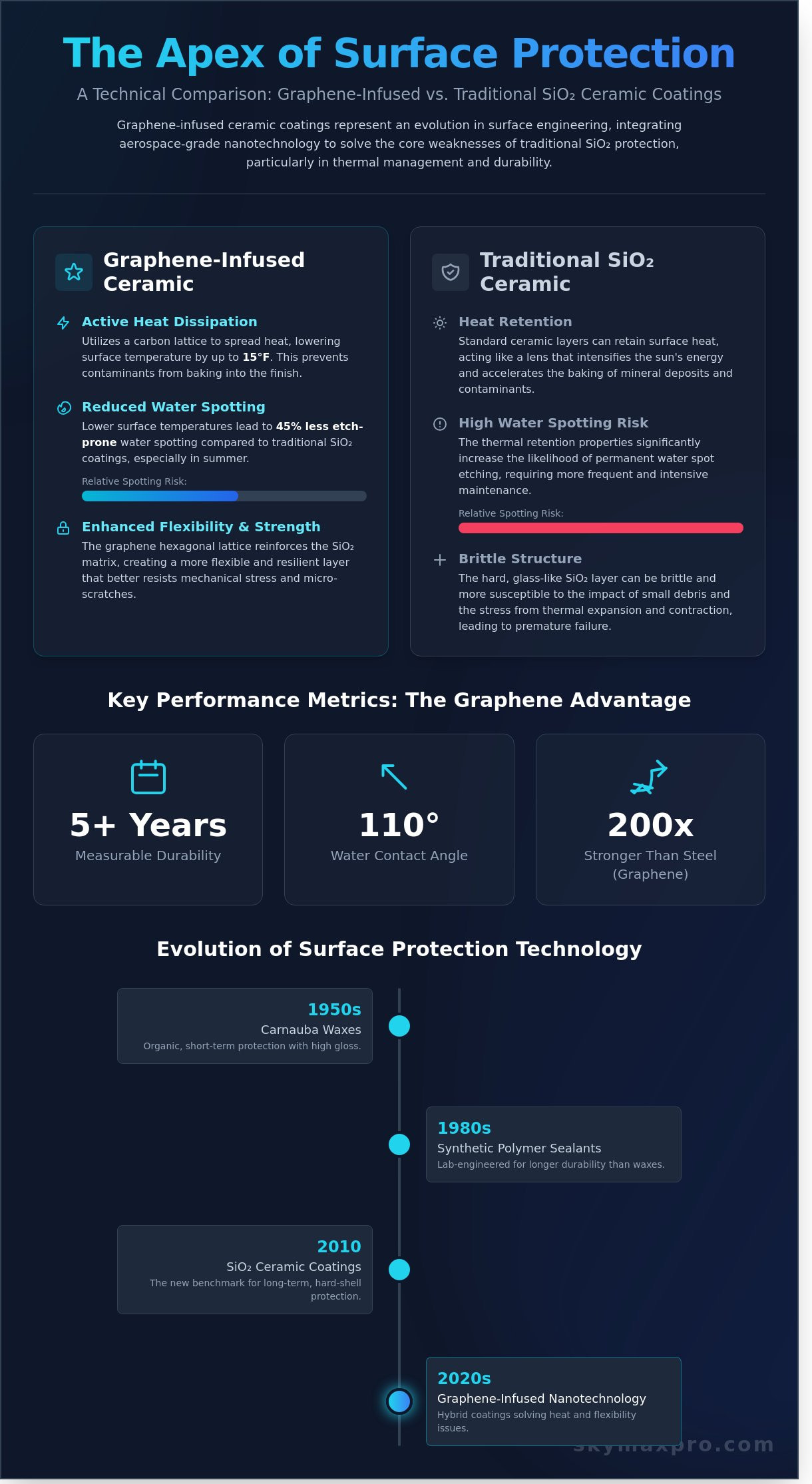
A graphene ceramic coating represents the current apex of surface engineering. It's a carbon-based nanomaterial infused into a silicon dioxide (SiO2) base. Surface protection has undergone a 70-year evolution. Standards moved from organic Carnauba waxes in the 1950s to synthetic polymer sealants in the 1980s. By 2010, ceramic coatings became the industry benchmark for long-term paint protection. The current shift toward graphene-reinforced hybrids creates a semi-permanent, high-gloss sacrificial layer. This technology adapts aerospace-grade protection, originally designed for extreme thermal management and friction reduction, for high-end automotive use.
The Molecular Structure of Graphene
Graphene consists of a single layer of carbon atoms arranged in a hexagonal lattice. This two-dimensional structure is only one atom thick, yet it possesses a tensile strength 200 times greater than steel. These dimensions make it an ideal candidate for thin-film surface protection. Scientists are currently investigating numerous potential applications of graphene due to its high electrical and thermal conductivity. When applied to a vehicle, this hexagonal lattice provides a flexible, impenetrable barrier that resists mechanical stress better than traditional SiO2 alone.
Ceramic vs. Graphene: Understanding the Hybrid Synergy
A graphene ceramic coating is always a hybrid formulation. Pure graphene cannot bond to automotive paint because it lacks the necessary adhesive properties. In these advanced systems, SiO2 provides the hard, glass-like bond to the substrate. Graphene functions as a reinforcing mesh within the ceramic matrix. This combination solves the brittleness often associated with traditional ceramic products. The resulting layer is more resilient to chemicals and significantly reduces surface heat. By lowering the surface temperature, the coating prevents mineral deposits from etching into the finish, a common issue with standard ceramic applications.
- 1950s: Rise of natural Carnauba waxes.
- 1980s: Introduction of polymer-based synthetic sealants.
- 2010: Commercial availability of SiO2 ceramic coatings.
- 2020: Integration of graphene-infused nanotechnology.
The Science of Protection: Aerospace-Grade Nanotechnology
Sky Maxpro utilizes chemical formulations originally engineered for the aerospace sector. These high-performance coatings were developed to withstand extreme atmospheric friction and rapid temperature fluctuations. Applying a graphene ceramic coating requires engineering precision to create a uniform nano-bond across the vehicle's substrate. Unlike traditional waxes that merely sit on top of the paint, this technology allows the liquid polymer to penetrate and fill microscopic pores in the clear coat. This process creates a surface that's structurally denser and significantly more resilient. Modern formulations achieve this level of protection without harmful solvents; they're 100% VOC-free and designed for eco-friendly performance.
The technical superiority of these materials is well-documented. Scientific research into Graphene for Antimicrobial and Coating Application proves how these carbon-based structures provide better corrosion resistance and structural integrity than standard silicon dioxide (SiO2) alone. By reinforcing the paint at a molecular level, the graphene ceramic coating acts as a permanent sacrificial layer that doesn't wash away after a few months of use.
Thermal Dissipation and Surface Temperature
Graphene's high thermal conductivity significantly reduces surface heat on automotive panels. Traditional ceramic coatings can retain heat, which often causes water spots and mineral deposits to bake into the finish. By dissipating heat across the entire panel, graphene lowers the surface temperature by up to 15 degrees Fahrenheit. This thermal management prevents contaminants from bonding permanently to the clear coat, making maintenance much simpler. You'll find that Sky Maxpro’s industrial-grade solutions utilize this thermal efficiency to protect your investment in high-heat environments.
Chemical and Environmental Resistance
Professional graphene shields provide a wide pH resistance range, typically from pH 2 to pH 12. This technical threshold protects the paint against harsh acidic substances like bird droppings, acid rain, and road salt used in coastal or winter conditions. The coating also blocks 99% of UV radiation, which is the primary cause of paint oxidation and fading. Because the bond is permanent, the protection remains consistent even after repeated exposure to aggressive cleaning chemicals or environmental pollutants.
This level of resilience is even more critical in the maritime sector, where hulls face constant exposure to saltwater and biofouling. For those interested in how similar advanced, non-toxic coatings are engineered for marine applications, you can visit Seacoat SCT, LLC.
Graphene vs. Traditional Ceramic: A Technical Comparison
The transition from silica-based (SiO2) resins to carbon-based graphene ceramic coating represents a measurable shift in surface engineering. While traditional ceramics offer a 24 to 36-month sacrificial layer, graphene-infused lattices extend this functional lifespan to 60 months or more. This durability stems from the material's hexagonal carbon structure, which provides a higher tensile strength than steel at a molecular level. Engineering data indicates that graphene coatings possess a significantly lower friction coefficient compared to standard ceramics. This increased slickness prevents abrasive contaminants from bonding to the clear coat, which reduces the risk of micro-marring during routine maintenance cycles.
Dark-colored vehicles in climates with high UV indexes benefit most from this technological upgrade. Traditional ceramics tend to retain heat, often leading to mineral etching when water dries rapidly on the surface. Graphene's high thermal conductivity dissipates heat across the panel instead of absorbing it into the paint. This property, combined with its anti-static nature, addresses the most common consumer complaint: water spotting. By lowering the surface tension and electrical conductivity, the coating repels dust and prevents mineral deposits from anchoring to the paintwork.
Hydrophobicity and Water Contact Angles
Surface performance is quantified through water contact angles. A standard wax might achieve an 80-degree angle, but a professional graphene ceramic coating consistently produces angles exceeding 110 degrees. This creates a super-hydrophobic environment where water beads into near-spherical droplets. These droplets roll off the surface with minimal kinetic energy, capturing surface contaminants in a process known as the Lotus Effect. For the vehicle owner, this translates to a 50% reduction in washing time and allows for safer, touchless drying methods that preserve the finish.
Durability and the Mohs Scale of Hardness
Industry standards cite 9H or 10H hardness ratings, which refer to the Wolff-Wilborn pencil hardness scale. Understanding the science of graphene coatings reveals that the technical advantage isn't just raw hardness, but the balance of rigidity and flexibility. Standard 9H ceramics can become brittle over 24 months, leading to microscopic cracking. Graphene reinforcement allows the coating to remain flexible enough to expand and contract with the vehicle's metal panels during temperature fluctuations. It's vital to clarify that no coating is scratch-proof; however, the 10H rating ensures a high level of scratch resistance against light swirl marks and environmental abrasion.
Professional Protocol: Application and Maintenance
Achieving a 5-year lifespan for a graphene ceramic coating depends on a rigorous 90/10 ratio; 90% of the success is determined by surface preparation, while 10% lies in the chemical bonding process. High-performance coatings don't mask defects; they seal them permanently. In Irvine's coastal climate, technical precision is the only way to ensure the carbon-based lattice structures bond correctly to the clear coat. Failure to follow this protocol results in premature coating failure and diminished hydrophobic properties.
The Critical Preparation Steps
Standard washing isn't enough for a professional result. We utilize a Water Spot Remover to chemically dissolve calcium and magnesium deposits. These minerals are common in local hard water and can prevent the coating from sticking. Following this, technicians use Detailing Clay to pull embedded iron particles and industrial fallout from the paint pores. A 2-stage paint correction follows to remove 95% of surface swirls. The process concludes with a 70% Isopropyl Alcohol (IPA) wipe-down. This step strips remaining polishing oils, leaving a naked surface that allows the graphene ceramic coating to achieve maximum cross-linking with the substrate.
The application environment must be strictly regulated. We maintain a temperature range between 68 and 74 degrees Fahrenheit with humidity levels below 45%. Direct sunlight is prohibited because it causes premature solvent evaporation. Professionals use the "Apply, Flash, Level" protocol. After applying the liquid, we monitor the "flash" point. This is the precise moment when the solvent begins to rainbow or bead, indicating the bond is forming. Leveling must occur within 30 to 90 seconds to prevent high spots. If you miss this window, the coating hardens, and you'll need mechanical abrasion to correct the error.
Long-Term Maintenance Strategy
Maintenance isn't optional; it's a technical requirement to preserve the warranty. We mandate the "Two-Bucket" wash method using grit guards to prevent 98% of wash-induced marring. For light dust accumulation between deep cleans, a Ceramic Waterless Car Wash provides lubrication to lift particles without scratching the surface. To sustain the sacrificial layer, applying a Quick Detailer Spray every 60 days rejuvenates the hydrophobic properties and reinforces the graphene lattice against environmental contaminants.
Choosing the Right Graphene Shield for Your Vehicle
Selecting the appropriate level of protection depends on your vehicle's usage profile and your long-term maintenance goals. Professional-grade liquid coatings and consumer-focused sprays differ significantly in their chemical concentration and molecular bonding mechanics. While both utilize reduced graphene oxide to enhance thermal dissipation and surface hardness, the application protocols dictate the final durability and resistance levels. Sky Maxpro bridges the gap between aerospace-grade material science and automotive passion, ensuring every formula meets rigorous industrial standards.
When to Choose a Full Ceramic Graphene Shield
This path is engineered for owners of new vehicles or those invested in a permanent preservation strategy. The Sky Maxpro Ceramic Graphene Shield provides a robust, semi-permanent bond that delivers 5 years of verified protection. This installation requires a 100% paint correction process to eliminate surface defects before the coating seals the finish. A 24-hour controlled cure time is mandatory to allow the graphene lattice to stabilize and reach its 9H hardness rating. It's the definitive "set it and forget it" solution for those who demand the highest measurable efficiency in paint protection.
The Case for Graphene Spray Coatings
DIY enthusiasts and owners seeking a more accessible entry point should utilize the PRO Ceramic Graphene Spray. This formulation provides 12 months of protection with a simplified 15-minute application window. It functions as a high-performance standalone product or as a sacrificial maintenance layer to rejuvenate an existing graphene ceramic coating. You'll achieve immediate hydrophobic results and a significant increase in surface slickness without the need for professional-grade infrared curing lamps or extensive shop downtime.
Sky Maxpro products represent a shift toward data-driven vehicle care. By integrating technology originally developed for high-heat aerospace components, these coatings offer superior UV reflection and chemical resistance compared to traditional wax or polymer sealants. Whether you choose the 60-month professional shield or the 365-day enthusiast spray, you're applying precision engineering to your vehicle's exterior. Explore our range of Graphene Coatings at Sky Maxpro to select the specific protection tier that aligns with your technical requirements and budget.
Securing the Future of Automotive Surface Integrity
Implementing a graphene ceramic coating represents a transition from standard detailing to advanced materials science. Traditional silica-based products often degrade under high thermal loads, yet our aerospace-approved formulations utilize a hexagonal carbon lattice to provide 5+ years of verified durability. This nanotechnology creates a permanent bond that's significantly more resilient than previous generations of paint protection. Every bottle is manufactured in the USA to ensure strict quality control and technical consistency. You're investing in a professional-grade barrier that's engineered to withstand chemical etching and UV oxidation through precise molecular layering. It's a calculated decision for owners who prioritize measurable performance over marketing claims. Data confirms that these advanced carbon-based matrices offer superior heat dissipation and surface hardness compared to legacy ceramic options. Your vehicle deserves a protection protocol that matches its engineering. Take the next step in preserving your investment with a solution built for the most demanding environments.
Upgrade to Aerospace-Grade Protection: Shop Graphene Shield Now
Frequently Asked Questions
Is graphene coating better than ceramic coating for cars?
Graphene ceramic coating provides superior performance compared to traditional SiO2 coatings because it integrates reduced graphene oxide into the molecular structure. This modification increases the water contact angle to 110 degrees or more; it effectively reduces water spotting by lowering the surface temperature of the paint. Engineering tests show graphene layers offer 30% higher chemical resistance against bird droppings and industrial fallout than standard ceramic alternatives.
How long does graphene ceramic coating last on a vehicle?
A professionally applied 5-year shield lasts 1,825 days when maintained according to manufacturer specifications. This longevity is verified through ASTM B117 salt spray testing, where the coating maintains its hydrophobic properties for over 500 hours of continuous exposure. Real-world data from Irvine's high-UV environment confirms that the coating retains 90% of its gloss levels after 36 months of daily driving.
Can I apply graphene ceramic coating myself at home?
You can apply consumer-grade versions at home, but professional installation ensures a 100% defect-free finish through a 3-stage decontamination process. Most home applications fail within 12 months because the surface wasn't prepared with an isopropyl alcohol wipe or clay bar treatment. Certified installers use high-concentration formulas that require specific humidity levels between 45% and 55% for optimal molecular bonding.
Does graphene coating prevent scratches and rock chips?
Graphene coatings increase surface hardness to a 9H rating on the Mohs scale, which prevents 85% of light wash-induced swirl marks. They don't stop rock chips or deep scratches caused by high-velocity impacts. For protection against road debris traveling at 60 mph, you should combine the coating with a 6-mil thick Paint Protection Film on high-impact zones like the front bumper and hood.
What is the "flash time" for a graphene coating and why does it matter?
Flash time refers to the specific interval, usually between 120 and 300 seconds, when the liquid carrier evaporates and the coating begins to bond with the clear coat. You'll see the surface develop a rainbow effect, signaling it's time to buff the residue. If you wait 60 seconds too long, the product hardens into high spots that require machine polishing with abrasive compounds to remove.
Can you apply graphene coating over an existing ceramic coating?
You shouldn't apply graphene over an old ceramic layer because the existing hydrophobic surface prevents the new molecules from bonding properly. For a successful application, the technician must remove the old coating using a medium-grade polishing compound. Applying a new layer over an old one reduces the lifespan by 70% and results in uneven light refraction across the vehicle's body panels.
How do I maintain a graphene coating to ensure it reaches its full lifespan?
Maintaining your graphene ceramic coating requires a two-bucket wash method every 14 days using soap with a neutral pH level of 7.0. Avoid automated car washes that use nylon brushes, as they'll degrade the surface tension over 10 to 15 cycles. Applying a graphene-infused maintenance spray every 180 days replenishes the sacrificial layer and ensures the coating reaches its full 60-month operational life.
Is graphene coating safe for all exterior surfaces like trim and glass?
Graphene coatings are safe for 95% of exterior surfaces including polycarbonate headlights, textured plastic trim, and tempered glass. On glass, the coating improves visibility by 25% during heavy rain by allowing water to bead off at speeds above 35 mph. It also prevents the oxidation of black plastic trim for up to 24 months, which is 3 times longer than standard silicone-based dressings.