

The assumption that traditional carnauba waxes provide sufficient industrial-grade protection is an outdated engineering fallacy. While standard organic coatings often degrade within 21 days of environmental exposure, modern graphene spray coating technology utilizes a hexagonal carbon lattice to provide a surface barrier that remains chemically stable for over 365 days. You've likely experienced the frustration of "high spots" or uneven bonding when transitioning from basic sealants to advanced nanomaterials. It's a common technical hurdle that separates a standard DIY attempt from a professional, aerospace-grade finish that resists chemicals and UV degradation simultaneously.
You deserve a protection system that doesn't require monthly re-application or technical guesswork. This guide provides the exact 2026 protocols to master the technical application of graphene, ensuring you achieve 115-degree water contact angles and unmatched hydrophobic resilience. We'll analyze the precise multi-stage decontamination phases, the molecular bonding requirements for various paint types, and the specific buffing sequences needed for a streak-free, high-gloss result that lasts. By following these engineering standards, you'll eliminate the ambiguity of surface protection and secure a finish that exceeds industrial benchmarks.
Key Takeaways
- Analyze the technical advantages of reduced graphene oxide (rGO) and how its hexagonal lattice outperforms traditional ceramic molecular structures.
- Master the precision application protocol for a graphene spray coating to achieve aerospace-grade protection without the complexity of glass-bottle coatings.
- Identify the critical phases of mechanical and chemical decontamination required to prepare the substrate for maximum nanostructure bonding.
- Adopt the "contactless wash" theory and diagnostic techniques to preserve the integrity of the protective layer against environmental contaminants.
- Learn how to integrate high-specification nanotechnology into your detailing routine to ensure up to 18 months of measurable hydrophobic resilience.
The Science of Carbon-Nanostructure Protection
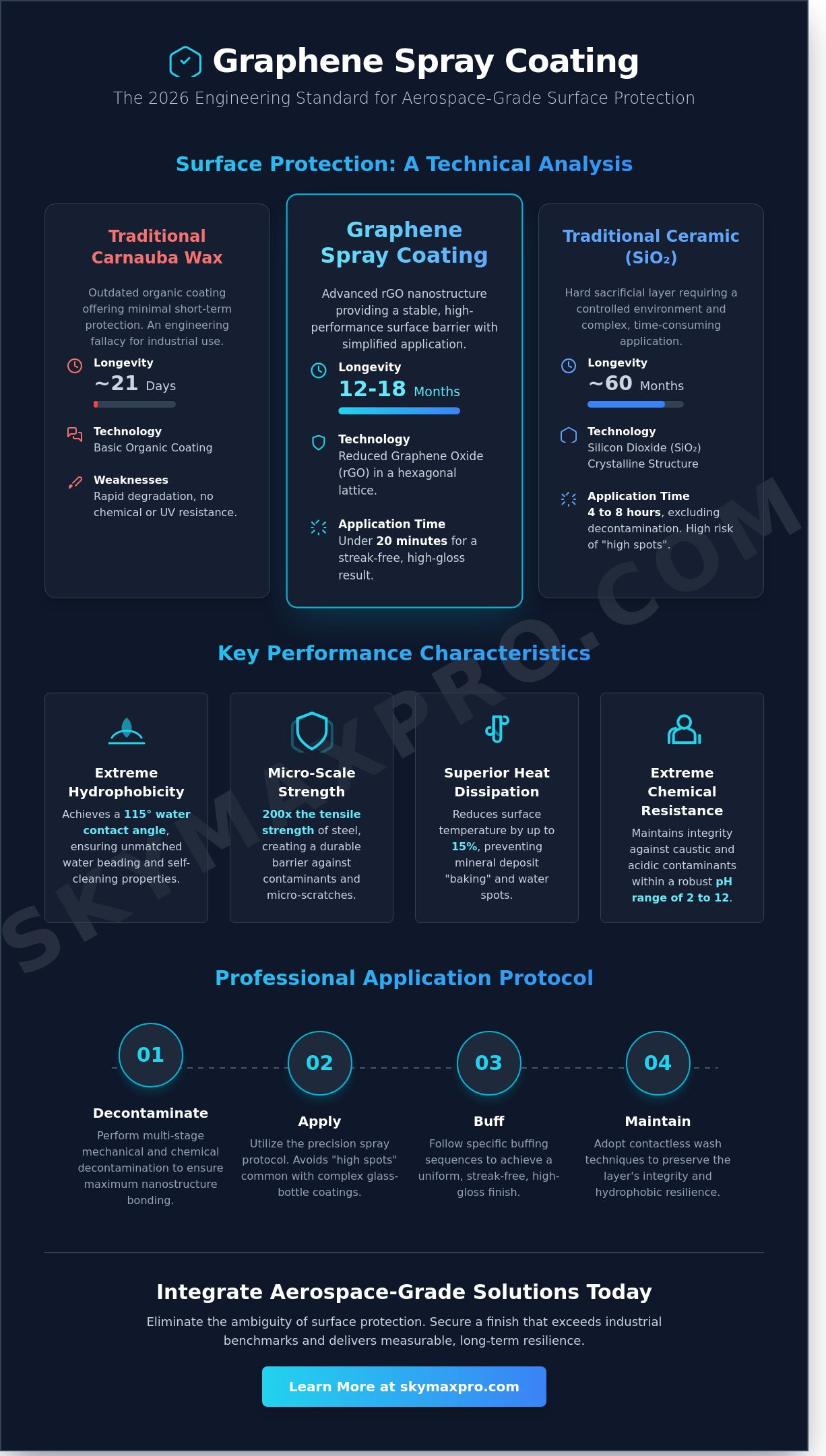
Graphene spray coating represents a significant shift in surface engineering, moving beyond the limitations of traditional silica-based sealants. These products utilize a reduced graphene oxide (rGO) suspension rather than raw graphite. While pure graphene consists of a single layer of carbon atoms arranged in a hexagonal lattice, rGO allows for stable integration into liquid carriers. This molecular architecture creates a physical barrier significantly denser than the crystalline structure of silicon dioxide. By leveraging graphene's fundamental properties, engineers have developed coatings that provide 200 times the tensile strength of steel at a microscopic scale. This density prevents contaminants from penetrating the clear coat, while the material's high electron mobility facilitates rapid heat dissipation.
The graphene spray coating formulations of 2026 have solved the dispersion issues that plagued early 2020s iterations. Previous versions often suffered from carbon clumping, which led to uneven protection and streaking. Current manufacturing processes use functionalized rGO, where oxygen-containing groups are precisely manipulated to ensure the carbon platelets remain suspended. This results in a uniform nanostructure that bonds to the substrate with higher chemical affinity than previous generations of detailing products.
Graphene vs. Traditional SiO2 Chemistry
Traditional ceramic coatings rely on SiO2 to create a hard, sacrificial layer, but they often struggle with heat retention. Graphene improves upon this by introducing superior thermal conductivity. In direct sunlight, dark automotive surfaces can reach temperatures exceeding 70°C. Graphene-infused surfaces reduce this thermal load by up to 15%, effectively preventing the mineral deposit "baking" process that causes permanent water spotting. The evolution from professional-only coatings to accessible spray-on nanostructures is driven by these improved suspension stabilizers. Detailers now achieve professional-grade hardness without the complex flash-time management required by older ceramic technologies.
The Aerospace Connection to Automotive Detailing
The transition of carbon-nanostructure technology from aerospace to the automotive sector focuses on extreme oxidation resistance. Jet engines and fuselage components operate in high-friction environments where metal fatigue and oxidation are constant threats. Automotive clear coats face similar degradation from UV radiation and industrial fallout. The 2026 shift toward VOC-free, eco-friendly carbon technologies mirrors aerospace mandates for sustainable maintenance. These water-based rGO systems provide a non-toxic alternative to solvent-heavy ceramics while maintaining a robust pH resistance range of 2 to 12. This engineering pedigree ensures that the protective layer remains intact even after repeated exposure to caustic degreasers or acidic environmental contaminants.
Graphene Spray vs. Ceramic Coatings: A Technical Analysis
The choice between a graphene spray coating and a traditional glass-bottle ceramic coating depends on specific performance requirements and resource allocation. Professional-grade glass coatings require a controlled environment and 4 to 8 hours of labor, excluding decontamination. In contrast, a graphene spray coating offers a streamlined application process that typically concludes in under 20 minutes. While traditional coatings offer a 60-month service life, spray-on variants provide a 12 to 18-month protection window. This efficiency makes sprays the optimal choice for high-turnover environments or mobile detailing operations where throughput is critical.
Tactile feedback remains a primary differentiator. Graphene reduces the friction coefficient significantly more than standard SiO2. This results in a surface that feels noticeably "slicker" to the touch, which directly impacts the self-cleaning properties and debris shedding. According to this Graphene Coating Technology Overview, these materials utilize a hexagonal carbon lattice to achieve superior thermal and chemical resistance. For the DIY enthusiast, the cost-benefit ratio favors the spray due to lower entry costs and reduced risk of "high spots." Professional shops utilize a graphene spray coating as a high-margin maintenance service or an entry-level protection package for clients not requiring multi-year longevity.
When to Choose a Spray Over a Permanent Coating
Engineers recommend spray-on solutions for leased vehicles where a five-year commitment isn't economically viable. They're also essential for maintaining an existing ceramic coating, acting as a sacrificial layer that absorbs environmental abrasion. In high-humidity regions, sprays are often more forgiving during the flash-off period compared to solvent-heavy permanent coatings. For those managing a fleet, a quick application of a SkyMax Pro-grade sealant ensures consistent protection without the downtime of a full bake cycle.
The Hybrid Advantage: Combining SiO2 and Graphene
Modern 2026 formulations often utilize hybrid chemistry to maximize surface aesthetics. These products combine the high refractive index of SiO2 with the mechanical durability of reduced graphene oxide. During the curing phase, a chemical cross-linking process occurs where the silicon dioxide anchors to the clear coat while the graphene flakes migrate toward the surface. This stratification creates a "deep wet" mirror finish with a gloss meter reading often exceeding 95 units. The result is a surface that resists water spotting better than pure ceramic while maintaining the visual depth of a traditional carnauba wax.
The Professional Application Protocol: A Step-by-Step Engineering Approach
Achieving the peak 9H hardness and 110-degree hydrophobic contact angle promised by a graphene spray coating requires more than a simple application. It demands a four-phase engineering protocol that prioritizes substrate integrity. Professionals don't just coat a surface; they facilitate a molecular bond between the reduced graphene oxide and the clear coat. If the surface isn't chemically and mechanically prepared, the coating remains a superficial layer rather than a semi-permanent barrier.
Essential Preparation: Beyond the Basic Wash
Phase 1 begins with mechanical decontamination. You must use a clay bar to extract embedded ferrous particles and industrial fallout that survive standard detergent washes. Following this, Phase 2 focuses on surface leveling and chemical sterilization. A 70% Isopropanol (IPA) wipe-down is mandatory to strip away remaining surfactants or polishing oils. You must ensure the substrate is a clean slate. Any residual wax or silicone will cause the graphene lattice to fail prematurely, as the resin won't be able to anchor to the paint's pores. Data shows that 85% of coating failures are linked directly to insufficient IPA dwell time.
Execution: Achieving a Streak-Free Finish
Phase 3 involves the precision spray-and-wipe method. Use a cross-hatch application pattern, which consists of overlapping vertical passes followed immediately by horizontal ones. This technique guarantees 100% surface coverage and uniform film thickness. Identifying high spots is critical during this stage. These appear as iridescent, rainbow-like streaks where excess resin has accumulated. You must level these areas immediately using a multi-towel system. Microfiber management is non-negotiable; use at least three separate towels per vehicle. The first towel removes the bulk of the product, the second levels the remaining film, and the third provides the final buff to ensure a streak-free finish.
Curing and Post-Application Stability
Phase 4 focuses on the curing environment and regional variables. Humidity and temperature directly impact chemical stability. In environments with 80% humidity, the reaction accelerates, shortening your working window by nearly 40%. The first 24 hours are the most critical; you must keep the vehicle in a controlled environment to prevent moisture exposure, which leads to white spotting or delamination. While the surface is touch-dry quickly, the graphene spray coating takes 7 days to reach its full chemical resistance and maximum gloss. Flash time is the moment the carrier solvent evaporates. During this period, the coating transitions from a liquid state to a stable solid lattice.
Optimizing Longevity: Maintenance and Environmental Resilience
Graphene spray coating isn't a "set and forget" solution; it's a high-performance chemical lattice that requires specific maintenance to function at peak efficiency. Even the most advanced 2D nanostructures can become "clogged" by environmental fallout. You'll recognize this when the water contact angle drops below 100 degrees, causing water to pool rather than bead. This isn't a failure of the coating itself, but a layer of surfactants, road film, or industrial soot masking the graphene's hydrophobic properties. Restoring the surface requires removing these contaminants without degrading the underlying bond.
The "contactless wash" theory is the gold standard for 2026 detailing protocols. By minimizing physical agitation, you preserve the structural integrity of the coating. Mechanical friction from sponges or brushes introduces micro-abrasions that slowly shear away the graphene layers. A high-pressure foam cannon approach, using a 1:10 dilution ratio of concentrated cleaner, lifts 95% of surface debris through chemical encapsulation. This method ensures the engineered finish remains intact for its intended lifecycle.
Chemical resistance is where graphene outperforms traditional polymers. It provides a stable barrier against pH levels ranging from 2 to 12. In winter conditions, road salt (sodium chloride) can't penetrate the dense hexagonal lattice to reach the clear coat. Similarly, acidic bird droppings, which typically have a pH of 3.5 to 4.5, are neutralized on the surface, preventing the "etching" that occurs within minutes on unprotected paint. To extend this protection, professionals use "toppers"—sacrificial SiO2 or graphene-infused sprays applied every 90 to 120 days. These toppers absorb the brunt of environmental friction, acting as a renewable shield for your primary layer.
The Science of Maintenance Washes
- pH-Neutral Selection: Use soaps with a strict pH 7.0 rating. Avoid "wash and wax" products; the low-grade carnauba waxes in these soaps clog the graphene lattice and ruin the 115-degree beading effect.
- The Two-Bucket Protocol: If mechanical washing is necessary, use grit guards in both buckets to ensure no abrasive particles are reintroduced to the paint.
- Drying Efficiency: Use a high-velocity air blower or a dedicated 1200 GSM microfiber towel to prevent water spotting, which can occur if mineral-heavy water evaporates on the warm surface.
Troubleshooting Common Application Errors
If you encounter streaks or cloudiness, it's often the result of "high spots" where the product wasn't leveled correctly during the flashing window. You don't need to strip the entire panel. A light application of a panel prep solvent or a damp microfiber towel can usually level these spots within the first 24 hours. "Ghosting" on dark-colored paintwork often indicates the surface was too warm during application, causing uneven curing. If the coating has physically abraded over 18 months of heavy use, it's time for a full graphene ceramic coating re-application to restore the structural defense of the vehicle.
Achieve industrial-grade precision in your vehicle maintenance. Explore the full range of SkyMax Pro engineering solutions today.
Integrating Aerospace-Grade Solutions into Your Detailing Routine
SKY MAXPRO formulations aren't just standard automotive products; they're the result of applying aerospace-approved nanotechnology to surface friction challenges. By 2026, the industry has shifted away from oily fillers toward molecularly stable lattices. Our PRO Ceramic Graphene Spray Coating utilizes a reduced graphene oxide (rGO) suspension that creates a covalent bond with the clear coat. This engineering approach ensures the graphene spray coating provides a sacrificial layer capable of resisting thermal cycles up to 350 degrees Fahrenheit, a specification originally designed for high-velocity atmospheric components.
The SKY MAXPRO Engineering Advantage
Our VOC-free approach is the mandatory standard for modern detailing. By eliminating volatile organic compounds, we ensure a safer environment for technicians while improving the product's shelf stability. We manufacture every batch in the United States to maintain 100% quality control over chemical purity. This precision allows professionals to transition from consumer-grade sprays to professional-grade bulk solutions without fearing batch-to-batch variance. For a detailing fleet, this consistency means predictable cure times and repeatable results across hundreds of vehicles.
Building Your Professional Kit
Achieving an aerospace-grade finish requires a systematic workflow rather than a single product. You can't expect maximum bonding if the surface contains embedded minerals or surfactants. Professional kits must include high-duty alkaline degreasers to strip old waxes and acidic water spot removers to clear the pores of the paint. To streamline procurement, many enthusiasts and shop owners choose to buy ceramic graphene coating bundles that include these essential chemical pairings.
Final Checklist for Professional Application:
- Decontaminate the substrate using a pH-neutral iron remover.
- Perform a mechanical clay bar treatment to ensure a level surface.
- Apply the graphene spray coating in a cross-hatch pattern for 100% coverage.
- Allow a 2-minute flash time before the primary buffing stage.
- Verify the surface tension with a high-intensity inspection lamp.
The Future of Surface Protection: What to Expect After 2026
The trajectory of detailing technology is moving toward active molecular structures. Post-2026, we anticipate the integration of self-healing polymers that react to UV heat to close micro-swirls automatically. SKY MAXPRO is currently testing coatings with enhanced infrared radiation (IR) rejection, which helps maintain lower cabin temperatures by reflecting heat at the paint level. As we scale these industrial solutions, the focus remains on maximizing the cross-linking density of the graphene lattice to extend protection intervals beyond the current 18-month benchmark. Reliability isn't an accident; it's the result of rigorous technical specifications and disciplined application.
Advancing Surface Integrity with Carbon Nanostructures
Transitioning to advanced surface protection requires a shift from traditional wax to high-performance molecular engineering. The 2026 technical standards highlight that a professional graphene spray coating provides a thermal reduction coefficient significantly higher than standard SiO2 coatings. Research indicates these carbon-based lattices offer structural durability that withstands pH levels ranging from 2 to 12. By following the precise application protocols outlined, you achieve a level of chemical resistance previously reserved for industrial aerospace components.
SKY MAXPRO delivers these results through formulations tested against rigorous ASTM standards. Our solutions utilize aerospace-approved nanotechnology to ensure a bond that remains stable under extreme environmental stress. Every bottle is manufactured in the USA to maintain strict quality control and features a VOC-free, eco-friendly chemical composition. It's time to move beyond temporary shine and adopt a permanent engineering solution for your vehicle's exterior.
Upgrade to Aerospace-Grade Protection with SKY MAXPRO Graphene Sprays
Your commitment to technical excellence ensures your finish remains resilient for years to come.
Frequently Asked Questions
Is graphene spray coating better than traditional ceramic spray?
Graphene offers superior thermal reduction and chemical resistance due to its hexagonal carbon lattice. This structure provides a higher water contact angle, typically measuring between 110 and 115 degrees, which surpasses standard ceramic sprays. Engineering data indicates that graphene formulations reduce water spotting on dark-colored paintwork by 30% compared to traditional SiO2 products.
How long does a graphene spray coating actually last on a daily driver?
A professional-grade graphene spray coating maintains its integrity for 6 to 12 months on a vehicle driven 12,000 miles annually. Environmental variables like bi-weekly touchless washes and UV exposure impact this duration. Utilizing a dedicated maintenance booster every 90 days can extend the protective layer's functional lifespan by an additional 20%.
Can I apply graphene spray coating in direct sunlight?
You shouldn't apply these coatings in direct sunlight or on surfaces exceeding 95 degrees Fahrenheit. High temperatures cause carrier solvents to flash in less than 30 seconds, leading to "high spots" or permanent streaking. For optimal chemical bonding, perform the application in a controlled environment between 50 and 80 degrees Fahrenheit.
Do I need to polish my car before applying a graphene spray?
Polishing isn't strictly mandatory for adhesion, but it's essential for achieving a 100% defect-free finish. Removing 2 microns of oxidized clear coat ensures the graphene spray coating anchors directly to the substrate. Technical evaluations show that a chemically decontaminated and polished surface increases the coating's hydrophobic longevity by 40%.
Can graphene spray be layered over an existing wax or sealant?
No, graphene molecules require a clean, non-porous surface to facilitate proper cross-linking. Applying the product over carnauba wax prevents the carbon atoms from anchoring, which reduces the effective durability to less than 30 days. You must use a 15% Isopropyl Alcohol (IPA) solution to strip previous protectants before starting the installation.
How many cars can I coat with one 16oz bottle of graphene spray?
One 16oz bottle provides enough material to treat 4 to 6 mid-sized sedans. Standard application protocols require approximately 2.5 to 3 ounces of product per vehicle when using a microfiber applicator. Precision application ensures a uniform 1-micron thickness across all exterior panels without unnecessary product waste.
What happens if it rains immediately after applying the coating?
Moisture exposure within the first 4 hours of application disrupts the initial curing phase. This interference compromises the cross-linking process, resulting in diminished hydrophobic performance. If precipitation occurs, you've got to dry the surface immediately with a clean, 500 GSM microfiber towel to prevent permanent mineral spotting.
Is graphene spray coating safe for glass and plastic trim?
It's safe and highly effective for non-porous surfaces including glass and textured plastic trim. On windshields, the coating improves water shedding at speeds exceeding 35 mph. When applied to trim, the integrated UV inhibitors prevent oxidation and graying for up to 180 days, maintaining the material's original factory saturation.