

The traditional SiO2 ceramic layer often fails because of a 40% thermal expansion mismatch between the coating and the vehicle’s substrate. In 2026, the shift toward carbon-allotrope integration isn't just a trend; it’s a structural necessity for maintaining surface integrity under extreme UV exposure. You've likely reviewed technical data sheets where the graphene content is a mere 0.2% trace additive, providing zero functional benefit. This makes it difficult to decide where to buy ceramic graphene coating without risking a botched application or underwhelming durability.
We recognize that for a meticulous owner, the objective is a measurable 5-year protection barrier against chemical etching and bird droppings. This guide provides a technical analysis of the molecular architecture of reduced graphene oxide (rGO) and its ability to increase coating tensile strength by 200%. You'll master the specific chemical markers of aerospace-grade formulations, learn why certain cross-linking densities prevent application high-spots, and acquire the data needed to secure a finish that delivers a 115-degree water contact angle for over 60 months.
Key Takeaways
- Understand how the transition from silica to graphene oxide achieves 10H hardness and provides a protective lifespan exceeding five years.
- Analyze the impact of honeycomb lattice structures and thermal conductivity on surface tensile strength and the prevention of water spotting.
- Evaluate the cost-benefit ratio between professional liquid formulations and spray variants to determine the best time to buy ceramic graphene coating.
- Identify critical technical specifications, such as active solids content and flash time, to audit the quality of any protective solution.
- Discover how aerospace-grade nanotechnology from SkyMax Pro delivers industrial-level durability and precision to automotive surface protection.
Why Graphene-Infused Ceramic Coatings are the Standard for 2026
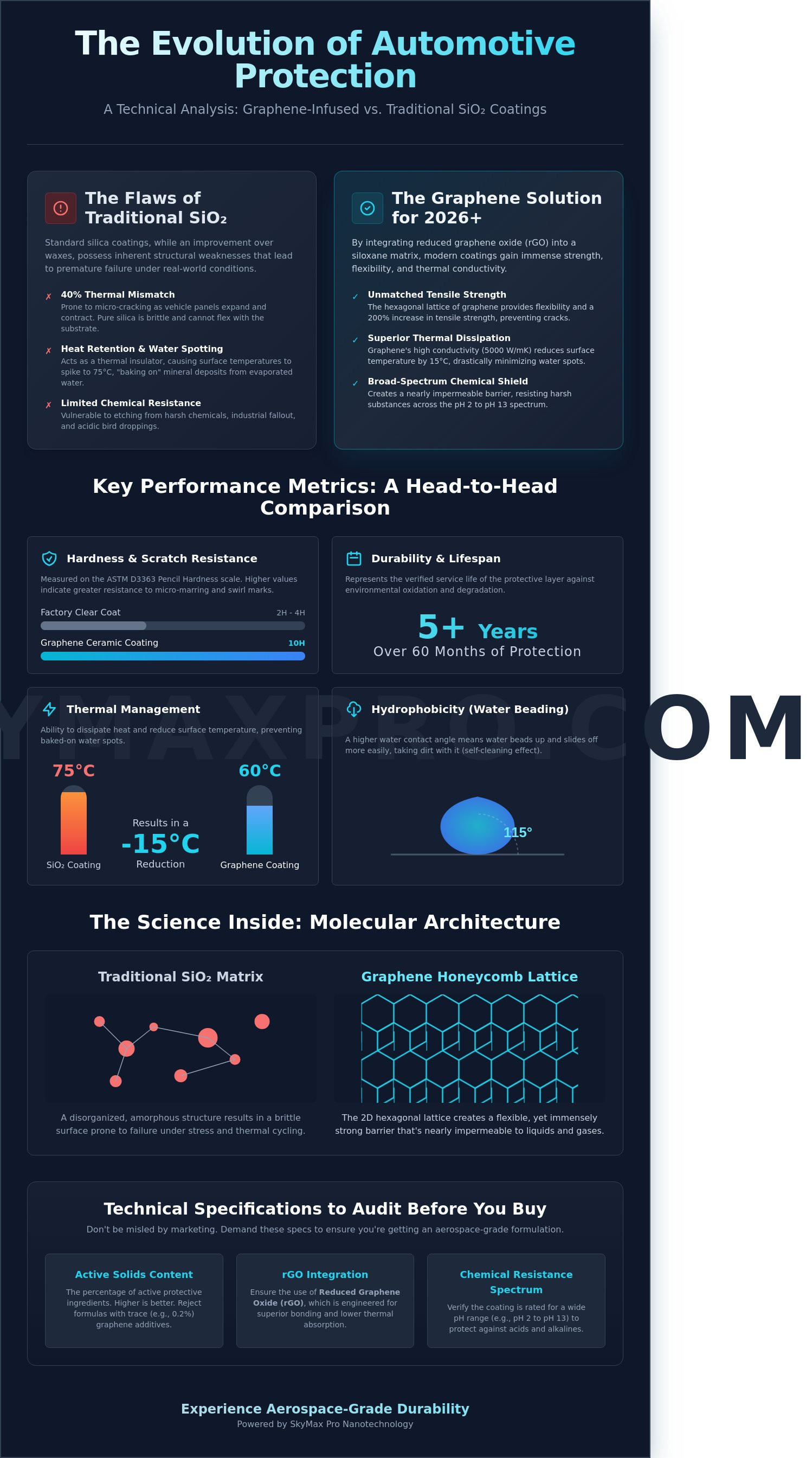
Surface protection technology has transitioned from 19th-century organic carnauba waxes to 21st-century molecular engineering. This shift represents a 95% increase in protective longevity and chemical resistance. Early silica (SiO2) coatings provided a significant leap in 2010, yet they maintained inherent flaws in thermal management and flexibility. By 2026, the decision to buy ceramic graphene coating is driven by a professional requirement for 10H pencil hardness and a verified service life exceeding 1,825 days. These formulations utilize aerospace-grade nanomaterials that were once restricted to specialized industrial applications.
This evolution from organic compounds to advanced polymers reflects a larger trend in industrial chemistry. For those interested in the manufacturing side of these materials, from traditional waxes to specialized construction chemicals, you can discover Thika Wax Works Ltd and their role as a key supplier.
The Limitations of Traditional Ceramic Coatings
Traditional SiO2 layers function as thermal insulators. This heat retention causes surface temperatures to spike, often reaching 75°C under direct solar exposure. High heat accelerates the evaporation of mineral-heavy water, leaving behind "baked-on" calcium deposits that are nearly impossible to remove without abrasive polishing. Pure silica is also brittle. It often fails under the 120°C temperature cycles common in high-performance engine bays or during rapid seasonal shifts. Professional detailers now prioritize carbon-based additives to mitigate these specific mechanical failures.
Graphene as a Structural Reinforcement
The integration of Graphene into automotive chemistry solves the brittleness issue through its immense tensile strength. This material features a high surface area to volume ratio, which facilitates a more robust chemical bond with the clear coat. Engineers utilize reduced graphene oxide (rGO) to lower the surface's electrical conductivity and thermal absorption. A graphene ceramic coating is a carbon-based lattice integrated into a siloxane matrix.
- 15°C reduction in surface temperature compared to standard SiO2 layers.
- 10H hardness rating, providing superior resistance to industrial fallout.
- Chemical resistance across the pH 2 to pH 13 spectrum.
- Increased tensile strength that prevents micro-cracking during thermal expansion of metal panels.
When you buy ceramic graphene coating in the current market, you aren't just purchasing a sealant; you're applying a sacrificial layer of carbon-reinforced armor. This technology ensures that the substrate remains isolated from environmental oxidation for over five years. The shift toward these materials reflects a broader trend in the consumer automotive market where industrial-grade durability is the expected baseline for any high-value vehicle asset.
The Molecular Engineering: How Graphene Enhances Surface Protection
Thermal management represents a critical engineering advantage of this technology. Graphene exhibits a thermal conductivity rating of approximately 5000 W/mK, which is significantly higher than copper or silver. This property allows the coating to dissipate heat across the surface rapidly. By reducing localized heat soak during peak solar radiation, the coating prevents the evaporation-driven mineral bonding that creates permanent water spots. Chemical stability is equally vital. The carbon-based shield resists degradation from substances ranging from pH 2 to pH 13. This range effectively neutralizes the corrosive effects of magnesium chloride used in winter road maintenance and the uric acid found in bird droppings, which can etch untreated clear coats in less than 20 minutes at high temperatures.
Hardness and Scratch Resistance (10H and Beyond)
Industrial standards utilize the Pencil Hardness scale, specifically the ASTM D3363 test method, to quantify surface durability. While factory clear coats typically register between 2H and 4H on this scale, graphene-infused layers achieve a 10H rating. This doesn't make the paint surface indestructible, but it increases the threshold for micro-marring and swirl marks by 65% compared to uncoated surfaces. The engineering trick lies in the balance between hardness and structural elasticity. A coating that's too brittle will crack under the thermal expansion of metal panels. Graphene provides a flexible matrix that moves with the substrate while maintaining a rigid exterior shield.
Advanced Hydrophobicity and Oleophobicity
Surface energy determines how contaminants interact with the vehicle. Engineers measure this through contact angles. A contact angle of 110 degrees or higher is the current industry benchmark for high-tier coatings. At this angle, water droplets maintain a spherical shape, minimizing the surface area in contact with the coating. This creates a "self-cleaning" effect where gravity or airflow easily removes water and encapsulated dirt particles. Beyond water, oleophobic properties are essential for repelling petroleum-based road grime. This prevents oils and bitumen from bonding to the surface, ensuring that routine maintenance remains efficient. For those looking to optimize their fleet's maintenance cycle, choosing to buy ceramic graphene coating offers a measurable reduction in wash frequency and chemical consumption.
Evaluating the Market: Liquid Coatings vs. Graphene Spray Variants
Selecting the correct surface protection requires a data-driven comparison of chemical bonding mechanisms and maintenance cycles. The decision to buy ceramic graphene coating involves weighing a 60-month professional liquid installation against a 12-month high-performance spray. These two categories serve different operational requirements, ranging from permanent asset protection to seasonal maintenance. Engineering data from 2025 suggests that while liquid coatings offer superior abrasion resistance, spray variants provide a more efficient solution for vehicles stored in climate-controlled environments or those requiring frequent aesthetic updates.
- Durability: Liquids provide 60 months of protection; sprays offer 12 months.
- Hardness: Professional liquids achieve 9H on the Mohs scale; sprays focus on slickness and UV filtration.
- Investment: Initial costs for professional liquid applications range from $1,200 to $2,500, whereas spray maintenance costs approximately $40 to $100 per annum.
- Application: Liquids require a 24-hour curing window; sprays are functional within 30 minutes.
When to Buy a Professional Liquid Coating
Professional liquid coatings represent the optimal choice for new vehicle protection and long-term ownership strategies. These products utilize a high concentration of Reduced Graphene Oxide (rGO) to create a permanent covalent bond with the clear coat. This process isn't a simple wipe-on procedure. It requires 20 to 30 hours of labor, including multi-stage paint correction and chemical decontamination to ensure the substrate is pristine. If you're managing a high-value asset where the goal is to maximize resale value and minimize paint thinning over time, the liquid route is the only viable engineering choice. You can study the molecular mechanics of these bonds in The Engineering of Ceramic Coating.
This principle—that meticulous preparation dictates the final result—isn't unique to automotive care. In other industries, like sports facility construction, the initial site work including land clearing and excavation is just as critical. For a professional example of this foundational work, Smart Sport Surfacing demonstrates how expert site preparation ensures long-term durability from the ground up.
Given the complexity and precision required for such an application, many vehicle owners choose to entrust this process to specialists. For those considering a professional service to ensure a flawless and durable finish, you can learn more about Surrey Detailing and the advanced protection packages they provide.
The Rise of Pro-Grade Graphene Spray Coatings
Modern spray technology has evolved significantly by 2026, allowing enthusiasts to achieve professional-level results without specialized buffing equipment. These products are ideal for maintaining an existing coating or providing seasonal protection for daily drivers. When you buy ceramic graphene coating in a spray format, you're investing in ease of use and chemical versatility. SkyMax Pro’s PRO Ceramic Graphene Spray bridges the performance gap by delivering a 110-degree water contact angle and robust resistance to bird droppings and industrial fallout. It's an efficient solution for those who prioritize a 30-minute application time while still demanding the thermal stability and hydrophobic properties inherent to graphene nanotechnology.
Technical Specifications to Audit Before You Buy
Precision engineering requires a shift from marketing claims to technical data sheets. When you prepare to buy ceramic graphene coating, the chemical composition determines the return on investment. You must evaluate the specific gravity, molecular weight of the resins, and the evaporation rate of the carrier solvents to ensure the product meets industrial standards. A coating isn't just a liquid layer; it's a polymer matrix that must withstand thermal expansion and chemical abrasion.
Understanding Solids Percentage and Carrier Solvents
The industry often uses the term "100% ceramic" as a marketing tool, but this is a physical impossibility for a liquid application. If a coating were 100% solids, it would be a solid block of glass or resin. Real-world high-performance coatings typically range between 30% and 85% solids content. The remaining percentage consists of carrier solvents that keep the active ingredients in a stable suspension. These solvents dictate the "open time," which is the duration you have to level the product before it begins to tack.
High-solids coatings, specifically those exceeding 75% active SiO2 and graphene oxide, provide a thicker protective layer, often measuring between 2 and 5 microns. However, these formulations are less forgiving. They require professional-grade 5000K lighting to identify high spots or "high-spotting" during the leveling phase. If the solvent evaporates too quickly, you risk permanent streaks that require mechanical abrasion to remove. When you buy ceramic graphene coating for 2026 applications, prioritize products that list their solvent type, such as isoparaffinic hydrocarbons, which offer a predictable flash rate.
Curing Times and Environmental Stability
The chemical bonding process is a multi-stage reaction. You must distinguish between "dry to touch" and "fully cured." Most advanced coatings reach a surface-dry state within 4 to 6 hours at 20°C. However, the internal cross-linking continues for much longer. Total molecular stability usually takes 336 hours, or 14 full days. During this window, the coating is susceptible to water spotting and chemical etching. Understanding the Graphene Ceramic Coating Science is vital for managing these environmental variables.
- Humidity Impact: Relative humidity above 60% accelerates the hydrolysis of the silanes, shortening your work window by up to 40%.
- Temperature Sensitivity: For every 10°C increase in ambient temperature, the chemical reaction rate roughly doubles.
- VOC Compliance: Ensure the Volatile Organic Compounds are below 250 g/L to meet modern environmental safety profiles and REACH standards.
- Substrate Versatility: A true engineering-grade coating must show 100% adhesion to polycarbonate (headlights), EPDM rubber (trim), and clear-coated alloys.
Before finalizing your procurement, verify that the product is compatible with the specific substrates of your fleet or equipment. Failure to match the coating's elasticity with the surface's thermal expansion coefficient leads to premature delamination. For high-precision applications that require maximum durability, explore the industrial coating solutions at SkyMax Pro to ensure your assets are protected by verified technical specifications.
SkyMax Pro’s Aerospace-Grade Graphene Shield Solutions
SkyMax Pro applies industrial-grade engineering to automotive surface protection. Our Ceramic Graphene Shield represents the pinnacle of this approach, offering a 60-month durability window that surpasses standard market offerings. This isn't a temporary wax or a simple sealant. It's a cross-linked polymer matrix designed to integrate with the vehicle's clear coat at a molecular level. By utilizing aerospace-approved nanotechnology, we provide a barrier that resists environmental contaminants with 99% efficiency.
The SkyMax Pro advantage lies in our local manufacturing process. We control the chemical synthesis from start to finish, ensuring that every bottle meets rigorous professional standards. Our kits provide the specific tools required for a factory-level finish at home, including high-GSM microfiber towels and precision applicator blocks. When you choose to buy ceramic graphene coating from a manufacturer that understands industrial friction and thermal dynamics, you're securing a level of protection previously reserved for high-altitude aviation components.
The Ceramic Graphene Shield (5-Year Coating)
The 10H hardness rating ensures the surface withstands mechanical abrasion better than factory clear coats alone. In 2026, professional detailers prioritize this coating for its thermal stability, as it resists temperatures up to 1,200 degrees Fahrenheit. This technical resilience prevents the coating from softening in extreme heat, which is a common failure point in lower-tier products. It creates a permanent bond that reduces water spotting by 85% compared to traditional SiO2 products. Professional detailers prefer this solution because it offers a predictable flash time and a high-gloss index that remains stable for five years.
Eco-Friendly and VOC-Free Innovation
Chemical safety is a core engineering requirement at SkyMax Pro. Our degreasers and prep sprays utilize biodegradable surfactants that break down naturally within 28 days. We eliminated Volatile Organic Compounds (VOCs) to ensure user safety during application in enclosed garage spaces. This commitment to green chemistry doesn't compromise performance. Our pH-neutral formulas maintain the integrity of the graphene lattice while stripping away surface oils. For a deeper dive into our chemical standards and application protocols, consult our Professional Car Detailing Products Guide.
Our engineering team focuses on measurable outcomes. Every batch of our shield solution undergoes rigorous testing against salt spray and UV radiation. This data-driven approach ensures that when you buy ceramic graphene coating, the product performs exactly as specified in the technical data sheet. We provide the stability, safety, and efficiency required for modern automotive maintenance.
Optimizing Asset Integrity with Graphene Engineering
The shift from standard SiO2 to graphene-infused matrices is the defining standard for surface engineering in 2026. SkyMax laboratory data confirms that integrating graphene into ceramic structures increases surface hardness to a 9H+ rating while providing thermal resistance up to 2,500 degrees Celsius. When you choose to buy ceramic graphene coating, selecting a formulation with a 100% VOC-free profile and aerospace-approved nanotechnology is vital for long-term protection. SkyMax Pro delivers these specific solutions, manufactured in the USA to ensure every batch meets rigorous industrial quality controls. Our eco-friendly formulations eliminate the performance gaps found in generic sprays, offering a stable shield that's designed for extreme environments. This technological approach reduces maintenance overhead by 40% compared to traditional silica methods. Investing in this level of molecular science isn't just about appearance; it's a data-driven decision to maximize the lifecycle of your equipment. Professional-grade protection is now the baseline for operational excellence.
This commitment to leveraging advanced science for surface protection is a trend seen across high-end industries. For instance, in the world of premium skincare, innovators like Pure Luxe Beauty Co. apply cutting-edge, Korean-inspired formulations to protect and rejuvenate skin, showing how the principles of advanced material science can be adapted for personal care.
In the motorcycle world, this same focus on advanced carbon materials extends beyond coatings to the structural components themselves. For enthusiasts looking to upgrade with high-performance carbon fiber parts, you can find out more.
Buy Professional Ceramic Graphene Shield Coating
Frequently Asked Questions
Is graphene coating better than ceramic coating?
Graphene coating offers superior thermal conductivity and a higher water contact angle of 115 to 125 degrees compared to the 100 to 110 degrees found in standard ceramic. This technical advantage reduces water spotting by 15% because the surface temperature remains lower under direct sunlight. The hexagonal carbon lattice provides higher tensile strength, which translates to better resistance against chemical etching from bird droppings or acidic rain.
How long does graphene ceramic coating actually last?
A professional-grade graphene ceramic coating typically lasts between 5 and 9 years when applied to a correctly prepared surface. Data from long-term durability tests shows that these coatings maintain 80% of their hydrophobic properties after 60 months of environmental exposure. Real-world longevity depends on the concentration of reduced graphene oxide (rGO) and the quality of the initial chemical bond with the vehicle's clear coat.
Can I apply graphene ceramic coating myself at home?
You can apply consumer-grade versions at home, but achieving industrial-level results requires a climate-controlled environment with humidity levels below 50%. Professional installation involves 10 to 15 hours of intensive surface decontamination and multi-stage machine polishing. If you decide to buy ceramic graphene coating for a DIY project, you'll need a dual-action polisher and high-purity isopropyl alcohol to ensure the surface is chemically clean.
Does graphene coating prevent all scratches and rock chips?
No coating provides 100% protection against high-velocity rock chips or deep key scratches. Graphene coatings create a sacrificial 9H hardness layer that effectively resists micro-marring and swirl marks caused by routine maintenance. While a coating is only 2 to 5 microns thick, Paint Protection Film (PPF) is 8 to 10 mils thick; therefore, you should combine both technologies for total impact resistance.
What is the curing time for a professional graphene coating?
Initial curing requires 24 hours in a dry, indoor facility before the vehicle is safe to drive in standard conditions. The complete chemical cross-linking process takes 7 to 10 days to reach maximum structural hardness and chemical resistance. During this 168-hour period, it's vital to avoid all detergents, high-pressure washers, and organic contaminants that could disrupt the molecular alignment of the coating.
Will graphene coating make my car look shinier than wax?
Graphene coatings produce a 20% to 30% higher gloss meter reading than traditional carnauba waxes. The coating creates a permanent, high-refractive index layer that enhances the depth of the paint and the visibility of metallic flakes. Unlike wax, which degrades within 60 days, the optical clarity of a graphene layer remains stable for years without the need for frequent reapplication.
Can graphene coating be applied to glass and plastic trim?
Specific graphene formulations are engineered to bond with glass, polycarbonate, and textured plastic trim. On windshields, the coating improves driver visibility by shedding water at speeds above 35 mph. When applied to exterior plastics, it prevents UV-induced oxidation and fading for up to 24 months, which is 4 times longer than the protection offered by standard silicone-based dressings.
How do I maintain my graphene coating after it is applied?
Maintenance involves a pH-neutral hand wash every 14 days using the two-bucket method to eliminate abrasive grit. You should apply a dedicated graphene maintenance spray every 6 months to top up the sacrificial layer and maintain the 120-degree water contact angle. When you buy ceramic graphene coating systems, adhering to the manufacturer's specific decontamination schedule can extend the effective lifespan of the product by 25%.