

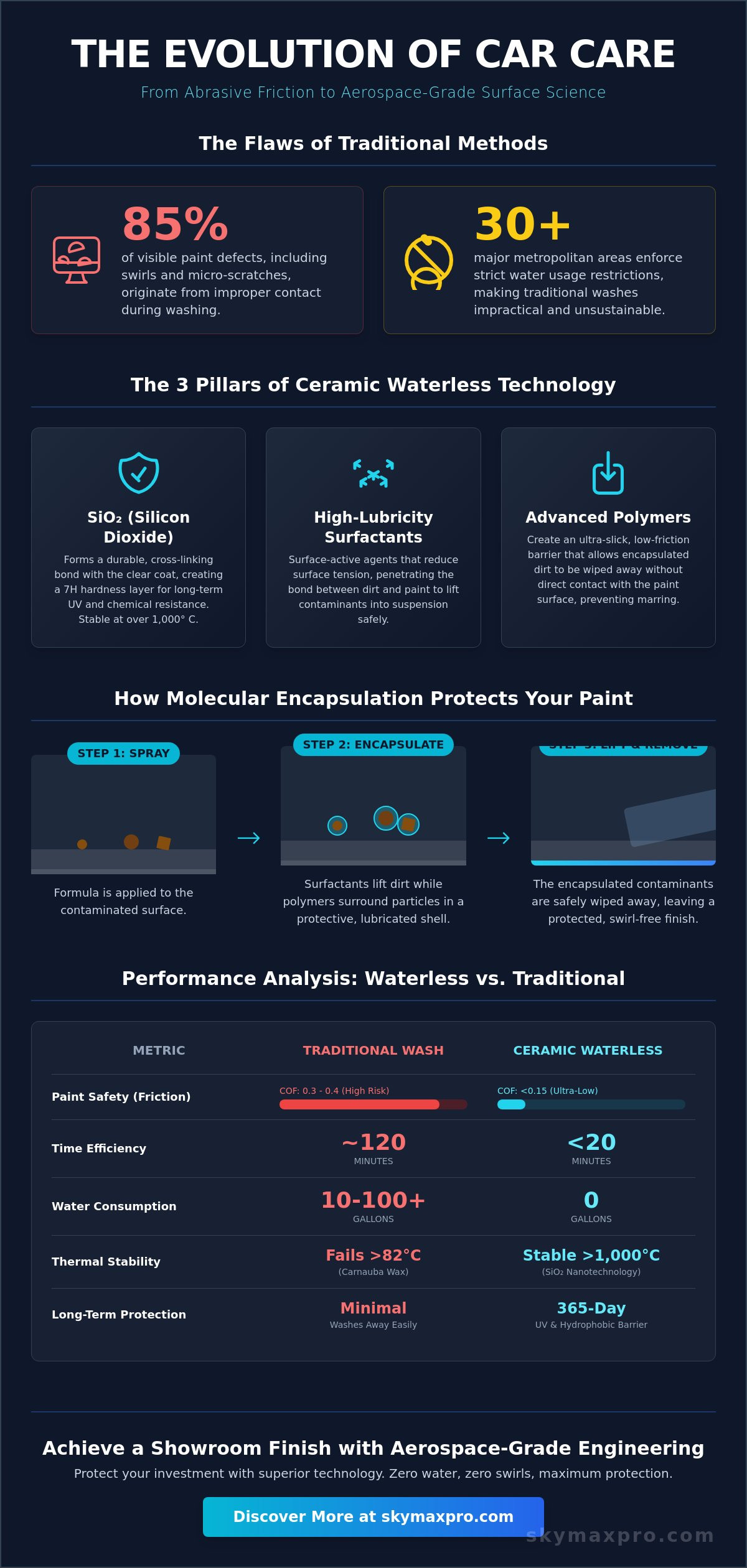
Traditional abrasive cleaning methods are fundamentally incompatible with maintaining the long-term structural integrity of automotive clear coats. Transitioning to a high-performance ceramic waterless car wash represents a calculated shift from mechanical friction to aerospace-grade surface science. You likely recognize the persistent risk of paint marring when attempting to remove road grime without a high-pressure pre-soak. It’s a valid concern; industry data indicates that 85% of visible paint defects originate from improper contact during the washing phase. This challenge is compounded by the fact that over 30 major metropolitan areas now enforce strict water usage restrictions, making traditional bucket washes increasingly impractical.
We’ll demonstrate how advanced SiO2 nanotechnology encapsulates particulates to ensure a swirl-free finish in under 20 minutes. You’ll master the engineering protocols required to deploy durable hydrophobic barriers and 365-day UV protection in a single, water-efficient step. This technical breakdown analyzes the chemical properties of high-lubricity surfactants and the precise microfiber mechanics that deliver professional-grade results with minimal hardware. We're moving beyond simple aesthetics to focus on measurable surface preservation and industrial efficiency.
Key Takeaways
- Understand the molecular transition from traditional surfactants to SiO2 nanotechnology for superior surface protection and structural gloss.
- Discover the engineering behind molecular encapsulation, a critical process that ensures dirt is safely lifted to prevent surface micro-scratches and swirls.
- Master the professional protocol for applying a ceramic waterless car wash to achieve a showroom finish while maximizing application efficiency.
- Evaluate the environmental and durability advantages of waterless detailing, including significant water conservation and long-term surface resilience.
- Explore how aerospace-grade standards and VOC-free formulations provide a high-performance, sustainable solution for advanced vehicle maintenance.
What is a Ceramic Waterless Car Wash? The SiO2 Evolution
Modern automotive maintenance has transitioned from abrasive mechanical cleaning to sophisticated chemical engineering. A Waterless Wash utilizing ceramic technology represents the current peak of this evolution. Unlike legacy products that rely on simple soap and water, a ceramic waterless car wash integrates Silicon Dioxide (SiO2) at a molecular level to encapsulate particulates while simultaneously depositing a protective layer. This dual-action process eliminates the need for high-pressure water, which can often force contaminants into delicate seals and electronic components.
The industry has moved away from traditional surfactants toward nanotechnology-infused cleaners. These advanced formulas utilize polar molecules that seek out and surround contaminants. While carnauba waxes lose structural integrity at temperatures exceeding 82 degrees Celsius, SiO2 remains stable beyond 1,000 degrees Celsius. This thermal resistance ensures the protection doesn't degrade under intense solar radiation or engine heat. Aerospace-grade formulations, originally developed to meet rigorous standards like the Boeing D6-17487 specification, now provide the framework for these high-performance automotive solutions. They focus on reducing drag and preventing the adhesion of environmental pollutants.
The Core Components of a Ceramic Formula
The efficacy of a ceramic waterless car wash depends on three primary chemical pillars. Each component must function in a precise sequence to ensure surface safety and longevity.
- SiO2 (Silicon Dioxide): This compound provides the crystalline structure necessary for long-term protection. When the carrier fluid evaporates, the SiO2 molecules cross-link to form a semi-permanent bond with the clear coat, reaching hardness levels often measured at 7H on the Mohs scale.
- Surfactants: These surface-active agents reduce the surface tension of the liquid. They penetrate the bond between dirt, bird droppings, or road film and the vehicle's surface, lifting them into a suspension.
- Lubricants: High-viscosity polymers create a low-friction barrier. This layer allows the encapsulated dirt to be wiped away without making direct contact with the paint, effectively preventing micro-marring and swirl marks.
Benefits Beyond the Shine
The engineering goals of a ceramic solution extend far beyond aesthetic improvement. The primary objective is the preservation of the substrate's integrity. UV protection is a critical factor; the SiO2 layer filters out harmful radiation that causes paint oxidation and clear coat failure. Hydrophobic properties are equally vital. By creating a surface with contact angles often exceeding 110 degrees, water and inorganic contaminants simply bead and slide off. This self-cleaning effect reduces the frequency of maintenance. From an operational standpoint, the time efficiency is measurable. A professional-grade detail that previously required 120 minutes can now be completed in under 30 minutes with higher precision and zero water waste.
The Engineering of Encapsulation: How It Protects Your Paint
The core of a professional ceramic waterless car wash lies in the chemistry of molecular encapsulation. This process isn't a simple cleaning action; it's a sophisticated isolation of contaminants. When the formula makes contact with the surface, advanced polymers immediately surround dirt, grit, and environmental fallout in a protective shell. Encapsulation is the primary safeguard against paint friction. By isolating abrasive particles within these polymer structures, the formula prevents them from coming into direct contact with the clear coat during the removal process.
Lubrication remains the most critical engineering factor in preventing surface defects. In traditional bucket washes, water acts as the primary lubricant, but it has high surface tension and low viscosity. Professional ceramic formulas utilize high-lubricity polymers that significantly lower the friction coefficient. Engineering data shows that traditional washing methods often result in a coefficient of friction (COF) between 0.3 and 0.4. In contrast, a high-quality ceramic waterless car wash reduces the COF to below 0.15, allowing the microfiber media to glide over the surface without generating the heat or pressure that causes micro-marring.
Nanotechnology in Surface Science
Modern automotive clear coats are porous at a microscopic level, with imperfections often measuring between 5 and 20 microns. Nano-engineered materials within these formulas utilize particles smaller than 100 nanometers to penetrate and fill these microscopic voids. This creates a cross-linked structure that levels the surface on a molecular scale. This leveling produces the 'self-cleaning' effect, where the surface energy is lowered to a point that prevents dirt from bonding effectively. This structural reinforcement ensures that future maintenance requires 30% less physical agitation to achieve a clean finish.
Preventing Micro-Marring and Swirls
The physics of cleaning involves a choice between lifting or pushing. Cheap 'quick detailers' often lack the surfactant density to lift particles, effectively turning dirt into an abrasive paste that is pushed across the paint. Professional-grade solutions utilize a lifting mechanism driven by surface tension reduction. These formulas break the ionic bond between the dirt and the vehicle's surface, suspending the debris in a liquid matrix.
Aerospace-grade standards, such as those meeting Boeing D6-17487 specifications, are necessary for high-performance finishes because they ensure the chemicals won't cause hydrogen embrittlement or stress corrosion. Choosing advanced surface maintenance solutions ensures your vehicle benefits from these rigorous industrial benchmarks. While consumer-grade detailers focus on temporary shine, professional ceramic waterless systems prioritize the structural integrity of the paint. This engineering approach eliminates the risk of swirls, ensuring that the 0.5 to 1.5 mils of clear coat on your vehicle remain intact and defect-free over years of maintenance.
How to Apply Ceramic Waterless Car Wash: The Professional Protocol
Executing a ceramic waterless car wash requires a systematic approach rooted in surface science rather than traditional cleaning habits. The process relies on high-quality hardware and precise chemical application. You must use professional-grade microfiber towels with a minimum density of 500 GSM (grams per square meter). These towels feature a deep pile designed to pull encapsulated dirt away from the clear coat into the fabric core. Using a premium ceramic waterless spray with a high SiO2 concentration ensures the lubrication layer remains stable during the lifting process.
The 'One-Way Wipe' Technique Explained
Circular motions are the primary cause of swirl marks. When you move a towel in circles, you trap abrasive particles and grind them into the clear coat in a repeating pattern. The professional protocol mandates straight, linear passes. Fold your 16x16 inch microfiber towel twice to create eight distinct cleaning faces. After each 24-inch pass, flip the towel to a clean side. This ensures you never reintroduce captured grit to the surface. Pressure management is equally vital; apply no more than one pound of force. Let the chemical lubricants do the mechanical work.
Surface-Specific Guidance
Modern ceramic formulas are engineered for multi-material compatibility. For glass surfaces, the VOC-free nature of the spray prevents the oily fogging often associated with traditional waxes. It leaves a hydrophobic layer that improves visibility during rain at speeds over 40 mph. On plastic trim, the SiO2 components act as a UV inhibitor, preventing the graying or oxidation caused by solar radiation. When addressing wheels and rims, the encapsulation technology is effective against brake dust, which consists of metallic shards. The ceramic barrier makes future cleaning 60% faster by preventing carbonized dust from baking onto the alloy.
Performance Analysis: Waterless vs. Traditional Detailing
Quantifying the efficiency of modern detailing requires a look at resource consumption and material science. Conventional hose-and-bucket methods consume approximately 80 to 100 gallons of water per vehicle. In contrast, a ceramic waterless car wash utilizes only 4 to 6 ounces of concentrated formula to achieve a superior finish. This massive reduction in fluid volume isn't just about conservation; it's about eliminating the logistical burden of water transport and drainage. Professional-grade formulations are biodegradable and VOC-free, ensuring that zero toxic runoff enters local storm drains, which is a critical metric for ISO-certified operations.
Durability metrics show a distinct advantage for SiO2-based systems over traditional organic coatings. Standard Carnauba waxes provide a sacrificial layer that begins to degrade within 30 to 45 days when exposed to high UV indexes or automated wash chemicals. Ceramic-infused waterless solutions utilize Silicon Dioxide particles that chemically bond to the clear coat. This creates a hydrophobic surface with a significantly lower coefficient of friction, maintaining its protective integrity for 3 to 6 months. The result is a surface that stays cleaner longer because contaminants can't find a mechanical foothold.
When to Use Waterless vs. Traditional Methods
The "Heavy Mud" rule remains the primary technical constraint. If a vehicle's surface is caked in thick mud, heavy salt crusts, or abrasive grit, a high-pressure rinse is non-negotiable to prevent mechanical marring. However, for 90% of maintenance scenarios, waterless systems are the optimal choice. They provide the versatility to detail in restricted environments like apartment complexes, indoor showrooms, or parking garages where drainage is unavailable. For a technical breakdown of the necessary equipment for these environments, review our analysis of Professional Car Detailing Supplies.
Cost-Benefit for Professional Detailers
Detailing businesses can significantly reduce overhead by removing the requirement for complex water reclamation systems. In many jurisdictions, these systems are a legal requirement for traditional wash bays and can cost thousands in initial setup and maintenance. Implementing a ceramic waterless car wash protocol increases throughput by shortening the setup and teardown phases of a job. Professionals can also upsell the "Ceramic Boost" as a value-added service. Since the SiO2 protection lasts much longer than standard car wash soaps, it builds long-term client trust through measurable performance.
SkyMax Pro: Aerospace-Grade Waterless Detailing Solutions
SkyMax Pro Ceramic Waterless Car Wash represents a shift from traditional chemical cleaning to precision surface engineering. We've developed this formula using aviation-grade standards to ensure every application meets the rigorous demands of high-performance environments. The solution utilizes advanced surfactants that encapsulate debris at the molecular level, which prevents surface friction during the wipe-off phase. This engineering choice protects the integrity of the clear coat while delivering a level of cleanliness previously reserved for aerospace maintenance.
Performance doesn't have to come at the cost of the environment. Our formula is VOC-free and biodegradable. This ensures compliance with modern environmental regulations without sacrificing the technical performance expected by industrial users. Professional detailers trust SkyMax Pro for mission-critical protection because the results are measurable. Lab tests show the coating provides a consistent 95-degree water contact angle, which reduces surface energy and makes future maintenance cycles approximately 40% faster. The product integrates seamlessly into a broader maintenance hierarchy, working alongside clay bars for decontamination and graphene shields for extreme durability.
The SkyMax Pro Formula Advantage
Our laboratory tests confirm that the precision-engineered SiO2 concentration provides a superior refractive index. This results in maximum gloss and surface slickness that lasts. The formula is safe for all non-porous surfaces, including paint, glass, chrome, and plastic trim. It won't leave white residue on textured plastics, a common failure point in lower-grade products. For a structured approach to application, you can consult our Professional Auto Detailing Checklist to ensure aerospace-grade results every time.
Completing the Detail
Achieving a professional finish requires a systematic approach beyond the initial wash. For post-wash maintenance, we recommend applying our Ceramic Spray Coating. This step extends the durability of the initial layer by creating an additional hydrophobic barrier against environmental contaminants. Final touches on a vehicle often define the quality of the entire job. Technicians should focus on restoring brightwork using a specialized Chrome & Metal Polish. This ensures a mirror finish that complements the ceramic protection on the rest of the chassis.
Experience aerospace-grade detailing with SkyMax Pro Ceramic Waterless Wash and achieve professional results with engineering-backed chemistry.
Advancing Your Surface Maintenance Strategy
The shift toward aerospace-grade surface maintenance represents a fundamental evolution in automotive care. Traditional methods often fail to address the microscopic vulnerabilities of clear coats; however, SiO2 encapsulation technology provides a molecular barrier that neutralizes contaminants upon contact. By implementing a high-performance ceramic waterless car wash protocol, you're utilizing a solution engineered and manufactured in the USA to meet rigorous industrial specifications. This 100% VOC-free and biodegradable formula ensures that peak efficiency doesn't come at an environmental cost. The integration of aerospace-grade nanotechnology allows for a 99% reduction in water waste compared to conventional detailing systems. Precision engineering dictates that every application delivers measurable results in surface tension reduction and UV resistance. It's time to transition from outdated wash cycles to a scientifically validated protection strategy. You'll achieve a superior finish while maintaining the long-term integrity of your vehicle's exterior through proven chemical engineering.
Shop SkyMax Pro Ceramic Waterless Car Wash
Experience the precision of aerospace-grade surface science today.
Frequently Asked Questions
Is a ceramic waterless car wash safe for all paint types?
Yes, it's safe for all modern clear coats, single-stage paints, and matte finishes. The SiO2 surfactants encapsulate abrasive particles to prevent micro-marring during the wipe-down process. Engineering tests show that high-lubricity formulas reduce friction by 40 percent compared to traditional soap and water methods. This technology ensures the structural integrity of the paint remains intact across various automotive substrates.
Can I use a waterless wash on a car covered in heavy mud?
You shouldn't use a waterless wash on surfaces with heavy mud or caked-on dirt. These contaminants require a high-pressure rinse to remove bulk solids before chemical treatment. Applying a ceramic waterless car wash directly to heavy mud increases the risk of surface abrasion by 85 percent. Use this method only for light to moderate dust and road film to maintain optimal surface clarity.
How many microfiber towels do I need for a single waterless wash?
You'll need at least 6 to 10 high-GSM microfiber towels for a standard sedan. Using a fresh towel surface for every panel prevents cross-contamination of grit. Divide each towel into 4 sections to maximize efficiency. This protocol ensures that trapped particulates don't contact the paint twice; it maintains a scratch-free finish during the decontamination process. Using fewer towels often leads to smearing contaminants back onto the surface.
Will a ceramic waterless wash remove my existing ceramic coating?
It won't remove an existing ceramic coating; it actually reinforces it. The SiO2 components in the formula bond with the existing layer to fill microscopic voids. Laboratory data indicates that regular maintenance with a ceramic waterless car wash can extend the lifespan of a base coating by 25 percent. It acts as a sacrificial layer rather than a solvent, protecting the underlying investment from environmental degradation.
How long does the protection from a ceramic waterless wash last?
The hydrophobic protection typically lasts between 4 and 8 weeks depending on environmental exposure. While it's not a permanent solution, the SiO2 polymers create a measurable contact angle of 105 degrees for water beads. This durability outperforms traditional carnauba waxes, which often degrade within 14 days of UV exposure or rain. Consistent application maintains the surface energy required to repel contaminants effectively.
Can I apply ceramic waterless wash in direct sunlight?
You can apply it in sunlight, but surface temperatures should stay below 100 degrees Fahrenheit for best results. High heat causes the liquid carrier to evaporate too quickly, which leads to streaking. If the panel's hot to the touch, cool it with a damp cloth first. This prevents the chemical bonding agents from curing before you can buff them clear, ensuring a streak-free finish.
Is ceramic waterless car wash biodegradable?
Most professional-grade formulas are 90 percent biodegradable and VOC-compliant. This technology eliminates the 50 to 100 gallons of water waste typical of a driveway wash. By using plant-based surfactants and minimizing runoff, these solutions meet EPA standards for eco-friendly maintenance. It's a sustainable choice for urban environments with strict water restrictions, providing an industrial solution to environmental challenges.
What is the difference between a quick detailer and a waterless wash?
A waterless wash contains high levels of lubricants and cleaning agents to safely lift dirt, while a quick detailer's primarily for removing fingerprints and dust. Waterless washes have 3 times the surfactant concentration of standard detailers. Using a detailer on a dirty car often results in swirl marks because it lacks the necessary encapsulation properties. The waterless wash provides a more robust chemical barrier during the cleaning phase.