

The moment spray paint hits your vehicle, you aren't just looking at a stain; you're witnessing a high speed chemical reaction that threatens to permanently bond with your clear coat. While many owners panic, the best way to get spray paint off a car requires a calculated engineering approach rather than aggressive scrubbing. With professional detailing costs in 2026 reaching up to $600 for intensive paint correction, understanding the molecular interaction between aerosol pigments and factory finishes is essential for any vehicle owner looking to preserve their investment.
It's understandable to fear that a DIY attempt might cause more damage than the vandalism itself, especially with evolving 2026 VOC regulations like SCAQMD Rule 1151 restricting many traditional solvents. This guide details a professional decontamination protocol designed to remove foreign paint without compromising the 50 micron thickness of your original finish. You'll discover how to leverage mechanical tools like the Final Touch I PRO Detailing Clay and learn how modern graphene infused shields prevent future paint adhesion. We'll move through a structured hierarchy of removal methods to restore your vehicle's original gloss and structural integrity.
Key Takeaways
- Understand the molecular interaction between aerosol pigments and polyurethane clear coats to ensure a safe, non-destructive removal process.
- Identify why the best way to get spray paint off a car involves a systematic hierarchy of aggression, starting with mechanical tools like Final Touch I PRO Detailing Clay.
- Master the selection of chemical solvents to neutralize foreign contaminants while maintaining the integrity of the underlying factory finish.
- Execute post-removal restoration techniques to eliminate surface marring and restore the original mirror-like gloss of your vehicle.
- Deploy advanced graphene-infused coatings to establish a low-energy surface that rejects future paint adhesion and environmental pollutants.
Surface Chemistry: Why Spray Paint Sticks (and How to Break the Bond)
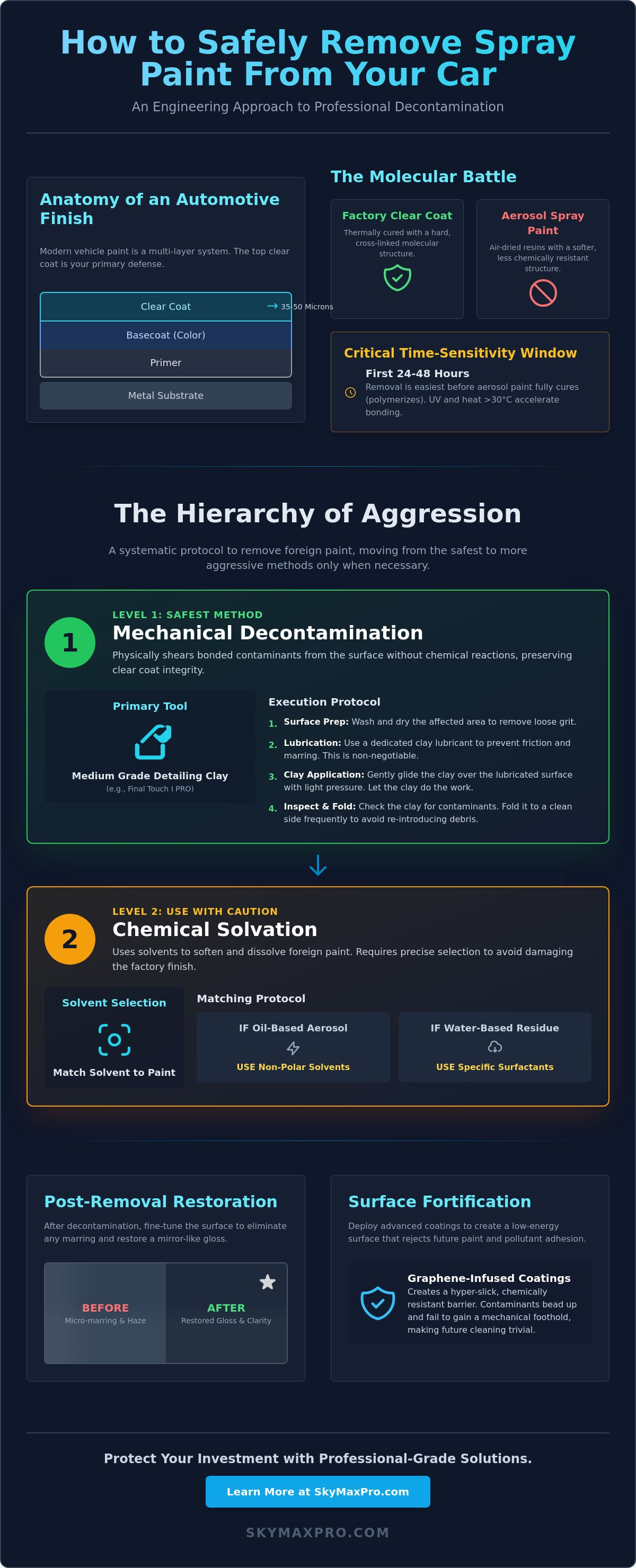
Automotive finishes are complex multi-layer systems engineered for extreme durability. To understand the best way to get spray paint off a car, one must first analyze the chemistry of modern car paint. Most contemporary vehicles utilize a three-stage system consisting of a primer, a color basecoat, and a polyurethane clear coat. This clear coat functions as a non-porous, high-density barrier. Because factory clear coats undergo a thermal curing process, they develop a cross-linked molecular structure. This structure is significantly harder and more chemically resistant than the air-dried resins found in standard aerosol cans, which provides the technical window needed for safe decontamination.
Anatomy of an Automotive Finish
The clear coat acts as a sacrificial layer, typically measuring between 35 and 50 microns in thickness. Its surface energy determines how easily foreign substances adhere to it. High-energy surfaces allow liquids to spread and bond tightly; conversely, low-energy surfaces, such as those treated with a Ceramic Graphene Shield Coating, cause contaminants to bead and fail to gain a mechanical foothold. When spray paint is applied, its solvents attempt to "bite" into this surface. However, because the factory finish is fully cured, the aerosol paint usually remains topical. Determining the best way to get spray paint off a car depends heavily on whether the aerosol has merely rested on the surface or if aggressive thinners have begun the process of chemical etching.
The Science of De-bonding
Breaking the bond between the aerosol pigment and the clear coat requires a precise balance of mechanical force and chemical dissolution. The "Time-Sensitivity Window" is a critical factor in this engineering challenge. Within the first 24 to 48 hours, the spray paint is still outgassing and hasn't reached full polymerization. Exposure to UV radiation and temperatures exceeding 30 degrees Celsius accelerates this bonding process, making removal significantly more difficult as the resins harden.
Effective de-bonding relies on two primary protocols:
- Mechanical Disruption: Utilizing a specialized medium like Final Touch I PRO Detailing Clay to physically shear the paint droplets from the surface without abrading the underlying clear coat.
- Chemical Solvation: Introducing solvents to soften the foreign resin without liquefying the factory finish.
Identifying the residue type is vital for success. Oil-based aerosols require non-polar solvents, while water-based residues respond better to specific surfactants. Regardless of the method, maintaining surface lubrication is non-negotiable. Without it, the friction generated during removal can lead to localized heat buildup. This heat can soften the clear coat, allowing the pigment to migrate deeper into the finish and causing permanent ghosting or staining.
The Mechanical Protocol: Using Detailing Clay for Safe Removal
Mechanical decontamination represents the foundational stage in the professional hierarchy of paint removal. Unlike aggressive automotive paint strippers that can potentially compromise the integrity of clear coat resins if misapplied, detailing clay utilizes localized shearing forces. This approach is frequently the best way to get spray paint off a car because it targets only the material protruding above the clear coat's surface. By focusing on physical separation rather than chemical dissolution, you preserve the factory finish's structural thickness.
Selecting the correct substrate is a critical engineering decision. Fine grade clay is typically reserved for light environmental fallout, such as industrial dust or pollen. However, aerosol vandalism and heavy overspray usually require a medium grade clay like the Final Touch I PRO Detailing Clay. This specific grade provides the abrasive density necessary to "grab" the edges of the spray paint droplets. The goal is to achieve a "shearing effect," where the clay pulls the foreign paint away from the surface without abrading the underlying polyurethane layer.
Step-by-Step Clay Decontamination
Surface preparation is mandatory before any mechanical action. Any residual grit or loose particulates on the panel can be trapped by the clay, effectively turning it into a sanding block that creates deep swirls. Professionals should consult the Professional Auto Detailing master checklist for the exact pre-wash sequence required to stabilize the work area. Once the surface is clean, apply a high-lubricity lubricant generously.
Technique must remain precise. Use linear strokes along the length of the panel rather than circular motions to distribute mechanical stress evenly. As the clay encounters the spray paint, you'll feel a distinct "drag" and hear a light audible feedback. This indicates the clay is engaging with the contamination. Continue the process until the "sound and feel" of the paint being lifted disappears and the clay glides silently. To maintain safety, constantly fold the clay to expose a clean, uncontaminated surface, ensuring that removed pigments aren't dragged back across the finish.
When Clay Isn't Enough
Mechanical removal has defined physical limits. If the spray paint has been exposed to UV radiation for more than 48 hours, it may have achieved a bond that resists simple shearing. Attempting to force removal through excessive pressure leads to "over-claying," which generates friction heat and risks surface hazing. When the clay stops making progress on textured or porous surfaces, it's time to transition to chemical protocols. For stubborn residues that resist mechanical force, integrating a Heavy Duty Red Power Degreaser can help soften the aerosol bond before the final removal pass.
The Hierarchy of Aggression: Chemical Solvent Protocols
When mechanical methods reach their physical limits, the protocol shifts to chemical dissolution. Following the "Least Aggressive First" rule is the best way to get spray paint off a car while minimizing risk to the substrate. Professionals typically begin with 70% Isopropyl Alcohol (IPA) to test the bond's stability. If the aerosol remains resilient, the hierarchy advances to specialized emulsifiers. Unlike high-VOC industrial thinners, which can cause swelling in plastic trim or permanent clouding of the clear coat, engineered automotive solvents are designed to destabilize foreign resins without attacking the cross-linked factory finish.
Professional Degreasers vs. Household Solvents
Avoid the dangerous misinformation common on public forums suggesting the use of gasoline or brake fluid. These substances lack the controlled evaporation rates required for safe paint removal and can lead to catastrophic clear coat failure. A precision-engineered formula like the Heavy Duty Red Power Degreaser provides the necessary chemical "bite" while remaining stable enough for controlled application. Dwell time management is the most critical variable in this phase. You must never allow a solvent to dry on the panel. The chemical reaction must be monitored constantly, ensuring the solvent remains active only as long as necessary to liquefy the pigment. Safety protocols require working on panels cooled to below 25 degrees Celsius and ensuring adequate ventilation to manage vapor concentrations.
The Application Method: Blotting vs. Scrubbing
The physical application of the solvent is just as important as the chemical itself. Scrubbing is a common failure point. Aggressive friction drives dissolved paint particles deeper into the microscopic pores of the clear coat, leading to permanent "ghosting" effects. Instead, utilize the "Transfer Method." Apply the solvent to a high-quality microfiber towel and gently blot the affected area. This allows the towel's capillary action to pull the liquefied paint away from the vehicle's surface rather than smearing it across the panel.
Once the pigment is lifted, immediate neutralization is required. Rinsing the area with a pH-neutral solution or a Ceramic Waterless Car Wash stops the chemical reaction instantly. This prevents the solvent from continuing to act on the clear coat after the contamination has been removed. Managing runoff is also vital; ensure that chemicals don't pool on wheels or sensitive rubber seals, as these materials have different resistance levels than painted metal panels. This controlled termination of the process ensures that the decontamination remains a surgical procedure rather than a destructive one. It's the best way to get spray paint off a car without leaving behind permanent chemical scarring.
Post-Removal Restoration: Fixing Haze and Swirls
Decontaminating a vehicle panel is a high-stress operation for any factory finish. Once you've successfully lifted the aerosol pigment, the surface often reveals "battle scars" in the form of micro-marring, hazing, or ghosting. Micro-marring occurs when the detailing clay shears off contaminants, leaving behind microscopic abrasions in the top 1-2 microns of the clear coat. Hazing is typically the result of solvent interaction that temporarily softens the resin. To achieve a truly professional result, the best way to get spray paint off a car must conclude with a rigorous surface refinement protocol to restore optical clarity and structural uniformity.
Restoring Optical Clarity
Light machine polishing is non-negotiable for removing the textural inconsistencies left by mechanical decontamination. Professionals should utilize a dual-action polisher paired with soft foam finishing pads to minimize heat buildup. Unlike heavy cutting pads, soft foam allows for the precise removal of hazing without thinning the clear coat further. This stage requires a fine finishing polish to level the micro-ridges created during the claying process. Before beginning, ensure the panel is chemically stripped of any residual oils or solvent films. This step ensures the abrasive particles in the polish can interact directly with the clear coat. For a complete list of the hardware required for this stage, refer to our guide on Professional Car Detailing Supplies.
Cleaning the Details
Vandalism rarely respects clean panel lines. Aerosol pigments often migrate into tight panel gaps, weather stripping, and porous plastic trim. These areas require surgical attention. Use a soft-bristled detailing brush and a pH-neutral cleaner to evacuate paint remnants from crevices. If chemical solvents were used in the previous steps, they may have leached essential plasticizers from the rubber and plastic components, leading to a chalky, faded appearance. Restoring these surfaces is critical for a uniform aesthetic. Utilizing an engineered ceramic trim plastic restorer will re-moisturize the substrate and provide a long-term UV barrier.
The final inspection should be conducted under high-CRI (Color Rendering Index) lighting, ideally with a rating above 90. This specialized illumination reveals "ghost" images—faint silhouettes of the original graffiti that only appear under specific light angles. If ghosting is detected, it indicates that pigments have migrated into the clear coat pores, necessitating a slightly more aggressive polishing pass. Once the surface is optically clear and free of all chemical residues, the vehicle is ready for its final fortification layer. To ensure your finish remains flawless, consider investing in a comprehensive Exterior Detailing Kit to maintain the restored gloss.
Surface Fortification: Preventing Future Vandalism Adhesion
Restoration of optical clarity is only half the engineering challenge. Once the factory clear coat is stripped of contaminants, it remains a high-energy surface, making it susceptible to rapid re-contamination. While the decontamination protocols discussed in previous sections represent the best way to get spray paint off a car once damage has occurred, the most efficient long-term strategy involves reducing the surface energy of the substrate. Traditional carnauba waxes and polymer sealants are insufficient for this task; they possess low thermal stability and are easily dissolved by the aggressive non-polar solvents found in aerosol paints.
True fortification requires a transition to nanotechnology. By establishing a sacrificial layer with superior chemical resistance, you ensure that future vandalism bonds to the coating rather than the vehicle’s permanent finish. This approach shifts the maintenance burden from aggressive paint correction to simple surface maintenance. In the 2026 detailing landscape, the focus has shifted from reactive cleaning to proactive surface engineering, where the goal is to make the clear coat as inert as possible.
Ceramic Graphene Shield: The Ultimate Defense
Modern surface protection has evolved toward graphene-infused matrices. Utilizing a Ceramic Graphene Shield Coating creates a molecular bond with the clear coat, providing up to 5 years of documented durability. Graphene’s hexagonal lattice structure provides a high-slip, low-friction surface. This "Easy-Clean" property is a result of extreme hydrophobicity and chemical inertness. When spray paint is applied to a graphene-protected surface, the aerosol solvents cannot penetrate the dense lattice. The pigment remains topical and loosely bonded, often allowing for removal with a simple high-pressure rinse or a pH-neutral wash. This technology effectively renders the best way to get spray paint off a car a non-invasive procedure, preserving the 50-micron factory finish from chemical etching.
Routine Maintenance for Coated Surfaces
Maintaining the integrity of this sacrificial shield is essential for sustained protection. Relying on ceramic-infused washes, such as a Ceramic Waterless Car Wash, helps replenish the hydrophobic top layer without introducing abrasive particulates. For localized maintenance between deep cleans, a Quick Detailer Spray with Ceramic High Gloss Finish preserves the low-energy state of the panel. These maintenance steps prevent the degradation of the coating’s structural lattice over time. To achieve a professional-grade defense system and ensure your vehicle remains protected against environmental and human-led threats, secure your finish with a comprehensive Ceramic Coating Kit. This systematic approach to fortification represents the pinnacle of modern automotive surface engineering.
Implementing Professional-Grade Surface Defense
Safely managing aerosol contamination requires a systematic shift from reactive cleaning to engineering-based prevention. You've learned that the best way to get spray paint off a car involves a disciplined hierarchy. It begins with mechanical shearing via medium-grade clay and advances to controlled chemical dissolution only when necessary. This protocol must always conclude with surface refinement to eliminate the micro-marring and hazing inherent in the decontamination process.
The most efficient long-term protocol is to render the clear coat chemically inert. By utilizing advanced nanotechnology, you establish a low-energy surface that rejects foreign pigments before they can achieve a permanent bond. SKY MAXPRO solutions are manufactured in the USA and utilize aerospace-approved formulations to ensure structural integrity across all vehicle substrates. Don't leave your factory finish vulnerable to the next incident of vandalism or environmental overspray. Your vehicle's structural aesthetics and resale value depend on the precision of its protection.
Secure your vehicle's finish with our Ceramic Graphene Shield Coating and transform your maintenance routine into a streamlined, high-efficiency operation.
Frequently Asked Questions
Will nail polish remover take spray paint off my car without damage?
Nail polish remover containing acetone can dissolve aerosol pigments, but it poses a high risk to your clear coat. Acetone is an aggressive solvent that can soften polyurethane resins if left in contact for more than a few seconds. Professionals utilize engineered automotive degreasers with controlled evaporation rates to ensure the factory finish remains structurally intact during the decontamination process.
How long can I wait before the spray paint becomes permanent?
The critical window for easy removal is usually 24 to 48 hours. During this period, the aerosol resins are still outgassing and haven't achieved full molecular polymerization. High UV exposure and temperatures exceeding 30 degrees Celsius accelerate this bonding process. Once the paint fully cures, the best way to get spray paint off a car shifts from simple mechanical claying to more intensive chemical solvation and machine polishing.
Is it safe to use a pressure washer to blast the paint off?
Pressure washing is rarely effective for bonded spray paint and can lead to clear coat delamination. While a 1500 PSI stream might dislodge loose overspray, it cannot break the chemical bond of cured aerosol resins. Directing high pressure at close range risks driving water into existing paint chips or microscopic fissures, which can cause the factory finish to lift or peel away from the substrate.
Can I use a magic eraser to get spray paint off my car?
You should avoid magic erasers because they are composed of melamine foam, which functions as a 3000 grit abrasive. Using this material is essentially a localized sanding operation that will leave a dull, matte patch on your clear coat. Detailing clay remains a superior alternative because it shears contaminants from the surface without the aggressive leveling effect and subsequent gloss loss associated with melamine foam.
What should I do if the spray paint is on my car windows?
Use a new stainless steel razor blade held at a 45 degree angle combined with a high lubricity glass cleaner. Glass has a significantly higher Mohs hardness rating than automotive clear coat, allowing for safe mechanical scraping. For any residual haze or silhouette, apply a specialized multi cleaner or Isopropyl Alcohol (IPA) to dissolve the remaining resins without compromising the surrounding rubber gaskets or weather stripping.
Will a clay bar remove spray paint that has been there for months?
A clay bar may remove the physical texture of old paint, but it often fails to eliminate deep staining or ghosting. After several months, aerosol pigments can migrate into the microscopic pores of the clear coat. In these scenarios, the best way to get spray paint off a car involves a multi stage approach. This includes chemical softening with an automotive degreaser followed by a medium grade clay pass and a final machine polishing sequence.
Does insurance usually cover professional spray paint removal?
Comprehensive insurance policies typically cover vandalism, which includes spray paint damage. If the estimated restoration costs exceed your deductible, which frequently ranges from $250 to $500, you should consider filing a claim. It's vital to document the contamination with high resolution photography and a formal police report before attempting any decontamination to ensure your coverage remains valid during the claims process.
How can I tell if the spray paint has already damaged my clear coat?
Inspect the surface for "etching" or swelling after the pigment has been removed. If you see a permanent silhouette or a wrinkled texture in the clear coat, the aerosol solvents have successfully penetrated the polyurethane layer. This damage usually occurs after 72 hours of exposure to direct sunlight. When the structural integrity of the clear coat is compromised, professional level leveling and refinement are necessary to restore the surface uniformity.