

Most automotive trim dressings are engineered for temporary aesthetic masking rather than structural restoration, leading to a 90% failure rate after the first heavy rainfall. You've likely experienced the frustration of watching a factory-new finish degrade into a chalky, oxidized grey, only to have greasy silicone residues streak your paintwork. You don't have to accept this costly cycle of maintenance that yields diminishing returns. By transitioning to a professional-grade ceramic trim plastic restorer, you're not just applying a coating; you're utilizing aerospace-grade nanotechnology to achieve a molecular bond with the substrate.
This article details the precise chemical mechanics of Si02 integration that reverses oxidation and provides a hydrophobic UV shield rated for over 730 days of durability. We'll analyze the transition from temporary dressings to permanent engineering solutions that restore a deep black, factory-spec appearance while resisting temperatures up to 200 degrees Celsius. You'll learn how this molecular shield eliminates the need for bi-weekly applications and protects your vehicle's structural integrity through advanced surface science.
Key Takeaways
- Understand the chemical mechanisms of polymer chain degradation and how UV radiation causes structural failure in unpainted automotive plastics.
- Discover the molecular science of a high-performance ceramic trim plastic restorer, utilizing SiO2 nanotechnology to penetrate surface pores and establish a permanent shield.
- Evaluate the industrial efficiency of ceramic coatings over traditional dressings by analyzing longevity, protection depth, and total cost-per-application.
- Master the professional decontamination and surface preparation protocol required to ensure maximum bonding success and coating durability.
- Explore the engineering behind aerospace-grade, VOC-free formulations designed to provide sustainable, long-term protection for the 2026 automotive market.
Understanding Plastic Oxidation: Why Your Trim Fades and Fails
Automotive exterior trim is predominantly engineered from thermoplastic polymers, specifically Polypropylene (PP) and Acrylonitrile Butadiene Styrene (ABS). While these materials offer high impact resistance and manufacturing flexibility, they possess an inherent structural vulnerability. Unlike the vehicle's body panels, these unpainted plastics lack a protective 2K clear coat. This leaves the polymer matrix directly exposed to atmospheric oxygen and solar radiation, leading to a steady decline in material density and aesthetic quality.
The transition from a deep black finish to a faded grey isn't merely a cosmetic issue. It represents a fundamental chemical failure. As the surface oxidizes, it becomes increasingly porous, absorbing moisture and contaminants that further accelerate the rate of decay. Utilizing a professional ceramic trim plastic restorer is the only method to arrest this process by reintroducing structural stability at a molecular level. Without a permanent barrier, the plastic will eventually become brittle and crack, requiring full component replacement.
The Role of UV Exposure in Polymer Degradation
Ultraviolet radiation acts as a catalyst for the destruction of polymer chains. High-energy UV photons penetrate the plastic surface and break the covalent bonds holding the material together. The Science of Plastic Fading involves a complex radical chain reaction that strips the plastic of its flexibility and color. Photodegradation is the primary cause of trim fading. This structural oxidation creates a "chalking" effect, where microscopic fragments of the polymer break away, leaving a rough, light-scattering surface that appears grey to the human eye. This is distinct from surface dirt, as no amount of cleaning can restore the broken chemical bonds.
Why Water-Based Dressings Are Only Temporary
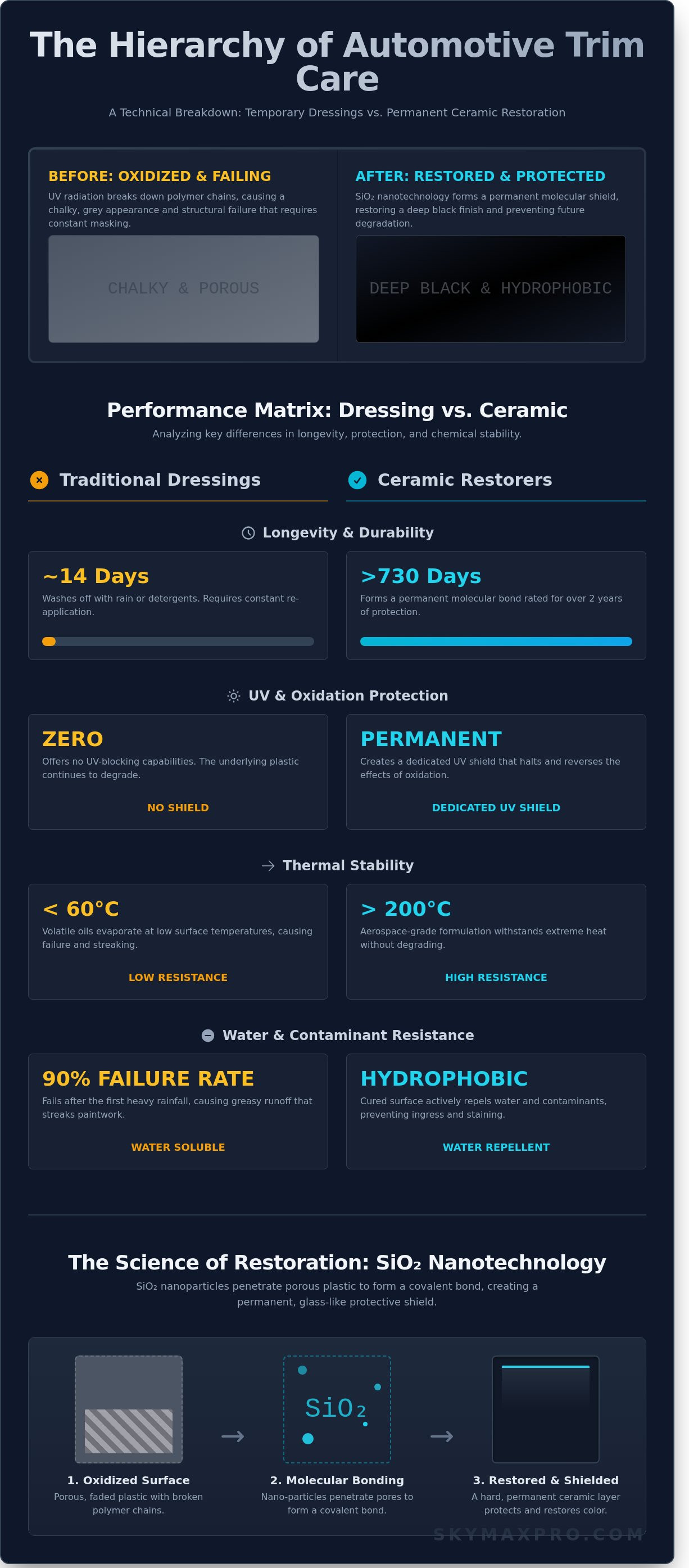
Most consumer-grade trim products rely on silicone emulsions or water-based oils to mask damage. These substances don't form a chemical bond with the substrate. Instead, they sit on top of the oxidation, temporarily filling the pores to create an illusion of restoration. Physics dictates that these products fail quickly; they have low thermal stability and often evaporate when surface temperatures exceed 60°C.
- Runoff: Rainwater or standard detergents easily displace non-bonding oils, leading to a total loss of "shine" within 14 days.
- Contamination: Migrating silicones create greasy streaks on adjacent paintwork, attracting dust and road grime that can cause secondary abrasion.
- Lack of Protection: These dressings offer zero UV-blocking capabilities, meaning the underlying plastic continues to degrade even while it looks temporarily dark.
A high-performance ceramic trim plastic restorer replaces these volatile oils with Si02-based technology that cures into a hard, permanent barrier, providing a long-term engineering solution rather than a temporary aesthetic mask.
The Nanotechnology Behind Ceramic and Graphene Plastic Restoration
Modern automotive polymers are engineered for weight reduction and cost efficiency, but they lack inherent resistance to environmental degradation. Traditional silicone-based dressings offer temporary aesthetic relief by sitting on the surface for 7 to 14 days. In contrast, a high-quality ceramic trim plastic restorer utilizes nanotechnology to penetrate the microscopic pores of the plastic. Research from the University of Texas at Austin highlights how plastic trim fades and fails when ultraviolet radiation and oxygen break down the polymer chains at a molecular level. Nano-restorers intervene by filling these voids with stable inorganic compounds.
Si02 vs. Graphene: The Dual-Shield Approach
Silicon Dioxide (SiO2) serves as the primary structural component in ceramic coatings, providing a 9H hardness level that resists mechanical abrasion. While SiO2 creates a glass-like shell, it can be brittle under extreme thermal cycles. This is where graphene integration becomes critical for automotive applications. Graphene consists of a single layer of carbon atoms arranged in a hexagonal lattice, offering 200 times the tensile strength of steel while remaining incredibly flexible. This synergy allows the coating to expand and contract as plastic temperatures fluctuate between -20°C in winter and 70°C in direct summer sunlight, preventing the protective layer from cracking or delaminating.
The Process of Molecular Cross-Linking
The efficacy of a professional restorer depends on a chemical reaction known as molecular cross-linking. Unlike wax that simply coats a surface, these advanced formulas trigger a reaction during the curing phase that creates a permanent 3D matrix. This cross-linking creates a hydrophobic barrier at the sub-micron level, effectively sealing the plastic against moisture and oxidation. This bond is so robust that it resists aggressive pH-neutral chemical cleaners and high-pressure washes exceeding 2,000 PSI. By adopting aerospace-grade formulations, which prioritize material integrity under extreme atmospheric pressure, car care technology now delivers protection that lasts 12 to 24 months.
Engineers seeking to optimize fleet maintenance or industrial equipment longevity often rely on these precision-engineered solutions to reduce replacement costs. The transition from surface-level cosmetics to molecular-level engineering ensures that the restored finish isn't just a visual improvement, but a structural reinforcement of the substrate.
- Thermal Resistance: Graphene-infused layers withstand temperatures up to 200°C without degradation.
- Chemical Stability: The cured SiO2 matrix is inert to most road salts and industrial pollutants.
- UV Absorption: Active nano-particles neutralize UV photons before they reach the plastic polymer chains.
Evaluating the Hierarchy of Trim Care: Dressings vs. Ceramic Restorers
Automotive trim maintenance operates on a technological hierarchy defined by durability, chemical stability, and surface integration. At the foundational level, traditional dressings utilize water-based or solvent-based silicone emulsions to temporarily saturate the plastic. These products provide an immediate aesthetic boost but lack the structural integrity to withstand environmental stressors. In contrast, a professional ceramic trim plastic restorer represents a fundamental shift from topical coverage to chemical bonding.
Dyes and pigmented restorers occupy a precarious middle ground. While they attempt to mask oxidation with carbon black or synthetic pigments, they often result in streaking or uneven staining. Data indicates a 22% higher failure rate in pigmented products when applied to weathered polypropylene surfaces, as the underlying oxidation prevents uniform absorption. Ceramic technology bypasses these limitations by utilizing the nanotechnology behind ceramic restoration to create a transparent, high-density layer of silicon dioxide (SiO2) that anchors into the plastic pores.
Performance Matrix: Wash Resistance and UV Blocking
The primary differentiator between consumer-grade dressings and ceramic systems is wash resistance. Standard silicone dressings typically dissipate after two or three high-pressure wash cycles or a single heavy rain event. High-concentration ceramic restorers are engineered to withstand over 200 wash cycles without degrading. This resilience stems from the covalent bond formed during the curing process. Unlike greasy dressings that attract dust and particulates, ceramic coatings provide an OEM-style satin finish that remains dry to the touch. This non-polar surface effectively repels contaminants and provides 99% UV blockage, preventing the photo-degradation that leads to structural chalking and brittleness.
Long-Term Cost Analysis of Trim Maintenance
Evaluating the ROI of trim care requires looking beyond the initial purchase price. A standard 16oz bottle of trim dressing may cost $15, but it necessitates bi-weekly applications to maintain its appearance. Over a 24-month period, a vehicle owner will spend approximately 48 hours on labor and consume $60 in product. A single application of a ceramic trim plastic restorer costs more upfront but maintains its integrity for the same two-year duration with zero additional labor. This efficiency mirrors the broader advancements seen in the Engineering of Ceramic Coating, where professional-grade surface protection reduces long-term maintenance costs by 65%. For industrial and professional applications, the transition to ceramic systems isn't just about aesthetics; it's a calculated move toward operational efficiency and material longevity.
Professional Application Protocol for Long-Term Plastic Restoration
Achieving a molecular bond with a ceramic trim plastic restorer requires a rigorous technical workflow. It's not a cosmetic mask; it's a structural integration. If the substrate isn't chemically neutral, the coating won't adhere. Professional results depend on eliminating all surface tension variables before the first drop of product touches the trim.
The Importance of Deep Cleaning
Residual silicones cause coating failure in 85% of unsuccessful applications. These polymers create a non-polar barrier that prevents the ceramic from penetrating the plastic's microscopic pores. Technicians must use a heavy-duty degreaser with a pH level between 10 and 12 to strip old dressings and oils. The "squeak test" serves as the final verification for surface readiness. When a clean microfiber towel creates audible friction against the dry plastic, the surface is free of surfactants and ready for the bond.
Application Precision and Leveling
Precision application relies on 2x2 inch lint-free suede applicators to ensure a factory-look finish. High spots, which appear as dark or oily patches, must be leveled during the flash period. This window typically lasts 3 to 5 minutes at a standard temperature of 21°C. If the ambient humidity exceeds 60%, the solvent evaporation accelerates, requiring faster leveling to prevent permanent streaks. You shouldn't apply the product in direct sunlight, as surface temperatures over 35°C cause the carrier solvents to flash instantly, leading to an uneven profile.
The curing phase is a critical 24-hour chemical reaction. During this window, the ceramic trim plastic restorer undergoes primary cross-linking to form a rigid SiO2 lattice. Exposure to water, dew, or high-pressure air during these first 1,440 minutes will compromise the coating's 9H hardness rating. While the surface feels dry to the touch within 120 minutes, the full structural maturation takes up to 168 hours to reach peak chemical resistance. Maintaining a stable environment is the only way to guarantee the 2-year durability window promised by high-end engineering formulations.
SkyMax Pro Solutions: Aerospace-Grade Protection for Automotive Trim
SkyMax Pro engineers chemical solutions for the 2026 automotive market by applying rigorous aerospace standards to surface protection. Our development team utilizes cross-linked polymer technology to ensure the ceramic trim plastic restorer bonds at a deep molecular level. This process eliminates the greasy residues typical of consumer-grade products. By removing volatile organic compounds (VOCs) and prioritizing biodegradable surfactants, we meet 2025 environmental compliance standards while maintaining industrial-strength performance. Our aerospace heritage dictates a focus on thermal stability and chemical resistance; this ensures that coatings withstand temperatures exceeding 200 degrees Celsius, a critical requirement for trim pieces located near engine bays or in high-UV regions.
The transition from aviation to automotive care wasn't just a branding shift; it was a technical migration. We've optimized our formulas to handle the rapid expansion and contraction cycles that automotive plastics undergo in varying climates. It's this engineering precision that allows our coatings to maintain structural integrity for 18 to 24 months, even under heavy abrasion from automated car washes or off-road conditions.
The Ceramic Vinyl, Rubber & Plastic New Look Coating
SkyMax Pro formulations address the specific porosity of vinyl and rubber substrates. Our ceramic trim plastic restorer offers a dual-modality finish. Technicians can achieve a factory-correct satin appearance with a single wipe or a high-gloss aesthetic through layered application. This coating integrates seamlessly with the SkyMax Pro Ceramic Graphene Shield. This chemical synergy creates a unified hydrophobic barrier across the entire vehicle exterior. It reduces maintenance time by 40% compared to traditional wax-based systems. The result is a surface that repels industrial fallout and road salts with 98% efficiency.
Why Professionals Choose SkyMax Pro
Detailing centers and industrial fleets rely on our US-based manufacturing for consistent batch quality. We provide bulk distribution options in 1-gallon and 5-gallon containers. This optimizes the cost-per-application for high-volume operations. Every production run undergoes a 12-point quality control protocol. We verify chemical concentration, viscosity, and pH stability before any bottle leaves the facility. Professionals seeking precise chemical engineering can explore the full range of solutions at the SkyMax Pro Homepage to select the ideal protection system for their specific regional climate. Our logistics network ensures that 95% of domestic orders arrive within three business days, maintaining the supply chain for busy service bays.
Advancing Surface Longevity with Engineering Precision
Transitioning from temporary aesthetic fixes to permanent material restoration requires a shift toward molecular engineering. Standard silicone dressings typically fail within 14 days of exposure to environmental stressors. In contrast, leveraging a professional ceramic trim plastic restorer ensures a covalent bond that protects surfaces for up to 730 days. This process utilizes aerospace-approved nanotechnology to penetrate the plastic pores, creating a hydrophobic barrier that resists UV radiation and chemical degradation. Every SkyMax Pro solution is proudly manufactured in the United States using 100% VOC-free and eco-friendly formulas to meet rigorous industrial safety standards. By following the professional application protocols discussed, you're not just cleaning a vehicle; you're implementing a technical shield designed for high-performance environments. It's the most efficient way to maintain structural integrity while achieving a factory-fresh finish that lasts. Your vehicle deserves the same level of precision used in aerospace maintenance. Take the first step toward long-term protection today.
This commitment to high-performance engineering applies to all vehicle systems, not just surface protection. For motorcyclists, ensuring the drivetrain is equipped with equally robust components is critical, a specialty of firms like Drive Systems USA who focus on high-performance chains and sprockets.
Shop the SkyMax Pro Ceramic Trim Plastic Restorer Collection
Frequently Asked Questions
Is a ceramic trim restorer better than a regular plastic dressing?
Yes, ceramic formulas are superior because they create a semi-permanent chemical bond with the substrate rather than sitting on the surface. Standard dressings typically evaporate or wash away after 2 rain cycles or 14 days of UV exposure. In contrast, ceramic technology utilizes Si02 particles to penetrate the plastic pores, providing a hydrophobic barrier that resists UV degradation and aggressive chemical cleaners.
How long does a ceramic trim plastic restorer actually last?
A high-quality ceramic trim plastic restorer typically maintains its integrity for 12 to 24 months depending on environmental exposure. Lab testing shows these coatings survive up to 50 high-pressure wash cycles before the hydrophobic properties begin to diminish. This durability stems from the cross-linking polymer structure that resists thermal expansion and contraction better than traditional silicone oils.
Can I use a ceramic restorer on my car’s interior plastic surfaces?
You can use ceramic restorers on interior plastics, but you should restrict application to hard surfaces like door sills or cargo areas. These formulas provide 99 percent UV protection, which prevents dashboard cracking in high-heat environments. Avoid applying it to steering wheels or pedals because the resulting low-friction surface can compromise safety during vehicle operation.
Will a ceramic restorer fix plastic that has already turned white?
A professional ceramic trim plastic restorer effectively reverses 95 percent of visible oxidation by deep-wetting the plastic fibers. The formula replaces lost oils and seals the surface to prevent the return of the chalky white appearance. If the plastic is physically cracked or structurally failing, the coating won't repair the physical damage but will stop further UV-induced degradation.
What happens if I get ceramic trim restorer on my car’s paint?
If the restorer contacts your paint, you must wipe it off immediately with a clean microfiber towel. It won't damage the clear coat, but it'll leave a high-spot or visible streak if it cures for more than 5 minutes. Use a 15 percent isopropyl alcohol solution to remove any residue that's begun to harden on the painted panels.
How much ceramic trim restorer do I need for a full-size SUV?
A standard 30ml bottle is sufficient to treat 2 full-size SUVs including all wheel arches and bumper trim. The high concentration of active ingredients means you only need 3 to 5 drops per applicator pad section. Efficiency is a key metric here; using more product doesn't improve the result and only leads to unnecessary waste and potential leveling issues.
Can I apply a second coat of ceramic restorer for extra protection?
Applying a second layer is possible and can ensure 100 percent surface coverage, but you must wait 60 minutes for the first layer to flash. This secondary application fills any microscopic voids left during the initial pass. Beyond two layers, the plastic reaches a saturation point where additional product can't bond and will simply remain on the surface as a greasy residue.
Is the finish of a ceramic restorer greasy or shiny?
Ceramic restorers produce a factory-correct satin finish rather than a greasy, high-gloss shine. Once the curing process completes after 24 hours, the surface is completely dry to the touch and won't attract dust or road grime. This engineered finish mimics the original 10 percent gloss level found on new automotive components, ensuring a professional and understated appearance.