

Achieving a mirror-like finish isn't a matter of luck; it's a precise calculation of light refraction and surface leveling. With DIY consumers representing 56.72% of the car care market demand in 2025, more owners are seeking professional results at home. However, most struggle with how to make car paint look wet and deep because they rely on organic waxes that degrade under UV exposure or wash off after a single rain. You've likely noticed your paint looks flat despite hours of labor, or that frustrating swirl marks continue to scatter light and ruin the visual depth. We agree that a premium vehicle deserves more than a temporary shine that lasts only a few weeks.
This guide will teach you how to master the technical process of achieving a professional-grade, deep-mirror finish using protocols originally developed for the aerospace industry. By shifting your focus from simply shining to engineering the surface, you can secure a permanent wet look and high surface slickness. We'll explore the application of high-performance solutions, such as the SKY MAXPRO Ceramic Graphene Shield, which provides protection for up to 5 years. You'll discover how to leverage nanotechnology to create a finish that resists the elements and maintains its clarity long after traditional products fail.
Key Takeaways
- Understand the physics of specular reflection and how surface leveling minimizes light diffusion to create an optical illusion of depth.
- Master the critical preparation phase, including chemical decontamination and mechanical clay bar treatment, to establish a perfectly smooth foundation for gloss.
- Discover technical protocols on how to make car paint look wet and deep by selecting high-refraction graphene coatings that offer superior color saturation over traditional waxes.
- Learn professional application strategies, such as panel-by-panel coverage in controlled environments, to ensure uniform coating thickness and a streak-free finish.
- Implement engineering-grade maintenance routines, including the two-bucket wash method and pH-neutral shampoos, to preserve surface slickness and long-term coating integrity.
The Physics of Depth: Why Paint Looks Dull vs. Wet
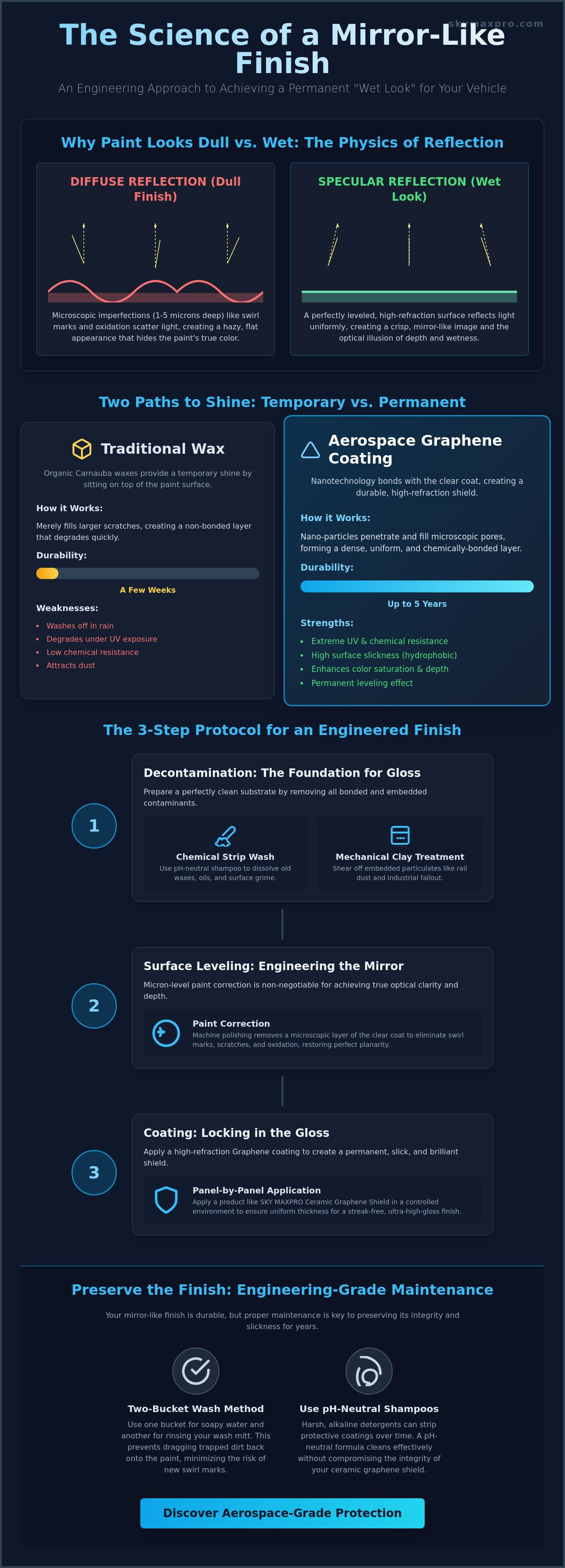
To understand how to make car paint look wet and deep, we must analyze the interaction between photons and the surface topography of the vehicle's clear coat. The "wet look" isn't a subjective aesthetic; it's a technical state where high specular gloss meets maximum color saturation. According to The Physics of Gloss, the visual perception of a surface depends on how light reflects off it. When light hits a perfectly smooth surface, it reflects at a consistent angle, creating a mirror-like effect. This is known as specular reflection.
Dull or "flat" paint occurs when light encounters diffuse reflection. This happens because microscopic imperfections, such as oxidation or swirl marks, create an uneven surface. These defects, often measuring between 1 and 5 microns in depth, scatter light in multiple directions. Instead of a crisp image, the eye perceives a hazy, grayish film that obscures the true color of the pigment underneath. Achieving professional-grade depth requires minimizing this light scattering by restoring the clear coat's planarity through precise mechanical and chemical protocols.
Specular Reflection and Surface Leveling
A perfectly leveled surface acts as a high-precision optical mirror. Even on a vehicle that appears clean, microscopic peaks and valleys on the clear coat prevent the "wet" appearance. If the surface isn't leveled at a micron scale, the light return is fragmented. Engineering a wet finish involves removing these irregularities so that light can pass through the clear coat, hit the base color, and return to the observer with minimal interference. This process maximizes the refractive index, which is the measure of how much light bends as it enters a medium. Standard clear coats have a refractive index of approximately 1.5; increasing this through specialized coatings is essential for that "dripping wet" visual result.
The Role of Nanotechnology in Saturation
Nanotechnology provides the solution for filling the microscopic pores that traditional waxes cannot reach. While a standard Carnauba wax sits on top of the surface, nano-sized particles in aerospace-grade formulations penetrate the clear coat's structure. This creates a denser, more uniform layer that enhances color saturation. You aren't just adding a layer of "shine" which reflects light off the top. You're creating a deep "glow" by allowing light to saturate the pigment more effectively. This is why professional protocols on how to make car paint look wet and deep prioritize high-solid ceramic or graphene coatings. These formulations provide a superior leveling effect that remains stable for years, unlike retail-grade products that evaporate or degrade under thermal stress.
Mechanical Surface Leveling: The Foundation of Gloss
Gloss is not merely an additive property provided by a coating; it's an engineering outcome of surface planarity. Research into automotive paint appearance quality demonstrates that surface topography, including "orange peel" and microscopic textures, dictates the efficiency of light reflection. If the clear coat is littered with embedded particulates or micro-scratches, the light will scatter, regardless of the quality of the sealant used. True depth begins with a multi-stage decontamination and leveling process that prepares the substrate for high-refraction finishes.
Chemical and Mechanical Decontamination
The initial phase involves a deep chemical strip wash. Using a pH-neutral shampoo designed to break down old waxes and surface oils is critical. This ensures that the mechanical leveling tools interact directly with the clear coat rather than a layer of degraded organic material. Once the surface is chemically clean, "above-surface" contaminants like industrial fallout, rail dust, and tree sap must be addressed. These particles are often invisible to the eye but can be identified by feel. Sliding a hand over the paint inside a thin plastic bag will reveal a grit-like texture if contaminants remain.
To eliminate these obstructions, utilize a high-quality clay treatment. The Final Touch I PRO Detailing Clay is engineered to shear off embedded particulates without marring the surface. This mechanical step is non-negotiable for anyone learning how to make car paint look wet and deep, as it creates the initial smooth plane required for specular reflection. A smooth surface feels like glass and allows subsequent polishing stages to be far more effective.
The Polishing Protocol
Mechanical polishing is the actual "correction" phase where we level the clear coat by removing a microscopic layer of paint to eliminate swirl marks and scratches. Swirls act as tiny canyons that trap light, preventing it from reaching the base pigment. We distinguish between a heavy compound, used for deep defect removal, and a finishing polish, used for refining the clarity. Relying on "filler" waxes is a common mistake; these products only temporarily hide defects and will wash off, leaving the paint looking flat again.
Precision requires high-intensity LED inspection. Under specific light spectrums, you can verify if the scratches are truly removed or just masked. The final stage, often called "jeweling," uses ultra-fine abrasives and soft foam pads at low speeds to maximize the clear coat's transparency. This meticulous refinement is the secret to how to make car paint look wet and deep, as it optimizes the refractive index before the final protection is applied. If you want to achieve this level of precision, consider integrating aerospace-grade detailing protocols into your workflow to ensure the most durable and reflective results possible.
Selecting the Right Sealant for Maximum Refraction
Once the clear coat has been mechanically leveled to a mirror finish, the final optical characteristic is determined by the chemical composition of the sealant. Selecting the correct bonding agent is the definitive step in how to make car paint look wet and deep. While traditional detailing relies on organic waxes, engineering-grade finishes require materials that can withstand thermal expansion and UV degradation while maximizing light saturation. The goal is to apply a layer that doesn't just sit on the paint but integrates with it to enhance the refractive index.
Carnauba vs. Ceramic vs. Graphene
Carnauba wax is often praised for its "warm" glow, yet it fails the engineering test for durability. With a melting point typically around 180°F, organic waxes can degrade in as little as 30 days under direct solar radiation. Ceramic coatings, primarily composed of Silicon Dioxide (SiO2), offer a significant leap in hardness and longevity. They create a "glassy" reflection that is highly durable, though some enthusiasts find the look too sterile or "plastic-like" on darker vehicles. Graphene represents the current technological peak in surface protection. By integrating a honeycomb lattice of carbon atoms, graphene coatings provide a "darker" and "wetter" appearance. This occurs because the graphene molecules fill the microscopic pores of the clear coat more densely than SiO2 alone, creating a surface that appears submerged in liquid.
The Science of Graphene Shielding
The technical advantage of graphene lies in its thermal conductivity and reduced surface tension. Unlike standard ceramics, graphene actually helps dissipate heat across the panel, which significantly lowers the risk of mineral deposits and water spotting. When applying a professional-grade Ceramic Graphene Shield Coating, you are establishing a barrier with an exceptionally high water contact angle. This creates extreme hydrophobicity where contaminants cannot easily bond to the substrate.
For those investigating how to make car paint look wet and deep, the 5-year durability of aerospace-grade graphene is a critical factor. Verified data from April 2026 indicates that premium graphene shields, such as the SKY MAXPRO variant priced at $169.99, maintain their refractive efficiency through hundreds of wash cycles. This stability is essential for preserving that "freshly washed" saturation. While retail-grade sealants often lose their slickness after 4 to 6 washes, a graphene-based shield ensures the surface remains perfectly level, maintaining the high-contrast "wet mirror" effect that defines a professional-grade finish.
Professional Application Techniques for the 'Wet Mirror' Effect
The execution phase of surface protection is where the previous hours of mechanical leveling either culminate in a mirror finish or fail due to improper technique. Applying aerospace-grade coatings is a high-stakes task that requires strict environmental control. You must operate in a clean, temperature-controlled space, ideally between 60°F and 80°F. High humidity or direct sunlight will accelerate solvent evaporation, leading to premature "flashing" and permanent streaks. If you're serious about how to make car paint look wet and deep, your workspace must be as surgical as your preparation.
Work panel-by-panel to maintain total control over the chemical reaction. Using a suede applicator, apply the coating in a consistent cross-hatch pattern. This ensures 100% coverage without leaving thin spots that could compromise the refractive index. You'll notice a "rainbowing" effect on the surface as the product begins to bond. This visual cue indicates the optimal window for leveling. Missing this window by even 60 seconds can result in "high spots" that require mechanical abrasion to correct.
The Art of the Leveling Wipe
Leveling requires a two-towel protocol. The first towel, a low-pile microfiber, removes the excess carrier solvent. The second towel must be a high-GSM (500 or higher) microfiber to buff the surface to its final clarity. Watch the paint surface from multiple angles using a high-intensity LED light. You're looking for dark, oily-looking patches; these are high spots. Gently level them with the second towel using circular motions. Don't apply excessive pressure. Over-buffing can thin the coating before it has a chance to bond, reducing the overall depth of the finish. Mastering the timing of the leveling wipe is the final secret in how to make car paint look wet and deep while ensuring long-term durability.
Curing and Post-Application Care
The chemical cross-linking of a graphene or ceramic shield is a time-sensitive process. Most professional coatings require a strict 24-hour dry window where the vehicle must remain indoors and away from moisture. Even a few drops of rain can interfere with the molecular bonding, leading to hazy patches. After this initial period, the coating continues to harden for approximately 7 days. During this time, avoid high-pressure washes or abrasive contact. To achieve the final aesthetic "pop" after the curing phase is complete, applying a high-quality Quick Detailer Spray will enhance the surface slickness and maximize the light return. For the highest precision, browse our aerospace-certified application tools to ensure your finish meets industrial standards.
Maintaining the Deep Gloss: The SKY MAXPRO Engineering Approach
Maintenance is a risk-management protocol designed to protect the surface planarity achieved during the correction and coating phases. Even the most advanced graphene shields require systematic care to prevent the accumulation of bonded contaminants that degrade light refraction. If you've mastered how to make car paint look wet and deep, your objective shifts to preserving that high-refraction state by minimizing mechanical friction and chemical interference. This requires a transition from traditional cleaning to an engineering-based maintenance cycle.
The foundation of this cycle is the two-bucket wash method. By utilizing dedicated buckets for soap and rinsing, each equipped with grit guards, you isolate abrasive particulates from the wash medium. This prevents the re-introduction of micro-swirls that scatter light and flatten the paint's appearance. Industry data from 2025 indicates that 56.72% of market demand is driven by DIY consumers who often overlook this step, leading to premature coating failure. Precision maintenance ensures the clear coat remains a perfectly smooth optical plane.
Residue-Free Maintenance Washing
Selecting the correct surfactant is critical for coating longevity. Many retail-grade "Wash and Wax" soaps contain gloss enhancers or cheap silicone oils that leave a film over the coating. These residues clog the nanopores of the graphene lattice, reducing its hydrophobic efficiency and dulling the "wet" look. You must use a pH-neutral, residue-free shampoo that cleans without adding organic layers. For light dust removal between bi-weekly washes, the Ceramic Waterless Car Wash provides a high-lubricity solution that encapsulates particulates, preventing scratches during the wipe-down process. Always conclude the wash with forced air drying or high-GSM microfiber towels to eliminate the risk of mineral deposits from drying water.
Extending the Life of the Wet Look
A professional finish is a dynamic system that requires periodic replenishment of its sacrificial layer. To maintain the extreme hydrophobicity and deep saturation, we recommend applying a ceramic-based topper every 12 to 16 weeks. This "boost" layer absorbs environmental punishment, such as UV radiation and industrial fallout, before it reaches the primary 5-year shield. You can identify the need for chemical decontamination when water beading slows or the surface loses its characteristic slickness. The SKY MAXPRO philosophy focuses on engineering protection that simplifies maintenance. By establishing a high-performance barrier, you reduce the time required for cleaning while ensuring the finish remains submerged in that liquid-like glow. This systematic approach is the only way to sustain how to make car paint look wet and deep long after the initial application is complete.
Engineering the Ultimate Reflective Surface
Transitioning from a dull finish to a high-refraction mirror requires a departure from traditional waxing. You've learned that surface leveling is the foundation of gloss and that graphene technology provides the saturation necessary for a true wet look. By following aerospace-inspired protocols, you can transform the clear coat into a stable optical plane that maximizes light return. Mastering how to make car paint look wet and deep is ultimately about understanding the chemistry and physics of your vehicle's exterior.
Precision engineering ensures that your efforts aren't temporary. Our formulations are engineered and manufactured in the USA to meet industrial standards, providing a 5-year durability guarantee that resists environmental degradation. Don't settle for retail-grade products that evaporate after a few weeks. Achieve the ultimate wet look with the SKY MAXPRO Ceramic Graphene Shield Kit and secure an aerospace-approved finish today. Your vehicle's transformation into a deep-mirror masterpiece is now within your technical reach.
Frequently Asked Questions
Why does my car look wet when it's covered in water but dull when it's dry?
Water acts as a temporary leveling agent that fills microscopic surface defects, allowing for uniform light reflection. This eliminates the light scattering caused by swirl marks, creating a momentary mirror effect. To achieve this result permanently, you must learn how to make car paint look wet and deep by using nano-coatings. These products fill those same microscopic voids with durable solids that don't evaporate, ensuring the finish remains reflective even when dry.
Can I get a wet look on a white car, or is it only for black cars?
While darker pigments emphasize depth, white paint achieves a wet look through increased surface clarity and sharpness. On white vehicles, the goal is to remove the "chalky" oxidation that obscures the clear coat's transparency. Professional mechanical leveling and high-refraction coatings allow light to pass through to the base color and return without interference. This creates a brilliant, liquid-like glow that makes white paint appear much deeper than a standard factory finish.
Is it better to use a wax or a ceramic coating for the deepest shine?
Graphene and ceramic coatings are objectively superior for depth due to their higher refractive index and ability to bond at a molecular level. Traditional Carnauba wax sits on top of the paint and has a low melting point, typically around 180°F. In contrast, aerospace-grade coatings penetrate the surface pores to create a denser layer of protection. This results in a finish that is not only more reflective but also significantly more durable against UV rays.
How often should I polish my car to keep it looking wet?
Mechanical correction should be limited to once every 18 to 24 months to preserve clear coat thickness. Each polishing stage removes a small percentage of the paint's protective layer. To maintain a wet look without frequent polishing, you should focus on the two-bucket wash method and pH-neutral shampoos. These maintenance protocols prevent the re-introduction of swirl marks, allowing your high-refraction coating to remain clear and reflective for its entire 5-year lifespan.
Do glazes actually help in achieving a deep paint finish?
Glazes are temporary fillers that mask defects rather than correcting them. They contain oils that provide an immediate optical illusion of depth, but these ingredients usually wash off after one or two rains. Professional engineering avoids glazes because they interfere with the bonding of long-term coatings. If you want a permanent solution for how to make car paint look wet and deep, mechanical surface leveling is the only reliable method for achieving professional results.
Can I apply a graphene coating over an existing wax?
Applying graphene over wax is ineffective because the coating requires a bare clear coat for molecular bonding. Existing organic waxes act as a barrier that prevents the graphene lattice from cross-linking with the paint. This leads to poor adhesion and significantly reduced durability. You must perform a chemical strip wash and a clay bar treatment to ensure all previous protection is removed. This preparation ensures the coating can provide its full 5-year protection cycle.
What is the best type of towel to use for a streak-free mirror finish?
A dual-towel system using high-GSM microfiber is the most effective way to ensure a streak-free finish. You should use a 300-GSM low-pile towel for the initial leveling of the coating, which removes the excess solvent. Follow this immediately with a 500-GSM or higher plush microfiber for the final buff. This technique prevents the formation of high spots and ensures that the light reflects off a perfectly uniform surface, maximizing the final mirror effect.
How much does a professional-grade ceramic coating kit cost?
The cost of professional-grade kits is determined by the concentration of active nano-solids and the durability of the protection. As of April 2026, the SKY MAXPRO Ceramic Graphene Shield is listed at $169.99 for up to 5 years of protection. For users seeking a faster application, the PRO Ceramic Graphene Spray Coating Crystal is available for $239.99. These prices reflect industrial chemistry designed to withstand environmental stress far better than standard retail sealants.