

A ceramic coating high spot isn't just a cosmetic annoyance; it's a localized failure in the cross-linking process that compromises the uniformity of your vehicle's protective layer. Seeing those iridescent, oil-slick streaks on dark paint after hours of application is a common frustration for detailers who demand perfection. You've likely spent significant time and resources on premium products, so the fear of damaging the clear coat while attempting a repair is valid. Understanding how to fix ceramic coating high spots requires a technical approach that respects the chemical bond of the nanostructure rather than relying on aggressive, uncalculated buffing.
We'll provide a professional engineering protocol to identify, level, and eliminate these imperfections without stripping the entire panel. You'll learn how environmental variables like a 90-degree surface temperature can slash flash times to just 90 seconds, turning a routine application into a high-precision race against curing. This guide outlines a systematic recovery plan based on the specific curing state of the coating. We'll cover everything from simple solvent reactivation to mechanical abrasion with silica-infused polishes, ensuring you achieve a clear, level finish that maintains the integrity of the original application.
Key Takeaways
- Identify high spots through visual indicators like iridescent streaks or darker patches caused by unleveled resin during the flashing phase.
- Learn how to fix ceramic coating high spots using a graduated technical approach, ranging from chemical reactivation within the first hour to precise hand polishing for soft-cured areas.
- Master the critical 0–12 hour correction window to ensure effective leveling before the nanostructure reaches a full, hard cure.
- Implement engineering-grade application techniques, such as the two-towel method and climate-specific section control, to prevent leveling errors at the source.
- Discover how advanced formulations like Ceramic Graphene Shield provide extended flash times to minimize the risk of high spots and simplify the installation process.
Understanding Ceramic Coating High Spots: Diagnosis and Causes
A high spot represents a mechanical failure in the leveling phase of a nanostructure application. These defects occur when excess ceramic resin isn't properly removed before the solvent carrier evaporates completely. While basic guides describe these as simple "dark spots," a technical diagnosis reveals they are localized areas of increased coating thickness that disrupt the optical clarity of the finish. Learning how to fix ceramic coating high spots begins with identifying these iridescent, oily streaks that often appear on dark paint under high-intensity LED lighting. These irregularities are not just surface contaminants; they are concentrated deposits of SiO2 or graphene that have begun to cross-link with the clear coat.
The "Flash Point" is the precise moment when the solvent begins to leave the resin, signaling the start of the bonding process. If a technician misses this window, the resin becomes tacky and resistant to leveling. Environmental variables dictate this timeline. For example, high humidity or elevated surface temperatures drastically accelerate solvent evaporation. Applying a coating in 90-degree heat can reduce your working window to a mere 90 seconds, whereas a 60-degree environment might allow for five minutes of workability. When the evaporation rate exceeds the leveling speed, surface irregularities become locked into the finish.
The Science of Leveling Nanotechnology
Carrier solvents are engineered to keep the ceramic resin pliable enough for uniform distribution across the substrate. A foundational step in understanding ceramic materials used in automotive protection is recognizing their transition from a liquid suspension to a solid, cross-linked lattice. The "rainbowing" effect is a visual signal of this molecular bonding. It is essentially light interference caused by the changing thickness of the liquid layer as solvents escape. Once this transition is complete, the coating shifts from a liquid state to a semi-permanent sacrificial layer that's difficult to move without mechanical intervention.
Common Application Errors Leading to Spots
Precision is mandatory to avoid corrective measures. High spots are usually the result of specific procedural lapses rather than product failure. Consider these primary causes:
- Over-application: Using too much product for the ambient temperature creates a resin layer too thick for a single leveling pass to clear.
- Poor lighting: Failing to use a high-CRI light source at multiple angles prevents the technician from seeing the high spot before it cures. A single overhead light is insufficient for diagnostic inspection.
- Inadequate towel rotation: Saturated microfiber towels cannot absorb additional resin. Instead, they redeposit it back onto the paint, causing streaks.
Understanding these triggers is the first step in learning how to fix ceramic coating high spots effectively. By diagnosing whether the error was environmental or procedural, you can better implement the corrective protocols detailed in the following sections.
The Critical Time Window for High Spot Correction
Correction of surface irregularities is not a uniform task. It follows a technical timeline dictated by the cross-linking state of the nanostructure. Attempting a recovery method suited for a fresh application on a 24-hour cured panel will fail. Conversely, using aggressive mechanical methods too early can strip the entire protective layer unnecessarily. Understanding the specific timeline is essential when determining how to fix ceramic coating high spots without compromising the surrounding surface.
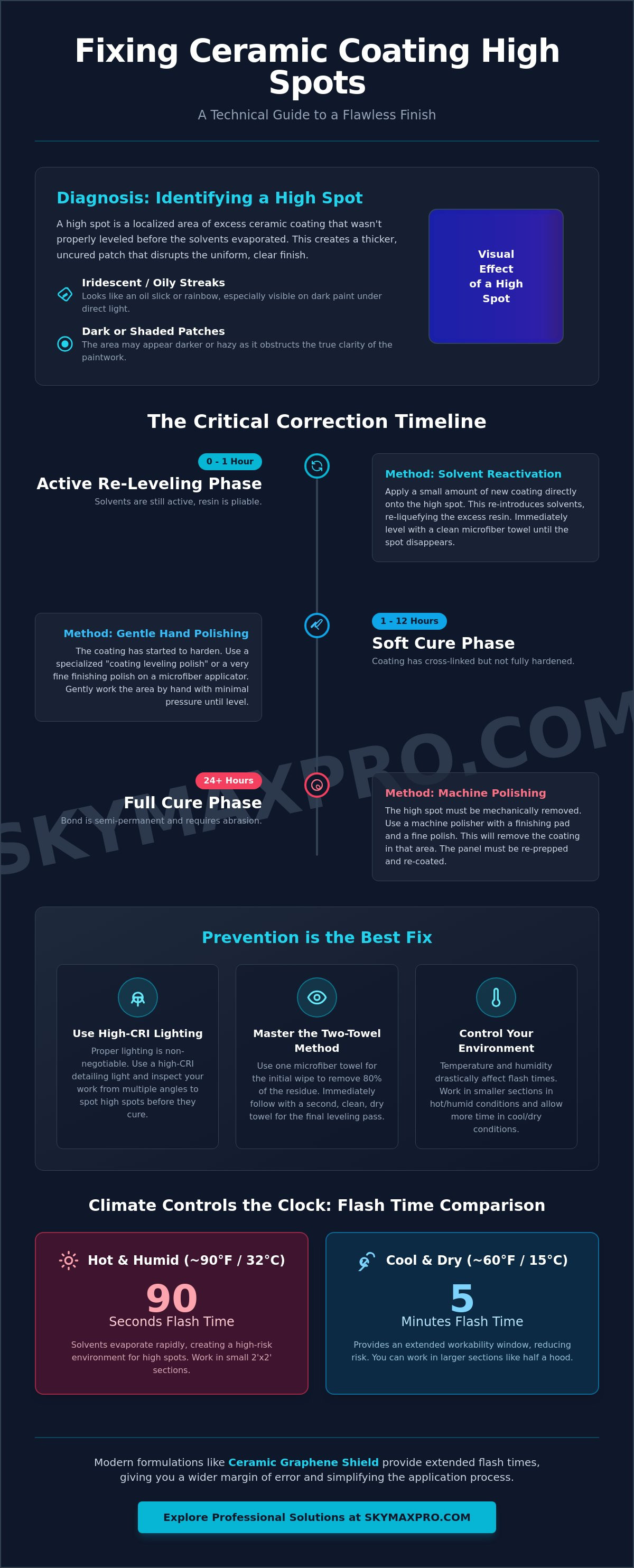
The 0–20 minute window represents the "Active Re-leveling" phase. During this period, carrier solvents haven't fully evaporated, and the resin remains chemically receptive. Between 1 and 12 hours, the coating enters the "Soft Cure" phase. The lattice structure has formed, but it hasn't reached maximum density or hardness. Beyond 24 hours, the "Full Cure" phase is reached. At this point, the bond is semi-permanent and requires mechanical abrasion for removal. Graphene-based formulas, such as the Ceramic Graphene Shield Coating, often provide a more stable application window, yet they still adhere to these fundamental chemical stages.
Immediate Recovery (The First 20 Minutes)
If you detect an iridescent streak within minutes of application, the most efficient solution is solvent reactivation. This relies on the "Like-Dissolves-Like" chemical principle. By applying a few fresh drops of the same coating to a clean applicator and lightly wiping the high spot, you reintroduce solvents that soften the partially dried resin. This allows you to re-level the area using a clean, low-pile microfiber towel. This method is the least invasive way to address errors before the curing process becomes irreversible.
Delayed Recovery (The 2-12 Hour Mark)
Once the coating has sat for several hours, simple reactivation usually fails. The initial cross-linking has already created a resistant barrier that fresh solvents cannot easily penetrate. Water-based leveling agents are ineffective at this stage because they lack the chemical strength to break down the resin. Instead, you must assess the coating's hardness. If the spot is visible but the surface is no longer tacky, a specialized detailer or a very mild hand polish is often required. The goal is to level the protrusion without removing the entire base layer, which requires precise pressure and a high-quality microfiber medium.
Determining how to fix ceramic coating high spots during this middle phase requires a balance of chemical knowledge and physical technique. If the high spot resists a mild chemical wipe, it's a signal that the nanostructure has progressed too far for non-abrasive methods. In such cases, waiting for the soft cure to stabilize before a light mechanical leveling is often the safest engineering choice for the clear coat.
Technical Methods to Fix Ceramic Coating High Spots
Executing a corrective protocol requires a selection of tools and techniques that match the coating's current chemical state. When determining how to fix ceramic coating high spots after the initial flashing phase, technicians must choose between chemical and mechanical intervention. The objective is always to restore surface uniformity while preserving as much of the protective nanostructure as possible. A graduated approach ensures that you don't use excessive force on a defect that only requires minor leveling.
- Method 1: Chemical Reactivation: This is the standard procedure for spots caught within 60 minutes. It uses fresh resin to re-liquefy the tacky surface.
- Method 2: Hand Polishing: This provides localized mechanical leveling for isolated spots caught within 12 hours.
- Method 3: Machine Correction: This is mandatory for high spots that have reached a full cure, typically after 24 hours of bonding.
- Method 4: Spot Re-application: This is the final engineering step used to replace any protection removed during the leveling process.
Step-by-Step Hand Polishing Protocol
Hand polishing is the preferred method for defects that have progressed past the point of chemical reactivation but haven't yet reached maximum hardness. This technique allows for extreme precision, ensuring you only affect the specific area of the high spot. High spot hand-polishing is a precision removal of excess resin rather than a full coating strip. Follow this technical sequence:
- Select a fine-grade finishing polish and a dual-action foam applicator. Avoid aggressive compounds that can scour the clear coat.
- Apply light, consistent pressure in a circular motion directly over the high spot. Limit your work area to a 2x2 inch section to avoid affecting the surrounding cured coating.
- Wipe the area with an Isopropyl Alcohol (IPA) solution to remove polish oils and inspect the results under high-CRI lighting.
Machine Correction for Cured High Spots
When a high spot has fully cross-linked, hand methods are often insufficient. You must use a Dual Action (DA) polisher equipped with a soft finishing pad. The DA motion mimics hand movement but provides the consistent oscillation needed to level hardened SiO2 or graphene structures. Keep the machine at a low speed to minimize heat buildup, as excessive thermal energy can cause the remaining coating to delaminate or "smear."
Avoid aggressive compounding. The goal is to "shave" the high spot down to the level of the surrounding surface. Once the iridescent streak is no longer visible under a diagnostic light, clean the panel thoroughly to remove all residue. Finally, restore the integrity of the sacrificial layer by reapplying a thin, even coat of Ceramic Graphene Shield. This ensures the corrected area matches the hydrophobic and protective properties of the rest of the vehicle.
Engineering the Perfect Application to Prevent Leveling Issues
Prevention is the most efficient engineering strategy in automotive surface protection. While understanding how to fix ceramic coating high spots is a necessary reactive skill, establishing a controlled application environment eliminates the need for corrective labor. High spots are rarely the result of product failure; they are symptoms of environmental or procedural mismanagement. By standardizing your application protocol, you ensure a uniform nanostructure across the entire substrate.
Environmental monitoring is mandatory for professional results. Ambient humidity and surface temperature directly dictate the solvent evaporation rate. If the panel temperature reaches 90 degrees Fahrenheit, the flash time can drop to a mere 90 seconds. In these high-heat conditions, you must reduce your working section size to ensure the leveling process keeps pace with the chemical transition. Conversely, in a 60-degree environment, the window extends to five minutes, allowing for larger sections. Matching your section control to these variables is the first line of defense against resin accumulation.
Advanced Lighting and Inspection Techniques
Optical clarity depends on precision inspection. Standard overhead shop lights are insufficient for detecting localized resin thickness. Use high-CRI light sources in the 4000K to 5000K range, as this spectrum is engineered to reveal "shadow" spots and iridescent streaks that warmer or cooler lights might mask. Implement the "headlamp method" by viewing the panel from a 45-degree angle. This perspective uses light refraction to highlight surface irregularities. Systematic inspection patterns are essential for large horizontal surfaces like hoods and roofs, where high spots are most common due to lighting angles.
Towel Management for Professional Results
Effective leveling requires a strict towel rotation protocol. Low-GSM, closed-loop microfiber towels are preferred for the initial leveling of car detailing products because they absorb excess resin without redepositing it. Use the "two-towel method": the primary towel levels the bulk of the product, while a secondary, clean buffing towel removes the remaining residue. Implement a "flip and fold" technique to ensure a fresh surface for every pass. Once a towel becomes saturated with resin, it must be discarded immediately to prevent streaking.
Achieving a defect-free finish requires the right tools and a disciplined approach. To ensure you have every component necessary for a successful installation, consider the Ceramic Coating Kit, which is engineered for professional-grade surface prep and application.
Professional Solutions for High Spot Recovery and Maintenance
Technical proficiency in automotive protection isn't solely about application technique; it's about utilizing advanced chemical formulations that provide a wider margin for error. While previous sections detailed how to fix ceramic coating high spots through mechanical and chemical means, the most effective engineering strategy involves selecting products designed for stability. High-performance coatings and specialized maintenance agents ensure that once a surface is corrected, it remains uniform and hydrophobic throughout its service life.
The SKY MAXPRO Ceramic Graphene Shield is specifically engineered to address the volatility of traditional ceramic resins. By integrating graphene into the SiO2 matrix, the coating offers extended flash times, which significantly reduces the pressure on the technician during the leveling phase. If an error is detected, the Water Spot Remover serves as a critical diagnostic tool. It's essential for removing mineral deposits that can be easily mistaken for high spots, preventing unnecessary polishing of the base layer. For long-term preservation, the Quick Detailer Spray with Ceramic High Gloss Finish provides the necessary lubrication and sacrificial protection to maintain the corrected surface without introducing new swirls.
Why Graphene Technology Reduces Leveling Errors
Graphene technology represents a significant leap in material science for surface protection. Unlike standard ceramics, the graphene lattice structure provides a more distinct visual "flash" signal, making it easier for the technician to identify exactly when to begin the leveling process. This structural integrity also translates to superior thermal stability. Graphene coatings are more resistant to "flash drying" in challenging environments, such as higher ambient temperatures or humidity levels that would cause traditional products to harden prematurely. Utilizing professional car detailing supplies allows even DIY users to benefit from these industrial-grade chemical advantages, ensuring a more predictable installation.
Maintenance After High Spot Correction
Once you've successfully executed the protocol for how to fix ceramic coating high spots, the corrected area requires a specific stabilization period. You shouldn't wash the vehicle with aggressive detergents for at least seven days to allow the newly applied spot-treatment to reach full cross-linking density. During this period, avoid any contact that could cause mechanical abrasion to the soft resin.
For ongoing care, the Ceramic Waterless Car Wash is the ideal solution. It allows for the removal of light surface contaminants without the risk of hard water spotting or friction-induced marring. Maintaining the integrity of the nanostructure depends on following established auto detailing protocols that prioritize chemical cleaning over physical scrubbing. By using a complete Ceramic Coating Kit, you ensure that every stage of the process, from initial prep to post-correction maintenance, is supported by a cohesive system of engineered solutions.
Achieving Aerospace-Grade Surface Uniformity
Precision timing and environmental monitoring are the foundations of a defect-free finish. You've now mastered the technical protocols for identifying resin accumulation and understanding how to fix ceramic coating high spots based on specific curing windows. Whether you're utilizing chemical reactivation within the first hour or localized mechanical leveling after a full cure, the goal remains the restoration of optical clarity without compromising the substrate. By implementing advanced lighting strategies and the two-towel method, you can eliminate these irregularities at the source.
Our solutions are manufactured in the USA and utilize aerospace-grade nanotechnology formulations designed to provide superior thermal stability and extended flash times. These engineering advantages make professional-grade results accessible to both DIY enthusiasts and high-volume detailing professionals. Don't let application errors compromise your vehicle's protection or aesthetic value. Take command of your next project with tools engineered for precision and durability.
Shop Professional Ceramic Graphene Kits at SKY MAXPRO
Frequently Asked Questions
Can I just wipe a high spot with water to fix it?
No, water is completely ineffective for removing high spots because ceramic resins are engineered to be hydrophobic and solvent-based. Water lacks the chemical strength to reactivate the carrier solvents or dissolve the bonding resin once it begins to flash. Attempting to use water might even introduce mineral deposits, further complicating the surface correction process. You must use either fresh coating for reactivation or a dedicated polish for mechanical leveling.
Will a ceramic coating high spot go away on its own over time?
A high spot will not disappear or level out on its own. Once the cross-linking process is complete, the excess resin becomes a permanent part of the protective lattice structure. These iridescent streaks are semi-permanent and will remain visible for the entire lifespan of the coating unless you intervene. They require specific technical methods, such as chemical softening or abrasive polishing, to be removed from the clear coat.
Is it possible to fix a high spot after the coating has fully cured for 24 hours?
Yes, you can fix a high spot after a full cure, but it requires mechanical abrasion rather than chemical reactivation. At the 24-hour mark, the nanostructure has reached maximum density and is resistant to solvents. You'll need to use a fine finishing polish and a dual-action polisher to carefully shave down the excess resin. This is the most common method for how to fix ceramic coating high spots found a day after the initial application.
What is the best polish to use for removing ceramic coating high spots?
The best choice is a fine-grade finishing polish or a silica-infused polish designed for ceramic maintenance. You should avoid aggressive cutting compounds, as these can easily strip the coating entirely or scour the underlying clear coat. The goal is to use the least aggressive method possible to level the protrusion. A foam finishing pad combined with light pressure provides the necessary control for precise resin removal without damaging the surrounding protection.
Does a high spot mean the coating is not protecting the paint in that area?
A high spot actually indicates an area of excessive protection, but it compromises the optical finish of the vehicle. The iridescent or dark patch is a localized concentration of SiO2 or graphene resin that's thicker than the surrounding layer. While the paint is technically shielded from environmental contaminants, the uneven thickness causes light to refract incorrectly. This results in the "rainbow" effect that detracts from the vehicle's aesthetic uniformity.
How can I tell the difference between a high spot and a water spot?
High spots typically appear as dark, oily streaks or iridescent patches, while water spots are usually white, circular mineral deposits. You can identify the difference by using a dedicated Water Spot Remover. If the mark disappears after a chemical wipe, it was a mineral deposit. If the mark remains and looks like a "smudge" under LED lighting, it's a high spot that requires mechanical leveling to resolve.
Can I apply a second layer of coating over a high spot to hide it?
No, applying an additional layer will only amplify the visibility of the high spot. Ceramic coatings are optically clear, meaning they don't hide surface defects; they encapsulate them. Adding more product over an unleveled area will trap the high spot and potentially make the dark patch even more prominent. You must level the surface and remove the excess resin before attempting to apply any additional layers of protection.
Do graphene coatings have more high spots than traditional ceramic coatings?
Graphene coatings don't inherently produce more high spots, and they often provide a clearer visual signal during the flashing phase. Advanced graphene shields are engineered with superior thermal stability, which helps prevent the "flash drying" that leads to leveling errors. These formulations often give the technician a more predictable window for identifying how to fix ceramic coating high spots before the resin reaches a hard cure, leading to a more consistent finish.