

A true mirror finish isn't the result of a single product; it's a precise manipulation of the paint surface's refractive index through multi-stage engineering. You've likely experienced the frustration of spending hours buffing only to see a cloudy, hazy finish or swirl marks that compromise the vehicle's clarity after just one wash. Mastering how to apply car wax sealant for a mirror finish requires moving beyond basic application to a professional understanding of surface preparation and molecular layering. We agree that a temporary shine is insufficient for high-level detailing where the goal is maximum Distinction of Image (DOI) and measurable reflectivity.
This guide provides a technical roadmap to achieving a high-definition, deep-wet look that offers more than just aesthetic appeal. You'll learn the exact sequence of surface decontamination and bonding techniques required to create a durable, high-gloss barrier. We'll analyze the engineering behind surface leveling and the role of specialized polymers that can provide a UV protection factor approximately 40% higher than standard carnauba products. By utilizing the specific methodology for layering our Ceramic Deep Wet Mirror Shine Wax Sealant, you'll possess the expertise to transform any vehicle surface into a high-performance reflective shield with long-lasting structural integrity.
Key Takeaways
- Identify Distinction of Image (DOI) as the primary engineering metric for mirror-like clarity and understand how micro-imperfections scatter light.
- Execute a rigorous surface engineering protocol using chemical decontamination and Final Touch I PRO Detailing Clay to maximize the paint's refractive index.
- Master the precise sequence of how to apply car wax sealant for a mirror finish by ensuring synthetic polymers bond directly to the clear coat.
- Utilize the professional Two-Towel Method for streak-free leveling to prevent haze and manage ambient environmental variables during application.
- Maintain the high-definition finish through pH-neutral maintenance and the strategic use of sacrificial layers to protect the primary wax-sealant bond.
The Physics of Reflectivity: Understanding the Mirror Finish
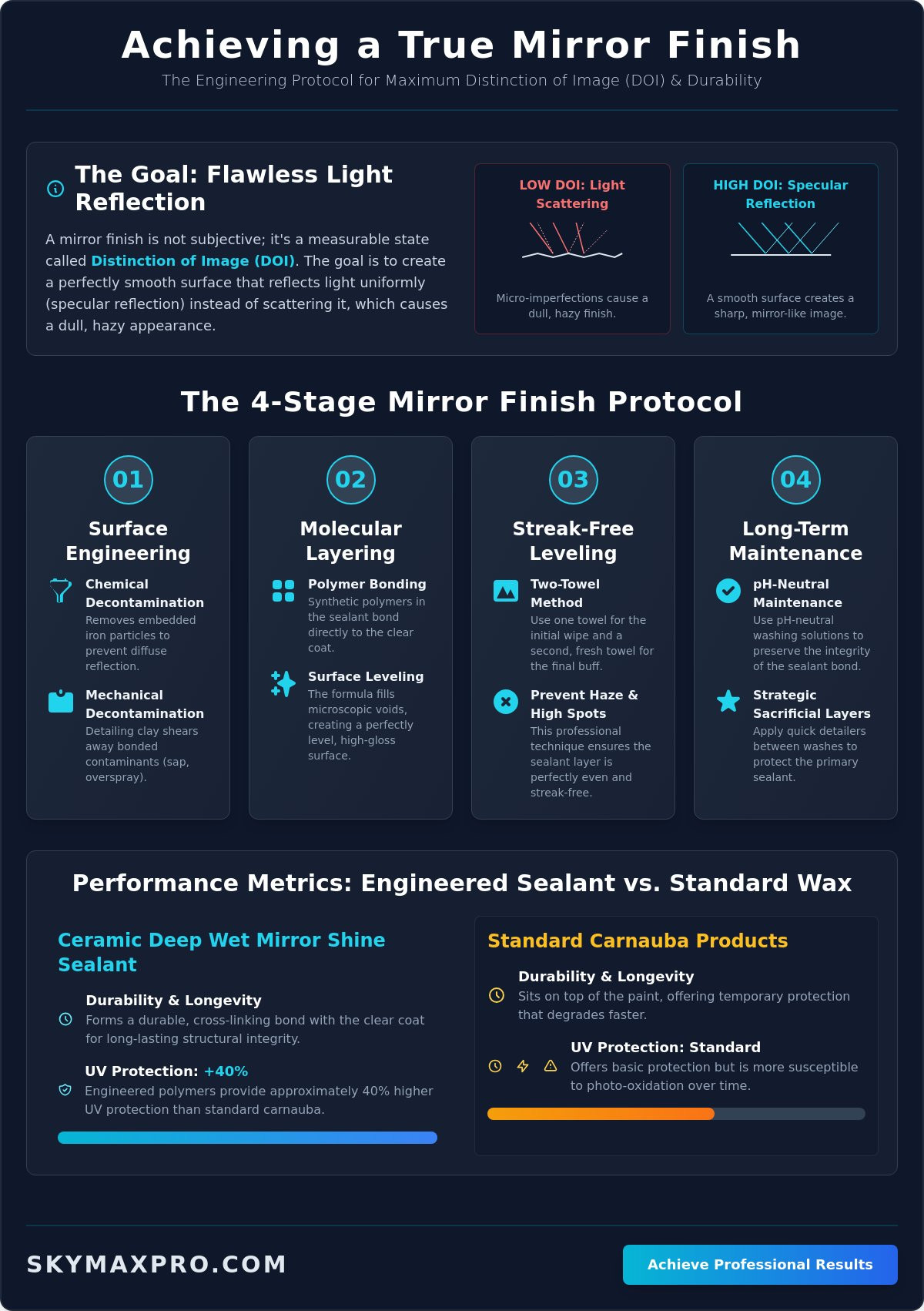
A mirror finish isn't a subjective aesthetic choice; it's a measurable optical state defined by the Distinction of Image (DOI). In professional detailing, DOI quantifies the sharpness of a reflection on a scale from 0 to 100. Achieving a high DOI requires a fundamental understanding of how light interacts with modern automobile paint. When photons hit a surface, they either reflect specularly in a single direction or scatter due to micro-imperfections. Microscopic peaks and valleys on the clear coat surface, often invisible to the naked eye, act as prisms that deflect light at irregular angles. This scattering creates a sterile or dull appearance, regardless of how clean the vehicle is.
To solve this, advanced formulations use high-refractive index polymers. These molecules are engineered to settle into surface voids, effectively leveling the substrate at a microscopic scale. While traditional carnauba waxes provide a warm glow, they often lack the optical clarity of aerospace-grade synthetic sealants. Synthetic polymers create a more uniform layer that maximizes light return. Understanding this physics is the first step in learning how to apply car wax sealant for a mirror finish that lasts. By filling these microscopic gaps, we reduce light diffusion and increase the surface's total luminous flux.
Refraction vs. Reflection
Reflection occurs when light bounces off the top layer of the sealant. Refraction happens when light passes through the clear coat and bends. If the surface is uneven, light bends inconsistently. This ruins the 1:1 reflection ratio needed for a mirror look. High surface tension is also critical. It ensures that the product doesn't just sit on the paint but forms a cohesive, dense layer. This density creates the wet look aesthetic. It mimics the refractive properties of standing water without the evaporative instability found in natural oils.
The Role of UV Protection in Maintaining Clarity
Optical clarity is constantly under threat from ultraviolet radiation. UV rays initiate photo-oxidation, which breaks down the molecular bonds in the clear coat. This chemical degradation creates a microscopic fog that permanently lowers the DOI. Superior protection requires a barrier that absorbs or reflects these wavelengths before they reach the paint. We emphasize VOC-free formulations because they prevent the solvent-based swelling that can lead to premature clear coat failure. Preserving the structural integrity of the paint is just as important as the initial shine when considering how to apply car wax sealant for a mirror finish. Without a UV-stable foundation, the mirror effect will degrade into a hazy finish within weeks.
Surface Engineering: Prepping the Paint for Maximum DOI
Achieving a high Distinction of Image (DOI) requires more than just a clean surface; it requires a surgically sterile substrate. The technical process starts with chemical decontamination. Iron particles from brake dust and industrial fallout embed themselves into the clear coat, creating microscopic jagged points. If you skip this step, you're essentially learning how to apply car wax sealant for a mirror finish over a landscape of metallic shrapnel. These particulates cause diffuse reflection, violating the fundamental law of reflection which dictates that a smooth surface is mandatory for specular clarity.
Following chemical treatment, mechanical decontamination is necessary. Using a professional-grade detailing clay ensures that bonded contaminants like tree sap or overspray are sheared away. Once the surface is mechanically smooth, surface stripping is performed. This removes residual silicone or old wax layers that interfere with the sealant's cross-linking process. A final inspection under high-lumen LED lighting is the final engineering check. Standard ambient light often masks micro-marring that will compromise the final reflection.
The Importance of a Clean Slate
Applying a high-gloss sealant over a contaminated surface effectively traps dullness beneath a protective layer. This creates a sterile look where the paint lacks depth. The plastic bag test remains the industry standard for verification. By placing your hand inside a thin plastic bag and sliding it over the dry paint, you amplify the tactile feedback of surface imperfections. If the surface feels granular, the decontamination phase isn't complete. For those seeking a professional edge, our Exterior Detailing Kit provides the necessary tools for this critical engineering phase.
Polishing for Optical Perfection
Swirl marks and micro-scratches function as tiny prisms. They catch light and scatter it, which is the primary cause of the hazy look many enthusiasts struggle with. Polishing isn't about filling these scratches; it's about leveling the surrounding clear coat to the depth of the scratch. This restores a flat plane for light to bounce off. Choosing the right abrasive grade is a balance between material removal and finish refinement. A heavy-cut compound might be necessary for deep defects, but a fine finishing polish is what truly elevates the DOI. Understanding how to apply car wax sealant for a mirror finish involves knowing that the sealant protects the shine, but the polish creates it.
The Layering Protocol: Applying Sealant and Wax for Depth
Layering is a precise chemical operation that requires a specific hierarchy of application to ensure molecular bonding. The "Sealant First" rule is a non-negotiable standard in professional detailing. Synthetic polymers are engineered to cross-link directly with the clear coat. If a natural wax is applied first, its oils will prevent the sealant from bonding, which leads to premature failure of the protective layer. By applying a base layer of synthetic protection, you create a stable foundation that maximizes specular reflection. This university-level concept explains why a flat, uniform surface is the only way to achieve a true mirror finish.
Our Ceramic Deep Wet Mirror Shine Wax Sealant utilizes a hybrid formulation that combines the durability of synthetic polymers with the visual depth of ceramic components. Curing time is the most overlooked variable in this process. Most synthetic sealants require a 12 to 24 hour window to fully cross-link. During this phase, the molecular structure hardens into a protective shield. Rushing to add a second layer before the first has cured results in "solvent slap," where the solvents in the second layer dissolve the uncured base. Understanding these chemical interactions is vital when learning how to apply car wax sealant for a mirror finish that maintains its integrity over time.
Mastering the Thin Layer Technique
Applying a thick coat is a common technical error. More product doesn't increase protection; it only makes leveling more difficult and increases the risk of hazing. Use a cross-hatch pattern to ensure 100% surface coverage without gaps. Monitor the surface for the "flash point," which is when the liquid carrier evaporates and leaves a light haze behind. This indicates the product is ready for leveling. Precision at this stage prevents the cloudy finish often associated with improper application.
Stacking for the "Wet Look"
Once the base layer has cured, you can stack additional products to enhance the depth of the finish. Stacking adds physical thickness to the protective barrier, which increases the refractive index of the surface. For maximum efficiency, we recommend using a PRO Ceramic Graphene Spray Coating as a topper. Graphene-infused sprays offer high chemical resistance and complement the base sealant without causing interference. This synergy creates the "wet look" while maintaining the structural integrity of the primary mirror finish. This is the definitive method for how to apply car wax sealant for a mirror finish that withstands environmental stress. For those starting their first professional-grade project, our comprehensive exterior solutions provide the chemical compatibility required for these advanced layering techniques.
Professional Leveling: Avoiding Haze and High Spots
Leveling is the mechanical phase where the applied product is refined into a uniform, microscopically thin layer. This step determines the final optical clarity of the vehicle. While the application phase introduces the protective material, leveling ensures that the material doesn't interfere with the paint's refractive uniformity. A common failure in understanding how to apply car wax sealant for a mirror finish is treating removal as a simple wipe-down. In professional engineering contexts, we utilize the Two-Towel Method to achieve a streak-free, high-definition result.
The Two-Towel Method involves a primary towel with a medium-pile weave to remove the bulk of the flashed residue. This is immediately followed by a secondary, high-GSM (Grams per Square Meter) microfiber towel for the final buff. High-GSM towels, typically 500 or above, provide the necessary surface area to trap microscopic particulates without inducing secondary marring. If you identify a "high spot"—a dark, oily patch where the sealant has bonded too thickly—you must "melt" it by re-applying a small amount of product to the area. This re-introduces solvents that soften the bond, allowing for successful leveling before the layer fully cures.
The Mechanical Action of Leveling
Pressure management is vital during this phase. Excessive force can strip the freshly bonded polymers before they've completed the cross-linking process. We recommend using light, linear motions rather than circular ones. Linear wiping reduces the risk of creating visible swirl patterns if a stray contaminant is caught in the towel. The final buff should be performed with zero downward pressure, relying on the microfiber's capillary action to lift any remaining carrier oils. This maximizes light refraction and ensures the surface meets the desired Distinction of Image standards.
Environmental Control
Ambient temperature and humidity directly dictate the flash point of aerospace-grade sealants. Direct sunlight is the primary enemy of a mirror finish because it causes the carrier solvents to evaporate too quickly, leading to "solvent trap" and permanent hazing. Optimal results are achieved in a controlled environment between 15°C and 25°C with low dust levels. If you encounter stubborn residues due to low humidity, using a quick detailer spray can act as a leveling lubricant. This assists in breaking down surface tension without compromising the underlying bond. For high-precision results, ensure you are equipped with professional-grade leveling tools designed for high-refractive coatings.
Maintaining Optical Clarity: The Post-Application Strategy
The engineering required to achieve a high-definition reflection is only half the battle; the second half is preserving the structural integrity of the bond. Once you've mastered how to apply car wax sealant for a mirror finish, you must shift your focus to maintenance protocols that prevent environmental degradation. The primary threat to optical clarity is the use of high-pH detergents found in most automatic car washes. These caustic chemicals are designed to strip organic matter but also aggressively break down the synthetic polymers in your sealant. To maintain the Distinction of Image (DOI), use only pH-neutral car wash soaps that provide high lubricity without leaving behind wax-masking surfactants.
A "sacrificial layer" strategy is the most effective way to protect the primary mirror finish. This involves applying a secondary, less permanent layer over the cured sealant to absorb environmental impact. We recommend a monthly "recharge" using our PRO Ceramic Graphene Spray Coating. This maintains the surface's refractive index while adding a layer of chemical resistance against bird droppings and industrial fallout. By ensuring the primary sealant remains untouched by mechanical or chemical abrasion, you extend the life of the high-gloss barrier and prevent the return of the "cloudy" finish often seen on poorly maintained vehicles.
The Science of Hydrophobicity
Hydrophobicity is more than a visual effect; it's a functional self-cleaning mechanism. High contact angles cause water to form spherical beads that roll off the surface, carrying away loose contaminants before they can bond. This prevents the formation of mineral deposits, or water spots, which act as microscopic obstructions to light. Modern ceramic coating technologies utilize this principle to reduce surface friction. Lower friction means that during the wash process, dirt particles slide off the paint rather than being dragged across it, which significantly reduces wash-induced marring and swirl marks.
The SKY MAXPRO Solution
Integrating the Ceramic Deep Wet Mirror Shine Wax Sealant into a professional car cleaning products routine ensures aerospace-grade durability across varying national climates. Whether facing high UV exposure or road salt, the cross-linked shield maintains its optical properties. To ensure year-round show-car results, follow this final maintenance checklist:
- Perform a contact wash every 7 to 14 days using the two-bucket method.
- Use a dedicated drying aid to minimize friction during the drying phase.
- Apply a graphene-based topper every 30 days to replenish the sacrificial layer.
- Monitor the surface for any loss in hydrophobicity as an indicator for re-application.
By following these data-driven maintenance steps, you ensure that the effort invested in learning how to apply car wax sealant for a mirror finish yields a long-term, high-performance result. Consistency in maintenance is the final step in the engineering process.
Advancing Beyond Standard Detailing to Surface Engineering
Achieving a mirror finish is a technical process involving the maximization of the Distinction of Image (DOI) through precise surface leveling and molecular layering. You've learned that a surgically clean substrate, achieved via chemical and mechanical decontamination, is the mandatory foundation for any high-refractive coating. By mastering the professional sequence of how to apply car wax sealant for a mirror finish, you eliminate the scattering of light caused by micro-imperfections and preserve the clear coat's structural integrity.
To secure these results, utilize formulations designed for extreme durability and optical clarity. Our products feature aerospace-approved nanotechnology and are engineered for maximum DOI. Proudly manufactured in the United States, our solutions provide the stability required for a long-lasting, high-definition reflection. Achieve a Professional Mirror Finish with SKY MAXPRO Ceramic Wax Sealant today and transform your vehicle's surface into a high-performance reflective shield. Confidence in your finish starts with engineering-grade protection.
Frequently Asked Questions
How long does a wax sealant mirror finish typically last?
A professional-grade synthetic sealant typically maintains its protective properties for 6 to 12 months. This longevity depends on environmental exposure and your specific maintenance routine. Hybrid formulations like our Ceramic Deep Wet Mirror Shine Wax Sealant provide a durable barrier that resists chemical degradation longer than traditional organic waxes. Regular maintenance with pH-neutral soaps is required to preserve the bond's structural integrity and optical clarity over this period.
Can I apply a sealant over an existing carnauba wax layer?
You shouldn't apply a synthetic sealant over carnauba wax because the wax's natural oils prevent the sealant from cross-linking with the paint substrate. This results in poor adhesion and a significant reduction in durability. Always strip old wax layers before starting the process of how to apply car wax sealant for a mirror finish. Using a heavy-duty degreaser ensures a surgically clean surface for the synthetic polymers to bond.
What is the difference between a mirror finish and a standard car wash shine?
The primary difference lies in the Distinction of Image (DOI) and light refraction. A standard car wash shine merely removes surface dirt, while a mirror finish involves leveling the clear coat to create a perfectly flat surface. This technical refinement ensures that light reflects specularly rather than scattering, resulting in a 1:1 reflection ratio. Standard shines lack the optical depth and surface uniformity found in engineered mirror finishes.
How many layers of sealant are necessary for maximum reflectivity?
Two layers of sealant are generally sufficient for maximum reflectivity and uniform coverage. The first layer establishes the primary bond with the clear coat, while the second layer fills any microscopic gaps left during the initial application. Adding more than two layers often provides diminishing returns and can complicate the leveling process. Precision during the application of these two layers is more important than the total number of applications.
Is it safe to use a machine polisher to apply a mirror shine sealant?
It's safe and often more efficient to use a Dual Action (DA) polisher with a soft foam finishing pad. The machine ensures a perfectly even, thin layer that's difficult to achieve by hand. Keep the speed setting low to prevent heat buildup, as the goal is distribution rather than paint correction. Machine application helps the polymers achieve a more uniform spread across the entire surface area of the vehicle.
What happens if I don’t let the sealant cure for the recommended time?
Failing to allow the sealant to cure results in a weak molecular bond and increased susceptibility to environmental damage. If you apply a second layer or expose the vehicle to moisture before the cross-linking is complete, you'll likely experience "solvent slap" or permanent hazing. This ruins the optical clarity you worked to achieve. Most professional sealants require a stable 12 to 24 hour window to reach full structural hardness.
Can a mirror finish hide existing scratches on my car paint?
A mirror finish won't hide deep scratches; it often amplifies them by increasing the surface's overall reflectivity. While high-refractive index polymers can fill microscopic marring, visible swirl marks must be mechanically removed during the polishing phase. Learning how to apply car wax sealant for a mirror finish effectively requires correcting these defects before the final sealing step. High-definition reflections demand a perfectly level substrate to avoid light distortion.
How does temperature affect the application of a mirror finish sealant?
Temperature directly influences the evaporation rate of the carrier solvents, also known as the "flash time." High temperatures cause the product to dry too quickly, leading to difficult leveling and the formation of high spots. Conversely, cold temperatures below 10°C can prevent the polymers from cross-linking correctly, resulting in an unstable protective layer. Optimal application occurs in a controlled environment between 15°C and 25°C with moderate humidity levels.