

Applying a high-grade carnauba wax over your professional ceramic coating is actually a functional regression that compromises the very engineering you paid to install. While the desire for that classic, deep-wet look is understandable, the technical reality is that traditional waxes possess a higher surface energy than the coating itself. This creates a layer that attracts and holds onto contaminants rather than repelling them. If you've asked yourself, "can you wax over ceramic coating" to boost gloss, the short answer is that you're likely masking the hydrophobic performance and self-cleaning properties of the SiO2 layer.
We understand the frustration of losing that specific glow after moving to a ceramic system. You shouldn't have to choose between protection and aesthetics. This article explains the science of surface bonding and why traditional waxes fail to adhere to slick, non-polar ceramic surfaces. You'll learn how to achieve maximum gloss and aerospace-grade protection without degrading your coating's performance. We'll examine the shift toward graphene-infused maintenance and provide a precise routine using products like our Ceramic Graphene Spray Coating to ensure your vehicle maintains a mirror finish through advanced chemical synergy.
Key Takeaways
- Understand why applying traditional carnauba over a cured surface results in a functional downgrade of its hydrophobic and self-cleaning properties.
- Discover the engineering conflict between the permanent covalent bonds of siloxane polymers and the mechanical adhesion requirements of organic waxes.
- Learn why the question of can you wax over ceramic coating typically leads to a "clogged" surface that attracts more environmental contaminants than a bare coating.
- Identify high-performance alternatives like graphene-infused spray coatings that chemically integrate with your existing protection rather than sitting on top of it.
- Master a professional maintenance protocol using aerospace-grade sealants designed to refresh the surface shine without compromising its low friction coefficient.
Can You Wax Over Ceramic Coating? The Distinction Between Possible and Optimal
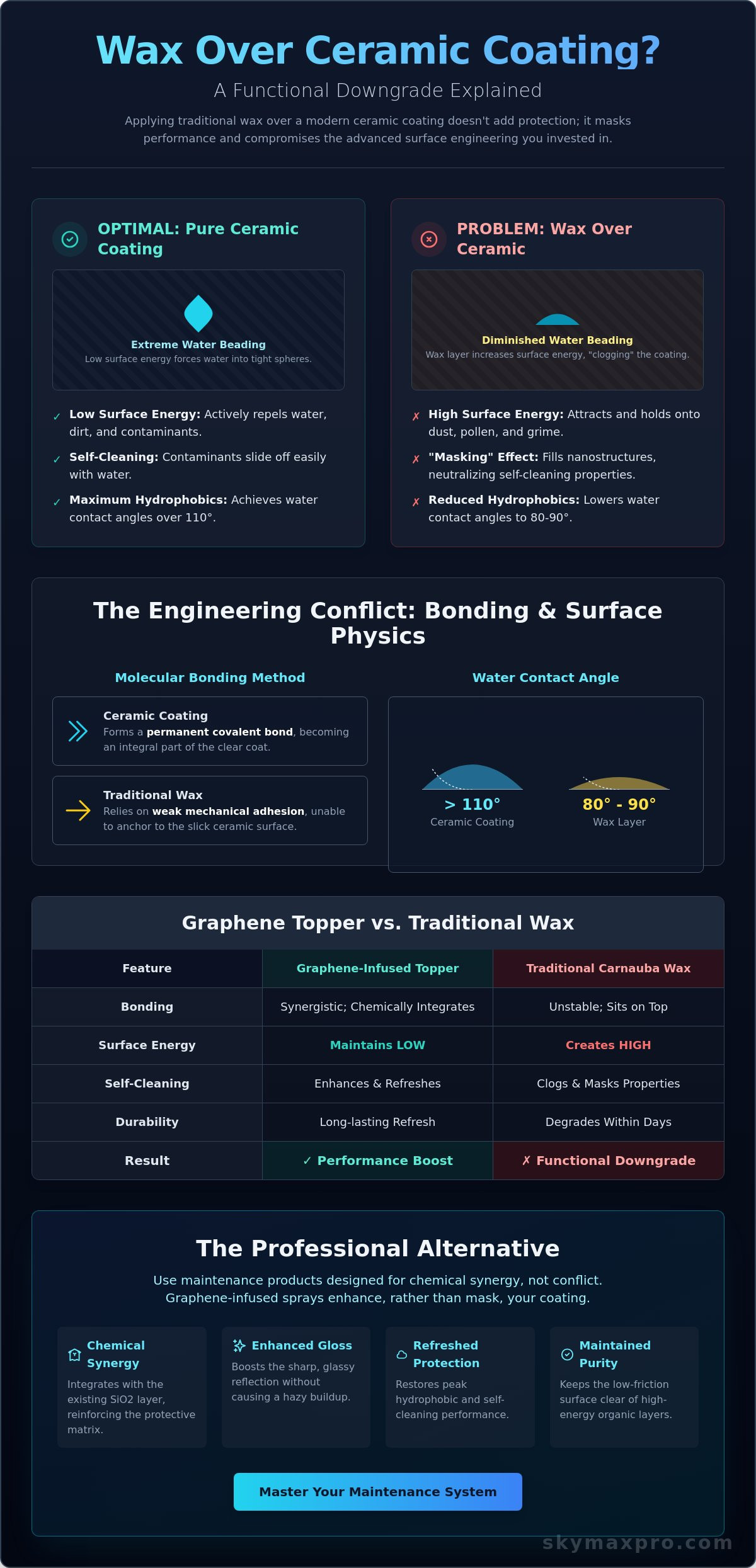
Technically, the answer is yes. You can apply wax over a cured ceramic coating without causing immediate physical degradation or chemical damage to the underlying layer. However, from an engineering perspective, this practice represents a functional downgrade of the surface properties. Ceramic coatings are specifically synthesized to provide a low surface energy environment, which is the primary mechanism behind their self-cleaning and hydrophobic capabilities. When you introduce a traditional wax, you are essentially replacing a high-performance, non-polar surface with a high-energy organic layer that possesses a greater affinity for atmospheric contaminants.
The core conflict lies in the physics of adhesion and repulsion. A professional coating, such as our Ceramic Graphene Shield Coating, creates a rigid, microscopic lattice that prevents dirt from finding an anchor point. Traditional carnauba waxes and synthetic sealants have a much higher surface energy, meaning they naturally attract and hold more dust, pollen, and industrial fallout than the coating beneath them. If you've been wondering, "can you wax over ceramic coating" to improve its performance, you'll find that doing so actually forces the surface to work harder to maintain its cleanliness.
The "Masking" Effect Explained
When an organic wax is applied over a nanostructure, it fills the microscopic "peaks and valleys" that facilitate extreme water beading. This creates a smoother, flatter surface at the molecular level, which paradoxically reduces the contact angle of water droplets. Masking is the temporary suppression of ceramic nanostructures by organic lipids. Once this layer is present, the self-cleaning characteristics of the ceramic are neutralized. Instead of contaminants sliding off during a rain event, they become embedded in the softer wax layer, requiring more aggressive maintenance cycles to remove.
Why Enthusiasts Still Want to Wax
Despite the technical disadvantages, many car owners feel a psychological pull toward traditional waxing. This often stems from the nostalgic "warm glow" associated with high-grade carnauba, which contrasts with the sharp, glassy, and almost clinical reflection provided by ceramic coatings. There's also a common misconception that a "sacrificial layer" of wax provides superior UV protection. In reality, modern nano-coatings offer significantly higher thermal and UV resistance than organic waxes, which begin to degrade at temperatures as low as 160°F. While the desire for a deep-wet look is valid, asking "can you wax over ceramic coating" usually reveals a need for better gloss-enhancement tools rather than a return to outdated organic chemistry.
The Engineering Conflict: Why Wax Struggles to Bond
Understanding the failure of wax on ceramic requires an analysis of molecular bonding. Ceramic coatings utilize silane or siloxane polymers to establish a permanent covalent bond with the vehicle's substrate. This chemical reaction creates a cross-linked shield that becomes an integral part of the clear coat. In contrast, traditional carnauba and synthetic waxes rely entirely on mechanical adhesion. They require a porous or high-energy surface to anchor their molecules effectively. Because a ceramic-coated surface is engineered to be non-polar and exceptionally slick, wax molecules simply cannot find a secure attachment point.
The physical result of this mismatch is often referred to as "wax ghosting." Within days of application, the wax layer begins to fail. It streaks or hazes as it slides across the low-energy surface rather than bonding to it. If you ask a specialist, "can you wax over ceramic coating" to add a sacrificial layer, the technical reality is that you're adding a temporary, unstable material over a permanent, stable one. This instability leads to premature degradation, rendering the effort of waxing redundant and counterproductive to the vehicle's long-term maintenance.
Surface Energy and Contact Angles
The evolution of ceramic coatings has pushed water contact angles to 110 degrees and beyond. This high contact angle is a direct result of low surface energy. Water beads into tight spheres because it has a higher affinity for itself than for the coating. Traditional wax typically achieves contact angles between 80 and 90 degrees. By applying wax, you lower the contact angle of the vehicle's surface. This transition causes water to sheet and dwell on the paint rather than rolling off. More importantly, higher surface energy attracts airborne pollutants. A waxed surface acts as a magnet for industrial fallout and brake dust, whereas a bare coating like our Ceramic Graphene Shield Coating maintains a superior self-cleaning state.
Chemical Incompatibility
Organic chemistry presents another hurdle for those wondering if they can you wax over ceramic coating without consequences. Natural carnauba contains essential oils and fatty acids that actively interfere with a ceramic’s ability to shed water. These oils can clog the nanostructure of the coating, effectively neutralizing its performance. Thermal stability also differs significantly between the two technologies. Organic waxes begin to liquefy and evaporate at temperatures between 160 and 180 degrees Fahrenheit. Ceramic coatings remain chemically stable at temperatures up to 1,000 degrees. During peak summer months, a dark-colored vehicle's surface can easily exceed the melting point of wax. At this stage, the organic wax acts as a "glue" for contaminants on an otherwise non-stick surface. It traps debris that would have otherwise washed away with simple high-pressure water rinse cycles.
Graphene vs. Traditional Wax: A 2026 Comparison
The automotive protection sector in 2026 has moved beyond simple silica formulations toward advanced carbon allotropes. Graphene coatings, such as our Ceramic Graphene Shield Coating, provide a friction coefficient significantly lower than traditional SiO2 products. This extreme slickness creates a mechanical barrier where organic molecules cannot find purchase. While the query "can you wax over ceramic coating" remains common among hobbyists, the honeycomb lattice of a graphene-reinforced surface makes it physically impossible for traditional paste wax to achieve meaningful adhesion.
Graphene's anti-static properties are a major technological advantage. These coatings actively repel dust by reducing the surface's electrical conductivity. Applying a static-prone organic wax on top of this precision-engineered layer neutralizes this benefit. You essentially trade a surface that stays clean for years for a layer that attracts dust and degrades within weeks. The durability gap is stark. A professional graphene application maintains its integrity for 5 to 7 years, whereas wax applied over such a slick surface often washes away in less than twenty-one days.
Thermal Dissipation and Water Spotting
Surface temperature management is a critical engineering metric. Graphene is a superior thermal conductor, allowing heat to dissipate across the panel rather than concentrating in specific areas. This reduction in surface temperature is vital for preventing water spotting. As a professional detailer explains, organic waxes behave differently. Wax absorbs and retains heat, which can increase the risk of mineral deposits etching into the soft wax layer during evaporation. Choosing Graphene Shield ensures your vehicle remains protected in high-heat environments where organic waxes would simply fail.
The Aesthetic Difference
Detailing enthusiasts often chase the "deep wet" look characteristic of high-end carnauba. Modern ceramic coating technology has evolved to replicate this depth without the chemical instability of lipids. Gloss meter readings confirm that graphene-infused layers provide a higher refractive index than wax-topped ceramic. This renders traditional wax obsolete. You achieve the desired visual saturation while maintaining the technical superiority of a professional-grade coating. If you've wondered "can you wax over ceramic coating" to gain more shine, the data suggests that a dedicated graphene maintenance routine is the only way to sustain that peak aesthetic performance.
The Professional Alternative: Ceramic Boosters and Maintenance
Replacing organic waxes with engineered maintenance products is the only way to preserve the integrity of a professional coating. Ceramic-infused boosters and graphene sprays are synthesized to integrate directly with the base SiO2 or graphene lattice. These products don't simply sit on top of the surface; they utilize compatible chemical surfactants to refresh the hydrophobic top-layer at a molecular level. While the question of whether can you wax over ceramic coating usually leads to performance loss, using a dedicated booster provides the sacrificial protection enthusiasts desire without the detrimental masking effects of organic lipids. These maintenance sprays are designed to chemically cross-link with the existing layer, creating a unified barrier that resists degradation from UV radiation and chemical exposure.
Proper maintenance focuses on chemical decontamination. It's not about adding unnecessary layers; it's about keeping the existing nanostructure clear of obstructions. By using chemistry that matches the original coating, you ensure that the surface energy remains low enough to repel contaminants while maintaining the aesthetic depth of a freshly detailed vehicle.
SiO2 and Graphene Maintenance Sprays
Modern car detailing products have evolved to include hybrid ceramic formulations. These products bridge the gap between a wash and a full coating re-application. Our PRO Ceramic Graphene Spray Coating uses a suspension of graphene oxide to fill microscopic wear patterns in the base coating. This maintains the ultra-low surface energy required for self-cleaning. If you wonder if can you wax over ceramic coating for better results, a graphene-based topper is the superior engineering choice. It offers the high-gloss finish of a show-car wax while maintaining the industrial-strength chemical resistance of a ceramic shield.
The Recommended Maintenance Cycle
An aerospace-grade maintenance protocol follows a structured process to ensure coating longevity. This routine prevents the accumulation of "environmental clogging" that often leads owners to believe their coating has failed.
- Step 1: pH-Neutral Wash. Use a ceramic-safe shampoo to remove loose surface contaminants. This prevents abrasive friction during the drying process and keeps the surface free of soap film.
- Step 2: Chemical Decontamination. Apply an iron and fallout remover to dissolve metallic particles embedded in the coating. Restoring the surface to its original smoothness requires chemical intervention rather than mechanical abrasion.
- Step 3: Graphene Topper Application. Apply a graphene-infused spray to the dry surface. This refreshes the hydrophobic properties and enhances the depth of the finish, providing a sacrificial layer that is chemically compatible with the base.
Maintaining your vehicle's performance requires precision tools rather than outdated wax applications. You can optimize your surface protection today by exploring our advanced maintenance solutions for a professional-grade finish.
Implementing the SKY MAXPRO Maintenance System
Transitioning from traditional automotive care to an aerospace-grade maintenance protocol requires a shift in priorities. Legacy methods focused on the frequent layering of organic substances to hide paint imperfections. Modern engineering focuses on maintaining the specific surface energy established by the initial coating. If you've spent time researching can you wax over ceramic coating, you've likely realized that most organic products are chemically incompatible. However, our Ceramic Deep Wet Mirror Shine Wax Sealant represents a unique technical exception. Unlike standard carnauba, this formula is engineered with synthetic siloxane polymers that allow it to bond securely with ceramic lattices without causing the functional regressions seen with traditional waxes.
Long-term paint health depends on prioritizing chemical compatibility over the urge to "layer" products. Using high-quality car detailing supplies is essential to prevent microscopic marring during the maintenance process. Even the most advanced coating can be compromised by poor mechanical agitation. Our system ensures that every touchpoint, from the initial decontamination to the final sealant, is chemically aligned to support the coating's structural integrity. This synergy prevents the "clogging" effect that occurs when incompatible oils are introduced to a low-energy surface.
The Role of Graphene Shield Coating
Establishing a foundation with our professional Ceramic Graphene Shield Coating provides a 5-year protection window that fundamentally changes your maintenance needs. This specific formulation utilizes a reinforced carbon lattice that eliminates the necessity for traditional wax toppers. Its inherent low friction coefficient and high thermal stability outperform organic lipids in every measurable metric. Before beginning the application of any maintenance product, ensure you follow our auto detailing checklist to guarantee the substrate is perfectly prepared for covalent bonding. Once the foundation is set, the question of can you wax over ceramic coating becomes irrelevant because the graphene layer provides a superior aesthetic and functional finish on its own.
Selecting the Right Maintenance Tools
Quarterly maintenance is most effectively performed using the PRO Ceramic Graphene Spray Coating. This product acts as a structural refresher for the base layer, filling microscopic voids and restoring peak hydrophobicity. Application should always be executed with clean, high-GSM microfiber towels to ensure even distribution and zero surface abrasion. Proper tools are just as critical as the chemistry itself in a professional detailing environment. To maintain your vehicle's aerospace-grade shine and ensure long-term durability, you can shop the Professional Graphene Maintenance Collection and access the same technology used by industry experts.
Optimizing Surface Longevity Through Chemical Synergy
Maintaining a professional-grade finish requires an understanding of molecular adhesion rather than a reliance on outdated layering habits. While the technical answer to can you wax over ceramic coating is yes, the engineering reality proves that doing so compromises the surface's low energy and self-cleaning efficiency. Transitioning to a maintenance routine centered on graphene-infused boosters ensures that your protection remains structurally sound while providing the aesthetic depth previously associated with organic carnauba.
Our formulations represent the pinnacle of surface science, utilizing aerospace-approved nanotechnology to deliver measurable results. Every product in our catalog is manufactured in the USA using VOC-free and eco-friendly formulations; this ensures high performance without environmental compromise. By prioritizing chemical compatibility, you protect your investment and maintain a mirror-like shine that lasts for years rather than weeks. It's time to move beyond traditional methods and embrace the next evolution of automotive care.
Upgrade to Aerospace-Grade Graphene Protection Today and experience the precision of professional engineering on every panel.
Frequently Asked Questions
Does waxing a ceramic coating void the warranty?
Waxing doesn't typically strip the coating, but it can invalidate performance-based warranties provided by professional installers. These warranties often mandate the use of specific SiO2-compatible maintenance products to ensure the coating's longevity. Applying an organic wax introduces incompatible chemistry that may hinder the self-cleaning properties, leading a manufacturer to deny claims related to coating failure or reduced hydrophobicity.
How can I get the "wax look" on a ceramic-coated car without using wax?
You can achieve the deep, warm aesthetic of carnauba by using graphene-infused maintenance sprays instead of traditional organic waxes. Products like PRO Ceramic Graphene Spray Coating are engineered to enhance the refractive index of the surface, providing a "wet" look while maintaining the covalent bond with the base layer. This approach ensures maximum optical clarity without the surface energy issues inherent when you ask can you wax over ceramic coating.
What happens if I already waxed over my ceramic coating?
If you have already applied wax, the immediate result is the "masking" of your coating's hydrophobic performance. The wax layer becomes the primary contact point, attracting more dust and environmental pollutants than the bare ceramic. To restore the coating's original properties, you must remove the wax layer using a pH-neutral strip wash or a diluted isopropyl alcohol solution to clear the surface energy barrier.
Can I use a "Ceramic Wax" instead of a traditional paste wax?
Using a dedicated "Ceramic Wax," such as Ceramic Deep Wet Mirror Shine Wax Sealant, is acceptable because these products utilize synthetic siloxane polymers rather than organic lipids. Unlike traditional paste waxes, these sealants are chemically compatible with the existing ceramic lattice. They provide the sacrificial protection you desire while integrating with the low-energy surface rather than simply sitting on top of it and attracting contaminants.
Will wax protect my ceramic coating from bird droppings?
Wax provides negligible protection against the acidic nature of bird droppings compared to a professional ceramic coating. Organic waxes begin to degrade at approximately 160°F, whereas ceramic coatings remain stable up to 1,000°F. The coating itself is engineered to resist chemical etching; adding a soft, heat-sensitive wax layer actually creates a trap for acids, potentially increasing the risk of surface damage during high-temperature exposure.
How do I remove a layer of wax from a ceramic coating without damaging the coating?
You can safely remove wax by using a specialized chemical cleaner like Heavy Duty Red Power Degreaser. This product is designed to break down organic lipids and wax bonds without affecting the cured ceramic or graphene layer beneath. Avoid using abrasive polishing compounds, as mechanical friction will degrade the nanostructure of the coating. A chemical-based decontamination is the most precise method for restoring the surface's low-energy state.
Is there any benefit to "stacking" different types of coatings?
Stacking is beneficial only when the products are engineered for chemical synergy, such as applying a graphene topper over an SiO2 base. This hybrid approach utilizes the different properties of each material, such as graphene's superior thermal dissipation and SiO2's hardness. However, stacking a high-energy organic wax over a low-energy ceramic coating offers no technical advantage and results in a functional regression of the surface properties.
Can I use a spray wax as a drying aid on a coated car?
Using a traditional spray wax as a drying aid is not recommended, as it leaves behind organic residues that mask the coating. Instead, use a Quick Detailer Spray with Ceramic High Gloss Finish during the drying process. This ensures that any product left on the surface is chemically compatible with the coating, enhancing slickness and gloss while maintaining the high water contact angles necessary for effective water shedding.