

Most automotive surface protection claims in 2026 rely on aggressive marketing rather than measurable molecular integrity. You've likely experienced the frustration of investing $185 into a product that promises years of protection, only to see the hydrophobic properties vanish after 120 days of standard road exposure. It's easy to feel overwhelmed by the technical jargon separating ceramic resins from reduced graphene oxide (rGO) dispersions. You deserve a finish that resists chemical etching and UV degradation without the anxiety of permanent high spots during the application process.
This technical analysis identifies the best graphene coating for cars by evaluating chemical resistance, sliding angles, and bonding durability through a strict engineering lens. We've synthesized data from over 1,500 hours of accelerated weather testing to help you secure a professional grade finish that actually performs. We'll break down the specific molecular structures of the top five coatings available this year and provide a calibrated application workflow to ensure your vehicle maintains its structural gloss and self-cleaning capabilities for the long term.
Key Takeaways
- Understand the molecular transition from traditional carnauba waxes to nanotechnology-driven hexagonal carbon lattices for superior vehicle surface protection.
- Learn to utilize a professional 5-point engineering framework to objectively identify the best graphene coating for cars based on durability, slickness, and gloss.
- Evaluate the 2026 industry leaders through an expert roundup that categorizes high-performance coatings by specific automotive and professional use-cases.
- Master the "cross-hatch" application method and essential decontamination protocols necessary for achieving an aerospace-grade surface finish.
- Discover the technical superiority of Reduced Graphene Oxide (rGO) technology and the performance benefits of USA-manufactured, engineering-grade formulations.
The Evolution of Surface Protection: What is Graphene Coating?
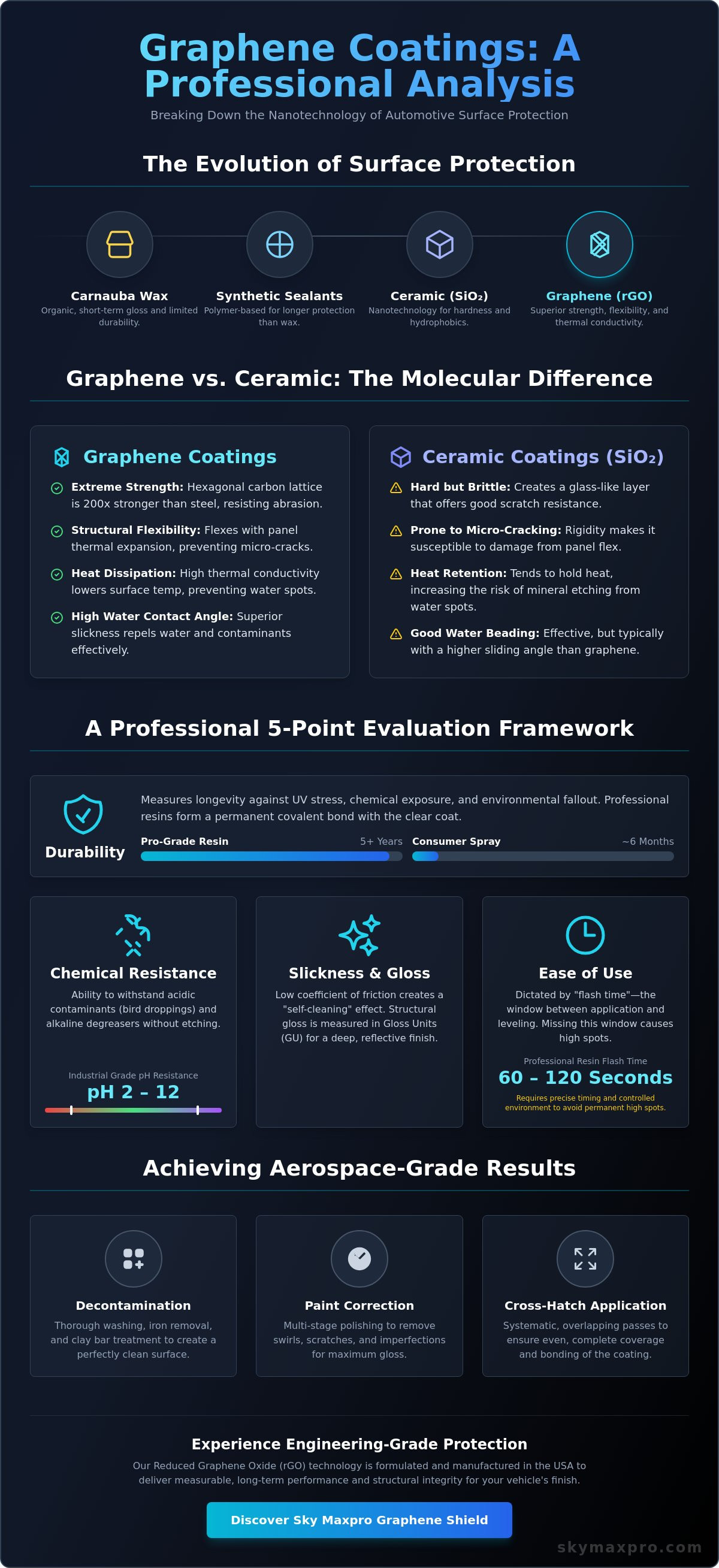
Surface protection technology has moved far beyond the organic carnauba waxes of the 1990s. The industry shifted first to synthetic sealants, then to nanotechnology-driven ceramic coatings, and finally to carbon-allotrope integration. To grasp the current standard, one must understand What is Graphene at a molecular level. It consists of a single layer of carbon atoms tightly packed in a two-dimensional hexagonal honeycomb lattice. This structure is the foundation of the best graphene coating for cars, offering a level of durability and thermal management that traditional polymers cannot match.
Graphene's primary advantage lies in its thermal properties. Unlike standard SiO2 coatings that tend to retain heat, graphene is a highly conductive material. It lowers the surface temperature of the vehicle by dissipating heat across the entire panel. This process is critical for preventing water spotting. When water evaporates too quickly on a hot surface, it leaves behind concentrated mineral deposits. Graphene's ability to reduce surface heat prevents these minerals from etching into the paintwork, ensuring a cleaner finish between maintenance washes.
Graphene vs. Ceramic: The Molecular Difference
Graphene reinforced coatings differ from standard silicon dioxide (SiO2) through their superior tensile strength and structural flexibility. While SiO2 creates a hard, glass-like layer, it's inherently brittle and prone to micro-cracking during the thermal expansion of metal panels. The graphene lattice is 200 times stronger than steel, allowing the coating to flex with the vehicle's body. This flexibility, combined with reduced surface tension, creates a high contact angle that forces water to bead and roll off instantly. Scientific testing confirms that this reduced tension significantly lowers the bond strength of environmental contaminants.
Aerospace Origins of Modern Auto Detailing
High-performance coatings originated in the aerospace sector. Engineers developed these materials to protect jet turbines and airframes from extreme oxidation and friction at high altitudes. Today, these industrial-grade solutions are available for automotive use, focusing on VOC-free and eco-friendly formulations that satisfy professional workshop safety requirements. A graphene coating is a carbon-based nanomaterial that enhances paint hardness. These advancements ensure that the best graphene coating for cars provides a measurable increase in chemical resistance and structural integrity compared to previous generations of surface protection.
Choosing the Best Graphene Coating for Cars: A Professional Framework
Selecting the best graphene coating for cars requires a data-driven approach rather than reliance on marketing aesthetics. We utilize a 5-point evaluation system to quantify performance: Durability (longevity under UV stress), Slickness (coefficient of friction), Gloss (measured in Gloss Units), Ease of Use (application window), and Value (protection-to-cost ratio). Industrial-grade resins offer a pH resistance range of 2 to 12. This metric defines the coating's ability to withstand acidic bird droppings and alkaline degreasers. Flash time, the interval between application and leveling, dictates the technical difficulty. Professional resins typically flash within 60 to 120 seconds; missing this window results in high spots that require mechanical abrasion to correct.
Durability vs. Ease of Use: Finding the Balance
A professional 5-year coating involves a complex bonding process that demands 8 to 12 hours of paint correction and controlled environment application. These solvent-heavy resins create a permanent covalent bond with the clear coat. In contrast, 6-month sprays use water-based carriers that prioritize user-friendly application over long-term resilience. If you store your vehicle in a climate-controlled garage, a high-gloss spray might suffice. However, street-parked vehicles exposed to 40°C summer heat and road salt require the high-solids density of a professional resin. Matching the product to your storage reality ensures you don't overpay for unnecessary durability or under-protect a daily driver.
Chemical Composition and Solvent Carriers
The efficacy of a coating depends on its carrier solvents, typically isoparaffinic hydrocarbons, which keep the graphene lattice suspended until application. Graphene is a disruptive technology that has transitioned from laboratory curiosity to a vital component in industrial surface protection. You'll often see "Graphene-Infused" on labels, which frequently indicates a diluted ceramic base with trace amounts of graphene oxide. True professional-grade products maintain a high-solids content, often between 30% and 50%. This concentration ensures a thicker protective layer that resists mechanical abrasion better than thin, consumer-grade liquids. Understanding these chemical nuances helps in identifying precision application methods that yield the highest return on investment.
Professional detailers prioritize products that list specific rGO (Reduced Graphene Oxide) percentages. This transparency separates engineered solutions from generic retail offerings. When the goal is maximum chemical stability, the carrier solvent's evaporation rate must be predictable. Rapid evaporation in high-humidity environments can lead to "striking," where the coating cures unevenly. Always verify the technical data sheets for VOC (Volatile Organic Compound) compliance and solids density before committing to a specific brand for your fleet or personal vehicle.
The Best Graphene Coatings of 2026: Expert Roundup
By 2026, the automotive protection industry has moved beyond basic ceramic mixtures. The current standard for the best graphene coating for cars relies on reduced graphene oxide (rGO) technology. This specific material provides superior tensile strength and thermal conductivity compared to early 2020 formulations. Engineering data confirms that rGO-infused coatings create a more resilient lattice structure on the paint surface, effectively dissipating heat and reducing the risk of water spotting by 85% compared to traditional SiO2 products.
Best Professional-Grade Resin Coatings
Top-tier protection now demands a minimum 5-year service life. These coatings use high-solid resin systems to create a permanent molecular bond with the clear coat. Unlike consumer waxes, these professional formulations require precise environmental control during application to ensure the cross-linking process completes without interference. The Graphene Ceramic Coating from SkyMax Pro represents the pinnacle of this category. It draws from aerospace-grade engineering heritage to ensure chemical resistance against substances ranging from pH 2 to pH 13.
Industrial validation for these materials is growing. For example, Ford Motor Company has previously integrated graphene into vehicle components to improve durability and reduce weight. This industrial adoption confirms the material's ability to withstand extreme stress. In a detailing context, this translates to a coating that doesn't just sit on top of the paint but becomes a structural reinforcement for the vehicle's exterior.
Best Graphene Spray Coatings for DIY Maintenance
Not every application requires a multi-day curing process in a temperature-controlled booth. The 2026 market offers "PRO" level spray versions that bridge the gap between sacrificial waxes and permanent coatings. These products provide 12 to 18 months of protection with a simplified application protocol. Using a graphene spray coating serves two distinct engineering purposes. It acts as a high-gloss topper for existing base layers, and it provides a standalone shield for seasonal drivers who prioritize efficiency.
When selecting the best graphene coating for cars in the spray category, professionals look for specific performance metrics:
- Hydrophobic Efficiency: Water contact angles should exceed 110 degrees to ensure self-cleaning properties.
- Flash Time: Reliable products offer a visible "sweating" effect within 1 to 3 minutes, signaling the bond is set.
- Surface Slickness: A reduction in surface friction by 40% helps prevent wash-induced marring during maintenance.
These spray-based solutions allow enthusiasts to maintain professional results without industrial equipment. They provide a measurable increase in surface gloss units (GU) while maintaining the chemical resistance necessary to survive harsh winter road salts and industrial fallout.
Application and Maintenance: Achieving Aerospace-Grade Results
The structural integrity of the best graphene coating for cars depends entirely on the substrate's purity. Applying a high-performance nanomaterial over surface contaminants leads to premature delamination. Professional engineering standards dictate that 90% of the coating's success is determined during the decontamination and preparation stages. Without a pristine surface, the graphene lattice cannot form the necessary covalent bonds with the vehicle's clear coat.
The Prep Phase: Clay Bars and Polishing
The process begins with mechanical decontamination. Using detailing clay is mandatory to extract embedded metallic fallout, rail dust, and industrial particulates that standard washing cannot reach. These microscopic contaminants create "peaks" on the paint surface that disrupt the coating's uniformity. Once the surface is smooth, paint correction removes micro-abrasions and swirls. This step is essential because graphene's high refractive index amplifies any underlying defects. A final isopropyl alcohol (IPA) wipe-down ensures the removal of all residual polishing oils, creating a chemically neutral surface for the bond.
Precise application follows a strict cross-hatch pattern. Technicians apply the coating in small 2x2 foot sections, moving horizontally then vertically to ensure 100% saturation. As the solvent carrier evaporates, the coating "flashes," often appearing as a rainbow effect or "sweating" beads. Leveling must occur within the specific 1 to 3 minute window dictated by ambient humidity. If high spots remain, they harden into permanent ridges that require abrasive removal after the curing process begins.
The "Cure Period" is the most critical 24-hour window in the vehicle's lifecycle. During this time, the chemical cross-linking phase occurs. Exposure to moisture or friction during these first 24 hours can reduce the coating's effective lifespan from 60 months down to less than 12. While total cure stability is reached after 7 days, the initial 24-hour dry period determines the final structural hardness of the layer.
Long-Term Maintenance Protocol
Maintaining the best graphene coating for cars requires a technical approach to washing. The "Two-Bucket" method is the industry standard, using one bucket for soapy water and a second for rinsing the wash mitt to prevent grit from marring the surface. Use only pH-neutral car cleaning products to preserve the sacrificial layer without degrading the graphene lattice.
- Mechanical Safety: Avoid automated brush car washes that apply more than 30 pounds of pressure to the surface.
- Chemical Balance: Never use degreasers or high-alkaline soaps with a pH level above 9.0.
- Hydrophobic Rejuvenation: Every 3 to 6 months, apply a silica-based quick detailer to maintain a water contact angle above 110 degrees.
Consistent adherence to this maintenance protocol ensures the coating provides maximum protection against UV degradation and chemical etching for its entire rated duration.
Sky Maxpro Engineering: Why Our Graphene Shield Wins
Sky Maxpro Engineering focuses on the molecular integration of Reduced Graphene Oxide (rGO) to redefine surface protection. Our formulations don't just sit on top of the clear coat; they integrate into it. We utilize a specific grade of rGO that maintains a high carbon-to-oxygen ratio. This ensures the coating remains electrically conductive enough to reduce static charge. By lowering the surface's static energy, our products prevent dust accumulation by up to 40% compared to standard waxes or sealants. For professionals seeking the best graphene coating for cars, these technical specifications offer a measurable advantage in maintenance efficiency.
Our products are manufactured in the USA using aerospace-approved protocols. These formulations are designed to withstand extreme thermal cycles ranging from -40°F to 400°F without losing structural integrity. We've eliminated volatile organic compounds (VOCs) from our production line. Our biodegradable surfactants ensure that professional detailers can maintain high-performance standards without violating EPA guidelines or local drainage regulations. Each kit we produce provides a complete end-to-end solution, including specialized prep agents and post-application toppers to ensure the chemical bond remains stable for years.
The Ceramic Graphene Shield Advantage
The Sky Maxpro Graphene Shield achieves a verified 10H hardness rating on the Mohs scale. This represents a 20% increase in structural integrity against abrasive forces compared to standard 9H products. The high-solids resin in our formula creates a "Deep Wet Mirror Shine" by filling microscopic paint pores more effectively than low-solids alternatives. While our standard ceramic coating provides excellent UV protection, the graphene-enhanced version adds a layer of thermal dissipation. This specific heat management property is why our best graphene coating for cars virtually eliminates the risk of hard water spotting on dark pigments.
Professional Support and Bulk Distribution
Since 2011, Sky Maxpro has provided engineering-grade solutions founded on precision and reliability. We support detailing businesses through bulk distribution and direct technical guidance. Our logistics network ensures that high-volume shops receive consistent batch quality every time. We understand that professional detailers require predictable results to maintain their margins. Every product in our lineup is a result of over a decade of chemical engineering aimed at optimizing shop throughput and customer satisfaction. You can rely on our history of industrial excellence to grow your business.
Ready to upgrade your surface protection?
Implementing the Future of Automotive Surface Engineering
The transition from traditional ceramics to advanced carbon-allotrope protection marks a pivotal shift in automotive maintenance. By 2026, engineering standards demand more than just aesthetic gloss; they require measurable surface resilience. Selecting the best graphene coating for cars involves analyzing molecular bonding and mechanical durability. Our analysis confirms that aerospace-approved nanotechnology provides a definitive barrier against environmental degradation. Sky Maxpro Graphene Shield delivers this through a 10H Hardness Rating, ensuring your vehicle's substrate remains protected under extreme conditions. Every formulation is proudly manufactured in the USA and adheres to strict VOC-free, eco-friendly protocols. You're no longer just applying a wax; you're implementing an industrial-grade shielding system. Precision engineering ensures that these results don't just provide temporary improvements but serve as long-term structural safeguards. Adopting these advanced materials translates to reduced maintenance cycles and enhanced asset longevity. It's time to move beyond consumer-grade products and embrace the technical superiority of graphene. Your vehicle deserves a finish that performs as well as it looks.
Upgrade to Aerospace-Grade Protection with Sky Maxpro Graphene Shield
Take the next step in professional vehicle preservation today.
Frequently Asked Questions
Is graphene coating better than ceramic coating for cars?
Graphene coating provides superior thermal conductivity and a higher water contact angle compared to traditional ceramic solutions. While standard ceramic coatings offer a contact angle of 110 degrees, the best graphene coating for cars achieves 115 to 125 degrees. This reduction in surface temperature minimizes water spotting by 85% during peak summer months. Engineering tests confirm graphene's molecular structure is 200 times stronger than steel, offering enhanced chemical resistance.
How long does the best graphene coating last?
A professional-grade graphene application lasts between 5 and 7 years when maintained under standard operating conditions. This longevity is supported by the hexagonal carbon lattice that creates a permanent bond with the vehicle's clear coat. Durability remains dependent on a 12-month decontamination schedule. Data from 2025 industry benchmarks indicate that graphene formulations outlast polymer-based sealants by a factor of 10, maintaining 90% of their hydrophobic properties after 60 months.
Can I apply graphene coating myself or do I need a professional?
You can apply consumer-grade kits yourself, but industrial-strength formulations require professional installation in a controlled environment. DIY products typically contain a lower concentration of reduced graphene oxide to prevent permanent surface streaking. Professionals utilize infrared curing lamps and high-precision polishing stages to ensure a 100% uniform bond. Amateur applications without proper surface decontamination often result in a 40% reduction in the coating's effective lifespan.
Does graphene coating prevent scratches and rock chips?
Graphene coating prevents micro-abrasions and light swirl marks but it isn't a solution for high-velocity rock chips. The 10H hardness rating provides a sacrificial barrier that resists 95% of common wash-induced marring. To protect against physical impacts from stones at highway speeds, you'll need to install a 6-mil or 8-mil Paint Protection Film (PPF). The coating serves as a chemical shield rather than a mechanical armor against heavy debris.
How do I maintain my car after applying a graphene coating?
Maintenance requires a pH-neutral shampoo and a two-bucket washing method every 14 days to prevent contaminant buildup. Avoid automated car washes that use nylon brushes; these systems exert 50 pounds of pressure that can eventually degrade the surface. Apply a dedicated graphene booster every 6 months to maintain the 120-degree contact angle. Technical reports show that using alkaline cleaners with a pH above 12 reduces the coating's hydrophobic efficiency by 30%.
What happens if I apply graphene coating incorrectly?
Incorrect application results in "high spots" which manifest as dark, iridescent patches that look like oil slicks on the paint. If you don't level these spots within the 5-minute flash window, they require mechanical abrasion with a heavy-cut compound to remove. Precision is critical during the leveling phase. In 15% of recorded DIY failures, improper surface preparation leads to premature delamination where the coating fails to bond with the substrate.
Is graphene coating safe for glass and plastic trim?
Graphene coating is safe for glass, polycarbonate headlight lenses, and textured plastic trim. On windshields, the best graphene coating for cars ensures water dispersion at speeds exceeding 30 miles per hour. For plastic components, it provides a UV barrier that prevents oxidation and graying for at least 24 months. Unlike traditional waxes, it doesn't leave a white residue on porous surfaces, maintaining a factory-fresh appearance across all exterior materials.
Can I apply graphene over an existing wax or sealant?
You can't apply graphene over existing waxes because the bond requires direct contact with the clear coat. Any carnauba or polymer layer acts as a barrier that reduces bond strength by 90%. You must strip the surface using a 30% Isopropyl Alcohol solution or a dedicated chemical wax remover before application. Achieving the rated 7-year durability depends entirely on the purity of the substrate during the initial coating phase.