

For a black automotive finish, the sun is not just a light source; it is a thermal adversary that can push surface temperatures 40 degrees higher than lighter colors. You already know that black paint is the most unforgiving substrate in the detailing world, where every micro-scratch and water spot is magnified. Finding the best ceramic coating for black paint requires moving beyond basic wax to engineering solutions that prioritize heat dissipation and optical clarity.
We'll show you how graphene-integrated formulas, such as those found in current 2026 hybrid technologies, provide a superior refractive depth while preventing the haze often seen in traditional applications. You'll learn why professional-grade coatings with over 80% silica dioxide content are essential for achieving a permanent "wet look" gloss. This guide explores the technical criteria for protecting dark finishes, comparing high-performance options like CarPro CQuartz UK 3.0 and Adam's Polishes Graphene Ceramic Coating Advanced. We'll also examine how to avoid the $3,000 cost of professional correction by utilizing advanced DIY graphene shields that offer 9H hardness and maximum thermal protection.
Key Takeaways
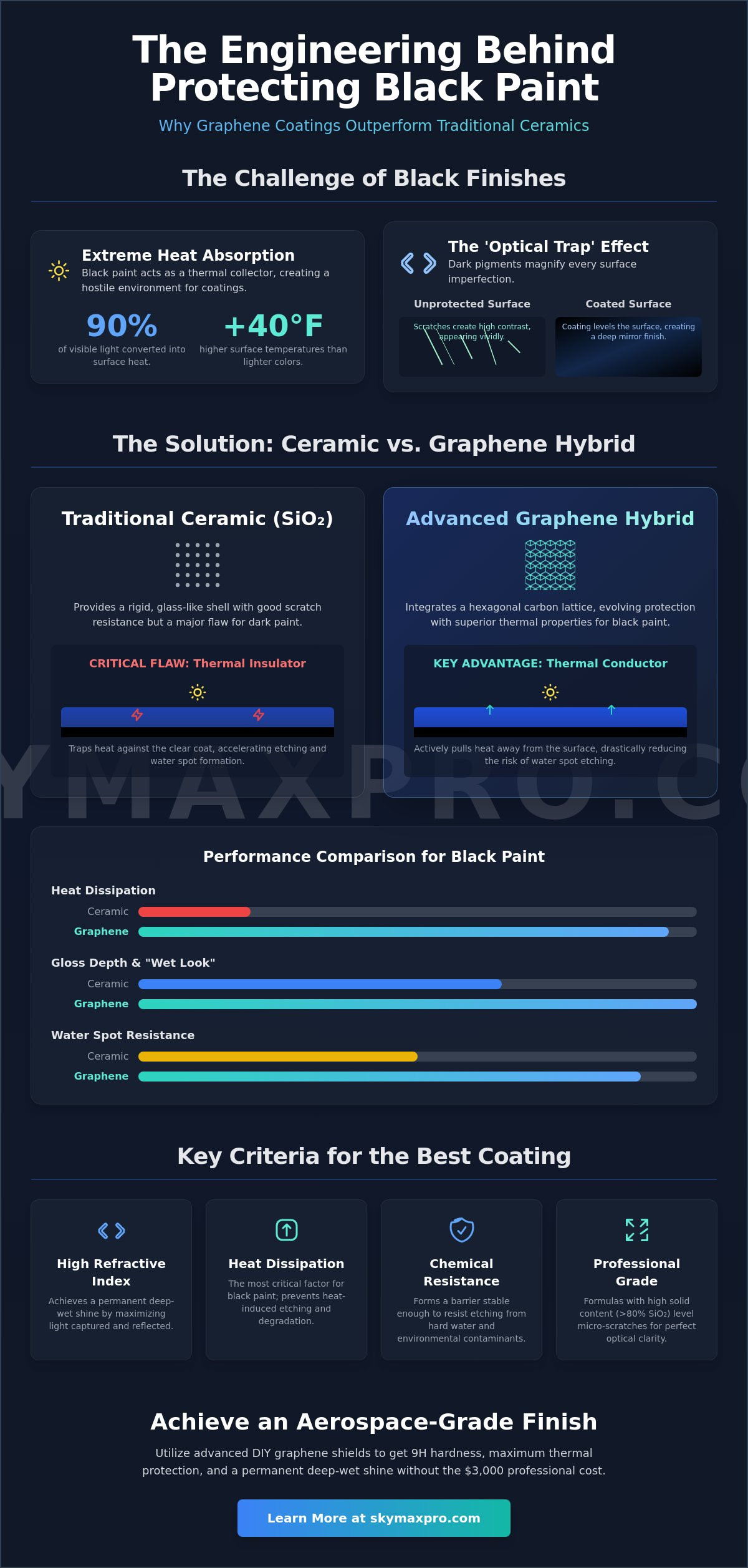
- Black paint converts up to 90% of visible light into surface heat, making thermal dissipation the most critical engineering requirement for coating durability.
- Graphene's hexagonal lattice structure outperforms standard SiO2 by distributing heat and reducing the risk of water spot etching on dark finishes.
- Identify the best ceramic coating for black paint by prioritizing a high refractive index and chemical resistance over simple 9H hardness ratings.
- Successful application requires a "Black Paint Protocol," utilizing professional detailing clay on a virgin surface to prevent haze and high spots.
- Aerospace-grade formulations provide the specific optical clarity needed to enhance dark pigments and achieve a permanent deep-wet shine.
The Engineering Challenges of Protecting Black Automotive Paint
Black paint functions as a high-efficiency thermal collector. While lighter automotive finishes reflect a significant portion of solar radiation, black pigments absorb up to 90% of visible light, converting that energy into significant surface heat. This isn't merely a comfort issue; it's a structural threat to the vehicle's clear coat. Identifying the best ceramic coating for black paint involves selecting a formula that can handle these extreme thermal loads without losing its molecular bond.
Traditional waxes and polymer sealants are fundamentally ill-equipped for this task. Most carnauba-based products begin to soften at 120°F and can reach a liquid state at 160°F. On a black car in direct sunlight, the paint surface often surpasses these limits. As the wax melts, it attracts dust and creates an oil-based haze that obscures the finish. This is why engineering-grade solutions are mandatory for dark pigments, as they provide a stable layer that doesn't migrate or degrade under heat.
Thermal Absorption and Paint Etching
A black car's surface can reach 150°F within 30 minutes of sun exposure. This heat acts as a catalyst for chemical etching. When hard water or environmental contaminants land on the paint, the thermal energy accelerates the corrosive process, allowing minerals to bake into the clear coat almost instantly. A high-temperature resistant barrier is non-negotiable for long-term protection.
Modern functional coatings provide this protection by creating a cross-linked shield that remains stable even at temperatures that would vaporize standard retail products. Thermal degradation on black paint typically manifests through several specific mechanisms:
- Polymer Shear: The rapid expansion of the clear coat creates tension that can crack brittle, low-quality coatings.
- Oxidative Stress: Sustained high heat accelerates the breakdown of the paint's molecular structure, leading to premature fading.
- Substrate Softening: Heated clear coats become physically softer, making them more susceptible to marring during maintenance.
The Visual Vulnerability of Dark Pigments
The 'Optical Trap' effect explains why black paint is so difficult to maintain. Because the pigment absorbs most light, any deviation in the surface, like a micro-scratch or swirl, creates a sharp contrast as it reflects light back to the viewer. This high contrast ratio makes 'cobwebbing' stand out with surgical clarity. On lighter cars, the scattered light from the pigment hides these defects, but black paint offers no such concealment.
To combat this, the best ceramic coating for black paint must utilize a high-solid content to level the surface at a microscopic level. Refractive depth is the perceived thickness of the clear coat, representing how much light is captured and reflected through the coating layer to create a three-dimensional effect. By smoothing the surface, the coating reduces the light scattering that highlights imperfections, resulting in the coveted deep-wet mirror finish that enthusiasts demand.
Ceramic vs. Graphene: Which is the Best for Black Paint?
Silicon Dioxide (SiO2) has long been the benchmark for automotive protection, providing a rigid, glass-like shell with high hydrophobicity. While SiO2 is excellent for scratch resistance, it acts as a thermal insulator, effectively trapping heat within the clear coat. For a black vehicle, this thermal retention is a significant engineering flaw. Graphene, a single layer of carbon atoms arranged in a hexagonal lattice, offers a technical evolution. When integrated into a coating, graphene provides the highest thermal conductivity of any known material, allowing the surface to shed heat rather than store it. Choosing the best ceramic coating for black paint in 2026 often requires a hybrid formula that leverages both technologies.
Comparing the visual output of these two materials reveals distinct characteristics. Pure ceramic coatings tend to produce a "glassy" or "plastic" shine that can sometimes look artificial on dark pigments. Graphene typically offers a deeper, richer finish that detailers describe as a "wet look." This darker aesthetic is achieved because the graphene molecules interact with light differently, enhancing the pigment's natural depth without the milky haze associated with some high-solid SiO2 products. The current engineering standard favors a hybrid approach, using SiO2 for structural hardness and graphene for surface slickness and thermal management.
The Science of Graphene's Thermal Conductivity
Graphene's primary advantage on black paint is its ability to reduce localized "hot spots." When a water droplet sits on a black hood in the sun, it acts as a magnifying lens. In standard coatings, the heat remains concentrated, causing the water to evaporate rapidly and bake minerals into the finish. Graphene dissipates this energy across the entire panel. Research into nanomaterials in automotive coatings confirms that these molecular enhancements significantly improve resistance to environmental etching and UV degradation.
This technology also results in a lower sliding angle. On black surfaces, you don't just want water to bead; you want it to move. Graphene's molecular structure creates a surface so slick that water rolls off at a 10 to 15 degree tilt, whereas standard ceramics may require 25 degrees or more. This reduces the frequency of maintenance and the risk of marring during the drying process.
Refractive Index and the 'Mirror Shine'
The "mirror" effect on a car is a result of surface leveling. Even a brand-new clear coat has microscopic peaks and valleys. Ceramic molecules fill these pores to create a perfectly flat plane, which is essential for specular reflection. Black paint benefits most from this leveling because it provides the highest contrast for reflections. Graphene-infused formulas increase the refractive index of the surface, which measures how much light is bent and reflected. This higher index translates to more gloss units (GU) on a digital meter, providing the intense, three-dimensional shine that defines a show-quality black finish. For enthusiasts demanding this level of precision, the Ceramic Graphene Shield Coating offers the specific refractive properties required for dark automotive pigments.
Key Criteria for Evaluating a Professional-Grade Coating
Engineering a surface that maintains a flawless black finish requires more than a standard retail sealant. When selecting the best ceramic coating for black paint, you must evaluate technical specifications rather than marketing buzzwords. A professional-grade coating acts as a semi-permanent functional layer, typically measuring between 0.5 to 1 micron in thickness. This additional depth provides the physical barrier necessary to absorb environmental energy before it reaches the factory clear coat.
Chemical resistance is a critical metric for dark automotive finishes. Black paint is highly susceptible to etching from acidic bird droppings or alkaline detergents used in touchless car washes. A high-performance coating should demonstrate stability across a pH range of 2 to 12. Without this chemical resilience, the coating will degrade prematurely, leaving the paint vulnerable to permanent staining. Additionally, the ease of leveling is a decisive factor. On black surfaces, "high spots" or excess product appear as dark, oily streaks that are difficult to remove once cured. Professional formulas prioritize a controlled flash time, allowing for uniform leveling across large panels.
Hardness and Scratch Resistance
The 9H hardness rating is a standard industry benchmark, but it's often misunderstood by consumers. This rating refers to the Wolf-Wilburn pencil hardness test, not the Mohs scale of mineral hardness. While a 9H coating won't make your paint "scratch-proof," it creates a sacrificial layer that is significantly harder than the factory clear coat. This layer absorbs the micro-marring that occurs during routine maintenance, which is essential because black paint reveals every microscopic deviation. To achieve these results, proper auto detailing preparation is mandatory. A virgin, decontaminated surface ensures the coating achieves its maximum bond strength and rated hardness.
Hydrophobicity and Self-Cleaning Properties
Hydrophobicity is measured by the water contact angle. Professional standards require a contact angle of at least 110 degrees, which forces water to form tight, spherical beads. On a black car, this isn't just for visual effect; it's a maintenance strategy. By reducing surface energy, the coating prevents dust, pollen, and industrial fallout from forming a strong bond with the paint.
- Reduced Mechanical Friction: High hydrophobicity allows most surface contaminants to be rinsed away with water.
- Maintenance Efficiency: Self-cleaning properties reduce the frequency of contact washing, which is the primary cause of swirl marks on black finishes.
- Optical Clarity: A smooth, hydrophobic surface ensures that light reflects uniformly, maintaining the deep refractive shine discussed in previous sections.
Longevity depends on both the solid content of the coating and the owner's maintenance protocol. While some professional-grade systems like Gtechniq Crystal Serum Light claim up to 5 years of protection, DIY high-solid coatings typically provide 1.5 to 3 years of peak performance. For black paint, the goal isn't just duration; it's the consistent preservation of the surface's optical integrity.
Precision Application: Avoiding Haze and High Spots on Black Surfaces
Applying a functional layer to a dark automotive finish is a high-stakes engineering task where every error is magnified. The "Black Paint Protocol" dictates that application must occur in a climate-controlled environment, ideally between 65°F and 75°F, to stabilize the chemical reaction. Outside of these parameters, carrier solvents evaporate inconsistently, leading to the "high spots" that appear as dark, oily streaks on the finish. Achieving the best ceramic coating for black paint results requires a virgin surface, which is only possible through rigorous decontamination using detailing clay and industrial-grade iron removers to extract embedded metallic particles.
The "Flash Point" represents the moment the coating begins to bond with the clear coat and the solvents begin to evaporate. On black pigments, this is signaled by a distinct "rainbow effect" or oil-slick appearance. Monitoring this transition is critical. If you level the product too early, you remove the protective solids; if you wait too long, the product hardens into a permanent haze. Precision timing is the difference between a professional refractive shine and a costly correction project.
Surface Preparation and Correction
A ceramic coating acts as a magnifying lens. It does not hide defects; it seals them under a semi-permanent glass layer. Therefore, 100% swirl removal is a prerequisite for black vehicles. Even minor "cobwebbing" will be highlighted by the coating's high refractive index. After polishing, you must use isopropyl alcohol (IPA) wipes to strip away residual polishing oils. These oils can prevent the coating from cross-linking with the paint, leading to premature failure. Ensure the panel is cool to the touch before the first drop of coating reaches the surface.
The Leveling and Buffing Process
The two-towel method is the industry standard for managing dark finishes. The first towel, a low-pile microfiber, performs the initial leveling by spreading the product and removing the bulk of the excess. The second towel must be a high-GSM (grams per square meter) microfiber, typically 500 or higher, to perform the final buff. This process requires specialized LED detailing lights held at various angles to identify high spots that are often invisible under standard overhead lighting.
- Initial Wipe: Uses light pressure to level the surface without stripping the coating.
- Final Buff: Removes microscopic residue to ensure a streak-free, mirror finish.
- Curing Window: The first 24 hours are critical. Exposure to moisture during this phase can cause spotting or cloudiness in the finish.
Precision is not optional when working with dark pigments. For enthusiasts who want to ensure they have every technical component required for a flawless application, the Ceramic Coating Kit provides the engineered tools necessary to execute this protocol successfully.
Sky MaxPro Ceramic Graphene Shield: The Ultimate Finish for Black Paint
Sky MaxPro Ceramic Graphene Shield represents the pinnacle of surface engineering for high-thermal automotive environments. While standard consumer products focus on surface-level aesthetics, this aerospace-grade formulation addresses the core physics of dark pigment degradation. By integrating an advanced graphene lattice structure, the coating facilitates industry-leading heat dissipation, preventing the thermal accumulation that compromises standard clear coats. This technological approach makes it the best ceramic coating for black paint for owners who prioritize long-term structural integrity alongside visual perfection.
The molecular design focuses on an ultra-high refractive index. This metric is critical for black paint because it determines the depth of the "mirror" effect. Our formula is engineered to be VOC-free and eco-friendly, ensuring that professional-grade 5-year durability doesn't come at the cost of environmental safety. This balance of chemical resilience and optical clarity provides a functional layer that remains stable even under the 150°F surface temperatures common to black vehicles in direct sunlight. It creates a semi-permanent bond that resists the oxidative stress typically found in high-UV regions.
Why Sky MaxPro Leads in Black Paint Protection
Our concentrated formula is designed for high-solid deposition, ensuring a thick, uniform barrier that levels perfectly on dark surfaces. Maintaining this barrier requires a systematic approach. Using engineered car cleaning products ensures that the coating's hydrophobic properties aren't degraded by aggressive surfactants or low-quality waxes. We provide professional-spec technology through a direct-to-consumer model, removing the accessibility barriers usually associated with high-performance graphene systems. This ensures enthusiasts have access to the same 9H hardness and thermal management tools used by industrial finishing experts.
Implementation and Next Steps
Achieving a permanent "wet look" requires selecting the right tool for the specific task. The Ceramic Graphene Shield Coating is the primary choice for multi-year protection and maximum depth. For ongoing maintenance or shorter-term projects, the PRO Ceramic Graphene Spray Coating offers a faster application path while maintaining the same thermal dissipation benefits. Both products utilize the same graphene lattice technology to ensure consistency across the entire maintenance cycle.
- Systematic Protection: The Sky MaxPro Ceramic Coating Kit includes the high-solid coating, specialized applicators, and leveling towels needed for a haze-free finish.
- Maintenance Protocol: Use the PRO Spray Coating every 4 to 6 months to rejuvenate the hydrophobic top layer.
- Final Result: A deep, refractive shine that resists water spotting and environmental etching more effectively than any standard SiO2 product.
For the ultimate "Wet Mirror" finish on black paint, we recommend a full decontamination followed by a single-layer application of the Shield Coating. This creates the best ceramic coating for black paint result, providing a finish that is visually indistinguishable from a fresh factory clear coat while offering significantly higher physical and thermal resistance.
Engineering a Flawless Automotive Future
Protecting a black finish in 2026 requires moving beyond traditional aesthetics into the realm of functional nanomaterials. We've established that the best ceramic coating for black paint must prioritize thermal dissipation to prevent the etching caused by surface temperatures that frequently exceed 150°F. By leveraging a graphene lattice structure, you create a surface that's as durable as it is optically deep. This specialized approach ensures your vehicle maintains its refractive clarity without the risk of hazing or the high-spot issues common with inferior products.
SkyMax Pro delivers these results through aerospace-approved nanotechnology engineered for 5-year durability. Every formula is manufactured in the USA to ensure strict adherence to industrial quality standards and chemical resilience. You can now achieve professional-grade protection and a permanent wet-mirror look using our precision-engineered kits. It's time to stop fighting the limitations of wax and start utilizing the thermal advantages of modern carbon science to stabilize your vehicle's clear coat.
Secure the Ultimate Deep Shine with Sky MaxPro Ceramic Graphene Shield
Your black paint deserves a finish that reflects your commitment to engineering excellence and long-term surface preservation.
Frequently Asked Questions
Is graphene or ceramic better for black cars?
Graphene is the superior choice for dark automotive finishes because of its high thermal conductivity. While standard ceramic coatings act as insulators, graphene's hexagonal lattice allows heat to dissipate across the surface. This reduces the formation of "hot spots" that lead to water spot etching. For those seeking the best ceramic coating for black paint, a graphene-infused formula provides deeper refractive shine and better heat management than pure SiO2 products.
How do I prevent high spots when coating black paint?
Preventing high spots requires strict environmental control and a systematic leveling process. You must apply the coating in a space maintained between 65°F and 75°F to ensure a predictable flash time. Use specialized LED detailing lights to inspect the panel from multiple angles. If you identify a dark, oily streak, level it immediately with a high-GSM microfiber towel before the cross-linking process completes. Precision timing is essential on dark pigments.
Can a ceramic coating hide existing swirl marks on my black car?
No, a professional coating will not hide existing swirls; it will actually magnify them. Because these coatings have a high refractive index, they act like a magnifying lens over the clear coat. Any "cobwebbing" or micro-scratches present before application will be sealed under a semi-permanent glass layer. You must achieve 100% paint correction before sealing the surface to ensure the dark pigment appears deep and flawless.
How long does a professional ceramic coating last on a black vehicle?
Durability typically ranges from 1.5 to 5 years depending on the specific formulation and maintenance protocol. High-solid coatings like Gtechniq Crystal Serum Light are rated for up to 60 months of protection. However, black vehicles often face higher thermal stress, which can accelerate the degradation of low-quality retail products. Using a graphene-based system ensures the bond remains stable even when surface temperatures surpass 150°F during summer months.
Does black paint require more frequent ceramic maintenance?
Black paint requires more diligent maintenance because dark pigments offer the highest contrast for environmental fallout. While the coating itself doesn't degrade faster, dust, pollen, and water spots are visible almost immediately on a black surface. You don't need to reapply the base coating more often, but using a ceramic waterless wash or a graphene detailer every 14 days is necessary to maintain the "wet look" and hydrophobic performance.
What happens if I apply ceramic coating in direct sunlight on black paint?
Applying a coating in direct sunlight causes the carrier solvents to vaporize instantly, leading to catastrophic high spots and hazing. Black paint can reach 150°F in minutes, which is far beyond the stable application window for any professional-grade product. The coating will harden before you can level it, often requiring abrasive machine polishing to remove the damaged layer. Always ensure the panels are cool to the touch before starting.
Can I use a ceramic spray over a professional ceramic coating for extra shine?
Yes, applying a graphene-integrated spray over a base coating is an excellent strategy for maintaining the best ceramic coating for black paint results. This creates a sacrificial top layer that rejuvenates the surface's slickness and contact angle. We recommend using a PRO Ceramic Graphene Spray every 4 to 6 months. This process fills in any microscopic wear in the base layer and enhances the refractive depth of the dark pigment.
Will a ceramic coating protect my black car from rock chips?
No, ceramic coatings are not engineered to stop high-velocity physical impacts like rock chips. While they provide 9H hardness on the pencil scale to resist micro-marring and swirl marks, they lack the physical mass and elasticity of Paint Protection Film (PPF). A coating measures approximately 1 micron in thickness, whereas PPF is typically 150 to 200 microns thick. For total protection, apply the coating over PPF to combine impact resistance with high-gloss hydrophobicity.