

While modern advanced formulations can now offer protection for over 15 years, the structural integrity of a ceramic bond is often compromised within the first 168 hours of application. You've likely invested significant resources to secure this high-performance shield; the fear of permanent water spotting or chemical etching on a fresh surface is a valid concern for any vehicle owner. Understanding exactly what not to do after ceramic coating is the difference between a decade of protection and a premature structural failure that compromises your investment.
You probably recognize that the curing phase is a delicate chemical process where SiO2 or graphene molecules must cross-link with the substrate. We'll help you master these critical maintenance protocols by providing a definitive list of forbidden actions and specific technical advice for your washing routine. This guide previews the essential steps to protect your coating's hydrophobic properties and ensures your vehicle maintains its engineered performance for its entire service life.
Key Takeaways
- Understand the 14-day molecular curing phase where solvent evaporation and chemical cross-linking are essential for achieving maximum Mohs hardness.
- Identify exactly what not to do after ceramic coating during the critical 72-hour window to prevent premature structural failure and permanent water spotting.
- Maintain the coating’s chemical stability by strictly using products within the safe pH range of 5.0 to 9.0 and avoiding abrasive automatic brush washes.
- Master the two-bucket washing method and periodic decontamination protocols to ensure the long-term durability of your vehicle's hydrophobic properties.
The Science of Molecular Curing: Why the First 14 Days Are Critical
Ceramic coating is not a topical sealant; it's a sophisticated chemical reaction between the liquid formula and the vehicle's clear coat. During the initial application, the product undergoes a process known as cross-linking. This molecular bonding creates a permanent or semi-permanent layer that becomes part of the substrate itself. Unlike a physical Paint Protection Film, which acts as a sacrificial barrier, a ceramic coating modifies the surface properties at a microscopic level. For this bond to reach its maximum Mohs hardness, the carrier solvents must evaporate completely. This evaporation allows the SiO2 or graphene particles to settle into a dense, structured lattice.
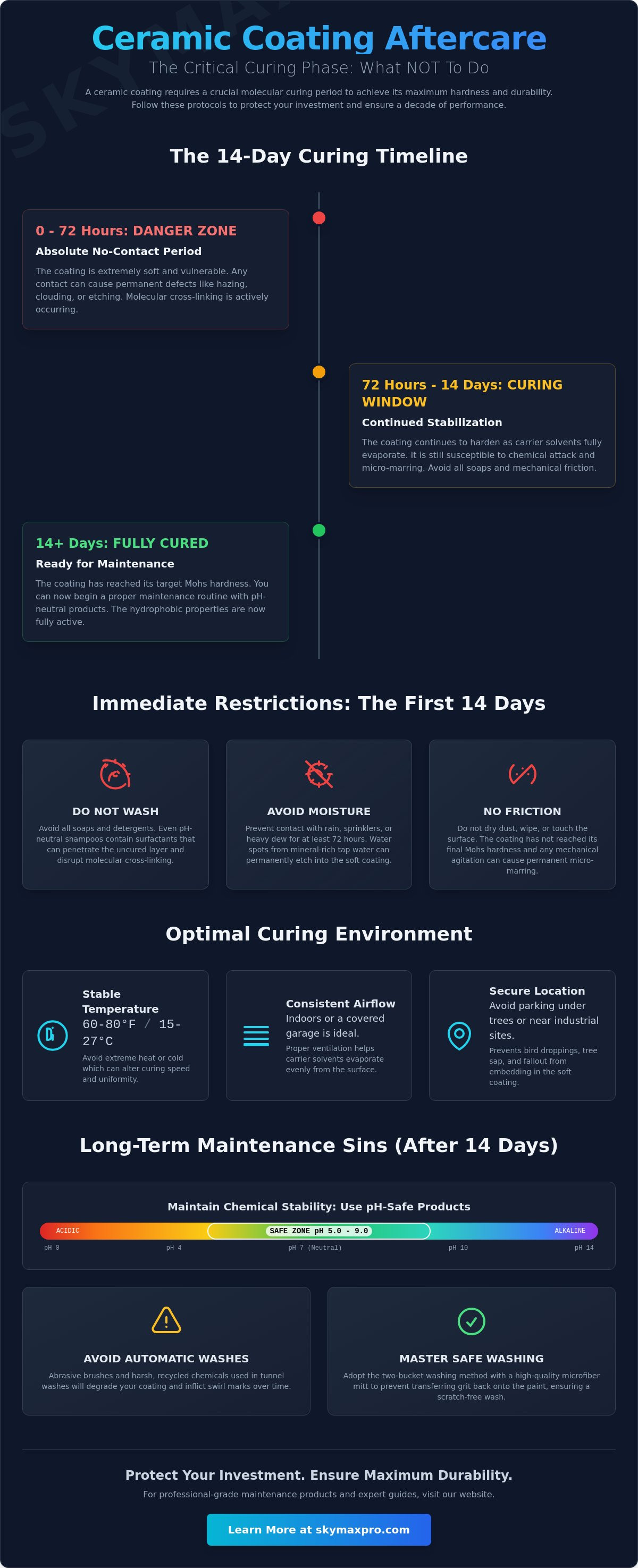
When owners ask what not to do after ceramic coating, the answer begins with respecting the 14-day curing window. During this time, the coating is "soft" and highly susceptible to environmental pH fluctuations. Acid rain, bird droppings, or even hard tap water can etch into the uncured layer. This causes permanent damage before the protection has even stabilized. Think of this period as a "no-interference" zone where molecular stability is the priority.
Understanding the Chemical Transition Period
The transition from a liquid state to a solid crystalline lattice is delicate. If moisture, such as rain or heavy dew, contacts the surface within the first 48 to 72 hours, it disrupts the cross-linking process. This interference often results in "clouding" or "hazing," where the coating loses its optical clarity. These visual defects are locked under the surface. They usually require abrasive polishing to correct, which effectively removes the coating you just applied. You don't want to restart the process because of a preventable moisture exposure.
Why Environmental Factors Dictate Coating Hardness
Ambient conditions directly influence the final durability of the shield. High humidity slows solvent evaporation, which extends the period of vulnerability. Conversely, controlled UV exposure can actually assist in stabilizing graphene-infused layers, though excessive heat may cause the coating to cure too rapidly. This leads to high spots or uneven thickness. Achieving the engineered performance specifications requires a stable environment. Use this checklist for the optimal curing environment:
- Maintain a temperature range between 60°F and 80°F (15°C to 27°C).
- Ensure consistent airflow to facilitate solvent outgassing.
- Guarantee zero precipitation or liquid contact for at least 72 hours.
- Avoid parking under trees or near industrial sites where fallout is prevalent.
Immediate Restrictions: What to Avoid in the First 14 Days
Mechanical agitation represents the highest risk factor during the initial stabilization phase. Many owners mistakenly believe that "dry dusting" with a microfiber towel is a safe way to remove light dust. In reality, the coating hasn't reached its full Mohs hardness yet. Any friction at this stage can lead to micro-marring that becomes a permanent part of the finish. Understanding what not to do after ceramic coating requires a shift from traditional maintenance habits to a more disciplined, technical approach. For the first 72 hours, you must enforce a strict ban on high-pressure water. The impact force from a pressure washer can disturb the layer before it has fully bonded, leading to uneven thickness or localized failure.
The "No-Soap" rule is equally critical. Even pH-neutral detergents contain surfactants designed to lift oils. During the first 14 days, these chemicals can penetrate the semi-porous uncured layer and interfere with molecular cross-linking. Avoid parking under trees or near industrial zones where metallic fallout is common. These contaminants can embed themselves into the soft coating, creating a permanent texture. Integrating these precautions into your routine is essential for long-term car care and ensures the investment delivers its promised durability.
The Dangers of Early Hydration and Water Spots
Water spots are more than just an aesthetic nuisance; they're a chemical threat. Tap water contains high concentrations of calcium and magnesium carbonates. If these minerals dry on a curing coating, they etch into the surface as the solvents evaporate. This creates a permanent crater in the ceramic lattice. If moisture does contact the paint, don't rub it. Instead, use a "wicking" technique by gently laying a clean microfiber over the drop to absorb it. If you discover dried minerals, using a dedicated Water Spot Remover is the safest way to neutralize the bond without using damaging mechanical force.
Mechanical Stress and Physical Abrasion Risks
Avoid the tactile temptation to feel the slickness of the new coating. Oils from your skin can disrupt the curing process, and the physical pressure can mar the surface before it reaches full structural integrity. Similarly, car covers are prohibited during the first 14 days. They trap ambient moisture against the paint and cause micro-oscillations from wind. This movement acts like sandpaper on a soft coating. You must wait for the full 14-day cure before introducing any physical barriers or heavy contact. Discipline during this window is a primary factor in what not to do after ceramic coating if you want to maintain the engineered hydrophobic properties.
Long-Term Maintenance Sins: Habits That Kill Your Protection
Once the initial 14-day curing phase concludes, the primary threat to your vehicle's finish shifts from chemical interference to mechanical degradation. Many owners assume that a hardened crystalline lattice is indestructible, leading to a relaxed maintenance routine. This is a critical error. Identifying what not to do after ceramic coating in the months and years following installation is vital for preserving the coating's surface energy. The most common long-term "sin" is the return to high-volume automatic car washes. These facilities are engineered for speed, not surface integrity, and they represent the fastest route to total coating failure.
Beyond mechanical abrasion, the use of improper chemical supplements can be equally damaging. 'Topping' a high-performance ceramic layer with traditional carnauba wax is a counterproductive practice that many enthusiasts still follow. While it might seem like adding "extra" protection, you're actually compromising the engineered properties of the SiO2 or graphene layer. Maintaining the nanostructure requires a technical understanding of surface tension and chemical compatibility. Avoiding these common pitfalls ensures your investment maintains its hydrophobic performance for its intended service life.
The Fatal Flaw of Automatic Brush Car Washes
Automatic brush washes exert significant mechanical force on the paint surface. The high-speed rotating bristles act like sandpaper on the nanostructure, creating thousands of microscopic swirl marks. On a ceramic-coated vehicle, these swirl marks are particularly problematic because they are locked into a layer that is much harder than the original clear coat. Correcting these defects requires abrasive polishing, which removes the coating itself. Furthermore, these facilities often use recycled water. Even with filtration systems, this water can carry abrasive particulates from previous vehicles, sandblasting your coating at high pressure. While some owners believe touchless options are a safe alternative, these often utilize aggressive chemicals with a pH level exceeding 11.0 to compensate for the lack of friction, which can gradually degrade the coating's bond.
Why Traditional Waxes and Sealants Interfere with Hydrophobics
Applying traditional waxes over a ceramic surface creates a "masking" effect. Ceramic coatings are designed to be high-energy surfaces that repel water and contaminants with extreme efficiency. Carnauba wax is an oily, low-energy organic substance. When you apply it over ceramic, you replace the superior hydrophobic properties of the coating with the inferior properties of the wax. This oily residue also acts as a magnet for dust, pollen, and environmental soot, making the car harder to clean. For proper maintenance, you should exclusively use professional car detailing products specifically formulated for ceramic surfaces. These maintain the chemical bond without leaving behind sticky residues that attract contaminants. Understanding what not to do after ceramic coating means recognizing that "more" is not always "better" when it involves non-compatible chemical layers.
Chemical Hazards: Substances That Compromise Surface Integrity
Maintaining the structural integrity of a nanostructure requires strict adherence to chemical compatibility standards. While ceramic coatings offer superior chemical resistance compared to traditional sealants, they aren't immune to aggressive solvents. The engineered safe zone for most SiO2 and graphene based coatings is a pH range between 5.0 and 9.0. When you step outside this window, you risk accelerating the degradation of the coating's hydrophobic top layer. Identifying what not to do after ceramic coating involves auditing every liquid that touches your vehicle's surface, from your car shampoo to the local environment's precipitation. Household detergents, specifically dish soaps, are primary culprits. These are formulated as heavy duty degreasers designed to break down organic oils, which can prematurely weaken the surfactant repelling properties of your coating.
Waterless wash systems also present a unique chemical challenge. Without proper lubrication, the act of wiping away encapsulated dirt can lead to surface scratching. You must ensure that any waterless or rinseless solution used is specifically formulated for ceramic maintenance. These products contain specialized polymers that maintain the surface energy of the coating rather than masking it with cheap gloss enhancers. Consistency in your chemical choices is the only way to ensure the coating performs to its maximum technical specifications.
High-pH Detergents and Aggressive Degreasers
Alkaline cleaners with a pH level of 10.0 or higher are frequently found in "touchless" car washes and industrial strength wheel cleaners. These chemicals are designed to strip organic matter, but they also aggressively attack the sacrificial hydrophobic layer of the ceramic. Over time, repeated exposure to high pH detergents causes the coating to "clog" or lose its water beading ability. Many All Purpose Cleaners (APCs) also fall into this dangerous category. To preserve the bond, you should exclusively use a dedicated pH neutral car shampoo for every maintenance wash. This ensures that you're removing surface contamination without compromising the underlying molecular lattice.
Environmental Contaminants: Bird Droppings and Tree Sap
Biological waste represents an acute chemical threat. Bird droppings are highly acidic, often featuring a pH between 3.0 and 4.5. When combined with the heat from direct sunlight, these contaminants can etch into a ceramic lattice in a matter of hours. Tree sap is equally problematic; as it hardens, it creates a localized bond that is difficult to break without mechanical force. You should never attempt to "scrub" these contaminants off, as this will lead to localized marring. Instead, use a quick detailer or a specialized water spot remover to chemically soften the bond before gently wicking it away. If you encounter stubborn mineral deposits or acidic etching, you can neutralize acidic contaminants with a professional-grade Water Spot Remover to safely restore surface clarity.
Engineering a Sustainable Maintenance Protocol
Operational durability is a function of consistent maintenance. While the initial curing phase establishes the bond, the operational lifecycle of the coating depends on your ability to prevent contaminant accumulation. Understanding what not to do after ceramic coating extends beyond the initial cure into the long-term management of surface energy. A technical maintenance protocol ensures that the SiO2 or graphene lattice remains free of bonded minerals and industrial fallout. This is not merely about aesthetics; it's about preserving the engineered hydrophobic performance that defines professional grade protection. Adopting a systematic approach to auto detailing is the only way to maximize the service life of your investment.
The two-bucket method remains the gold standard for minimizing mechanical stress. By utilizing grit guards and separate rinse buckets, you ensure that abrasive particulates are never reintroduced to the paint surface. For drying, forced air is the preferred engineering solution. It eliminates physical contact entirely, which prevents the micro-marring associated even with high-quality towels. If air is unavailable, use a dedicated, high-GSM microfiber towel and a "blotting" technique rather than a wiping motion. These small technical adjustments prevent the gradual degradation of the coating's sacrificial layer.
Decontamination washes are necessary every 6 to 12 months to address metallic fallout that standard shampoos cannot lift. Iron removers chemically dissolve brake dust and industrial particulates that embed in the coating's pores. Without this periodic deep clean, the surface becomes "clogged," leading to a perceived loss of hydrophobicity. Periodic use of ceramic boosters or graphene infused maintenance sprays can replenish the top layer, maintaining the high contact angle required for effective water sheeting.
Transitioning to Ceramic-Specific Cleaning Protocols
It's vital to distinguish between a "clogged" coating and a "failed" coating. A clogged surface has simply accumulated enough environmental soot or mineral deposits to mask its hydrophobic properties. You don't need to reapply the coating; you need to strip the surface contamination. Establishing a bi-weekly washing cadence prevents these minerals from bonding permanently. This regular interval is a key component of what not to do after ceramic coating, as neglecting the surface for months allows contaminants to become chemically integrated with the lattice, requiring more aggressive, and potentially damaging, recovery steps.
Leveraging Aerospace-Grade Maintenance Solutions
The SKY MAXPRO approach focuses on using nanotechnology to maintain nanotechnology. We don't rely on heavy solvents or abrasive surfactants. Instead, our formulations are designed to interact with the existing graphene and SiO2 layers to enhance gloss and structural integrity. Graphene-infused maintenance sprays provide a temporary high-durability layer that absorbs the brunt of environmental friction. For those committed to maintaining engineered performance, you can explore the SKY MAXPRO Ceramic Maintenance Collection to access professional-grade solutions that align with these technical protocols.
Maximizing the Lifecycle of Your Nanotechnology Shield
The transition from a freshly coated surface to a long-term protective barrier requires technical discipline. You now understand that the initial 14-day curing phase is a mandatory "no-interference" zone for molecular stability. By avoiding mechanical agitation and strictly adhering to the safe pH range of 5.0 to 9.0, you prevent the premature degradation of the coating's hydrophobic top layer. Mastering what not to do after ceramic coating is the primary factor in ensuring your vehicle's finish remains resilient against environmental etching and industrial fallout for its intended service life.
Maintaining this engineered performance requires solutions that match the sophistication of the coating itself. SKY MAXPRO provides nanotechnology-driven formulations used by professional detailers nationwide. These products are specifically engineered for maximum SiO2 and Graphene compatibility; they ensure your sacrificial layer is replenished without compromising surface energy. Secure Your Investment with Aerospace-Grade Maintenance Supplies and maintain the precision finish your vehicle deserves. With the right protocol, your coating will continue to deliver measurable efficiency and protection for years to come.
Frequently Asked Questions
Can I wash my car with soap immediately after ceramic coating?
No, you cannot wash your car with soap immediately following the application. You must wait for the full 14-day curing period to allow the molecular cross-linking to reach peak stability. Even pH-neutral detergents contain surfactants that can penetrate the soft coating and cause hazing or structural failure during this delicate chemical transition.
What happens if it rains the day after my ceramic coating is applied?
Rain within the first 24 to 72 hours represents a significant threat to the bond's integrity. If the vehicle gets wet, you must wick the moisture away using a clean microfiber towel without applying any lateral friction. Failure to remove rain water quickly can result in mineral deposits etching permanently into the curing lattice as the solvents evaporate.
Is it okay to use a touchless car wash with a ceramic coating?
You should avoid touchless car washes because they rely on aggressive chemical concentrations to compensate for the lack of friction. Many of these facilities use detergents with a pH level exceeding 11.0. This alkalinity is outside the safe 5.0 to 9.0 range and will gradually degrade the hydrophobic top layer of your coating over time.
Can I use a clay bar on a ceramic coated car?
No, you should never use a clay bar on a ceramic coated car for routine maintenance. Clay is an abrasive medium that will cause micro-marring on the hardened ceramic surface. If the surface feels rough due to bonded contaminants, use a chemical decontamination process like an iron remover to dissolve particulates without physical abrasion.
How long should I wait to drive my car after the coating is applied?
You should wait at least 24 hours before driving the vehicle to ensure the surface is no longer tacky. For optimal engineering results, wait 48 to 72 hours to prevent high-speed environmental particulates from impacting the coating while it's still in the early stages of solvent evaporation and hardening.
Do I ever need to wax my car again after it is ceramic coated?
You don't need to use traditional wax once the ceramic bond is established. Traditional carnauba waxes have lower surface energy and will mask the superior hydrophobic properties of the SiO2 or graphene layer. Stick to ceramic-specific maintenance sprays to replenish the sacrificial layer without attracting unwanted dust or oily residues.
Can I use dish soap to wash my ceramic coated vehicle?
Dish soap is strictly prohibited for ceramic maintenance due to its high alkalinity and aggressive degreasing agents. These chemicals are engineered to strip organic oils, which means they will rapidly break down the surfactants that provide your coating's water-beading performance. Understanding what not to do after ceramic coating includes replacing household cleaners with professional pH-neutral car shampoos.
What is the best way to remove bird droppings from a fresh coating?
The most effective way to remove bird droppings is through chemical neutralization rather than mechanical force. Apply a liberal amount of quick detailer or a specialized water spot remover to the area and let it dwell for 60 seconds. Once the contaminant is softened, gently wick it away with a microfiber towel to avoid scratching the underlying lattice.