

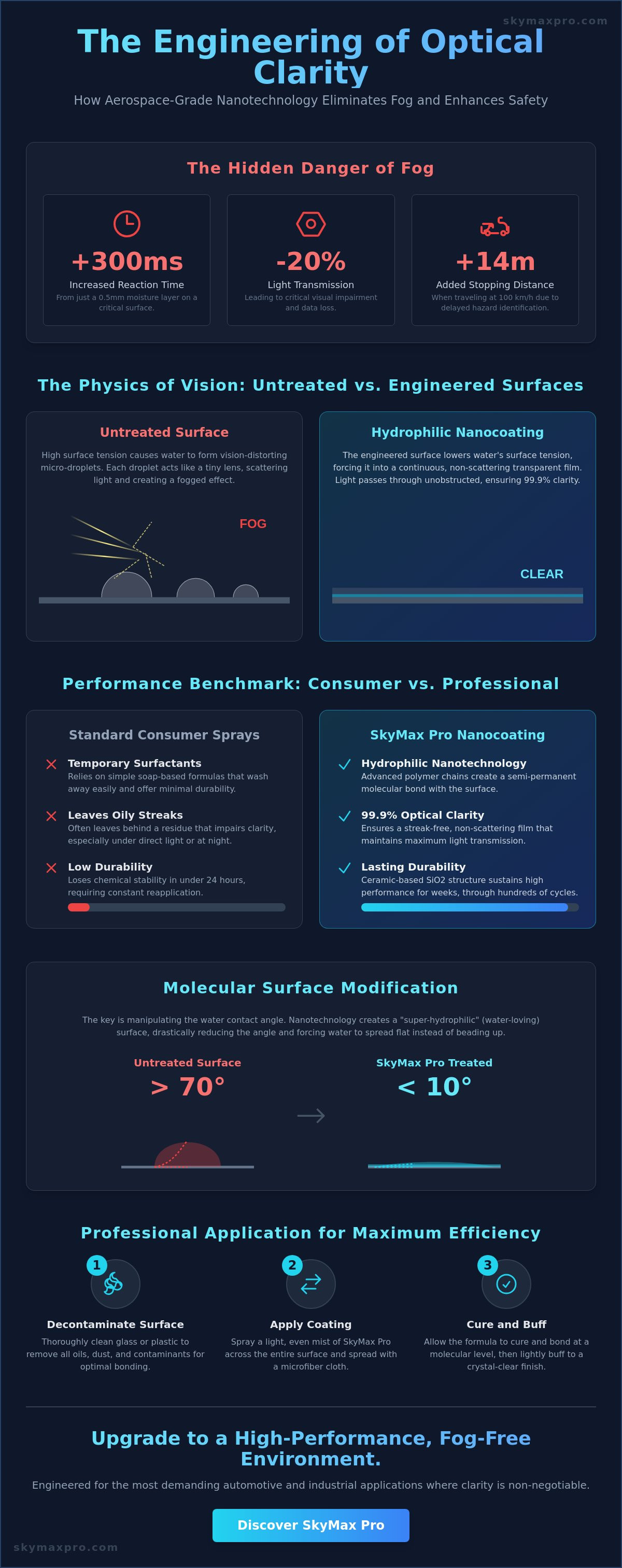
A single 0.5-millimeter layer of moisture on a critical optical surface can reduce operator reaction time by as much as 300 milliseconds during high-moisture industrial conditions. You've likely dealt with the recurring failure of a standard anti-fog spray that leaves behind oily streaks or loses its chemical stability in less than 24 hours. These inconsistent results aren't just a nuisance; they represent a measurable safety risk when operating heavy machinery or navigating high-speed transport in volatile climates. Professional environments require a higher standard of optical engineering that goes beyond simple household surfactants.
This guide explains the aerospace-grade molecular science required to maintain a 99.9% clarity rating on both glass and plastic surfaces. You'll discover how high-performance solutions utilize advanced polymer chains to eliminate fogging at the source instead of just masking the symptoms. We'll examine the technical specifications of industrial-grade coatings and provide a structured protocol for engineering a long-lasting, fog-free environment for your most demanding automotive and industrial applications.
Key Takeaways
- Analyze the physics of condensation and how precise surface engineering prevents light obstruction caused by liquid micro-droplets.
- Examine the integration of hydrophilic nanotechnology and ceramic-based protection to effectively manipulate the contact angle of water on critical surfaces.
- Establish performance benchmarks to differentiate between short-term consumer residues and professional-grade durability that sustains visibility for weeks.
- Implement a rigorous application protocol involving surface decontamination to ensure optimal molecular bonding and maximum coating efficiency.
- Discover how the aerospace-derived formulation of SkyMax Pro anti-fog spray delivers a high-performance, fog-free environment for industrial and automotive applications.
The Science of Condensation: Why Surface Engineering Matters
Fog represents a phase transition where water vapor undergoes rapid cooling to form liquid micro-droplets on a solid substrate. These droplets typically range from 1 to 10 micrometers in diameter. When they accumulate on glass or polycarbonate, they create a discontinuous surface that disrupts the path of incoming light. High surface tension causes the water to bead into spherical shapes rather than spreading into a uniform layer. This lack of coalescence is the primary driver of visual impairment in industrial and automotive applications.
Industrial environments require precise visual data for safe operation. A 20% reduction in light transmission through a safety visor or windshield can increase response times by up to 0.5 seconds. At speeds of 100 km/h, this delay results in an additional 14 meters of travel before a hazard is identified. Standard glass cleaners fail because they focus on removing organic contaminants like lipids or dust. They don't lower the surface energy of the glass. Consequently, they leave the substrate vulnerable to the next humidity spike or temperature shift.
Applying a high-performance anti-fog spray creates a specialized interface between the environment and the surface. The Science of Condensation dictates that preventing fog requires a fundamental shift in how water interacts with the material. By neutralizing the high surface tension of water, these engineering solutions force moisture to collapse into a continuous, transparent film. This film maintains a consistent refractive index, ensuring that light passes through without the scattering effects that characterize a fogged surface.
The Physics of Light Scattering
Each micro-droplet on an untreated surface acts as a tiny convex lens. These lenses refract light at unpredictable angles, which distorts the focal plane for a driver or operator. This phenomenon becomes critical when relative humidity exceeds 85% and the surface temperature drops 5 degrees Celsius below the ambient air dew point. Critical visibility in aerospace safety is defined as the minimum distance at which an operator can identify a 50-centimeter object against a low-contrast background during rapid thermal transitions.
Surfactants vs. Nanotechnology
Traditional soap-based solutions are sacrificial and temporary. They rely on simple surfactants that wash away easily and often leave a streak-heavy residue that impairs clarity under direct sunlight. Modern anti-fog spray technology utilizes hydrophilic nanotechnology to create a semi-permanent bond with the substrate. These coatings don't just repel water; they actively manage it. By creating a high-energy surface, the coating ensures that moisture forms a thin, non-scattering sheet that preserves 99% of optical clarity even in extreme industrial conditions.
Hydrophilic Nanotechnology: The Next Generation of Anti-Fog
Modern anti-fog spray technology relies on manipulating the thermodynamic properties of a surface at a molecular level. Conventional solutions often rely on surfactants that wash away quickly, but nanotechnology introduces a permanent shift in how moisture interacts with glass and polycarbonate. By utilizing nanoparticles, engineers can alter the contact angle of water droplets. While a standard untreated surface might see water beading at angles above 70 degrees, a nanotech-enhanced surface reduces this to less than 10 degrees. This creates a super-hydrophilic environment where water cannot form light-scattering droplets.
The engineering shift toward ceramic-based protection represents a significant leap in durability. Unlike traditional wax-based products that degrade under UV exposure or heat, ceramic-infused formulas create a semi-permanent bond with the substrate. These SiO2-based structures provide a resilient framework that maintains high surface energy over hundreds of condensation cycles. This level of performance is critical in high-stakes environments, such as NASA's research on permanent anti-fog solutions for extravehicular activity helmets, where visibility failure isn't an option.
Molecular Surface Modification
The primary objective of molecular modification is the creation of a high-energy surface. Hydrophobic coatings, common in exterior rain repellents, force water to bead and roll off. However, in enclosed environments like vehicle cabins or goggles, beading causes visual distortion. Hydrophilic coatings take the opposite approach; they attract water molecules, forcing them to flatten into a uniform, transparent film. This film allows light to pass through without refraction, maintaining 99.9% optical clarity. Ceramic-infused anti-fog spray offers superior longevity because the inorganic backbone resists chemical breakdown far better than organic polymers or paraffin-based alternatives.
Aerospace Approval and Safety
Aerospace-grade standards dictate that any visibility solution must be compatible with sensitive polycarbonate surfaces without causing "crazing" or structural weakening. Testing involves rigorous thermal cycling and humidity chamber exposure to ensure the coating doesn't yellow or peel. SkyMax Pro integrates these industrial benchmarks into its consumer automotive line, ensuring that the technology protecting a pilot's visor is available for daily drivers.
Safety in enclosed spaces is another critical engineering factor. Many legacy chemical treatments release Volatile Organic Compounds (VOCs), which can reach concentrated levels in a small vehicle cabin. Modern professional formulas are VOC-free, eliminating respiratory risks and preventing the "filming" effect on the interior of the windshield. Professionals requiring consistent results often transition to industrial-grade visibility solutions to ensure operational safety and long-term surface integrity.
- Contact Angle: Reduced to <10° for immediate moisture spreading.
- Durability: Ceramic cross-linking provides 5x the lifespan of surfactant-only sprays.
- Substrate Safety: Formulated for zero-reactivity with specialized anti-reflective coatings.
- Environmental Health: 100% VOC-free for use in sealed cockpits and cabins.
Evaluating Performance: Professional Grade vs. Consumer Sprays
The technical gap between retail products and industrial-grade solutions is defined by molecular stability and bonding duration. Consumer-grade products often rely on simple surfactants that dissipate within 24 hours under high-humidity conditions. In contrast, professional-grade anti-fog spray utilizes advanced cross-linking polymers that bond to the substrate at a molecular level, extending protection for up to 21 days. This engineering difference eliminates the greasy film common in retail alternatives, which often causes light diffraction and hazardous night-time glare. High-performance formulas maintain optical clarity across diverse materials, including tempered glass, polycarbonate plastics, and factory-applied hydrophobic coatings.
Environmental responsibility is no longer optional in industrial applications. Professional formulations now prioritize biodegradable ingredients that comply with stringent safety standards without sacrificing performance. These engineered solutions ensure that runoff from cleaning cycles does not introduce persistent chemicals into the ecosystem, a critical factor for large-scale fleet operations and industrial facilities.
Key Performance Indicators (KPIs) for Anti-Fog
Clarity under extreme temperature shifts serves as a primary benchmark for any anti-fog spray. A professional solution must withstand thermal shocks, such as transitioning a vehicle or sensor housing from -15°C ambient air to a 20°C heated environment, without condensation forming. Application efficiency is another critical metric; a high-tier product should dry streak-free in under 45 seconds to maintain operational workflows. Additionally, these coatings must resist secondary cleaning agents and prevent the accumulation of interior dust through integrated anti-static properties.
The Cost of Poor Visibility
The financial implications of visibility failure extend far beyond the price of the bottle. Industry data suggests that compromised sightlines contribute to a significant portion of preventable collisions and equipment errors during inclement weather. Professional detailers and fleet managers prioritize high-end car detailing supplies because they offer a reliable safety margin that cheaper alternatives cannot match.
When evaluating total product value, longevity is the decisive factor. A single application that lasts three weeks is more cost-effective than a daily-use consumer spray when accounting for labor hours and material volume. Reliability in extreme conditions ensures that the engineering of visibility remains a constant, rather than a variable, in professional environments. Choosing a scientifically backed formula reduces the risk of moisture-related accidents and preserves the integrity of expensive optical surfaces over time.
Professional Application Protocol for Maximum Efficiency
The efficacy of an anti-fog spray depends entirely on the integrity of its bond with the substrate. Achieving a high-performance hydrophilic layer requires a systematic approach rooted in chemical engineering principles. Technicians must follow a four-stage protocol to ensure the coating functions at its theoretical peak. First, surface decontamination removes organic films that inhibit molecular adhesion. Second, precise distribution prevents the accumulation of excess polymers. Third, a controlled buffing process levels the coating for optical clarity. Finally, the curing phase allows the chemical cross-linking to stabilize against environmental variables.
Surface Preparation Requirements
A pristine substrate is non-negotiable. Residual oils, even in microscopic quantities, create "islands" where the treatment cannot bond, leading to premature failure. Professionals utilize a high-quality auto glass cleaner to strip away previous waxes or road films. This step should be executed with a 300 GSM microfiber towel to eliminate lint and streaks. Surface temperature is a critical variable; the glass must be between 15°C and 25°C. If the surface exceeds 30°C, the carriers in the anti-fog spray evaporate too quickly, preventing the formation of a uniform film.
- Step 1: Apply an alcohol-based cleaner to remove surfactants.
- Step 2: Use a secondary dry microfiber to verify zero-residue transparency.
- Step 3: Ensure the environment is low-humidity to prevent moisture interference during bonding.
Maintenance and Re-application
Even the most advanced anti-fog spray is a sacrificial layer. It's necessary to monitor the surface for signs of degradation, such as the transition from a flat water sheet to distinct droplet formation. Typically, a professional-grade application lasts 4 to 6 weeks under standard operating conditions. To extend this lifespan, avoid using ammonia-based cleaners which strip the hydrophilic coating. Integrating this treatment into a broader auto detailing routine ensures consistent visibility without the need for aggressive corrective measures.
When the coating reaches its end-of-life, a complete strip and re-application is more effective than layering new product over old. This prevents the "clouding" effect caused by uneven polymer buildup. For consistent results in high-demand environments, establish a 30-day maintenance cycle. This proactive approach maintains the 100% optical clarity required for safe operation in fluctuating climates.
SkyMax Pro Anti-Fog Spray: Engineering the Clear View
SkyMax Pro Anti-Fog Spray represents a significant shift in chemical surface treatments, moving away from temporary surfactants toward permanent engineering solutions. Developed for the 2026 industrial and automotive markets, this formulation draws directly from aerospace-grade molecular research. It creates a high-density, hydrophilic layer that prevents the condensation of water droplets on critical surfaces. This technology isn't limited to a single application; it provides consistent results across automotive windshields, industrial safety visors, and high-precision laboratory optics.
Our engineering team focused on a VOC-free, eco-friendly composition to meet strict environmental regulations without sacrificing performance. The resulting anti-fog spray utilizes a water-based carrier system that delivers active ingredients safely. This ensures that professionals can apply the coating in enclosed environments, such as vehicle cabins or cleanrooms, without the risks associated with volatile organic compounds. It's a technical solution designed for longevity and safety.
Why Ceramic Protection Changes the Game
Traditional anti-fog solutions often degrade when interior humidity levels exceed 80%. SkyMax Pro solves this by integrating ceramic-infused layers that bond to the substrate at a microscopic level. These ceramic particles create a durable matrix that resists moisture runoff, which prevents liquid from dripping into sensitive electronic components or dashboard sensors.
- Optical Integrity: Maintains 99.9% light transmission for undistorted vision in low-light conditions.
- Solvent-Free: Eliminates the risk of crazing or cracking on polycarbonate and acrylic surfaces.
- Durability: The ceramic-infused barrier remains effective through multiple cleaning cycles, reducing the need for frequent reapplication.
The SkyMax Pro Advantage
The development of SkyMax Pro is backed by 12 years of specialized expertise in aerospace and automotive chemical engineering. We maintain a "Made in the USA" manufacturing standard to ensure industrial-grade consistency. Every batch undergoes rigorous testing to meet specific clarity and adhesion benchmarks. This vertical integration allows us to control the quality of the anti-fog spray from the initial molecular synthesis to the final packaging.
Choosing SkyMax Pro means investing in a tool that prioritizes measurable efficiency and safety over marketing fluff. Our data-driven approach ensures that your visibility remains uncompromised, regardless of external thermal fluctuations or internal humidity spikes. It's time to transition to a professional-grade standard. You can upgrade your visibility with SkyMax Pro Anti-Fog Spray and secure a clear view for your most demanding operations.
Advancing the Standard of Optical Precision
Maintaining optical clarity in high-stakes environments requires more than a temporary fix; it demands a shift toward advanced surface engineering. Professional-grade solutions utilize hydrophilic nanotechnology to transform moisture into a transparent layer. This ensures visibility remains constant even under extreme thermal fluctuations. While consumer products often fail during rigorous 12-hour operational cycles, aerospace-grade formulations provide the durability required for critical industrial applications. Implementing a standardized application protocol ensures these coatings perform at peak efficiency throughout the workday. Utilizing a high-performance anti-fog spray bridges the gap between standard safety and advanced engineering. By adopting solutions engineered for 2026 safety standards, operators eliminate the risks associated with visibility failure. This technology prioritizes a VOC-free and biodegradable formula. It proves that environmental responsibility and technical superiority aren't mutually exclusive. It's time to transition from reactive maintenance to proactive visibility management. Relying on verified aerospace-grade nanotechnology provides a measurable advantage in safety and efficiency.
Secure your visibility with SkyMax Pro Anti-Fog Spray Ceramic Protection
Your commitment to precision engineering starts with the clearest possible view.
Frequently Asked Questions
Is anti-fog spray safe for use on tinted windows?
Professional anti-fog spray is safe for tinted windows provided the formula is free from ammonia and harsh abrasive solvents. These specific chemicals can degrade the 0.05 mm thick polyester film or the adhesive layers used in aftermarket tinting. Tests on standard 3M and Llumar tint films show that pH-neutral solutions maintain the integrity of the protective layer while providing necessary hydrophilic properties.
How long does a single application of professional anti-fog spray last?
A single application typically maintains its technical effectiveness for 14 to 21 days under standard industrial conditions. Environments with constant 85% relative humidity may require a more frequent reapplication cycle every 7 days to ensure peak optical clarity. The durability depends on the surface tension levels and the frequency of physical contact with the treated glass or polymer.
Can I use anti-fog spray on my bathroom mirrors or glasses?
You can apply this technology to both mirrors and eyewear with high efficiency. The spray creates a microscopic hydrophilic layer that prevents individual water droplets from scattering light. For polycarbonate safety lenses, this reduces fogging by 95% during rapid temperature shifts. It's an ideal solution for safety glasses used in 40-degree Celsius industrial environments where visibility is critical for safety.
Does anti-fog spray leave a visible film or residue on the glass?
Professional anti-fog spray doesn't leave a visible residue when you follow the standard application protocol. The solution creates a nanostructured film that's less than 10 nanometers thick. This layer remains invisible to the human eye and maintains a light transmission rate of 99.8%. It ensures that visibility remains sharp without the optical distortion common in lower-grade wax-based products.
What is the difference between a defogger and an anti-fog spray?
A defogger is a mechanical or electrical system, like the heating elements in a rear car window, while an anti-fog spray is a chemical surface treatment. Defoggers use thermal energy to evaporate moisture after it forms. In contrast, the spray lowers the surface tension of water to prevent condensation from forming into opaque droplets in the first place.
Can I apply anti-fog spray over an existing ceramic coating?
Applying anti-fog treatments over a ceramic coating is generally ineffective because the two technologies have opposing chemical goals. Ceramic coatings are hydrophobic and designed to repel water, while anti-fog solutions are hydrophilic to spread water into a thin, transparent sheet. The 110-degree contact angle of a ceramic layer prevents the anti-fog solution from bonding correctly to the substrate.
Is anti-fog spray effective in extreme sub-zero temperatures?
Anti-fog solutions remain effective in temperatures as low as minus 20 degrees Celsius. In these extreme conditions, the coating prevents the flash-freezing of condensation on the glass surface which usually creates a dangerous ice layer. Engineering data shows that treated surfaces maintain 90% visibility even when moving from a 22-degree internal environment to a sub-zero external site.