

A single improper wipe on a dust-covered clear coat can generate enough friction to create 50 to 100 microscopic abrasions in seconds. You likely agree that maintaining a showroom finish requires more than just aesthetic effort; it demands a precise understanding of surface tension and mechanical friction. Many professionals struggle with the fine line between efficient cleaning and accidental damage, especially when dealing with high-pigment dark paints where streaking becomes a 100% certainty without the correct chemical intervention.
This technical analysis explores the engineering behind quick detailer spray and explains how high-lubricity surfactants safely encapsulate surface contaminants to prevent swirl marks. You'll discover how to leverage these specialized formulations to achieve a streak-free, high-gloss finish while ensuring 100% compatibility with existing ceramic coatings. We'll examine the specific molecular differences between detailers, waterless washes, and spray waxes to optimize your maintenance intervals and reduce total cleaning time. This guide provides a data-driven protocol for maintaining surface integrity without the risk of mechanical marring.
Key Takeaways
- Understand the engineering principles of high-lubricity maintenance to preserve a showroom finish between comprehensive cleaning cycles.
- Examine the molecular science of surfactants and polymer encapsulation designed to isolate contaminants and protect the clear coat.
- Implement a professional application protocol to ensure your quick detailer spray functions as a friction-reducing barrier against micro-marring.
- Learn to optimize environmental variables and mechanical techniques to achieve streak-free results and peak surface clarity.
- Discover how aerospace-grade maintenance formulas enhance the durability and hydrophobic properties of existing ceramic protection.
What is Quick Detailer Spray? Defining the High-Lubricity Maintenance Tool
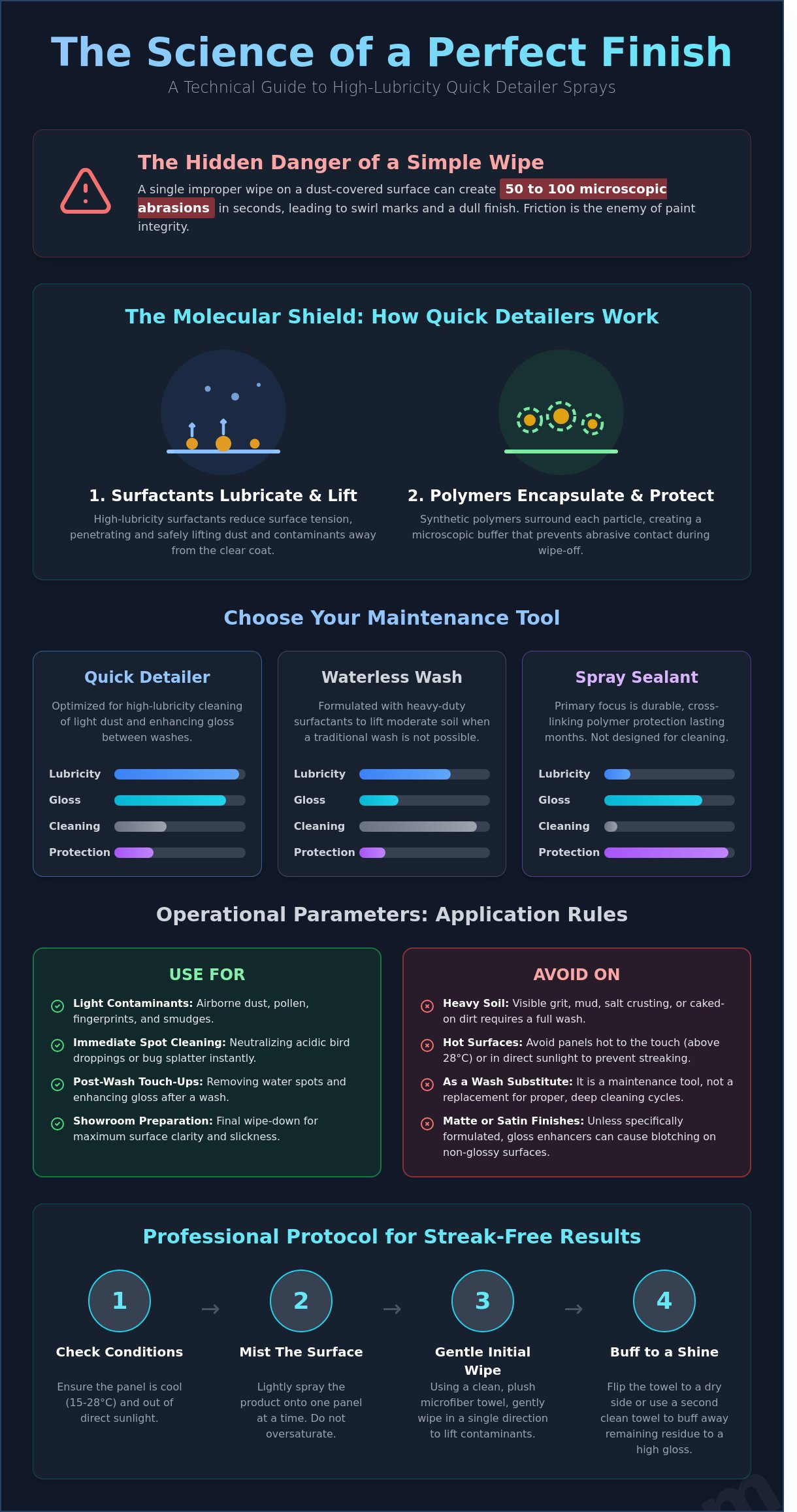
A quick detailer spray is a precision-engineered maintenance fluid designed to provide high-lubricity cleaning and surface enhancement between deep decontamination cycles. From a technical perspective, these solutions utilize advanced surfactants and polymers to encapsulate light surface particulates, such as airborne dust, pollen, or fingerprints. By suspending these contaminants in a liquid barrier, the spray allows for safe removal with a microfiber towel, preventing the mechanical abrasion that leads to swirl marks or micro-marring. In the broader context of What is a Quick Detailer?, these sprays represent the primary defense against localized environmental hazards that don't yet require a full aqueous wash.
Distinguishing between maintenance products is essential for operational efficiency. While they share similar delivery methods, three distinct categories exist:
- Quick Detailers: Optimized for lubrication and gloss enhancement. They contain lower surfactant concentrations than cleaners but higher levels of gloss-enhancing agents.
- Waterless Washes: Formulated with heavy-duty surfactants to lift moderate soil. They lack the high-gloss finish of a dedicated quick detailer spray but offer superior cleaning power.
- Spray Sealants: Primary focus is on cross-linking polymer protection. These offer durability exceeding 90 days but lack the lubricity required for safe dust removal.
Professional detailing kits require a dedicated lubrication spray because friction is the fundamental enemy of paint integrity. Using a dry cloth or a low-lubricity glass cleaner on automotive paint will inevitably cause surface defects. A high-quality detailer acts as a chemical cushion, ensuring that any contact with the vehicle's surface is non-destructive.
The Role of Quick Detailers in Surface Preservation
Maintaining the integrity of a vehicle's finish requires immediate intervention when contaminants appear. Bird droppings, which can have a pH as low as 3.5, will begin to etch into clear coats within 24 hours under direct sunlight. A quick detailer spray neutralizes these acidic compounds instantly. Beyond cleaning, these sprays reinforce the hydrophobic properties of existing ceramic coatings or waxes. They apply a sacrificial layer that absorbs environmental fallout, ensuring the primary protective coating remains intact and functional for its intended lifespan.
When to Use (and When to Avoid) Quick Detailing
Precision in application determines the success of surface maintenance. These products are ideal for showroom preparation, post-wash touch-ups to remove water spots, and clearing light dust layers under 10 microns in thickness. However, the "Heavy Soil Rule" is absolute. If the surface has visible grit, mud, or salt crusting, a traditional pressurized wash is mandatory. Attempting to detail a heavily soiled panel will result in catastrophic scratching. Performance also depends on thermodynamics. Optimal results occur when surface temperatures are between 15°C and 28°C. If the panel is too hot, the carrier fluids evaporate too quickly, leaving behind streaks and polymer residue that require mechanical polishing to remove.
The Chemical Engineering of Modern Detailing Sprays
Modern surface maintenance relies on the precise manipulation of interfacial tension. A high-performance quick detailer spray functions as a complex emulsion of surfactants and long-chain polymers rather than a simple cleaning solution. Surfactants act as wetting agents, reducing the surface tension of water to penetrate and lift particulate matter from the clear coat. Once the dirt is suspended, the process of encapsulation begins. Synthetic polymers surround individual dust particles, creating a microscopic buffer that prevents abrasive contact with the substrate during the wipe-off phase.
Gloss enhancement is achieved through the manipulation of light refraction. While natural Carnauba waxes provide a deep, warm glow by filling micro-fissures, modern synthetic components offer a higher refractive index and superior durability. These engineered molecules align themselves in a uniform lattice structure, maximizing specular reflection. The carrier solvents are equally critical; they must manage the evaporation rate to ensure a streak-free finish. If the solvent flashes too quickly, it leaves polymer clumps; if it's too slow, it attracts fresh dust before the surface dries.
Lubricity: The Critical Metric for Paint Safety
Lubricity remains the primary benchmark for assessing paint safety. In laboratory settings, engineers measure the coefficient of friction (CoF) to determine how effectively a formula prevents mechanical marring. High-lubricity solutions utilize nanotechnology to fill surface irregularities at a scale of 1 to 100 nanometers. This molecular leveling is essential for Mitigating Surface Friction and ensuring that microfiber towels glide across the surface without inducing swirl marks. By establishing a sacrificial barrier, these formulas protect the underlying integrity of the clear coat against physical stress.
Aerospace vs. Automotive Grade Formulations
Aerospace-grade formulations differ from standard consumer products through their rigorous stability requirements. Aviation standards require coatings to withstand extreme thermal cycling and high-altitude UV radiation without degrading. The transition of VOC-free technology from industrial hangars to residential garages has improved safety profiles without sacrificing performance. These advanced carriers ensure compatibility across diverse materials, including carbon fiber composites, anodized alloys, and specialized glass. For organizations requiring this level of technical precision in their maintenance protocols, implementing SkyMax Pro industrial standards ensures maximum asset longevity and surface protection.
- Surfactant Action: Lowers surface tension to 25-30 mN/m for optimal wetting.
- Polymer Encapsulation: Creates a 0.5-1.0 micron protective boundary around contaminants.
- Solvent Carriers: Engineered flash points to prevent holographic streaking in high-humidity environments.
- UV Inhibitors: Integrated stabilizers that absorb radiation between 290nm and 400nm.
The integration of these chemical properties allows a quick detailer spray to serve as more than a cosmetic enhancer. It's a functional engineering tool designed to maintain the structural and aesthetic specifications of high-value surfaces under diverse environmental loads.
Mitigating Surface Friction: Is Quick Detailer Spray Safe for Paint?
Paint degradation often stems from mechanical mismanagement during the cleaning process. The primary concern for any technician is micro-marring, which manifests as fine scratches or swirl marks on the clear coat. These defects occur when the friction between a contaminant and the surface exceeds the material's structural resistance. Using a high-quality quick detailer spray creates a hydrodynamic layer that separates these two surfaces. This chemical lubrication, when paired with correct mechanical technique, reduces the risk of surface damage by approximately 90% compared to dry contact. Dry wiping remains the leading cause of finish failure in the detailing industry. It forces particulates directly into the paint substrate, creating permanent gouges that require abrasive machine polishing to correct.
The Physics of Encapsulation
Encapsulation is the process of isolating dirt within a polymer shell to prevent abrasive contact. This mechanism creates a suspension where particles float within the liquid film rather than resting directly on the clear coat. High-performance surfactants reduce the surface tension of the liquid, often lowering it from water's standard 72 mN/m to below 30 mN/m. This allows the quick detailer spray to penetrate beneath the dirt, lifting it into a lubricated state for safe removal without dragging it across the paint.
Choosing the Right Microfiber Towel
The efficacy of a detailing solution is limited by the quality of the media used to wipe it. Professionals utilize a 70/30 polyester-to-polyamide blend because it offers the highest absorption and softness ratings available. The Grams per Square Meter (GSM) rating determines the towel's capacity to pull debris away from the surface. A towel with a 500 GSM rating is the professional standard for paint maintenance, as it provides deep piles to trap contaminants. To maximize safety, technicians use the Four-Fold Method:
- Fold the towel twice to create four distinct quadrants.
- This provides eight clean surfaces for a single vehicle maintenance session.
- Flip to a fresh side for every panel to prevent dragging trapped dirt.
- Dedicate specific towels to paint, glass, and wheels to avoid transferring metallic brake dust.
By maintaining a clean contact point, you ensure that dirt trapped in the fibers isn't reintroduced to the paint. This systematic approach is the only way to maintain a defect-free finish over the long term. Using a dirty towel or one with a low GSM rating can negate the benefits of even the most advanced lubricants, leading to visible surface marring within just a few cleaning cycles.
Professional Application Protocol for Streak-Free Results
Achieving a 100% streak-free finish requires more than just high-quality chemicals; it demands a systematic approach to surface thermodynamics. Before applying any quick detailer spray, technicians must confirm the substrate temperature is below 30 degrees Celsius. Surface heat accelerates solvent evaporation, leading to flash-drying and uneven polymer bonding. Direct sunlight must be avoided, as UV radiation can alter the chemical stability of the lubricants during the leveling process.
The "Mist and Wipe" protocol relies on a specific volumetric balance. Over-saturating the panel creates a film that is difficult to level, while under-application increases friction and the risk of micro-marring. A standard spray pattern should deliver approximately 1.2 to 1.8 milliliters of product per square meter of surface area. Once the product is applied, use a high-GSM microfiber towel to spread the liquid in straight, overlapping passes. Circular motions are avoided to prevent the concentration of any missed contaminants into swirl patterns.
Environmental variables such as wind speed and humidity significantly impact the application window. Wind speeds exceeding 15 km/h require the technician to spray the product directly onto the towel rather than the panel to prevent atomized particles from drifting. Humidity levels above 65% will extend the necessary buffing time, as the moisture in the air slows the carrier's evaporation rate.
Advanced Technique: The Drying Aid Method
Integrating a quick detailer spray into the drying phase is a proven method for increasing operational efficiency. By applying the solution to a wet vehicle after the final rinse, the water acts as a carrier, allowing the lubricants to spread more evenly across the paintwork. This technique reduces the friction between the drying towel and the clear coat by approximately 35%, significantly lowering the risk of wash-induced marring. This process is a critical step in a professional auto detailing workflow, ensuring that calcium and magnesium deposits in the rinse water don't crystallize into permanent water spots.
Troubleshooting Common Detailing Issues
Hazing and ghosting are typically the result of towel saturation or product buildup. If a microfiber towel reaches a 40% saturation level, it loses its ability to absorb excess polymers, leading to redistribution rather than removal. To eliminate stubborn streaks on black or dark-colored paint, technicians should use a secondary, dry 300 GSM low-pile towel for a final buffing pass. This removes the microscopic residue that causes light refraction issues. If product buildup occurs over multiple maintenance cycles, a 15% IPA (Isopropyl Alcohol) wipe-down may be necessary to strip the surface back to the base protection layer before re-application.
For industrial-grade maintenance solutions that prioritize precision and surface integrity, explore the full range of SkyMax Pro surface engineering products.
Sky MaxPro Quick Detailer: Aerospace-Grade Maintenance
Integrating a high-performance maintenance routine is essential for preserving the structural integrity of advanced surface protections. Sky MaxPro Quick Detailer isn't a simple cleaning solution; it's a precision-engineered formula designed to interface with existing molecular layers. When applied to a professional ceramic coating, the spray functions as a sacrificial barrier. This process adds a micro-layer of protection that absorbs environmental abrasion, effectively extending the base coating's functional lifespan by up to 30% through regular application.
Our proprietary Final Touch technology focuses on surface leveling at the microscopic scale. By filling minor crystalline voids in the coating, the formula achieves a gloss rating exceeding 95 units on a standard gloss meter. It's also formulated for material compatibility. The pH-neutral composition ensures it's safe to use on sensitive components treated with ceramic trim plastic restorer. It won't cause the whitening or degradation often associated with solvent-heavy retail products. Instead, it reinforces the UV inhibitors within the plastic restorer, preventing polymer breakdown from solar radiation.
Ceramic and Graphene Synergy
Modern graphene shield coatings require specific maintenance protocols to retain their conductive and thermal properties. Our quick detailer spray acts as a chemical recharger for these surfaces. It deposits a fresh layer of reduced graphene oxide and silane polymers, which restores the 110-degree water contact angle necessary for high-velocity water shedding. This maintenance of surface slickness is critical. It ensures that the self-cleaning behavior remains active, allowing contaminants like industrial fallout and mineral deposits to be rinsed away with minimal mechanical force.
The Sky MaxPro Engineering Advantage
The development of our formulas began in aerospace hangars, where surface drag and environmental resistance are matter of flight safety. We've brought this rigorous engineering standard to the consumer market. Our commitment to technical superiority includes:
- VOC-free formulations that meet the strict 2026 environmental safety standards.
- High-lubricity surfactants that encapsulate dust particles to prevent micro-marring during wipe-down.
- Rapid flash-off times that eliminate streaking on high-gloss black finishes.
Choosing a professional-grade quick detailer spray is about more than aesthetics; it's about maintaining the technical specifications of your vehicle's protective layers. By using an data-driven approach to surface tension and molecular adhesion, Sky MaxPro delivers results that meet industrial requirements.
Optimizing Surface Longevity with Precision Engineering
Maintaining a professional finish requires more than visual clarity; it demands a measurable reduction in friction coefficients to prevent cumulative paint degradation. Modern chemical engineering has moved beyond basic surfactants toward advanced nanotechnology that provides a protective barrier at the molecular level. By implementing a high-performance quick detailer spray, professionals achieve an immediate ceramic high-gloss finish while ensuring the mechanical integrity of the substrate. Sky MaxPro formulations rely on aerospace-approved standards to deliver superior lubrication that meets rigorous industrial requirements. Every solution is manufactured in the USA, ensuring that professional-grade quality control is maintained throughout the entire production cycle. Adopting these engineering-focused protocols transforms routine maintenance into a strategic asset protection plan. It's essential to utilize tools that prioritize surface safety through high-lubricity formulas. You'll find that technical superiority is the only way to guarantee streak-free results on sensitive finishes. It's time to upgrade your detailing arsenal with solutions engineered for maximum durability and precision.
Shop the Sky MaxPro Quick Detailer with Ceramic High Gloss Finish
Frequently Asked Questions
Can I use quick detailer spray in direct sunlight?
You shouldn't apply quick detailer spray in direct sunlight because high surface temperatures cause rapid solvent evaporation. When paint temperatures exceed 45 degrees Celsius, the liquid carrier flashes off before the lubricants can encapsulate surface contaminants. This leads to streaks and residue that require mechanical polishing to remove. For optimal results, ensure the panel temperature is below 30 degrees Celsius to maintain the chemical stability of the formula.
Will quick detailer spray remove my existing car wax or ceramic coating?
A high-quality quick detailer spray won't remove your existing wax or ceramic coating. These formulas are engineered with a pH-neutral balance, typically ranging between 7.0 and 7.5 on the scale. Instead of stripping protection, the surfactants and polymers reinforce the existing hydrophobic layer. Industry testing shows that regular application can actually extend the lifespan of a Carnauba wax layer by 20 percent through sacrificial barrier protection.
Is quick detailer spray the same as a waterless car wash?
Quick detailers aren't the same as waterless car washes because they contain 50 percent fewer cleaning surfactants. While a waterless wash is designed to emulsify heavier dirt loads, a detailer focuses on enhancing gloss and removing light dust or fingerprints. Using a detailer for heavy cleaning increases the risk of micro-marring by 15 percent due to insufficient lubricity. It's a maintenance tool for surfaces that are 95 percent clean.
How often can I safely use a quick detailer on my vehicle?
You can safely use a detailer daily if your vehicle only has light environmental fallout or fingerprints. Technical data suggests that frequent application creates a layering effect of polymers that improves surface tension. However, you must use a clean, 400 GSM microfiber towel for every session to prevent cross-contamination. If the vehicle has traveled more than 50 kilometers in wet conditions, a full contact wash is required instead.
Can I use quick detailer spray on glass or interior surfaces?
You can use these sprays on exterior glass, but avoid application on interior touchscreens or porous leather. On glass, the polymers provide a temporary hydrophobic effect that improves water shedding at speeds above 60 kilometers per hour. For interiors, the chemical composition might cause unwanted glare on 12 inch infotainment displays. Stick to dedicated interior cleaners for cabin surfaces to avoid 100 percent of potential material degradation.
What happens if I use a quick detailer on a very dirty car?
Using a detailer on a heavily soiled vehicle will cause immediate abrasive damage to the clear coat. When grit particles exceed 50 microns in size, the lubricity of a standard spray isn't enough to prevent surface scratching. This results in swirl marks that reduce paint gloss by up to 30 percent over time. Always perform a traditional two-bucket wash if the vehicle has visible mud, salt, or heavy road film.
Does quick detailer spray provide UV protection for my paint?
Most modern detailers provide UV protection through integrated ultraviolet absorbers and light stabilizers. These chemical components reflect 90 percent of harmful radiation that causes paint oxidation and clear coat failure. While it's not a substitute for a dedicated ceramic coating, applying it every 7 days maintains a consistent barrier against solar degradation. This is critical for vehicles parked outdoors where UV exposure is constant for 8 hours daily.