

With the fabric segment estimated to hold a 50.2% share of the global automotive upholstery market in 2026, why do most vehicle owners still rely on primitive surface sprays that fail at the molecular level? You likely understand the technical challenge of wicking, where residual moisture activates deep-seated particles and pulls them back to the surface during the drying phase. Effectively protecting fabric car seats from stains requires moving beyond these temporary fixes toward a precise engineering solution.
This guide provides the technical framework to master upholstery longevity using aerospace-grade nanotechnology. You'll learn how to transform vulnerable fibers into a high-performance hydrophobic surface where liquids bead and roll off without altering material texture or breathability. We'll analyze the science of molecular integration, the impact of modern safety standards like FMVSS 213b on interior maintenance, and the precise methodology for applying ceramic-based shields. By shifting your approach from reactive cleaning to proactive structural protection, you ensure your vehicle's interior remains impervious to environmental contaminants and daily wear.
Key Takeaways
- Understand the microscopic architecture of automotive textiles to prevent capillary action from pulling liquids into the foam backing.
- Learn how 1-100 nanometer scale coatings increase the contact angle of droplets, creating a hydrophobic surface where spills simply bead off.
- Identify the engineering differences between retail silicon sprays and ceramic-based shields when protecting fabric car seats from stains for long-term durability.
- Master the professional decontamination protocol to ensure your protectant bonds correctly to the fiber rather than surface contaminants.
- Establish an integrated maintenance strategy that replaces aggressive scrubbing with specialized blotting techniques to preserve the integrity of the protective barrier.
The Science of Fabric Vulnerability and Stain Formation
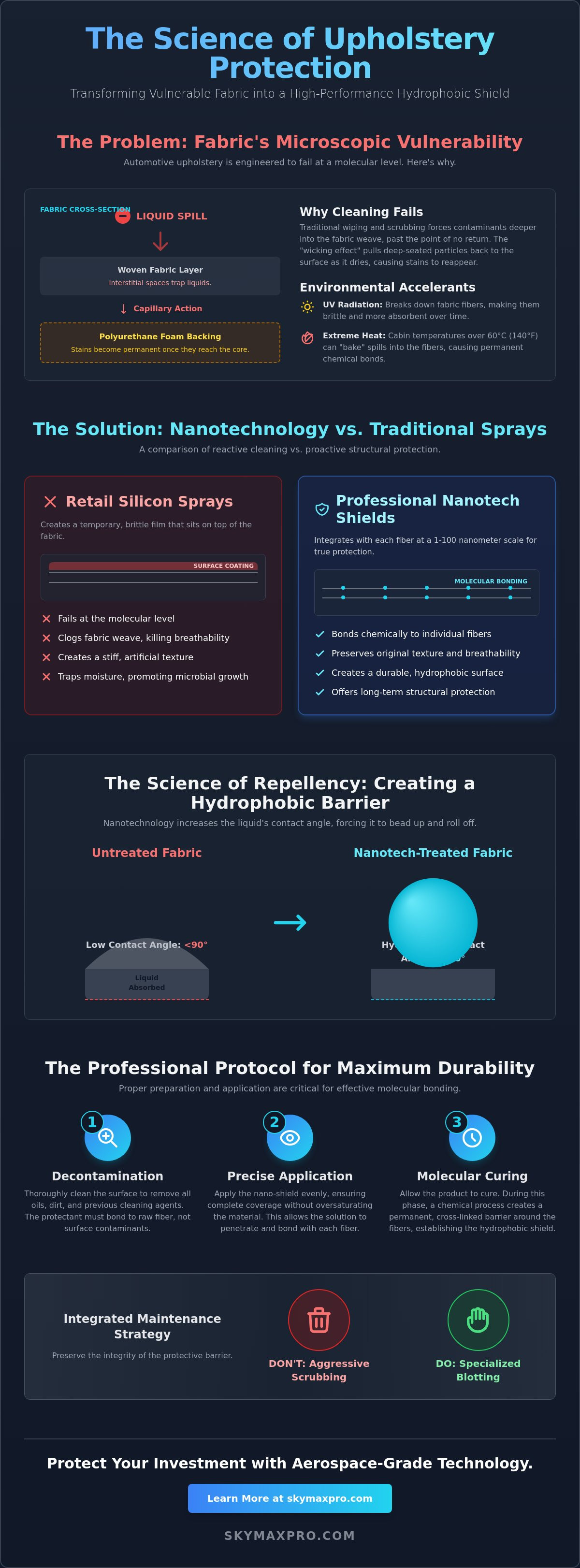
Automotive upholstery is a complex system of woven or non-woven fibers designed for durability, but its microscopic architecture makes it inherently vulnerable. At a granular level, these textiles consist of a vast network of interstitial spaces. When a liquid spill occurs, it doesn't merely rest on the surface. Instead, it's subjected to capillary action. This physical phenomenon occurs when the surface tension of the liquid is lower than the surface energy of the fiber, drawing the contaminant deep into the yarn and eventually into the polyurethane foam backing. Once a substance reaches the foam core, extraction becomes nearly impossible without specialized industrial equipment.
Understanding the chemical composition of the contaminant is essential for protecting fabric car seats from stains. Organic stains, such as coffee or mud, often contain acidic components that can bond with the fiber's dye sites. Chemical stains, including motor oils or synthetic dyes from clothing, present a different challenge as they can permanently alter the polymer structure of the textile. Historically, products like Scotchgard introduced the concept of using fluoropolymers to lower surface energy, though modern engineering has since moved toward more advanced molecular barriers that offer superior integration with the material's structural integrity.
The Porous Nature of Automotive Textiles
Woven fabrics provide high breathability but offer significantly more "pockets" for liquid retention compared to tight-knit synthetics. If you attempt to wipe a spill with a cloth, the mechanical pressure often forces the liquid deeper into the weave rather than lifting it. This is why high-pigment liquids like red wine or fruit juices often reach a "point of no return" within seconds. The pigment particles become trapped within the internal structure of the fiber itself, leading to permanent discoloration that no standard cleaner can fully reverse.
Environmental Factors Accelerating Interior Degradation
Interior surfaces are constantly under stress from UV radiation and extreme heat cycling. UV rays break down the molecular bonds of the fabric, making fibers brittle and more absorbent over time. In a closed vehicle, temperatures can exceed 60°C (140°F), which accelerates the chemical reaction of any spilled substances, effectively "baking" them into the material. Even dry contaminants like road salt or dust act as microscopic abrasives. Every time a passenger sits down, these particles grind against the fibers, stripping away any natural resistance and making the task of protecting fabric car seats from stains increasingly difficult as the vehicle ages. Left untreated, these trapped substances become breeding grounds for microbial growth, directly compromising cabin air quality and the long-term aesthetic of the interior.
Advanced Nanotechnology: Creating a Hydrophobic Barrier
Nanotechnology operates at the 1-100 nanometer scale, a dimension where the physical and chemical properties of materials undergo significant shifts. In the context of protecting fabric car seats from stains, this technology allows for the manipulation of surface energy at a molecular level. Unlike traditional silicon sprays that create a brittle film, nano-scale protectants integrate with the textile's structure. This precision ensures that the primary function of the upholstery, such as comfort and flexibility, remains entirely uncompromised.
The primary metric for effectiveness is the contact angle of liquid droplets. When a surface is truly hydrophobic, the contact angle exceeds 150 degrees, causing liquids to maintain a spherical shape rather than collapsing into the fibers. You can explore various nanotechnology applications to understand how these engineered surfaces repel residues in industrial settings. By increasing this angle, the protectant ensures that contaminants remain on the surface for easy removal. This technical approach is far superior to traditional methods that rely on heavy, non-breathable layers.
Molecular Bonding vs. Surface Coating
Traditional products often fail because they simply "clog" the weave of the fabric. This creates a stiff, artificial texture and traps moisture beneath the coating, which can lead to the microbial growth discussed in the previous section. Professional-grade shields bond to individual fibers through a chemical process that leaves the spaces between the yarns open. This preserves the breathability of the seat. It's the difference between wearing a plastic poncho and a high-performance breathable jacket. The tactile feel remains soft, yet the material becomes functionally impervious to spills.
Aerospace-Grade Performance in Automotive Applications
Engineering requirements in aviation demand materials that withstand extreme temperature fluctuations and high-frequency abrasion. These aerospace formulations have transitioned into the automotive sector to provide a level of durability that retail sprays cannot match. They offer superior chemical stability, meaning the barrier won't break down when exposed to the alkaline cleaners or UV radiation common in vehicle cabins. The "Lotus Effect" is the engineering benchmark for hydrophobicity, where a surface's micro-topography mimics the self-cleaning properties of the lotus leaf to repel water and contaminants automatically.
Utilizing a professional-grade fabric shield ensures these technical standards are met without introducing harmful chemicals into your vehicle. Since automotive interiors are enclosed environments, choosing VOC-free and biodegradable formulations is critical. Heat cycling inside a car can cause low-grade chemicals to off-gas, affecting cabin air quality. Advanced nano-coatings provide a safe, high-performance solution that maintains structural integrity while effectively protecting fabric car seats from stains over the long term.
Selecting Professional-Grade Fabric Protectants vs. Retail Options
Evaluating fabric protection requires a shift from marketing claims to technical specifications. A professional framework for protecting fabric car seats from stains focuses on molecular weight, chemical resistance, and the ability to withstand mechanical abrasion. In 2026, the fabric segment holds a 50.2% share of the automotive upholstery market, making the preservation of these materials a high-stakes financial decision for vehicle owners. The objective is to maintain a high contact angle over thousands of ingress and egress cycles without compromising the structural integrity of the textile.
Comparing silicon-based retail sprays to advanced ceramic-based shields reveals a significant gap in performance. Research into stain-resistant fabric demonstrates that effective protection depends on the uniformity of the molecular layer. Retail products often utilize high-viscosity silicones that sit on top of the fiber. These formulations fail the cost-benefit analysis. While the initial price is lower, the necessity for monthly reapplication and the risk of permanent fiber damage make them an inefficient choice compared to professional-grade systems that offer multi-year durability.
The Limitations of Consumer-Grade Silicone Sprays
Silicone-based products are notorious for creating a sticky or tacky residue. This occurs because the silicone molecules don't bond to the fiber; they merely coat it. This residue attracts dust and salt, which then act as abrasives against the yarn. Over time, heat cycling inside the cabin can cause these inferior formulations to oxidize. This leads to yellowing or discoloration of light-colored upholstery, a process that is often irreversible without professional intervention.
PRO Shield for Fabric: The Engineering Advantage
The PRO Shield for Fabric, Carpet, Upholstery & Floor Mats represents the next generation of textile engineering. It utilizes cross-linking polymers that integrate into the material's structure rather than forming a brittle surface film. This provides a multi-surface solution compatible with carpets and floor mats alike. When used as part of a total system with other professional car detailing products, it ensures that every interior surface meets the same high standard of chemical stability. Technical analysis of the MSDS for these professional-grade products reveals solvent carriers designed for rapid evaporation, leaving behind only the active protective agents. This approach minimizes VOC exposure while maximizing the longevity of the hydrophobic barrier when protecting fabric car seats from stains.
The Professional Application Protocol for Maximum Durability
The efficacy of a molecular barrier is entirely dependent on the quality of the bond established during application. If the fiber is contaminated with oils, dust, or previous retail-grade residues, the protectant cannot achieve full integration. This failure leads to premature degradation of the hydrophobic layer. Successfully protecting fabric car seats from stains requires a systematic approach that mirrors industrial coating standards, ensuring the substrate is chemically receptive to the nano-shield.
Phase 1: Decontamination and Preparation
Surface preparation is the most critical variable in the protocol. You must remove all latent contaminants using a specialized surfactant before applying any protective layer. Utilizing Carpet, Fabric & Upholstery Dry Foam Tech Shampoo Cleaner allows you to lift deeply embedded dirt without over-saturating the foam backing. This dry foam technology is essential because excess moisture trapped in the seat prevents the nano-coating from bonding directly to the individual fibers. It's a common mistake to apply protectant to damp seats, which results in a compromised barrier.
While the fabric dries, use Deep Clean Interior Cleaner on the surrounding non-fabric surfaces, such as plastic trim and door panels. This ensures a sterile environment and prevents cross-contamination during the spraying phase. The upholstery must be 100% dry before proceeding. Any residual water molecules will occupy the dye sites where the protectant needs to bond, creating microscopic gaps in your protection that liquids will eventually penetrate.
Phase 2: Precision Application and Curing
Achieving a uniform layer requires a specific mechanical technique. Hold the applicator approximately 20 centimeters from the surface and apply using a cross-hatch pattern. This involves spraying in consistent horizontal rows followed by vertical columns to ensure every side of the fiber is coated. For high-traffic zones like driver-side bolsters or child seat areas, a dual-coat approach is mandatory. Apply the second layer while the first is still slightly tacky to facilitate chemical cross-linking between the layers.
Environmental control is vital for molecular stability. Aim for a temperature range between 15°C and 25°C with humidity levels below 60%. High humidity interferes with the evaporation of solvent carriers, which can compromise the curing process. Once applied, a 24-hour "no-touch" period is essential for the nanoparticles to finish their structural alignment. You can test the integrity of the barrier after 48 hours by placing a single drop of deionized water on the surface. If the droplet maintains a high contact angle and rolls off freely, the application is successful. To ensure you have the right tools for this technical process, you can order the professional Interior Cleaning Kit here to begin protecting fabric car seats from stains with engineering precision.
Integrated Maintenance Strategy for Interior Surface Integrity
The application of a nano-coating is a foundational engineering step, but the enduring success of protecting fabric car seats from stains depends on a structured maintenance protocol. Once the molecular bond has reached full stability, your objective transitions from structural modification to barrier preservation. This phase is characterized by minimizing mechanical stress and avoiding chemical interference that could degrade the hydrophobic layer. A well-executed maintenance strategy extends the service life of the protectant and ensures the material remains functionally impervious to contaminants.
Handling Spills on Protected Surfaces
Spills on a treated surface behave differently because of the increased contact angle discussed in previous sections. The liquid remains in a state of suspension, unable to penetrate the fibers. The "blot, don’t rub" rule is a matter of physics. Rubbing generates localized heat and pressure that can force contaminants through the microscopic gaps in the shield. Use a clean, dry microfiber towel to absorb the liquid through capillary action alone. If you're dealing with dried mud or salt, utilize a vacuum with a soft brush attachment. This prevents these abrasive solids from compromising the coating's integrity. Using pH-neutral cleaners is essential; aggressive solvents will eventually dissolve the polymer bonds, leaving the fabric vulnerable.
The Long-Term Detailing Ecosystem
Achieving aerospace-grade results requires a holistic view of the vehicle's interior. Professional auto detailing isn't a one-time event but a continuous system of surface management. There's a calculated synergy between the initial shield and the daily use of specialized car cleaning products. We recommend a quarterly interior audit to assess the performance of the barrier. Focus your inspection on high-friction zones, such as seat bolsters and entry points, where physical wear is most aggressive. If water fails to bead in these specific areas, a targeted spot reapplication will restore the total integrity of the system.
This proactive approach prevents the accumulation of environmental contaminants and preserves the material's tactile quality. It's about maintaining the engineering benchmark established during the first application. To maintain this standard of excellence, the Interior Cleaning Kit offers a complete solution for the modern vehicle owner dedicated to protecting fabric car seats from stains and ensuring long-term upholstery longevity. By integrating these professional-grade tools into your routine, you preserve the aesthetic and structural value of your vehicle for years to come.
Engineering the Future of Interior Material Integrity
Transitioning from reactive cleaning to a proactive engineering mindset ensures that your vehicle's interior remains a controlled, high-performance environment. This guide has detailed the technical shift from surface-level sprays to molecular-level integration. By understanding the physics of capillary action and the precision required in application protocols, you can effectively prevent the structural degradation of automotive textiles. Successfully protecting fabric car seats from stains is no longer a matter of chance; it's a result of applying aerospace-grade standards to daily maintenance.
Implementing these advanced systems protects both the aesthetic and the functional value of your upholstery. Our solutions feature aerospace-approved nanotechnology and VOC-free, eco-friendly formulations that are trusted by professional detailers nationwide. To secure your vehicle's interior against environmental contaminants and daily wear, Upgrade to Aerospace-Grade Interior Protection with PRO Shield. Take control of your cabin's longevity with precision-engineered tools designed for the most demanding standards.
Frequently Asked Questions
How long does a professional fabric protectant last on car seats?
Professional-grade shields typically maintain their hydrophobic properties for 12 to 24 months. The exact duration depends on the frequency of mechanical abrasion and UV exposure. High-traffic areas like the driver’s seat bolster may require a technical audit sooner than rear passenger surfaces. Unlike retail sprays that degrade within weeks, these cross-linking polymers are chemically stable against extreme heat cycling.
Will protecting my fabric seats change the way the upholstery feels?
No, advanced nanotechnology preserves the original tactile properties and breathability of the textile. Because the nanoparticles bond to individual fibers rather than filling the interstitial spaces, the fabric doesn't become stiff or tacky. You'll maintain factory-standard comfort while successfully protecting fabric car seats from stains. The material remains soft to the touch because the coating operates at a molecular scale.
Can I apply fabric protectant to seats that are already stained?
You must perform a complete decontamination phase before application. Applying a shield over existing stains will effectively "lock" the contaminant into the fiber, making future removal nearly impossible. Use a dry foam shampoo to extract all organic and chemical residues first. Ensure the substrate is chemically receptive and 100% dry to allow for a proper molecular bond.
Is fabric protectant safe for use in vehicles with children and pets?
Yes, provided you select VOC-free and biodegradable formulations designed for enclosed automotive environments. Once the carrier solvents have fully evaporated and the coating has cured, the barrier becomes inert. This makes it an ideal engineering solution for managing the frequent spills and environmental contaminants associated with high-occupancy family vehicles without compromising cabin air quality.
How soon can I drive my car after applying a fabric shield?
The vehicle is generally safe to drive once the fabric is dry to the touch, which usually occurs within 2 to 4 hours under standard conditions. However, the molecular structure requires a full 24 hours to reach maximum stability. Avoid any liquid contact or heavy friction during this critical curing window. This patience ensures the long-term durability and effectiveness of the hydrophobic barrier.
What happens if I spill something on a protected seat but don’t clean it immediately?
The liquid will remain in a suspended state on the surface due to the increased contact angle. While the barrier prevents immediate absorption, prolonged exposure or passenger movement could eventually force the liquid through the protective layer. It's best to blot the spill with a microfiber towel as soon as possible. This prevents the liquid from finding microscopic gaps in the shield over time.
Does fabric protection help with odors as well as stains?
Yes, by preventing the absorption of organic liquids into the foam backing, you inhibit the microbial growth that causes persistent odors. Since contaminants cannot reach the porous core of the seat, they don't have the opportunity to decompose. This structural protection is essential for maintaining a neutral cabin environment and preventing the "wicking" of old smells during high-humidity cycles.
Can I use the same protectant on my car’s carpets and floor mats?
Most professional-grade textile shields are engineered for multi-surface compatibility across all interior fabrics. This includes woven upholstery, synthetic carpets, and floor mats. Using a unified system for protecting fabric car seats from stains and carpet integrity ensures consistent chemical resistance. It simplifies your maintenance protocol while providing aerospace-grade durability for every textile surface in the vehicle.