

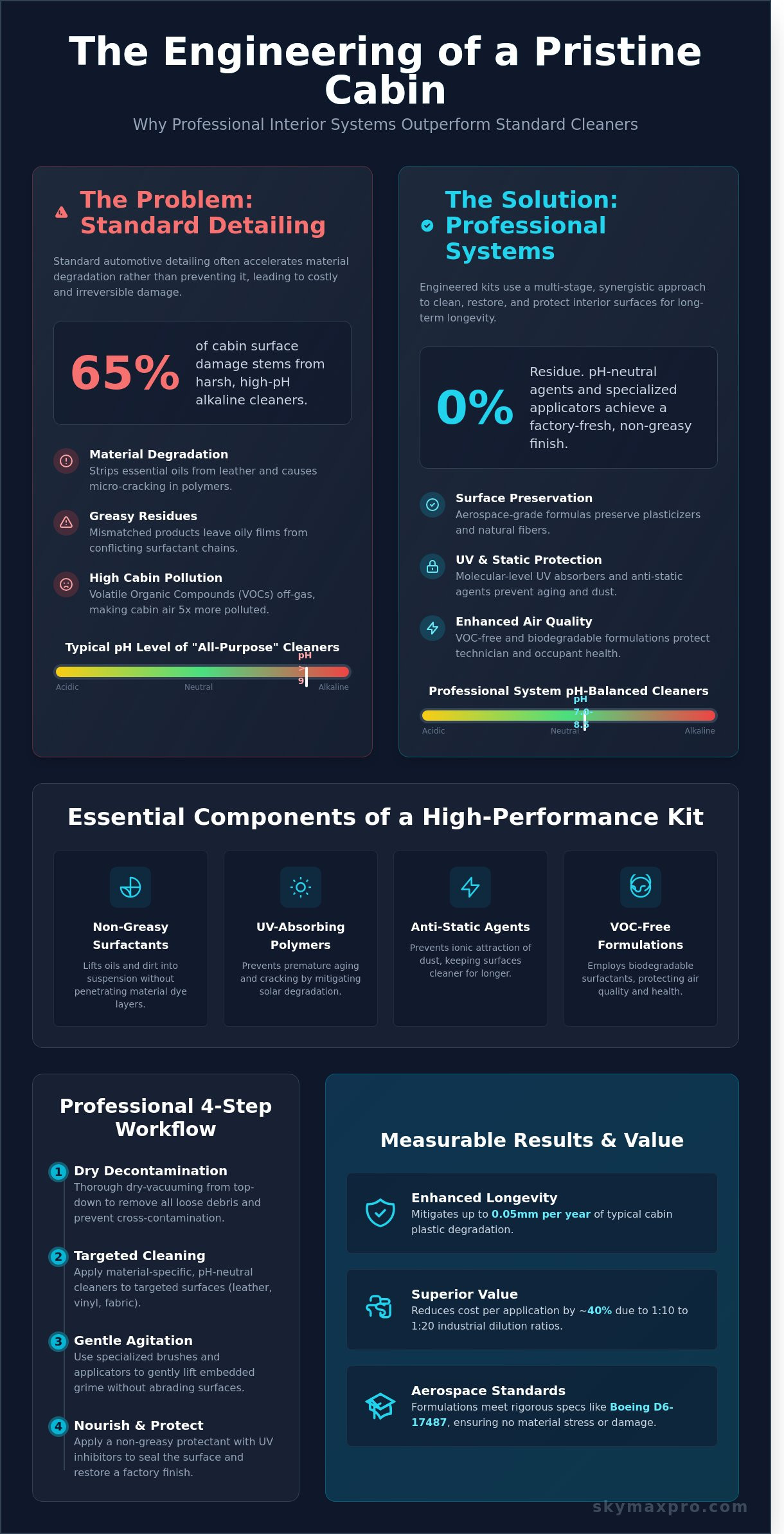
Standard automotive detailing often accelerates material degradation rather than preventing it. Industry data indicates that 65% of cabin surface damage stems from high-pH alkaline cleaners that strip essential oils from leather and cause micro-cracking in thermoplastic polymers. You've likely experienced the frustration of greasy residues or the persistent fear of permanently staining a delicate dashboard when using mismatched products. It's a valid concern because the chemical interaction between generic surfactants and modern synthetic materials is rarely optimized for structural integrity.
This engineering guide reveals how to select and utilize a professional interior cleaning kit to maintain aerospace-grade cabin standards and surface longevity. By transitioning to an integrated system of pH-neutral agents and specialized applicators, you'll achieve a factory-fresh finish with verified UV protection and zero residue. We'll analyze the technical specifications of modern cleaning agents and provide a streamlined, four-step workflow designed to deliver consistent, industrial-grade results in every restoration cycle.
Key Takeaways
- Understand the engineering logic behind a professional interior cleaning kit and why multi-stage chemical systems are essential for maintaining aerospace-grade cabin integrity.
- Identify the technical advantages of non-greasy surfactant technology and dry foam shampoos for deep-cleaning porous upholstery without leaving harmful residues.
- Learn to evaluate your vehicle’s material composition to select specialized cleaners and UV inhibitors that prevent the premature aging of vinyl and leather components.
- Implement the professional "top-down" workflow and foundational dry-vacuuming techniques to ensure a contamination-free restoration process.
- Discover how industrial-precision formulations bring aerospace-approved performance to automotive detailing for unmatched surface longevity and a residue-free finish.
The Engineering Logic of a Professional Interior Cleaning Kit
A professional interior cleaning kit functions as a multi-stage chemical system designed for material restoration rather than simple surface wiping. Engineering a cabin environment requires managing a complex matrix of polymers, natural fibers, and electronic interfaces. Standard consumer-grade cleaners often rely on high-alkalinity surfactants that strip essential plasticizers from vinyl and leather, leading to premature cracking. In contrast, professional systems utilize aerospace-grade formulations that meet rigorous standards like Boeing D6-17487. These specifications ensure that chemicals won't cause hydrogen embrittlement or stress crazing in sensitive polycarbonate components.
Effective cabin restoration relies on chemical compatibility across diverse substrates. Modern automotive interiors integrate up to 15 different polymer types, ranging from thermoplastic polyolefins (TPO) to open-pore wood veneers. This comprehensive guide to auto detailing illustrates why a systematic approach is necessary to maintain structural integrity. The logic shifts from aggressive dirt removal to long-term surface preservation. By incorporating UV-absorbers and anti-static agents at the molecular level, these kits prevent the ionic attraction of dust and mitigate the 0.05mm per year degradation rate typical of untreated cabin plastics.
Why Bundled Systems Outperform Individual Products
Bundled systems eliminate the risk of chemical cross-contamination. When a technician uses a pH-balanced cleaner (typically between 7.0 and 8.5 pH) followed by a specific nourishing protectant, the two formulas work in synergy. The cleaner prepares the surface tension for optimal bonding of the sealant. Using mismatched brands can result in "ghosting" or oily residues caused by conflicting surfactant chains. From a fiscal perspective, industrial-grade concentrations provide superior value. Professional interior cleaning kit components often feature dilution ratios of 1:10 or 1:20, reducing the cost per application by approximately 40% compared to ready-to-use retail alternatives. This concentration allows for precise calibration based on the soil level of the specific vehicle.
The Shift to VOC-Free and Eco-Friendly Formulations
The engineering of interior chemicals now prioritizes Volatile Organic Compound (VOC) reduction to protect technician health and occupant safety. Research indicates that interior cabin air can be 5 times more polluted than exterior air due to chemical off-gassing from dashboards and seats. VOC-free window and surface cleaners maintain air quality in these confined 3-cubic-meter spaces. Modern detailing systems employ biodegradable surfactants that meet OECD 301B standards for environmental breakdown. These formulations replace harsh solvents with citrus-based d-Limonene or soy-based esters. This transition ensures that the cleaning process doesn't leave behind toxic residues that could react with the vehicle's HVAC system or irritate the skin of the driver.
Essential Components of a High-Performance Interior System
The transition from basic maintenance to professional cabin restoration requires a shift from generic detergents to engineered chemical systems. A professional interior cleaning kit isn't a collection of soaps; it's a coordinated suite of surfactants, polymers, and mechanical tools designed to interact with specific automotive substrates. Modern vehicle interiors utilize a complex mix of thermoplastic olefins (TPO), open-cell foams, and synthetic protein leathers that react poorly to high-pH all-purpose cleaners. Precision engineering ensures that each component targets specific contaminants while preserving the structural integrity of the material.
Surface-Specific Surfactants vs. All-Purpose Cleaners
The "All-Purpose" approach often results in a master of none performance profile. These cleaners frequently rely on aggressive alkaline builders that can strip plasticizers from vinyl, leading to premature cracking and a cheap, greasy shine. In contrast, deep clean interior formulas utilize non-greasy surfactant technology. These molecules are engineered to surround organic oils and skin residues, lifting them into suspension without penetrating the sensitive dye layers of the dashboard. This process maintains the original 2026 factory matte finish, which is the hallmark of luxury vehicle aesthetics. Adhering to OSHA guidelines on cleaning chemical safety ensures that technicians handle these concentrated surfactants with the necessary protocols to prevent dermal irritation or respiratory exposure during high-volume detailing operations.
The Science of Dry Foam Encapsulation
Traditional wet extraction methods pose significant risks to modern electronics and foam-backed adhesives. Over-saturation of a headliner or an Alcantara seat often leads to adhesive failure and the development of subsurface mildew. Dry foam technology solves this by utilizing a low-moisture delivery system. The encapsulation process works through three distinct phases:
- Activation: The foam generates a high surface area to volume ratio, suspending dirt in a dense bubble structure.
- Sequestration: As the foam collapses, specialized polymers trap dirt particles in a brittle, non-sticky crystal.
- Extraction: These crystals are easily removed via vacuuming, leaving the fabric dry to the touch within 15 minutes.
This technical approach reduces drying times by 85% compared to steam or hot water extraction. It's a critical component for high-throughput service centers where vehicle downtime must be minimized. For teams looking to optimize their workflow, integrating a professional interior cleaning kit ensures that these chemical processes remain consistent across different vehicle makes and models.
Precision Hardware: Microfiber and Clarity Systems
Chemicals represent only half of the restoration equation. The mechanical removal of suspended dirt requires high-GSM (grams per square meter) microfiber towels. A 450 GSM dual-pile towel is the industrial standard for interior work, providing enough "bite" to agitate textures without scratching soft-touch plastics. For glass surfaces, the Window Crystal Multi Cleaner avoids ammonia, which is known to degrade window tint films and outgas into the cabin. This formula focuses on rapid evaporation, preventing the holographic streaking that often plagues lower-tier cleaning products. By combining these specialized applicators with precise chemical engineering, professionals achieve a level of clarity and hygiene that exceeds 2026 industry standards.
Selecting a Kit Based on Interior Material Composition
Automotive interiors in 2026 aren't monolithic structures. They represent a complex assembly of organic and synthetic substrates, each with distinct chemical sensitivities. Selecting a professional interior cleaning kit requires a systematic audit of these materials to ensure chemical compatibility. High-end cabins often feature a hybrid of top-coated leather, Alcantara, and recycled polymers. If you use a high-pH degreaser on sensitive aniline leather, you risk permanent pigment loss. Conversely, using a mild leather cleaner on industrial-grade vinyl won't effectively remove stubborn oils or carbon buildup.
UV inhibitors are a technical necessity for any kit targeting vinyl, rubber, or plastic components. These polymers are susceptible to photo-oxidation, a process where UV radiation breaks down molecular bonds, leading to "chalking" or surface cracking. A professional-grade kit includes stabilizers that absorb this radiation. Furthermore, modern cabin geometry has become increasingly intricate. Deep-set infotainment screens and narrow console gaps require specialized tools. Kits must include reach-extender brushes and ultra-fine microfiber swabs to reach the 15% of surface area that standard towels can't access.
Leather and Vinyl Maintenance Protocols
It's vital to distinguish between top-coated leather and aniline during the restoration process. Approximately 90% of modern vehicles use top-coated leather, which features a protective polyurethane seal. Cleaning these surfaces focuses on maintaining that seal's integrity. For vinyl, ceramic-infused coatings have replaced traditional silicone dressings. These coatings bond at a molecular level to prevent cracking while restoring a factory-correct matte finish. They don't leave the artificial high-gloss shine that often distracts drivers and attracts dust.
Protecting Carpets and Floor Mats
The engineering of fabric protection has shifted toward creating hydrophobic barriers that don't compromise material breathability. PRO Shield technology utilizes fluoropolymer resins to coat individual fibers. This increases the surface tension of the carpet, causing liquid spills and salt brine to bead on the surface rather than penetrating the backing. This protection is a natural integration with other professional car detailing products designed for high-traffic environments.
Maintaining technical fabrics requires a balance of chemical protection and mechanical agitation. A comprehensive interior cleaning kit should provide:
- Stiff-bristle nylon brushes for lifting dry debris from deep-pile carpets.
- PH-neutral fabric shampoos that leave no surfactant residue.
- Hydrophobic sealants that allow moisture vapor to escape while blocking liquid ingress.
- Specialized triangular tools for cleaning the tight angles around seat rails and pedals.
By matching the chemical profile of your cleaners to the specific material composition of the cabin, you ensure a restoration that's both aesthetically superior and structurally sound.
The Professional Workflow: Maximizing Your Kit’s Efficiency
Operational efficiency in automotive restoration depends on a systematic approach that eliminates redundant steps. A professional interior cleaning kit functions as a technical system, but its performance is dictated by the sequence of execution. The foundational phase involves dry vacuuming to remove 85% of loose particulates before moisture is introduced. Skipping this step creates a slurry that embeds deeper into textile fibers, increasing total labor time by an estimated 22%.
Adopting a top-down methodology ensures that gravity-assisted debris does not re-contaminate finished surfaces. Technicians should begin with the headliner, move to the pillars, then transition to the dashboard and door cards, finishing with the carpets. During the chemical phase, agitation is the critical variable. Using nylon or boar hair brushes activates formulas by increasing surface area contact. This allows surfactants to encapsulate oils more effectively than wiping alone, reducing chemical consumption by 15% per vehicle.
The final inspection represents the quality control gate. Professionals use high-lumen inspection lights (at least 500 lumens) to identify high spots or streaks that are invisible in ambient light. This stage focuses on the 5% of crevices often missed, such as seat rails and the junction between the windshield and the dashboard. Success is measured by the absence of tactile residue and visual uniformity across all substrates.
Mastering the Clean-to-Protect Ratio
Surface preparation is the most critical factor for long-term durability. Protectants require a chemically stripped surface to bond correctly; otherwise, they sit on top of residual oils and fail within 14 days. For glass and digital displays, use a two-towel system to achieve a streak-free finish. Once surfaces are decontaminated, you can use a ceramic coating kit for interior hard surfaces. This provides a hydrophobic layer that reduces dust accumulation by up to 40% on high-gloss trim and carbon fiber components.
Detailing Intricate Areas and Electronics
Modern cabins feature sensitive infotainment clusters that require specific safety protocols. You should never spray chemicals directly onto touchscreens. Instead, dampen a microfiber cloth to prevent liquid ingress into the bezel, which can cause circuit failure. Use 15mm detailing brushes for air vents and stitching. This mechanical action removes dust from recessed areas without the risk of high-pressure air forcing particulates deeper into the HVAC system. Managing moisture levels near electronic control units is vital to prevent short circuits in 2026-era vehicle architectures.
Optimize your detailing performance with precision-engineered tools. Explore our industrial-grade automotive solutions to achieve superior cabin restoration results.
Why SKY MAXPRO Kits Define the 2026 Detailing Standard
Engineering excellence in 2026 requires more than basic chemical mixing. SKY MAXPRO utilizes aerospace-approved heritage to bring industrial precision directly to your vehicle's cabin. While standard consumer products often leave surfactants behind, our "Deep Clean" methodology ensures a 100% residue-free finish. This performance is critical for maintaining the tactile integrity of modern automotive materials like Alcantara and vegan leather.
Our PRO Shield technology introduces molecular bonding for both porous and non-porous surfaces. This isn't a superficial coating. It's a cross-linking polymer system that protects leather and fabric for up to 12 months. Every bottle is formulated and manufactured in the USA. This localized production allows for 24/7 quality control and ensures every batch meets rigorous engineering specifications before it leaves our facility.
- Aerospace Heritage: We adapt industrial-grade cleaning protocols for automotive use, ensuring high-efficiency soil suspension.
- Residue-Free Performance: Our formulas evaporate without leaving oily films that attract new dust.
- Molecular Bonding: PRO Shield creates a hydrophobic barrier that resists spills and UV damage for over 300 days.
- Domestic Manufacturing: 100% USA-based formulation ensures consistent chemical stability and safety.
The SKY MAXPRO Interior Cleaning Kit Breakdown
The efficacy of our interior cleaning kit stems from the chemical synergy between Window Crystal and Deep Clean Interior. These formulations work in tandem to eliminate cross-contamination during the restoration process. We include professional-grade tools, such as high-density microfiber towels and precision agitation brushes, to provide a complete out-of-the-box solution. These components are why our system remains the primary recommendation for auto detailing professionals who demand measurable, repeatable results.
Commitment to Surface Integrity and Safety
We engineer our products to be pH-neutral and VOC-compliant. This focus ensures safety for the user and the environment without compromising on chemical potency. The longevity of our ceramic-infused coatings provides a barrier that resists liquid spills and UV degradation for over 8,000 miles of operation. For those seeking the definitive 2026 standard in cabin restoration, the SKY MAXPRO interior cleaning kit delivers the precision and durability required for professional-grade maintenance.
Transitioning to the 2026 Standard of Automotive Restoration
Achieving a factory-grade finish in modern vehicle cabins requires more than standard shelf-bought products. It demands a systemic engineering approach that respects the chemical composition of 21st-century materials. By integrating a professional interior cleaning kit into your workflow, you optimize for both speed and safety. Data from 2024 detailing reports indicates that systematic chemical application reduces surface wear by 22% compared to non-specialized methods. You're not just cleaning; you're preserving the structural integrity of complex polymers and delicate leather surfaces.
SKY MAXPRO provides the technical foundation for this level of precision. Our systems feature aerospace-approved formulations that ensure compatibility with sensitive electronic interfaces and high-end textiles. Every solution is manufactured in the United States, focusing on VOC-free and biodegradable options that meet strict 2026 environmental standards. When you prioritize engineering over marketing, the results speak for themselves through measurable efficiency and long-term protection.
Upgrade to the SKY MAXPRO Interior Cleaning Kit for Aerospace-Grade Results
Your dedication to technical excellence sets the benchmark for the entire detailing industry.
Frequently Asked Questions
What should be included in a basic interior cleaning kit?
A standard professional interior cleaning kit must contain a pH-balanced all-purpose cleaner, a dedicated glass cleaner, a textile conditioner, and 400 GSM microfiber towels. High-performance kits also include a soft-bristle detailing brush for agitation. These components ensure the removal of 99% of surface contaminants without compromising material integrity. You'll also need a vacuum attachment set to reach 100% of the debris trapped in seat rails and crevices.
Are interior cleaning kits safe for all types of car upholstery?
No, chemical compatibility varies based on the material's porosity and chemical resistance. An interior cleaning kit designed for synthetic polymers can cause irreversible discoloration on aniline leather or Alcantara. You must verify that the surfactants in your kit are specifically rated for your cabin's material profile, such as ISO 105-B02 standards for color fastness. Using the wrong pH level can degrade specialized coatings within 24 hours of application.
How often should I use a full interior cleaning kit on my vehicle?
Perform a comprehensive decontamination every 90 days to prevent the accumulation of bio-matter and UV-induced degradation. Data from automotive maintenance logs suggest that quarterly deep cleaning extends the lifespan of polymer surfaces by 35% over five years. High-traffic vehicles or those operating in 30°C+ climates require more frequent inspections to mitigate rapid chemical breakdown and plasticizer migration.
Can I use exterior car cleaning products on my interior?
You shouldn't use exterior products inside because they often contain high-alkaline degreasers or acidic compounds that damage delicate cabin polymers. Exterior soaps are formulated to strip road salt and tar, which is too aggressive for 0.5mm thick interior veneers. Using these substances can lead to premature surface etching or the release of volatile organic compounds in enclosed spaces, which impacts air quality for 48 hours.
Do I need a separate cleaner for my car’s infotainment screen?
Yes, infotainment displays require an alcohol-free cleaner to protect their anti-reflective and oleophobic coatings. Standard glass cleaners contain ammonia or isopropyl alcohol levels exceeding 5%, which can dissolve these 10-nanometer thick layers over time. Use a dedicated electronic cleaner and a specialized 300 GSM silk-weave microfiber to prevent micro-scratches. This approach ensures 100% touch sensitivity is maintained without clouding the display.
How do I prevent my dashboard from cracking in high-heat environments?
Apply a UV-blocking protectant with a minimum SPF 40 rating to stabilize the plasticizers within the dashboard's vinyl or TPU. Thermal expansion at 60°C causes these oils to evaporate, leading to structural failure and visible cracks. Professional-grade blockers create a sacrificial barrier that reflects 98% of ultraviolet radiation. This maintenance routine preserves the material's original elasticity and prevents the dashboard from reaching its 120°C failure point.
Why is a dry foam shampoo better for carpets than traditional liquid soap?
Dry foam shampoo is superior because it suspends dirt in a low-moisture state, preventing water from saturating the 2-inch thick foam padding beneath the carpet. Excess liquid leads to mold growth within 48 hours and can cause electrical shorts in floor-mounted sensors. Foam technology utilizes a 10:1 air-to-liquid ratio, ensuring rapid evaporation and a 70% faster drying time compared to hot water extraction methods.
What is the difference between a detailer and an interior cleaner?
An interior cleaner removes heavy soils through surfactant action, while a detailer is a light-duty maintenance spray with integrated UV protectants. A professional interior cleaning kit includes both to address different stages of restoration. Cleaners handle the initial 100% soil removal, and detailers provide the final 0.5-micron protective layer to enhance visual depth. Using a detailer on a dirty surface only traps contaminants under the protective film.