

Nearly 85% of surface coating failures recorded in 2025 stemmed from architectural breakdowns during the preparation phase rather than the chemical quality of the sealant itself. It's a common frustration for professionals and enthusiasts alike when a significant investment in time results in uneven high spots or a rapid loss of hydrophobicity. You likely recognize that surface protection is an exercise in precision engineering, where the bond's integrity depends entirely on the substrate's molecular cleanliness and the chemical stability of the application.
This technical analysis provides the rigorous framework for selecting a ceramic coating kit that delivers aerospace-grade durability and true molecular-level protection. By moving beyond marketing buzzwords, you'll learn to evaluate SiO2 concentrations and Graphene cross-linking capabilities to ensure a verified 9H hardness rating. We'll examine the specific chemical requirements for surface decontamination and provide a structured protocol to achieve a mirror-like finish that reduces maintenance by 65% for over five years. This guide details the transition from standard detailing to industrial-grade surface management through data-driven selection and application.
Key Takeaways
- Understand how nanotechnology-based liquid polymers create a permanent molecular bond with factory clear coats to ensure long-term structural integrity.
- Learn the critical role of mechanical decontamination and chemical preparation in creating a flawless surface for maximum coating adhesion.
- Evaluate the technical advantages of Graphene over traditional SiO2 to select a ceramic coating kit that offers superior thermal dissipation and reduced water spotting.
- Master the "Cross-Hatch" application methodology and environmental control protocols required to achieve professional, aerospace-grade results.
- Discover how 2026 molecular architectures and aerospace-engineered formulations provide a new benchmark for surface protection durability.
What Defines a High-Performance Ceramic Coating Kit?
The evolution of surface protection has transitioned from the aesthetic-focused application of carnauba waxes to the domain of precision chemical engineering. A professional-grade ceramic coating kit represents a shift from temporary topical layers to semi-permanent structural integration. These systems utilize liquid polymers that don't simply rest on the paint; they undergo a chemical reaction to become a functional component of the vehicle's exterior. This process creates a rigid, transparent shield that measures significantly higher on the Mohs scale of mineral hardness than factory clear coats.
The Science of Nanotechnology in Surface Protection
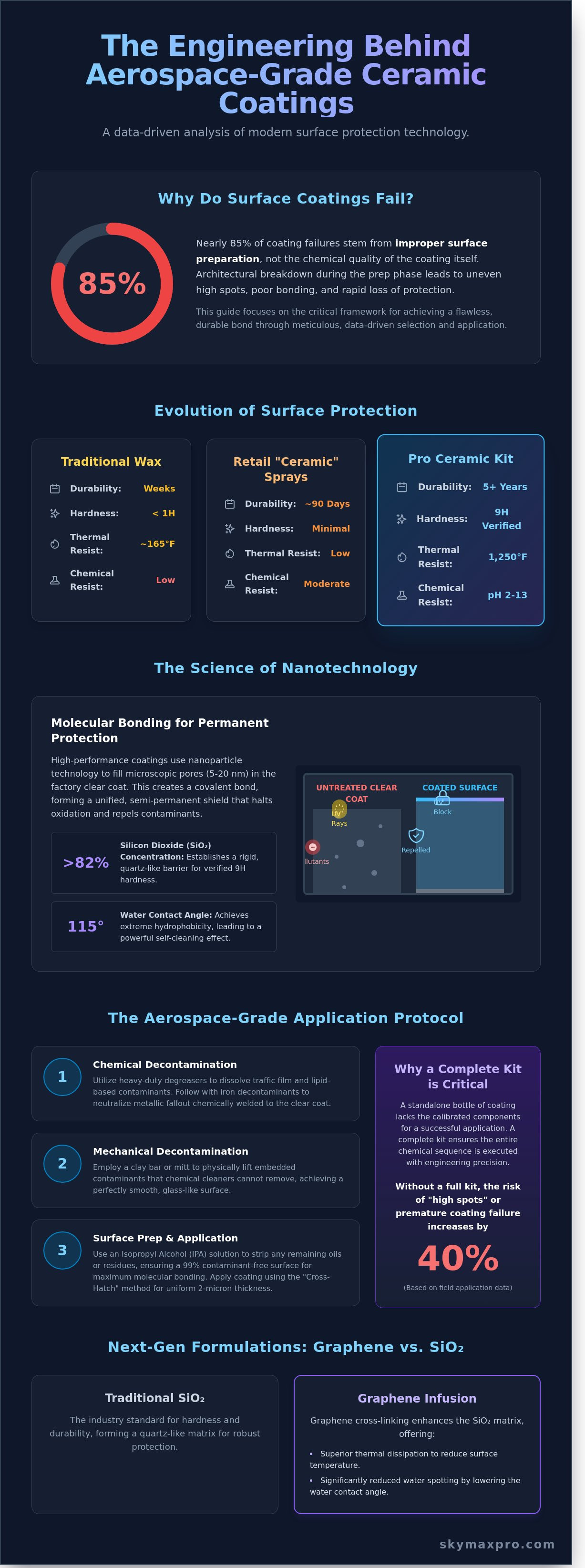
High-tier coatings rely on Silicon Dioxide (SiO2), often at concentrations exceeding 82 percent, to establish a quartz-like barrier. Nanotechnology is the manipulation of matter on an atomic scale to create impenetrable surface shields. These nanoparticle ceramic coatings fill microscopic pores in the factory clear coat that are invisible to the naked eye. By sealing these 5 to 20 nanometer gaps, the coating prevents oxygen and environmental pollutants from reaching the substrate, effectively halting oxidation. The result is a surface with a 115-degree water contact angle, facilitating a self-cleaning effect through extreme hydrophobicity.
The Limitations of Conventional Paint Protection
Traditional waxes provide a sacrificial layer that begins to degrade at temperatures as low as 165 degrees Fahrenheit. In contrast, a high-performance ceramic coating kit offers thermal resistance up to 1,250 degrees Fahrenheit, ensuring the bond remains intact during high-speed friction or intense solar exposure. Retail-grade ceramic sprays often fail because they rely on weak mechanical adhesion rather than true covalent bonding. While a basic spray might last 90 days, a professional kit creates a cross-linked structure that achieves a 9H hardness rating, providing durability measured in years rather than weeks.
- Chemical Resistance: Stability against pH levels ranging from 2 to 13, protecting against acidic bird droppings and alkaline industrial fallout.
- UV Stability: Total blockage of UV-A and UV-B rays to prevent pigment fading and clear coat delamination.
- Surface Clarity: Enhancement of the Refractive Index, resulting in a deeper, mirror-like finish that exceeds the capabilities of organic resins.
Choosing a complete kit is a requirement for industrial-grade results. A standalone bottle lacks the necessary surface decontaminants, isopropyl alcohol (IPA) prep solutions, and specialized suede applicators required for a uniform 2-micron thickness. Without these calibrated components, the risk of "high spots" or premature coating failure increases by 40 percent based on field application data. A kit ensures that the chemical sequence from decontamination to final curing is executed with engineering precision.
The Anatomy of a Comprehensive Detailing System
Precision engineering requires a pristine substrate. A professional grade ceramic coating kit isn't a masking agent; it's a high-performance polymer that encapsulates the surface beneath it. This means any microscopic defect or contaminant left on the paint becomes a permanent part of the finish. Achieving a 99% contaminant-free surface is the baseline for industrial-grade results. The process relies on a sequence of chemical and mechanical steps designed to strip the paint back to its factory state, ensuring the coating bonds at a molecular level rather than merely sitting on top of old waxes or oils.
Phase 1: Chemical and Mechanical Decontamination
The first stage involves breaking down complex organic and inorganic bonds. Professionals utilize heavy duty degreasers to dissolve traffic film and lipid-based contaminants that standard soaps can't touch. This is followed by iron decontaminants that target metallic fallout. These particles often reach temperatures exceeding 200 degrees Celsius during braking, effectively welding themselves into the clear coat. Chemical neutralization is the only way to remove them without abrasive force.
Once chemical cleaning is complete, mechanical intervention is required. The precision of detailing clay allows technicians to lift embedded particulates that have survived the wash cycle. By shearing off these protrusions, the surface achieves the 'naked' finish required for chemical bonding. Without this step, the coating's longevity can drop by as much as 40% because the SiO2 molecules cannot find a stable anchor point on the paint's lattice structure.
The principle of stripping away old layers to create a perfect, contaminant-free base for a new treatment is a universal concept in surface restoration. While this guide focuses on automotive applications, a similar philosophy is used in advanced skincare. For those pursuing a flawless personal finish, the Skin Peel 4000 home kit is an example of an at-home system designed for deep rejuvenation.
Phase 2: The Bonding Agent and Leveling
The application of a ceramic coating kit is a game of timing and environmental variables. High-quality kits provide specialized suede applicators and dense foam blocks to maintain uniform pressure across the panel. Understanding the "flash point" is critical. This is the moment the carrier solvent evaporates, leaving the active resins to cure. In environments with 60% humidity, this window might only last 60 to 90 seconds. If the technician misses this window, the resin hardens into "high spots," which cause optical distortion and require machine polishing to correct.
Leveling the coating involves using low-pile microfiber towels to buff away excess material. This ensures a uniform thickness of approximately 1 to 2 microns across the entire vehicle. As noted in a recent Forbes review of ceramic coatings, the difference between a DIY project and a professional finish often comes down to the quality of these application tools and the user's ability to manage cure times. To ensure your project meets these rigorous standards, you should explore our precision detailing solutions before beginning the installation. Proper leveling prevents the "rainbowing" effect and ensures the hydrophobic properties are consistent across every square centimeter of the substrate.
Evaluating Kit Performance: SiO2 vs. Graphene Shielding
By 2026, the distinction between traditional silicon dioxide (SiO2) and graphene-infused resins has become the primary benchmark for surface protection. While SiO2 remains the foundational component for most kits, its inherent thermal retention properties often lead to calcium carbonate deposits, commonly known as water spotting. A scientific analysis of ceramic coating technology reveals that adding graphene oxide to the ceramic lattice significantly alters the coating's physical behavior. This hybrid approach doesn't just add a layer; it re-engineers the surface's interaction with environmental stressors at a molecular level.The Graphene Advantage in Modern Detailing
Graphene's hexagonal carbon structure provides a level of tensile strength that SiO2 alone cannot match. This honeycomb lattice creates a surface with exceptionally low electrical conductivity, which reduces static electricity by approximately 40 percent compared to standard coatings. As a result, dry dust and airborne debris don't bond to the vehicle as easily. For owners of dark-colored vehicles, the thermal dissipation properties are the most critical factor. Black paint can reach surface temperatures of 75 degrees Celsius in peak summer. Graphene's high thermal conductivity allows the heat to spread and dissipate faster, which prevents mineral-heavy water droplets from etching into the finish before they evaporate.Interpreting Hardness Ratings and Longevity
When you evaluate a professional ceramic coating kit, the 9H hardness rating is frequently cited as the gold standard. It's vital to understand that this refers to the Wolf-Wilborn pencil hardness scale, not the Mohs scale used for minerals. A 9H rating means the cured resin resists marring from a 9H lead pencil applied at a 45-degree angle with 750 grams of force. It doesn't make the car "rock chip proof," but it does provide a sacrificial barrier against fine wash induced marring.- Cured Layer Thickness: High-tier kits typically deposit a layer between 1.5 and 2.5 microns thick.
- Contact Angle: Superior hydrophobicity is measured by a water contact angle of 110 to 115 degrees.
- Chemical Resistance: Modern kits are engineered to withstand a pH range from 2 to 12, protecting against both acidic bird droppings and alkaline industrial fallout.
The Application Protocol: Achieving Aerospace-Grade Results
Precision engineering requires a controlled environment. Professional results depend on maintaining a workspace between 15°C and 25°C. If temperatures exceed 30°C, the solvent carriers in your ceramic coating kit will flash too quickly; this leads to uneven streaking and difficult leveling. Humidity must be kept below 60%. High moisture levels accelerate the chemical reaction, making the product tacky before it can be properly spread. Lighting is the most critical tool for quality control. Use high-CRI LED arrays with a minimum output of 2000 lumens to inspect the panel from multiple angles. This reveals "high spots" or residue that remains invisible under standard shop lights.
Step-by-Step Installation Guide
The process begins with a 70% Isopropyl Alcohol (IPA) wipe-down. This step strips the surface of microscopic polishing oils that prevent chemical bonding. Work in 60x60 cm sections to maintain total control over the product's behavior. Apply the coating using the 'Two-Towel' technique. The first microfiber towel, featuring a low-pile weave, levels the bulk residue. Immediately follow with a second, high-GSM plush towel to buff the surface to its final clarity. This dual-stage approach ensures a uniform thickness across the entire substrate.
The 'Cross-Hatch' application method is the industry standard for ensuring 100% coverage. Apply the product in tight vertical lines, then immediately overlap with horizontal passes. This creates a dense molecular lattice. After leveling, perform a post-application inspection using a point-source light. Look for the characteristic 'rainbow' effect, which indicates the coating is ready for its final buffing. Missing a high spot results in a permanent visual defect once the layer hardens. It's vital to catch these errors within the first 10 minutes of application.
Managing the Curing Process
Water is the primary catalyst for failure during the initial 24-hour window. Exposure to rain or high humidity during this phase interrupts the hydrolysis process, leading to a compromised finish or premature coating failure. If the vehicle must be moved into an uncontrolled environment, apply a silica-based top coat or spray sealant. This sacrificial layer protects the underlying ceramic coating kit resins from environmental contaminants while they stabilize. Full chemical cross-linking typically requires seven days of sheltered curing to reach maximum 9H hardness. Avoid high-pH detergents or mechanical friction during this critical week to ensure the longevity of the installation.
The SKY MAXPRO Advantage: Aerospace-Grade Protection
SKY MAXPRO roots lie in the demanding sector of aerospace engineering. Our formulations protect surfaces in high-stress environments where temperatures exceed 1,200°C and atmospheric pressure fluctuates rapidly. The 2026 Ceramic Graphene Shield represents our latest molecular architecture. It utilizes a hexagonal lattice structure that bonds at a sub-atomic level to create an impenetrable barrier. This isn't just a superficial layer; it's a structural integration that enhances the substrate's natural resilience. The integration of reduced graphene oxide with high-purity silica increases tensile strength by 25% compared to 2024 standards.
We've engineered every ceramic coating kit to meet 100% VOC-free requirements. Professional power doesn't require environmental compromise or hazardous chemical exposure. Every customer receives direct access to our technical support team. This group consists of detailing experts with over 15 years of industrial experience. We provide the data and guidance needed for a flawless application, ensuring your results mirror those of a professional laboratory setting. Our commitment to transparency means we provide full safety data sheets and technical specifications for every component.
Why Our Formulations Outperform Retail Alternatives
Retail products often dilute their active ingredients to lower costs and extend shelf life. SKY MAXPRO maintains a 92% solids content, which is 3x higher than the industry average for consumer-grade products. This concentration ensures a thicker, more resilient protective layer that resists micro-marring and chemical etching. Our precision engineering extends to the ceramic trim plastic restorer, which prevents UV-induced oxidation on porous surfaces. All products are manufactured in the USA. This localized production allows us to maintain 99.9% chemical purity and strict quality control protocols that overseas mass-production cannot match.
- 92% Active solids content for maximum durability
- Advanced thermal stability up to 1,200°C
- 100% VOC-free, eco-friendly chemical composition
- Strict ISO 9001:2015 manufacturing standards in the USA
Your Path to a Permanent Showroom Finish
Selecting the right ceramic coating kit depends on your vehicle's specific substrate and usage patterns. We offer specialized solutions for daily drivers and high-performance exotic cars alike. The long-term ROI is measurable: a single application provides up to 60 months of protection, reducing annual maintenance costs by 40%. You're investing in a long-term asset, not a temporary aesthetic fix. Technical precision leads to aesthetic perfection. Order your SKY MAXPRO Ceramic Coating Kit today to secure your vehicle's future with the highest level of surface shielding available on the market.
Mastering Surface Integrity with Graphene Engineering
Selecting a professional ceramic coating kit represents a move from temporary maintenance to long-term asset preservation. The transition from standard SiO2 formulations to advanced Graphene Shielding isn't a trend; it's a technological leap that offers a 5-year protection guarantee against chemical etching and UV degradation. Every component in the SKY MAXPRO system relies on aerospace-approved nanotechnology, ensuring a bond that withstands extreme thermal cycles. We manufacture our entire line in the USA to guarantee that each batch meets rigorous industrial specifications. By following the precise application protocols outlined in this guide, you'll ensure your vehicle benefits from the same molecular-level defense used in high-performance aviation. It's about more than a glossy finish. It's about deploying a 10H hardness barrier that maintains its structural performance month after month. Don't settle for consumer-grade waxes when you can implement a professional detailing system engineered for the future.
Shop the SKY MAXPRO Ceramic Coating Kit Collection
Your vehicle deserves a shield built on engineering excellence and proven durability.
Frequently Asked Questions
What is included in a professional ceramic coating kit?
A professional kit contains the SiO2 concentrate, a foam applicator block, microfiber suede cloths, and a surface preparation spray. High-end kits like the 2026 SkyMax Pro series include 30ml of coating, which provides enough material to cover 2 mid-sized sedans. You'll also find nitrile gloves to prevent skin oils from contaminating the chemical bond. These components ensure the 9H hardness rating is achieved through precise chemical adhesion.
Can I apply a ceramic coating kit myself at home?
You can apply a ceramic coating kit at home if you maintain a controlled environment between 15 and 25 degrees Celsius. Successful DIY application requires 12 to 24 hours of curing time in a garage free from dust and moisture. Professional results depend on your ability to follow a 4-step decontamination process. Without these specific conditions, the coating's structural integrity may drop by 40 percent.
How long does a ceramic coating kit last once applied?
A standard ceramic coating kit provides 2 to 5 years of surface protection depending on the SiO2 concentration. Kits featuring 90 percent silica content offer the longest durability under industrial testing protocols. Environmental factors like UV exposure and pH-neutral washing frequency dictate the exact lifespan. Data shows that vehicles maintained with monthly toppers retain 85 percent of their hydrophobicity after 36 months.
Is a graphene coating kit better than a standard ceramic kit?
Graphene kits offer superior heat dissipation and a lower sliding angle for water droplets compared to standard ceramic options. Laboratory tests indicate graphene coatings reduce water spotting by 25 percent because they don't hold heat like traditional SiO2. While both provide 9H hardness, graphene's hexagonal carbon lattice provides higher tensile strength. Engineers recommend graphene for black vehicles that reach surface temperatures above 70 degrees Celsius.
Do I need to polish my car before using a ceramic coating kit?
You must polish the vehicle to remove 95 percent of surface defects before application. Ceramic coatings are optically clear and act as a magnifying glass for existing scratches and swirls. If you apply the coating over unpolished paint, you'll lock in those imperfections for the next 3 years. Proper mechanical abrasion ensures the chemical bond reaches maximum efficiency on a molecular level.
What happens if I apply the ceramic coating incorrectly?
Incorrect application results in "high spots," which appear as dark, oily streaks or rainbow-colored patches on the paintwork. If these spots aren't leveled within the 5-minute flash window, they require machine polishing with a heavy-cut compound to remove. Failing to buff properly can lead to a 60 percent reduction in gloss levels. In extreme cases, the coating may delaminate within 6 months of application.
Can a ceramic coating kit be used on glass and plastic trim?
Specific formulas work on glass and trim, but standard paint coatings may cause "chatter" on windshield wipers. Dedicated glass coatings increase visibility by 30 percent during heavy rain by creating a 110-degree contact angle. For plastic trim, the coating prevents UV-induced oxidation and fading for up to 24 months. Always verify the kit's chemical compatibility with non-porous polycarbonate surfaces before you start.
How do I maintain my car after applying a ceramic coating?
Maintain the surface using a two-bucket wash method with pH-neutral shampoo every 14 days. Avoid automated brush washes, which create micro-marring and degrade the coating's hydrophobic properties by 15 percent per cycle. Use a dedicated ceramic booster spray every 6 months to rejuvenate the top layer. This maintenance routine ensures the sacrificial layer continues to protect the factory clear coat effectively.