

The $2,500 question isn't whether your car needs protection, but whether the price of professional labor is actually buying you better chemistry. You're likely wondering, is DIY ceramic coating worth it when consumer-grade kits now utilize the same nanotechnology found in industrial aerospace applications? We understand the hesitation; the fear of permanent "high spots" or ruining a factory finish often outweighs the desire for savings. However, the data confirms that the technical gap between professional liquids and DIY solutions has reached a tipping point in 2026.
This article provides an objective engineering analysis of modern surface protection. You'll learn how to distinguish between marketing buzzwords and actual chemical performance, comparing $40 kits against $3,500 professional services. We'll examine the specific protocols for surface decontamination and explain why graphene-infused coatings now offer 800°C heat resistance and 7 years of durability. By the end, you'll have a clear framework for achieving a showroom-quality finish and significant cost savings without compromising on material integrity.
Key Takeaways
- Learn how Silicon Dioxide (SiO2) creates a permanent chemical bond that provides superior UV and chemical resistance over traditional sealants.
- Compare the engineering benefits of Graphene nanotechnology, which offers enhanced heat dissipation and prevents common water spotting issues.
- Identify why mechanical decontamination is the critical phase of application, ensuring that 90% of the final finish is achieved before the coating is applied.
- Assess your vehicle’s paint condition and available time to decide if is DIY ceramic coating worth it compared to high-cost professional detailing.
- Establish a precise 48-hour application and curing schedule to guarantee the coating reaches its full structural hardness and hydrophobic potential.
Defining the Value: What Makes a Ceramic Coating 'Worth It'?
A DIY ceramic coating is a liquid polymer that establishes a permanent chemical bond with the vehicle's factory clear coat. Unlike traditional waxes that sit on top of the surface, this technology integrates into the paint's pores. To understand the technology, one should look at the broader definition of a ceramic material, which includes inorganic, non-metallic solids that offer extreme durability. When evaluating if is DIY ceramic coating worth it, the decision hinges on three performance pillars: chemical resistance against environmental contaminants, UV protection to prevent oxidation, and high surface energy for hydrophobicity. The primary metric for value isn't just the product cost; it's the labor to quality ratio. You're trading your own precision labor for a $1,000 reduction in professional service fees.
The Economics of Surface Protection
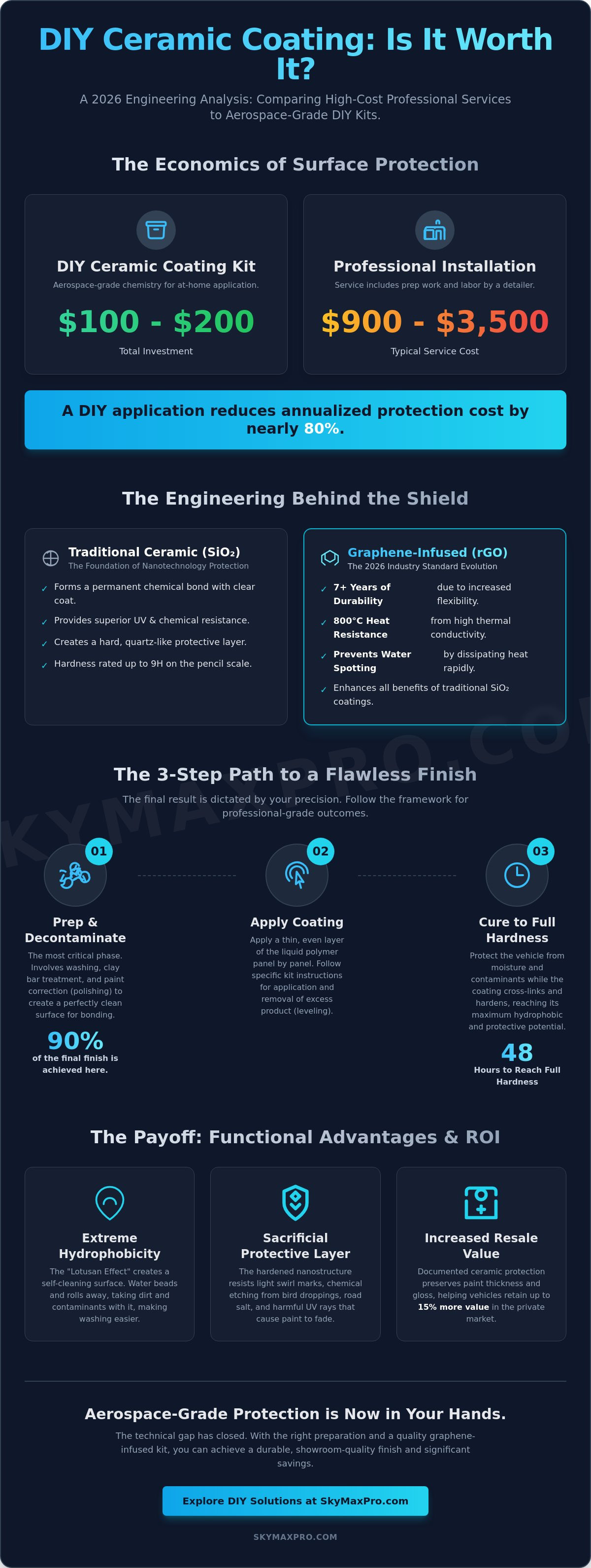
Professional ceramic coating costs for most vehicles in 2026 range from $900 to $2,500. Contrast this against a $100 to $200 DIY investment for high grade chemicals. When you calculate the annualized cost, a professional application costs approximately $180 to $500 per year over its lifespan. A DIY application reduces this figure by nearly 80%. This preserves the vehicle's resale value by maintaining paint thickness and gloss levels that traditional waxing cannot replicate. Data from 2026 indicates that vehicles with documented ceramic protection retain up to 15% more value in the private party market compared to those with neglected finishes. It's not a financial miracle; it's a calculated reduction in maintenance overhead. Coatings prevent the paint from fading or etching, which saves thousands in paint correction costs when you eventually sell the vehicle.
The Functional Advantages of Nanotechnology
The Lotusan effect, or self-cleaning property, describes how water droplets roll off the surface and collect dirt particles simultaneously. This is achieved through a nanostructure bonding process that creates a surface smoother than the paint itself. While the 9H hardness scale is often used in marketing, it specifically refers to the Pencil Hardness test. This means the coating resists light abrasions, chemical etching from bird droppings, and swirl marks from washing. Nanostructure bonding is the core differentiator from traditional waxes, providing a structural shield rather than a temporary film. Engineering a surface with high contact angles ensures that contaminants cannot gain a foothold, which fundamentally changes how you maintain the vehicle over a three to five year period. This molecular integration ensures that the protection doesn't wash away after a few months of exposure to harsh detergents or road salt.
The Engineering Behind the Shield: Ceramic vs. Graphene Nanotechnology
Silicon Dioxide (SiO2) serves as the primary structural component in liquid car protection. It forms a cross-linked polymer network that hardens into a quartz-like barrier. While traditional ceramic coatings are effective, the integration of graphene oxide has shifted the industry standard in 2026. Graphene is a single layer of carbon atoms arranged in a hexagonal lattice, providing a unique combination of flexibility and strength. When asking is DIY ceramic coating worth it, you must evaluate if the product utilizes these High-Performance Ceramic Coatings that incorporate advanced carbon structures. These formulations are no longer restricted to laboratory environments; they're now engineered for stable consumer application.
Spray-on ceramic products are essentially high-performance sealants with a small percentage of SiO2. They offer 6 to 12 months of protection and serve as excellent maintenance toppers. In contrast, true nano-coatings require a more meticulous application process but provide a structural bond that lasts for years. This distinction is vital when determining if is DIY ceramic coating worth it for your specific vehicle. A true coating creates a sacrificial layer that is significantly harder than the factory clear coat, measuring up to 9H on the pencil hardness scale. This prevents the majority of light swirl marks and chemical etching that plague unprotected paintwork.
SiO2 vs. Graphene: A Technical Breakdown
Graphene's high thermal conductivity allows it to dissipate heat across the vehicle surface. Standard ceramic coatings can sometimes trap heat; this leads to mineral deposits or water spotting in direct sunlight. Because graphene is naturally anti-static, it repels dust and light debris more effectively than SiO2 alone. The SkyMax Pro Ceramic Graphene Shield represents a benchmark in this hybrid category, offering a 7-year durability rating and resistance up to 800°C. This level of protection ensures that even a DIY application rivals professional industrial standards. You're effectively installing a heat-sink on your car's exterior that prevents environmental contaminants from baking into the finish.
Aerospace Origins of Modern Car Care
Modern car care technology originated in the aerospace sector. Engineers originally developed these coatings to protect jet turbine blades and fuselage components from extreme friction and temperature spikes. Today's consumer market has gained access to these same aerospace-grade chemicals, which are now formulated to be VOC-free and environmentally compliant. These nanotechnology solutions handle temperature fluctuations ranging from sub-zero winters to blistering summer heat without losing structural integrity. For those seeking long-term value, using a Ceramic Graphene Shield Coating ensures your vehicle benefits from this industrial-grade heritage. The transition from aviation to automotive use has simplified the application process while maintaining the rigorous protection standards required for high-altitude flight.
The Labor Reality: Why Prep Work Dictates the Final ROI
Engineering a professional-grade finish requires a meticulous multi-stage protocol that far exceeds a standard car wash. While marketing narratives often suggest a simple "wipe-on" application, the technical reality is that 90% of the coating's structural integrity is determined during the preparation phase. When calculating if is DIY ceramic coating worth it, you must account for the 15 to 20 hours of labor required to transform the paint into a receptive substrate. Without mechanical decontamination using a detailing clay bar, the liquid polymer will bond to surface contaminants rather than the clear coat, leading to premature delamination within months rather than years.
Paint correction, or machine polishing, is the second critical pillar of labor. Because ceramic and graphene coatings are optically clear, they act as a magnifying glass for existing defects. Applying a 5-year coating over swirl marks or light scratches locks those imperfections beneath a hardened shield. Furthermore, a leveled surface provides more surface area for the covalent bond to take hold. Failure to execute this stage correctly increases the risk of "high spots"—areas where excess product flashes too quickly, leaving dark, iridescent streaks that require abrasive removal if not corrected within the first few minutes of application.
The Decontamination Phase
Surface purity verification begins with a dual-stage decontamination process. Chemical decontamination uses pH-balanced iron removers to dissolve sintered brake dust, followed by a mechanical clay treatment to pull out embedded industrial fallout. You can verify the results using the "baggie test": placing your hand inside a thin plastic bag and sliding it over the paint. Any friction indicates remaining contaminants. The final step is a 30% Isopropyl Alcohol (IPA) wipe-down, which is essential to strip away residual polishing oils and lubricants that would otherwise prevent the nanostructure from anchoring to the paint pores.
Environmental Controls for DIY Success
The chemical reaction of a coating is highly sensitive to ambient conditions. High humidity levels accelerate the "flashing" process, reducing the window for leveling the product, while temperatures below 10°C can stall the curing cycle entirely. For a 5-year coating, a controlled garage environment is non-negotiable to prevent dust precipitation during the initial 24-hour cure. Successful DIY enthusiasts utilize high-lumen LED arrays at multiple angles; this lighting setup is the only way to identify high spots and ensure uniform coverage across the entire panel. If you don't have access to a shaded, dust-free workspace, the technical risk of the project increases significantly.
The Decision Framework: Comparing DIY Kits to Professional Application
Determining if is DIY ceramic coating worth it requires an objective assessment of your operational constraints and the current state of your vehicle's substrate. A logical decision framework begins with the paint's condition. If your clear coat exhibits level 3 defects, such as deep scratches that catch a fingernail or significant oxidation, the technical requirements for restoration likely exceed standard DIY capabilities. However, for vehicles with minor swirl marks or new factory paint, the engineering gap between a professional application and a high-end consumer kit is negligible when the correct protocols are followed.
Time management is the second critical variable. You must secure a dedicated 48-hour window where the vehicle can remain in a climate-controlled environment, free from dust and moisture. This period accounts for the intensive 15-hour preparation phase and the subsequent 24-hour initial curing cycle. Additionally, the investment in hardware must be factored into the ROI. Achieving a professional-grade bond necessitates a dual-action (DA) polisher to level the clear coat. If you aren't prepared to acquire and master this tool, a professional service may be the more efficient path to a 5-year protection window.
When to Go Professional
Professional detailing services are the correct choice when the vehicle lacks a secure indoor workspace or when dealing with high-value luxury assets that require a certified warranty for insurance purposes. Professionals utilize industrial infrared (IR) curing lamps that accelerate the cross-linking process, reaching maximum structural hardness in hours rather than days. This equipment ensures a level of uniformity that is difficult to replicate with ambient air curing alone. If the paint correction requires multi-stage heavy compounding to save the clear coat, the expertise of a seasoned technician provides a safety margin that protects the vehicle's long-term integrity.
This principle of professional restoration is equally valuable for other major assets. For instance, Cabinet refinishing Denver offers homeowners the same level of specialized surface treatment to ensure their kitchen cabinets maintain a durable and aesthetically pleasing finish for years.
When DIY is the Superior Choice
For the hands-on enthusiast, the DIY route offers a level of precision and satisfaction that external services rarely match. The cost-efficiency becomes undeniable when maintaining a multi-car household; the initial investment in a DA polisher and high-quality pads pays for itself after a single application. By utilizing professional car detailing supplies, you gain access to the same graphene and SiO2 concentrations used in elite shops at a fraction of the overhead. If you have the patience to execute the decontamination and leveling phases, is DIY ceramic coating worth it? The answer is a definitive yes, as you'll achieve a showroom-quality finish while saving upwards of $2,000 per vehicle. To begin your project with industrial-grade chemistry, consider the SkyMax Pro Ceramic Coating Kit for a complete, engineering-focused solution.
SkyMax Pro Solutions: Aerospace-Grade Protection for the DIY Enthusiast
Integrating industrial chemistry into a consumer-accessible format is the core mission of SkyMax Pro. When evaluating if is DIY ceramic coating worth it, the caliber of the chemical formulation is the deciding factor. Our 2026 Ceramic Graphene Shield isn't a mere retail wax; it's a precision-engineered hybrid that combines the structural hardness of SiO2 with the thermal resilience of graphene. This specific molecular arrangement provides a protective lattice that resists environmental pH fluctuations ranging from 2 to 12. By utilizing this technology, you're not just cleaning a car; you're applying a sacrificial barrier designed to withstand the same stressors as aerospace components.
We function as your engineering partner throughout the application process. SkyMax Pro provides detailed technical protocols that mirror professional industrial workflows. These guides eliminate the ambiguity that often leads to application errors or "high spots" discussed in previous sections. For the perfectionist, the data proves that is DIY ceramic coating worth it when the process is backed by aerospace-grade chemistry and a rigorous methodology. Following a structured sequence ensures that the nanotechnology achieves a 100% covalent bond with the clear coat, providing a finish that remains hydrophobic for years rather than months.
The SkyMax Pro Advantage
The Ceramic Graphene Shield carries a verified 5-year durability rating, which significantly exceeds the 2-year lifespan of traditional entry-level ceramic products. Every kit includes specialized microfiber applicators engineered for uniform fluid displacement and precise leveling. We've also prioritized environmental standards by ensuring our preparation chemicals, such as the Heavy Duty Red Power Degreaser, are biodegradable and eco-friendly. This allows you to achieve aggressive decontamination and surface stripping without introducing hazardous VOCs into your workspace. This balance of high-performance output and sustainable chemistry defines the SkyMax Pro standard for 2026.
Next Steps for Your Vehicle
Before initiating your project, perform a comprehensive surface audit using the "baggie test" and high-lumen LED lighting. This diagnostic phase ensures that the substrate is prepared for the molecular bonding of the graphene lattice. Once the coating is applied, transitioning from a standard wash routine to a ceramic-safe maintenance plan is essential. This involves using pH-neutral shampoos and avoiding abrasive mechanical car washes that can degrade the surface energy over time. To secure the specialized components necessary for this engineering-grade transformation, you can acquire the SkyMax Pro Ceramic Coating Kit directly from our digital storefront. Investing in the correct chemistry today eliminates the need for expensive paint correction in the future.
Engineering Your Vehicle's Long-Term Integrity
The technical data for 2026 confirms that the barrier between professional detailing and home application has effectively collapsed. By prioritizing mechanical decontamination and utilizing advanced graphene-ceramic hybrids, the answer to whether is DIY ceramic coating worth it becomes an objective yes for the informed enthusiast. You've learned that success depends on a 15 to 20 hour commitment to surface preparation and the use of aerospace-grade chemicals that establish a permanent covalent bond with your paintwork. It's a calculated investment in asset preservation.
SkyMax Pro delivers this industrial-grade capability through solutions engineered and manufactured in the USA. Our nanotechnology is approved for aerospace applications and backed by a 5-year durability guarantee. This approach ensures measurable efficiency and significant cost savings without sacrificing structural hardness. Secure your vehicle with the SkyMax Pro Ceramic Graphene Shield Kit today. You have the technical framework and the tools required to maintain a flawless showroom finish for years to come.
Frequently Asked Questions
Is DIY ceramic coating as good as professional?
Chemical parity between professional and consumer liquids has reached approximately 95% in 2026. The primary difference remains the application environment and specialized hardware like infrared curing lamps. If you follow a rigorous 20-hour preparation protocol in a dust-free garage, a DIY application using aerospace-grade chemicals provides nearly identical structural protection to a professional service. You're effectively trading your personal labor for the $1,500 overhead of a detailing shop.
Can I apply ceramic coating over wax or a sealant?
No, you cannot apply a coating over any existing surface protection. The nanostructure requires a direct covalent bond with the bare clear coat to function correctly. You must use a pH-balanced degreaser or a 30% Isopropyl Alcohol wipe-down to strip all residual oils and waxes. Applying a coating over a sealant will cause the bond to fail within 30 days, leading to a complete loss of hydrophobicity.
What happens if I mess up a DIY ceramic coating application?
Improper application usually manifests as "high spots," which are dark or iridescent streaks where the product wasn't leveled correctly. If you identify these within the first 10 minutes, you can usually buff them out with a fresh microfiber towel. Once the coating cures for 24 hours, these defects become permanent. At that stage, you must use a machine polisher and abrasive compound to mechanically remove the layer before attempting a reapplication.
How long does a DIY ceramic coating actually last in 2026?
Modern liquid coatings now carry a 5-year durability guarantee when maintained with pH-neutral chemicals. Spray-on variants typically offer 6 to 12 months of protection. Data from early 2026 indicates that graphene-infused formulas have extended these lifespans by 40% compared to traditional SiO2 products. The actual longevity depends entirely on your maintenance routine and whether you avoid abrasive mechanical car washes that can physically degrade the coating.
Do I really need to polish my car before applying a ceramic coating?
Machine polishing is essential for achieving maximum optical clarity and bond strength. While the coating will technically adhere to unpolished paint, it will lock in every swirl mark and scratch under a hardened shield for years. Polishing also levels the clear coat at a microscopic level, which increases the surface area for the chemical bond to take hold. Skipping this step significantly reduces the visual ROI of the project.
Can I apply ceramic coating to my car's glass and plastic trim?
Yes, but you should utilize specialized formulations for non-painted surfaces. Using a dedicated Ceramic Trim Plastic Restorer prevents the white residue often left by paint-specific coatings on textured surfaces. For glass, dedicated coatings prevent wiper "chatter" while maintaining high visibility. Using the correct product for each substrate ensures that the nanotechnology bonds correctly without causing structural or aesthetic issues over time.
How much does a complete DIY ceramic coating setup cost?
A comprehensive setup including a dual-action polisher, pads, decontamination chemicals, and a high-grade kit ranges from $300 to $600 in 2026. This represents a one-time capital expenditure that serves multiple vehicles. When you consider that is DIY ceramic coating worth it based on a $2,500 professional fee, the DIY route provides a 75% reduction in total protection costs while giving you full control over the chemical quality.
Is graphene better than ceramic for DIY applications?
Graphene is generally superior for DIY enthusiasts because it offers a more forgiving application window and higher resistance to water spotting. It dissipates heat more effectively than standard SiO2, withstanding temperatures up to 800°C. This thermal stability reduces the risk of the product "flashing" too quickly during the leveling phase. It's the ideal choice for users working in non-professional environments where humidity and temperature are harder to control.