

A flagship ceramic coating can cost upwards of $2,800 for luxury-tier protection, but its 9H hardness is only as durable as the maintenance protocol that follows. While a professional application creates a robust 1-6 µm shield, improper washing techniques can compromise its structural integrity within months. You likely chose this technology to ensure maximum gloss and protection, so the fear of creating swirl marks or using damaging chemicals is a valid concern for any vehicle owner. Understanding how to maintain a ceramic coated car is not just about cleaning; it's a technical requirement to preserve the chemical bond and hydrophobic properties you paid for.
In this engineering guide, you'll master the aerospace-grade maintenance techniques necessary to extend your coating’s life beyond its standard warranty. We provide a structured approach to pH-neutral washing, mineral deposit removal, and molecular replenishment using professional-grade tools like graphene-infused sprays. You'll learn the exact protocols used by industry experts to prevent water spots and maintain that deep, wet mirror shine at home. We'll cover everything from chemical safety to the precise mechanical steps required for a scratch-free finish, ensuring your investment remains protected against the elements.
Key Takeaways
- Understand the technical reality of "self-cleaning" properties and how micro-contaminants can mask hydrophobicity if not managed through regular maintenance.
- Master the professional two-bucket method and foam encapsulation protocols to learn exactly how to maintain a ceramic coated car without inducing abrasive surface defects.
- Identify specialized procedures for neutralizing mineral deposits and organic fallout before they compromise the coating's chemical bond.
- Implement the strategic use of SiO2 and graphene-enhanced boosters to replenish the sacrificial layer and maintain peak hydrophobic performance.
- Utilize aerospace-grade formulations and precise decontamination tools to extend the structural integrity of your coating beyond its original warranty.
The Science of Surface Preservation: Why Coated Cars Require Maintenance
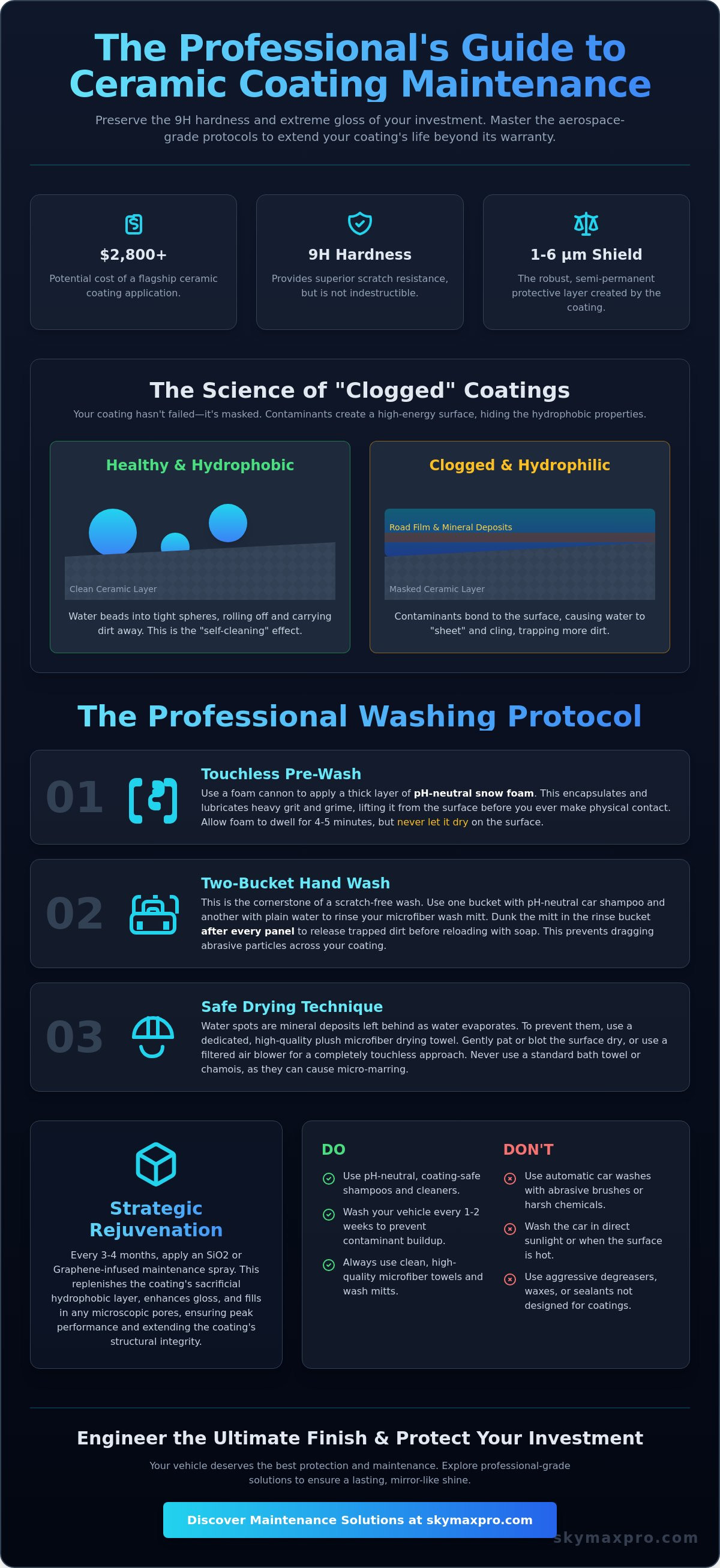
Ceramic coatings are high-performance chemical barriers, not indestructible force fields. The widely discussed "self-cleaning" effect is a result of extreme hydrophobicity, where high contact angles cause water to bead and roll, carrying surface debris with it. However, this property is finite without technical intervention. Environmental factors constantly work to degrade this high-energy surface. Knowing how to maintain a ceramic coated car is essential because the coating acts as a sacrificial layer, absorbing the brunt of UV radiation and chemical fallout to protect the underlying clear coat.
Understanding Hydrophobic Degradation
A common misconception in professional car detailing is that if water stops beading, the coating has failed. In most cases, the coating is simply "clogged." Environmental contaminants like road film, industrial fallout, and mineral deposits create a microscopic bridge over the nano-peaks of the ceramic layer. This bridge increases surface energy, allowing water to flatten out rather than bead. When this happens, the coating's ability to shed debris is compromised. UV radiation also plays a role; while SiO2 is resistant to photo-oxidation, prolonged exposure can slowly weaken the molecular bond if the surface is covered in contaminants that trap heat. Proper maintenance clears these microscopic bridges, restoring the coating's structural integrity and performance.
The Role of Aerospace-Grade Formulations
Modern surface protection has evolved from simple carnauba waxes to complex nanotechnology. Traditional waxes rely on physical adhesion and melt at relatively low temperatures. In contrast, ceramic coatings use cross-linking polymers to form a semi-permanent bond with the clear coat. This transition represents a shift from temporary gloss to structural engineering. To understand the underlying physics of these bonds, you can explore The Engineering of Ceramic Coating. These aerospace-grade formulations are designed to resist chemical etching from bird droppings and acid rain, which would otherwise penetrate standard paint.
The ultimate goal of learning how to maintain a ceramic coated car is the preservation of this sacrificial barrier. By following a structured maintenance protocol, you ensure that the coating remains the primary surface of contact for environmental stressors. This prevents the underlying paint from oxidizing or etching, which maintains the vehicle's resale value and aesthetic finish. Without regular decontamination, the coating's molecular structure becomes buried under layers of organic and inorganic matter, rendering its advanced hydrophobic properties useless. Maintenance is the process of uncovering the technology you've already invested in.
The Professional Washing Protocol: Eliminating Abrasive Contaminants
Mechanical friction is the primary cause of surface defects. Even with a 9H hardness rating, a ceramic coating can suffer from micro-marring if abrasive particles are dragged across the surface during a wash. High-level maintenance focuses on minimizing physical contact and utilizing chemical lubrication to safely suspend contaminants. Selecting a pH-neutral car shampoo is a non-negotiable requirement for this process. While aggressive degreasers might be necessary for uncoated vehicles, they can prematurely degrade the hydrophobic top layer of a ceramic system. Understanding the science of ceramic coatings reveals that their longevity depends on maintaining the surface's low-energy state through gentle chemistry.
Step 1: The Touchless Pre-Wash
Rinsing with high-pressure water alone is insufficient for removing the static film that bonds to vehicle surfaces. You must use a foam cannon to apply a thick layer of pH-neutral snow foam. This stage encapsulates grit and lubricates the surface before any mechanical agitation occurs. For optimal results, allow the foam to dwell on the surface for exactly four to five minutes without letting it dry in direct sunlight. This process ensures that the heaviest debris is safely carried away during the subsequent rinse, significantly reducing the risk of swirl marks. This is a foundational step in learning how to maintain a ceramic coated car without inducing damage.
Step 2: Contact Wash with Precision
When physical contact is required, the two-bucket method is the industry standard for preventing cross-contamination. One bucket contains your soap solution, while the second serves as a dedicated rinse bucket equipped with a grit guard. Always wash the vehicle from the top down. This prevents the transfer of heavy road grime from the lower rockers to the more delicate hood and roof panels. Use straight, overlapping lines rather than circular motions to ensure that any accidental marring remains less visible to the naked eye. Before starting the body panels, clean the wheels first with a separate bucket and specialized brushes to prevent metallic brake dust from reaching the paint. For a complete inventory of required equipment, consult the Professional Auto Detailing Master Checklist.
Step 3: Safe Dehydration Methods
Traditional drying towels can act as sandpaper if a single grain of dirt remains on the surface. To eliminate this risk, use forced air from a dedicated car dryer or a leaf blower to remove water from crevices, mirrors, and badges. If a towel is necessary, select a high-GSM microfiber and use a "blotting" technique rather than a wiping motion. This minimizes friction and preserves the coating's structural integrity. Implementing these precise steps is the only way to truly master how to maintain a ceramic coated car at a professional level. For those looking to upgrade their maintenance kit, a high-quality ceramic shampoo is the foundational tool for success.
Advanced Decontamination: Managing Water Spots and Industrial Fallout
Standard washing protocols often fail to address chemically bonded contaminants. While hydrophobicity is a primary benefit of nanotechnology, it creates a specific vulnerability known as water spotting. Because the coating causes water to bead, any minerals present in the water—such as calcium and magnesium—become concentrated as the bead evaporates. If left untreated, these minerals can etch into the coating's surface, permanently compromising its clarity. Addressing these deposits requires a technical understanding of chemical decontamination rather than mechanical force. Mastering how to maintain a ceramic coated car involves identifying when a surface is "clogged" by these inorganic elements and applying the correct chemical solution to restore performance.
According to the International Detailing Association's Maintenance Guide, chemical decontamination is the preferred method for preserving a coating's surface profile. Many vehicle owners mistakenly reach for a clay bar when they notice surface roughness. However, in a professional engineering context, mechanical claying is a last resort. Even the finest detailing clay is an abrasive that can induce micro-marring on the coating's top layer. If you must use clay, you're essentially sanding the sacrificial barrier you worked to build. Chemical solutions are far more efficient at dissolving contaminants without the risk of physical abrasion.
Chemical Mineral Removal
Mineral deposits require acidic intervention to break their ionic bonds. Specialized water spot removers use mild acids to dissolve calcium and magnesium, allowing them to be rinsed away without friction. It's critical to apply these cleaners to a cool surface in a shaded environment. Direct sunlight causes the chemicals to evaporate rapidly, which can lead to secondary chemical etching. This process is designed to restore the high contact angle of the beads without stripping the underlying SiO2 or graphene structure. It's a precise balance of chemistry that maintains the coating's functionality over several years.
Targeting Iron and Organic Fallout
Industrial fallout, specifically iron particles from brake dust or rail transport, can embed itself into the coating's pores. A pH-balanced iron remover is the standard tool for this task; it reacts with the iron to turn it into a water-soluble complex that can be safely rinsed off. For organic matter like tree sap or bird droppings, localized treatment with a heavy-duty degreaser is more effective than aggressive scrubbing. When managing high-impact areas like wheels, utilizing a specialized solution such as PRO Safe ACID Gel ensures that brake dust is neutralized without compromising the rim's protective finish. Implementing these chemical protocols is the most effective way to learn how to maintain a ceramic coated car while avoiding the need for premature polishing or re-application.
Strategic Rejuvenation: Utilizing Ceramic and Graphene Boosters
Strategic rejuvenation involves the periodic application of reactive topcoats to replenish the sacrificial barrier of your vehicle's protection system. While the base coating provides a semi-permanent bond, its top-level hydrophobicity can diminish due to friction and chemical exposure. A primary component of how to maintain a ceramic coated car is ensuring this base layer remains uncompromised by using "boosters" or "toppers." These products are engineered to bond with the existing ceramic structure, filling microscopic voids and restoring the high contact angle required for water beading. This process prevents environmental stressors from reaching the primary coating, effectively extending its functional lifespan beyond the initial warranty period.
The Graphene Advantage in Maintenance
In the 2026 detailing landscape, graphene has emerged as the superior additive for surface maintenance. Unlike traditional SiO2-only sprays, graphene-enhanced formulations offer increased thermal resistance and electrical conductivity. This conductivity is critical because it reduces the static charge on the vehicle's surface, which significantly minimizes dust attraction during dry weather. Utilizing a PRO Ceramic Graphene Spray Coating as a maintenance topper provides a harder, more resilient sacrificial layer that dissipates heat more efficiently than standard ceramic detailers. This thermal management helps prevent the "baking" of contaminants into the surface under intense UV exposure.
Application Protocols for Boosters
Achieving a streak-free finish requires precise application techniques to avoid "high spots," which are areas where excess product has leveled unevenly. You can apply these boosters using either a "wet" or "dry" method. The wet method involves using the spray as a drying aid on a clean, rinsed surface, which provides immediate lubrication and reduces drying time. For maximum gloss and durability, the dry method is preferred; apply the product to one panel at a time using a low-pile microfiber and immediately level it with a secondary, high-GSM buffing towel. Most professional-grade maintenance sprays require a minimum of 30 to 60 minutes of dry time before exposure to moisture to ensure the cross-linking process is complete. Mastering these protocols is the final step in understanding how to maintain a ceramic coated car at an industrial standard.
To maintain peak performance and structural integrity, you should apply a booster every three to six months, depending on the vehicle's exposure to harsh environments. Over-application can lead to unnecessary product layering, which may slightly cloud the finish, so a data-driven schedule is essential. For the highest level of surface protection, shop our professional ceramic maintenance collection to ensure your vehicle's finish remains uncompromised.
Engineering the Ultimate Finish: SKY MAXPRO Maintenance Solutions
SKY MAXPRO delivers a comprehensive ecosystem designed for the technical preservation of high-performance surfaces. While previous sections detailed the mechanical and chemical protocols for how to maintain a ceramic coated car, the efficacy of those steps depends on the chemical grade of the products used. Our formulations are derived from aerospace technology, where surface integrity is tested against extreme atmospheric pressure and thermal fluctuations. By bringing these industrial standards to the automotive consumer, we ensure that your maintenance routine provides measurable protection rather than just aesthetic improvement. This engineering-first approach eliminates the guesswork from surface care.
Sustainability is a core requirement of modern chemical engineering. Every solution in our catalog is developed to be VOC-free and biodegradable. This ensures that your detailing process complies with environmental standards, such as those set by the California Air Resources Board, without sacrificing the chemical potency needed to dissolve industrial fallout. We believe that professional-grade results should not come at the cost of environmental safety or user health. By utilizing these advanced formulations, you're choosing a path of responsible vehicle stewardship that prioritizes both performance and ecological impact.
Core Maintenance Products
Efficiency in maintenance is achieved through specialized chemistry. For scenarios involving light dust or light environmental fallout where a full wet wash is unnecessary, our Ceramic Waterless Car Wash provides a high-lubricity solution that encapsulates contaminants without the need for a hose. This prevents micro-marring while reinforcing the existing SiO2 layer. Between deep maintenance cycles, the Quick Detailer Spray with Ceramic High Gloss Finish serves as a technical "topper" to restore surface tension and show-car clarity. Selecting the appropriate car cleaning products is the most critical variable in the longevity of your coating. Our ecosystem ensures that every product works in synergy to maintain the bond's structural integrity.
Long-Term Protection Strategy
A comprehensive approach to vehicle preservation extends beyond the paintwork. To ensure a uniform aesthetic and structural defense, you should integrate the Ceramic Vinyl, Rubber & Plastic New Look Coating into your routine. This restores UV protection to exterior trim and prevents the fading often seen on high-exposure plastics. A successful monthly maintenance routine should include a decontamination rinse, a pH-neutral contact wash, and a final inspection of the hydrophobic performance. By mastering how to maintain a ceramic coated car with these industrial-grade tools, you transition from basic cleaning to professional surface engineering. Visit the SKY MAXPRO store to build your custom maintenance kit and secure the long-term integrity of your vehicle's finish.
Securing Your Surface Investment Through Engineering Precision
Maintaining a ceramic coating is a disciplined process of chemical preservation rather than a simple cleaning task. You've learned that high surface tension isn't a permanent state but a performance metric that requires technical upkeep. By implementing a structured washing protocol and prioritizing chemical decontamination over mechanical abrasion, you protect the structural integrity of your vehicle's finish. Mastering how to maintain a ceramic coated car involves more than just removing surface debris; it's about strategically replenishing the sacrificial layer with advanced boosters to combat UV radiation and mineral deposits.
SKY MAXPRO provides the technical solutions necessary to execute these maintenance protocols at an industrial standard. Our formulations utilize aerospace-grade nanotechnology to deliver measurable results while remaining biodegradable and VOC-free. Every product is proudly manufactured in the USA to guarantee rigorous quality control and consistency. To achieve professional results and extend the life of your coating well beyond its standard warranty, Shop the SKY MAXPRO Professional Maintenance Collection today. With the right tools and a data-driven approach, your vehicle's finish will remain uncompromised against the elements.
Frequently Asked Questions
How often should I wash my ceramic coated car?
You should wash your vehicle every one to two weeks depending on your environmental exposure. Regular cleaning prevents the accumulation of road film and industrial fallout that can "clog" the coating's nano-peaks. This frequency is a core component of how to maintain a ceramic coated car effectively. Frequent maintenance ensures that the high surface tension remains active; allowing water and debris to roll off as intended.
Can I take my ceramic coated car through an automated car wash?
Friction-based automated car washes are strictly prohibited for coated vehicles. The abrasive brushes used in these facilities are often contaminated with grit from previous vehicles; which induces significant micro-marring and swirl marks. Even touchless automated washes pose a risk due to their use of high-pH recycled water and aggressive detergents. These chemicals can prematurely degrade the coating's molecular structure and hydrophobic performance.
What is the best soap for maintaining a ceramic coating?
The optimal choice is a pH-neutral car shampoo that contains no added waxes, silicones, or gloss enhancers. Pure surfactants are necessary to clean the surface without leaving a film that masks the coating's natural properties. Using a soap with waxes is counterproductive because it places a low-quality layer over a high-performance ceramic bond. This effectively lowers the surface energy and reduces the water-beading performance you've invested in.
Do I still need to wax my car if it has a ceramic coating?
Traditional carnauba waxes and sealants aren't required and shouldn't be applied over a ceramic layer. These products don't bond effectively to the inorganic structure of the coating and often result in a streaky finish. Instead, utilize SiO2 or graphene-infused boosters. These technical toppers are engineered to chemically bond with the existing layer; replenishing the sacrificial barrier while enhancing the depth of the finish.
How do I remove water spots from a ceramic coating without damaging it?
Use a specialized chemical water spot remover designed to dissolve mineral deposits like calcium and magnesium. These acidic formulations break the ionic bonds of the spots without requiring mechanical agitation. Mechanical claying should be avoided as it can induce surface defects. Apply the remover to a cool surface in the shade; then rinse thoroughly to restore the coating's clarity and hydrophobic efficiency.
Can I use a pressure washer on a ceramic coated vehicle?
Pressure washers are safe and highly effective if used with technical precision. You should use a 40-degree wide-angle nozzle and maintain a distance of at least 12 to 18 inches from the surface. Ensure the pressure doesn't exceed 2,000 PSI to prevent potential damage to trim or edges. This touchless method is a superior way to remove loose grit before beginning the contact wash phase.
What happens if I don’t maintain my ceramic coating?
Neglecting maintenance leads to surface "clogging" where contaminants mask the coating’s performance. While the ceramic layer remains bonded to the paint; it loses its ability to shed water and resist dirt. Over time; these embedded contaminants can cause permanent etching or staining. Proper knowledge of how to maintain a ceramic coated car is necessary to prevent the coating from reaching a state where only professional machine polishing can restore it.
Is a graphene coating maintained differently than a standard ceramic coating?
Fundamental maintenance protocols remain identical; though graphene coatings benefit from specialized graphene maintenance sprays. Graphene offers lower static electricity and higher thermal resistance than standard SiO2 coatings. Using a graphene-infused booster reduces dust attraction more effectively. While the washing steps don't change; selecting a maintenance topper that matches the chemistry of the base coating ensures the highest level of molecular synergy.