

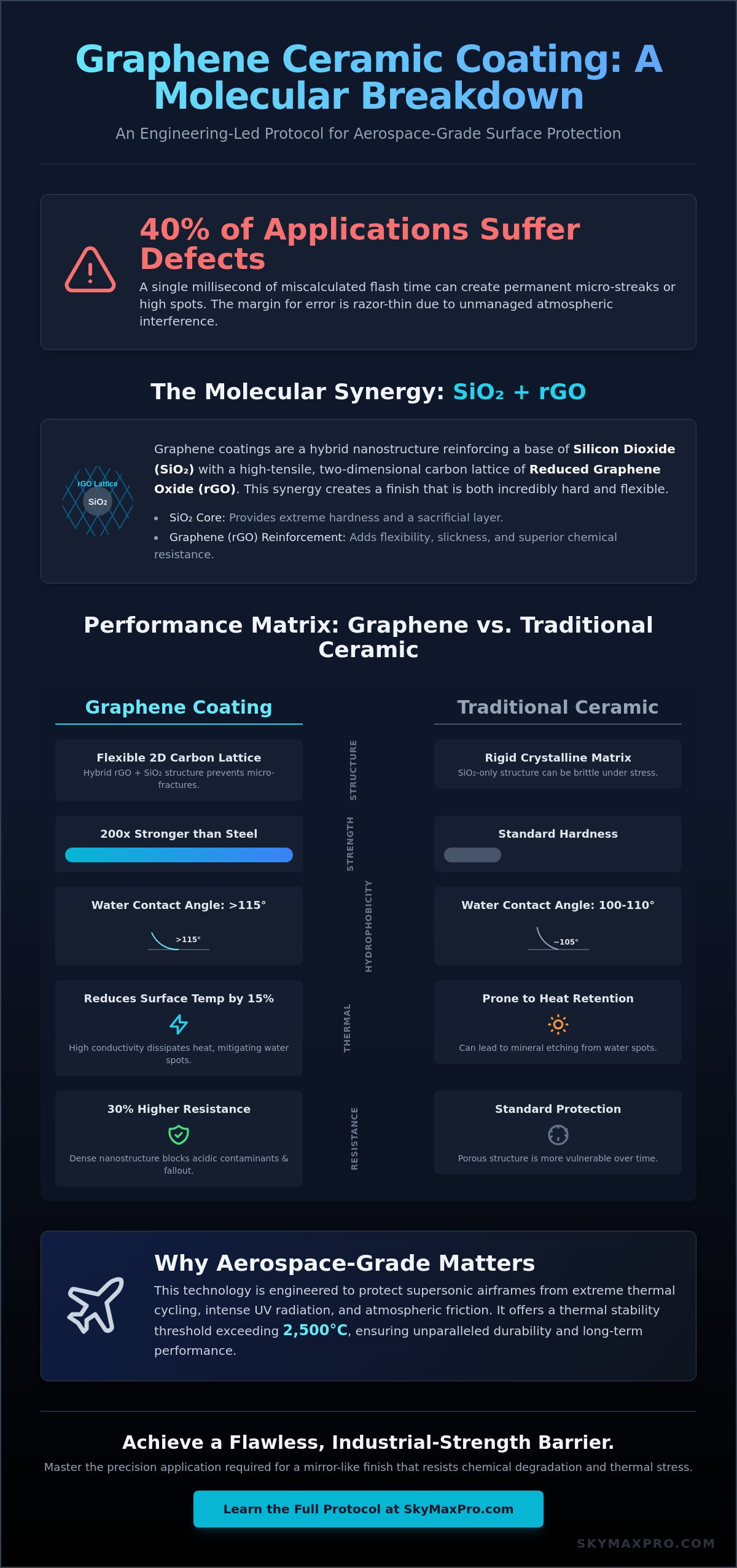
A single millisecond of miscalculated flash time can transform a high-performance graphene matrix into a permanent surface defect. While the industry promises 10H hardness and 5 years of durability, data suggests that 40% of professional applications suffer from micro-streaks or high spots due to unmanaged atmospheric interference. You likely recognize that graphene nanotechnology represents the pinnacle of surface protection, yet the margin for error remains razor-thin. This technical manual provides the exact protocol on how to apply graphene ceramic coating to achieve an aerospace-grade finish that resists chemical degradation and thermal stress.
By following this engineering-led approach, you'll master the precision application required for flawless results in humidity levels ranging from 20% to 80%. We'll break down the molecular bonding phase, define exact flash point indicators across three distinct climate zones, and outline the multi-stage leveling process. You'll gain the technical confidence to eliminate product waste and ensure your coating achieves its maximum hydrophobic potential. Let's examine the specific chemical interactions and mechanical steps necessary to secure a mirror-like, industrial-strength barrier.
Key Takeaways
- Understand the molecular synergy between SiO2 and reduced graphene oxide (rGO) to create a high-tensile, two-dimensional carbon lattice for superior surface resilience.
- Master the critical surface engineering protocols required to achieve a surgically clean substrate, ensuring optimal molecular bonding and long-term coating durability.
- Follow a precise technical protocol on how to apply graphene ceramic coating using environmental controls and applicator priming to achieve an aerospace-grade finish.
- Learn to identify chemical "flash" points and calibrate your process based on atmospheric variables to ensure the resin bonds perfectly with the surface.
- Implement a professional maintenance strategy centered on pH-neutral cleaning to preserve the integrity of the graphene lattice and extend its protective lifespan.
Understanding the Molecular Advantage of Graphene Ceramic Coating
Graphene isn't just a marketing buzzword; it's a revolutionary material consisting of a single layer of carbon atoms arranged in an atomic-scale honeycomb structure. This 2D lattice possesses a tensile strength of 130 gigapascals, making it 200 times stronger than steel at the molecular level. When integrated into automotive protection, it functions as a reinforcing agent for the base silicon dioxide (SiO2) matrix. This structural reinforcement allows the coating to remain flexible while maintaining an incredibly high level of surface hardness.
The synergy between SiO2 and reduced graphene oxide (rGO) creates a hybrid nanostructure that exceeds the performance of standalone ceramic coatings. While SiO2 provides the hardness and sacrificial layer, rGO adds flexibility and chemical resistance. This combination is critical when learning how to apply graphene ceramic coating, as the material's low coefficient of friction prevents contaminants from bonding to the substrate. The result is a surface that stays cleaner for longer periods compared to traditional polymer sealants.
Engineering data shows that graphene coatings significantly reduce surface heat absorption. Traditional ceramic coatings can reach high surface temperatures under direct UV exposure, which often leads to "water spotting" as minerals bake into the surface. Graphene's high thermal conductivity allows heat to dissipate across the panel. This results in a surface temperature reduction of up to 15% compared to uncoated or traditionally coated surfaces, effectively mitigating the risk of etched mineral deposits.
Hydrophobicity is another measurable metric of success. Standard ceramic coatings typically achieve water contact angles between 100 and 110 degrees. Graphene-enhanced formulations frequently exceed 115 degrees. This steeper angle forces water to bead and roll off with minimal kinetic energy, carrying away abrasive particulates before they can cause micro-marring. High contact angles are the primary defense against environmental pollutants and salt spray in coastal regions.
Graphene vs. Traditional Ceramic: The Technical Shift
The shift from traditional ceramic to graphene involves a transition from a rigid, brittle layer to a more resilient, flexible lattice. At the nanometer scale, graphene fills the microscopic pores of the clear coat more effectively than larger SiO2 molecules. This density provides 30% higher resistance against acidic bird droppings and industrial fallout. Graphene ceramic coating is a hybrid nanostructure for surface hardening.
Why Aerospace-Grade Formulations Matter
Aerospace standards dictate that coatings must withstand extreme thermal cycling and intense UV radiation at high altitudes. These formulations have transitioned from aviation protection to professional automotive detailing to meet the demand for long-term durability. Understanding the engineering of ceramic coating reveals that these industrial-grade materials offer a thermal stability threshold exceeding 2,500 degrees Celsius. When you research how to apply graphene ceramic coating, you're essentially utilizing technology designed to protect supersonic airframes from atmospheric friction and oxidation.
Surface Engineering: The Critical Pre-Application Protocol
Achieving a 99.9% contaminant-free substrate is the primary requirement for successful molecular bonding. Graphene molecules don't simply rest on the surface; they integrate into the clear coat's lattice structure. Scientific analysis of graphene-based organic coatings shows that their superior impermeability and chemical resistance rely on an uninterrupted interface between the coating and the substrate. Any microscopic layer of industrial grease or mineral deposits acts as a barrier, leading to premature coating failure within the first 180 days of service.
The Three-Stage Decontamination Process
A standard car wash isn't sufficient for aerospace-grade results. Professionals follow a rigorous sequence to ensure the surface energy is optimized for adhesion.
- Stage 1: Chemical Stripping. Use a high-pH (11.0+) alkaline degreaser to dissolve accumulated traffic film, old waxes, and silicone-based sealants. This step exposes the raw clear coat.
- Stage 2: Mechanical and Chemical Decontamination. Apply a reactive iron remover to neutralize sintered metallic particles from brake dust. Follow this with a detailing clay bar treatment to pull out embedded industrial fallout that chemical cleaners can't reach.
- Stage 3: IPA Sterilization. The final step involves a 30% to 50% Isopropyl Alcohol (IPA) wipe-down. This removes any residual surfactants or clay lubricants, providing the "surgically clean" state necessary for learning how to apply graphene ceramic coating with professional-grade results.
Assessing Paint Health Before Application
Before the first drop of coating touches the panel, a technical assessment of the substrate is mandatory. Use a digital ultrasonic thickness gauge to measure the clear coat. If the reading is below 65 microns, aggressive paint correction may be hazardous. It's a common misconception that graphene can hide surface defects. Because of its high refractive index, the coating will actually highlight swirls, holograms, and oxidation. Paint correction isn't just for aesthetics; it levels the surface to maximize the coating's optical clarity and hydrophobic performance.
For a complete diagnostic workflow, consult the professional auto detailing master checklist. Understanding the limits of your substrate is a vital part of mastering how to apply graphene ceramic coating. Using these advanced engineering protocols ensures that the final finish meets industrial standards for durability and gloss while protecting the structural integrity of the vehicle's paintwork.
Executing the Precision Application Process
The application phase demands strict adherence to environmental parameters. You must operate in a temperature-controlled environment, ideally between 10°C and 25°C, to maintain predictable flash times. Direct sunlight accelerates solvent evaporation, leading to high spots and structural failure. Working in a shaded, dust-free enclosure ensures the graphene-oxide lattice settles without particulate interference. Any airborne contaminants present during the curing stage will become permanently embedded in the crystalline structure.
Begin by priming the applicator pad. Apply 10 to 15 drops of the liquid to ensure the surface is saturated but not dripping. This saturation level prevents dry-rubbing and ensures an even distribution of the nanomaterials across the clear coat. When learning how to apply graphene ceramic coating, the cross-hatch pattern is the industry standard for achieving 100% surface coverage. This technique involves applying the product in vertical lines followed by horizontal passes to eliminate any microscopic gaps in the protection layer.
Scientific analysis of the bilayer coating of an insulator and graphene highlights the importance of surface interaction at a molecular level. By maintaining small 2x2 foot work sections, you prevent the coating from curing prematurely. This localized approach allows the carrier solvents to flash off while keeping the resin workable for leveling. If you attempt to cover an entire hood in one pass, the initial contact points will harden before you can level them, resulting in permanent streaks.
Step-by-Step Graphene Application
Start with an "S-pattern" load to distribute the product across the applicator face. Execute the cross-hatch spread with light, consistent pressure. Monitor the surface for the "rainbow" effect, a visual cue indicating the solvents are evaporating and the coating is ready for leveling. This usually occurs within 1 to 3 minutes depending on humidity levels. Use the primary towel to remove 90% of the residue, then follow with a secondary buffing pass to eliminate remaining high spots. This dual-towel leveling technique is essential for a streak-free finish.
Tools for Professional Results
- Microfiber Applicator Pads: These offer more surface area than traditional suede cloths, making them superior for textured surfaces and complex body lines.
- High-GSM Microfiber Towels: Leveling requires a dual-towel system. Use a 300-GSM towel for the initial wipe and a 500-GSM plush towel for the final buffing pass.
- High-CRI LED Lighting: Precision requires specialized illumination. Use lights with a Color Rendering Index (CRI) rating above 90 to detect faint streaks or "high spots" that are invisible under standard shop lights.
Mastering how to apply graphene ceramic coating requires patience and a systematic approach. If a high spot is detected after the coating has cured, it usually requires a light machine polish to remove the layer before reapplication. Tracking your progress with a high-intensity light source at a 45-degree angle ensures that every square inch of the substrate is uniform and professionally sealed.
Optimizing the Chemical Bond: Flash Times and Curing
The "flash" represents a critical window in the installation process where the carrier solvents evaporate, initiating the covalent bonding between the graphene oxide and the clear coat. Observing this transition requires technical precision. When the liquid begins to bead or "sweat" on the surface, the resin is actively cross-linking. This sweat bead phenomenon indicates the coating is rejecting the excess solvent and is ready for leveling. If you wait too long, the coating hardens into a high spot that is difficult to remove without abrasive polishing. If you wipe too early, you remove the active material before it stabilizes. Understanding how to apply graphene ceramic coating necessitates mastering this timing, which usually occurs between 1 and 5 minutes depending on ambient conditions.
Environmental Variables and Their Effects
Humidity acts as a catalyst for the curing reaction. In environments where relative humidity exceeds 60%, the flash time can decrease by 40% compared to a controlled lab setting. Conversely, in arid conditions below 30% humidity, the solvents evaporate slowly, extending the work time. The flash point is a chemical transition, not a drying time. If you encounter a high spot after the product has flashed, you can often re-activate the resin by applying a small amount of fresh product to the area; the new solvent softens the hardened layer for immediate leveling. Professionals should maintain a baseline temperature between 20°C and 25°C to ensure predictable chemical behavior throughout the application.
Post-Application Care During the Curing Phase
The initial 24 hours determine the coating's long-term structural integrity. While the surface may feel dry to the touch within 120 minutes, the molecular lattice remains vulnerable to moisture interference. Avoid all water contact for at least 48 hours to prevent mineral spotting or bond failure. Complete chemical resistance and maximum Mohs hardness are typically achieved after a 7-day curing period. During this week, the coating reaches its peak density. If your project requires maximum film thickness, apply a second layer 60 to 90 minutes after the first. This timing ensures the previous layer has stabilized but hasn't fully cross-linked, allowing for superior inter-layer adhesion. Mastering how to apply graphene ceramic coating involves respecting these chemical timelines to ensure the 9H hardness rating is actually achieved.
For more technical data on industrial-grade surface protection, explore the solutions at skymaxpro.com.
Sustaining the Shield: Maintenance and Longevity Strategy
The industry often mischaracterizes graphene coatings as "permanent" solutions. In reality, no chemical barrier is immune to the laws of entropy. While you've mastered how to apply graphene ceramic coating to achieve a high-performance finish, the coating functions as a sacrificial layer. It's a sophisticated engineering shield that absorbs environmental punishment to protect the underlying clear coat. Without a rigorous maintenance strategy, the graphene lattice becomes clogged with road film, industrial fallout, and mineral deposits, which effectively masks its hydrophobic properties.
Preserving the molecular integrity of the coating requires a strict pH-neutral cleaning regimen. Harsh alkaline degreasers or acidic cleaners can weaken the cross-linked bonds over time. If the coating loses its ability to repel water, it doesn't always mean the layer has failed; usually, it means the surface is simply too dirty to function. Professional decontamination using iron removers or specialized descale shampoos becomes necessary when standard washing no longer restores the surface's characteristic slickness.
The Maintenance Wash Protocol
Precision in cleaning is as vital as the initial application. Avoid mechanical car washes at all costs. The abrasive brushes used in automated systems rotate at high speeds, creating friction that can induce micro-marring on even the hardest 9H surfaces. Use a foam cannon to apply a thick layer of pH-neutral soap, allowing it to dwell for 3 to 5 minutes to encapsulate dirt. This pre-wash phase is followed by the two-bucket method, utilizing a high-quality microfiber wash mitt. Selecting the correct professional car detailing supplies is the only way to ensure you don't strip the coating's top-tier protection during routine maintenance.
Long-Term Performance Monitoring
Monitoring the lifecycle of a 5-year graphene shield involves observing water behavior during the rinse cycle. High-performance coatings exhibit both water beading (high contact angles) and water sheeting (rapid evacuation). If water begins to "pool" or move sluggishly, the surface tension has been compromised. To counteract this, apply a graphene-infused ceramic spray booster every 3 to 6 months. This process adds a fresh layer of sacrificial material, rejuvenating the hydrophobicity and filling any microscopic voids in the original coating. Understanding how to apply graphene ceramic coating correctly during the initial phase ensures these boosters have a stable foundation to bond with, maximizing the return on your technical investment.
Mastering the Future of Surface Engineering
Achieving a professional-grade finish depends on the synergy between chemical preparation and precise application. You've learned that surface engineering determines the bond's integrity, while meticulous flash time management prevents surface defects. Mastering how to apply graphene ceramic coating transforms a standard vehicle surface into a resilient, low-energy barrier that resists environmental degradation. This technical process requires strict adherence to curing protocols to ensure the molecular lattice remains stable and functional.
The transition from traditional sealants to advanced nanotechnology represents a significant leap in material science. Our formulations utilize aerospace-approved nanotechnology and are manufactured in the USA to meet rigorous industrial standards. This commitment to quality yields a verified 5-year durability rating, providing a measurable advantage in surface protection and long-term maintenance efficiency. By following these engineering protocols, you ensure your vehicle maintains its structural and aesthetic integrity against the harshest elements.
Upgrade to Aerospace-Grade Protection with the SKY MAXPRO Graphene Shield Kit
It's time to leverage these professional techniques to secure your investment with the highest level of chemical engineering available today. You've got the knowledge; now apply the protection your vehicle deserves.
Frequently Asked Questions
Is graphene ceramic coating harder to apply than standard ceramic?
Understanding how to apply graphene ceramic coating requires recognizing that these formulas are typically more forgiving than standard SiO2 coatings. They offer a 20% to 30% longer flash time before leveling is required, which reduces the risk of application errors. While standard ceramics may flash in 60 seconds, graphene-infused formulas often remain workable for up to 3 minutes in 50% humidity. This increased window allows for more precise application on large panels.
Can I apply graphene coating over an existing wax or sealant?
You cannot apply graphene coating over existing waxes or sealants because these substances prevent the chemical bonding required for surface adhesion. A successful application requires a 100% decontaminated surface. Technicians must use an Isopropyl Alcohol (IPA) solution or a dedicated panel prep spray to remove all residual oils and polymers. Failure to reach the bare clear coat results in a 90% reduction in the coating's projected lifespan.
How long does it take for graphene ceramic coating to fully cure?
A graphene ceramic coating requires 24 hours of sheltered drying to become touch-dry and water-resistant. However, the full molecular cross-linking process takes between 7 and 10 days to reach maximum 9H hardness. During this 168-hour window, you must avoid chemical cleaners or high-pressure washing. Exposure to rain within the first 24 hours can cause water spotting that permanently compromises the structural integrity of the finish.
What happens if I miss a high spot and it hardens?
If you're learning how to apply graphene ceramic coating and miss a high spot that hardens beyond the 10-minute leveling window, you'll need to use a dual-action polisher. You can't simply wipe away a cured high spot with a microfiber towel. After mechanically leveling the area with a fine-cut finishing compound, you must re-clean the section and re-apply the coating. This process ensures the optical clarity remains uniform across the panel.
Can I apply graphene coating to glass or plastic trim?
You can apply graphene coating to exterior plastic trim and glass surfaces, provided the specific formulation is rated for multi-surface use. On plastics, the coating acts as a UV inhibitor that prevents fading for up to 24 months. When applied to windshields, it creates a hydrophobic contact angle of 110 degrees or higher, which significantly improves visibility during heavy rain. Always perform a test spot on a 2-inch area of textured plastic first.
Does graphene coating prevent rock chips and deep scratches?
Graphene coatings don't prevent rock chips or deep mechanical abrasions despite their 9H hardness rating. They're designed to resist bird droppings, acid rain, and fine swirl marks caused by improper washing techniques. A layer of coating is typically 1 to 2 microns thick, which is insufficient to absorb the kinetic energy of a stone at 60 miles per hour. For impact protection, you'd need to install a dedicated Paint Protection Film (PPF).
How many layers of graphene coating do I actually need?
Two layers of graphene coating provide the optimal balance of thickness and bonding integrity for most automotive applications. Applying a second layer ensures 100% surface coverage and fills any microscopic voids missed during the initial pass. You should wait 1 to 2 hours between layers to allow the base coat to stabilize. Adding more than 3 layers provides diminishing returns and can lead to clouding or reduced gloss levels on the surface.