

What if the five year warranty on your vehicle’s surface protection isn't a fixed chronological guarantee, but a variable of molecular engineering? You've likely experienced the frustration of investing in high-end coatings only to see them fail in six months due to confusing 10H jargon or inconsistent weather performance. It's a common pain point for owners trying to determine how long does graphene coating last when faced with the aggressive industrial pollutants and UV levels of 2026.
We understand that you require measurable efficiency rather than marketing fluff. This engineering guide explores the technical reality behind graphene durability and the professional maintenance protocols required to hit the five year mark. You'll learn why SKY MAXPRO utilizes aerospace-grade nanotechnology to create a more resilient bond than traditional ceramic. By analyzing the relationship between molecular thickness and environmental resistance, we'll help you determine if a graphene-infused shield is the right technical solution for your specific needs.
Key Takeaways
- Analyze the molecular role of Reduced Graphene Oxide (rGO) in establishing a high-strength lattice to determine exactly how long does graphene coating last under industrial stress.
- Identify the specific impact of UV-induced polymer degradation and pH-extreme contaminants on the chemical resilience of your vehicle's protective bond.
- Understand the engineering advantages of graphene’s thermal conductivity and flexibility in preventing paint etching and surviving the thermal expansion of metal panels.
- Master the professional maintenance protocol, including the vital two-week curing rule and pH-neutral cleaning standards, to maximize coating longevity.
- Explore how aerospace-grade nanotechnology provides a verified 5-year protection barrier engineered for high-altitude endurance and extreme surface resilience.
The Science of Surface Resilience: Understanding Graphene Longevity
Graphene coating longevity describes the specific duration the carbon-based lattice remains chemically bonded to the clear coat. To understand how long does graphene coating last, we must analyze the structural integrity of the bond at a molecular level rather than relying on marketing estimates. Professional formulations from SKY MAXPRO utilize Reduced Graphene Oxide (rGO) to create a heat-resistant, high-strength barrier. This is a significant departure from consumer-grade "graphene waxes" that rely on surface-level adhesion. Aerospace-grade nanotechnology focuses on permanent molecular integration, ensuring the shield becomes a functional extension of the paint itself.
The relationship between molecular thickness and environmental resistance is a primary factor in surface defense. A uniform application allows the coating to withstand aggressive UV exposure and chemical attacks without thinning over time. According to The Science of Graphene, this material's hexagonal arrangement provides a unique combination of lightness and incredible tensile strength. By utilizing these properties, SKY MAXPRO delivers a surface treatment that survives industrial stressors that would typically degrade a standard ceramic finish within months.
The Molecular Lattice: How Graphene Bonds
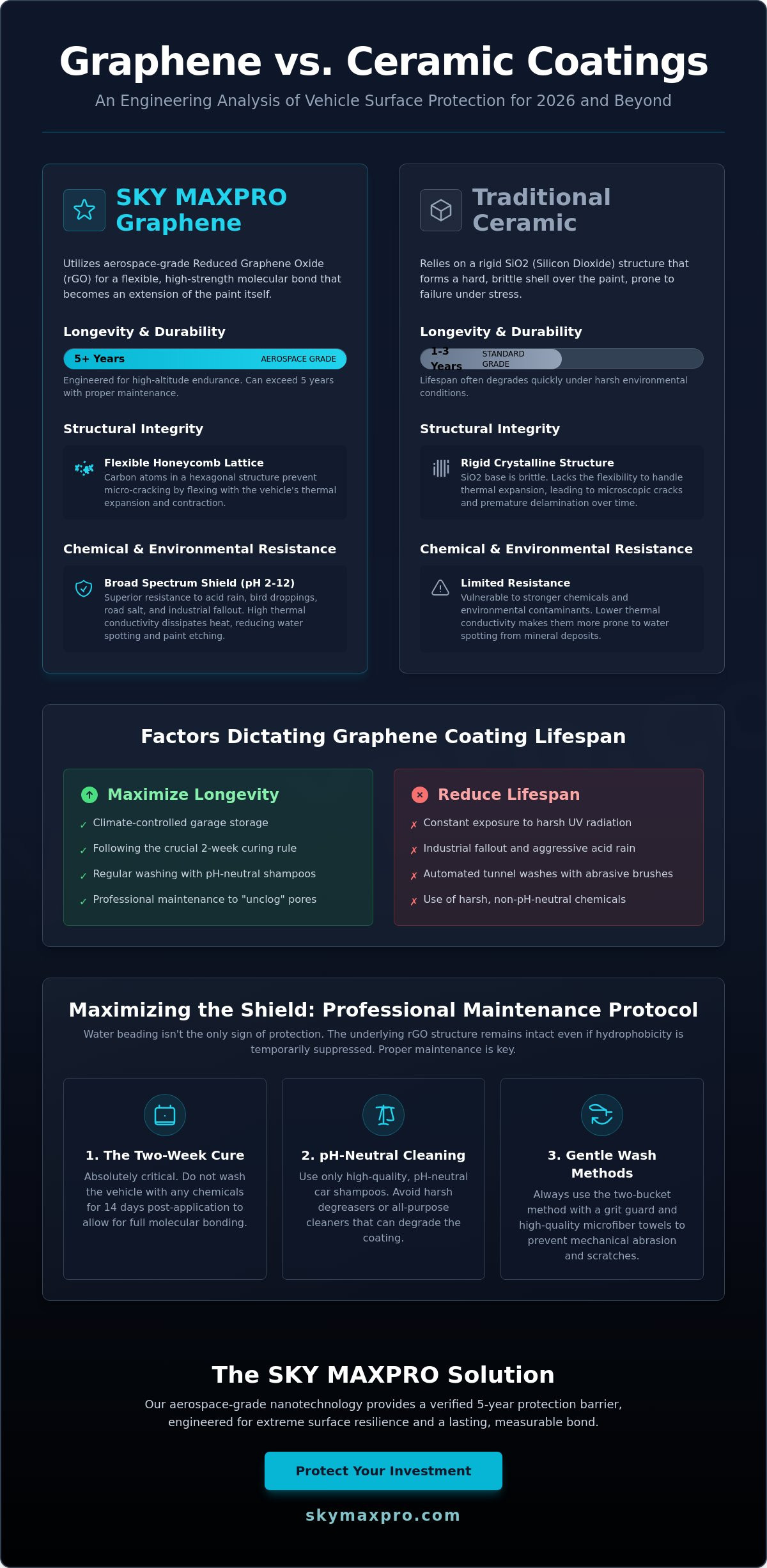
At the nano-level, graphene consists of a single layer of carbon atoms arranged in a honeycomb structure. This geometry provides exceptional tensile strength, allowing the coating to act as a flexible shield. While traditional ceramic coatings are rigid and brittle, graphene's hexagonal lattice allows it to move with the substrate. Vehicles experience constant thermal expansion and contraction as metal panels heat up and cool. Graphene's flexibility prevents the microscopic cracking and premature delamination common in SiO2-based products. By integrating directly into the microscopic pores of the paint, the coating creates a unified surface that resists mechanical wear.
Hydrophobicity vs. Structural Integrity
It's a common misconception that water beading is the only indicator of a coating's health. Hydrophobicity is a surface tension phenomenon that can be suppressed by road film, minerals, or environmental "clogging" of the lattice. Even if a surface stops beading water, the underlying rGO structure often remains intact and continues to provide protection. Maintenance involves clearing these pores rather than reapplying the base layer. The functional lifespan of a coating is defined as its continued capacity to resist chemical etching and UV-induced oxidation. Understanding this distinction helps owners accurately track how long does graphene coating last beyond simple visual cues.
Reality vs. Marketing: Factors That Dictate Graphene Coating Lifespan
Marketing departments often broadcast a flat "5-year" figure, but the engineering reality of how long does graphene coating last is dictated by environmental variables and storage protocols. The functional durability of any coating is a balance between the strength of the molecular bond discussed in the previous section and the severity of the external environment. UV radiation, chemical exposure, and mechanical abrasion all work to erode the protective lattice over time. Understanding these variables allows you to adjust maintenance expectations and maximize your investment.
Storage conditions act as a primary force multiplier. A vehicle stored in a climate-controlled garage can easily exceed its 5-year rating, as it's shielded from the 24/7 cycle of UV-induced polymer chain scission. In contrast, a daily driver exposed to industrial fallout, acid rain, and extreme temperature fluctuations may see a 50% reduction in functional life. UV exposure is particularly aggressive; it initiates polymer degradation that can compromise the carrier resins holding the graphene in place. Mechanical abrasion from improper wash cycles, such as automated tunnel washes with abrasive brushes, physically thins the coating regardless of its chemical hardness.
Environmental Stressors and Chemical Resistance
Professional-grade graphene is engineered to withstand a broad chemical spectrum, typically ranging from pH 2 to pH 12. This resilience is vital when facing high-alkaline road salts or acidic bird droppings. Graphene’s superior heat dissipation also plays a critical role here. By conducting heat across the surface, it prevents the "baking" of mineral deposits into the clear coat, a phenomenon known as water spotting that frequently plagues traditional ceramic coatings. High-alkaline cleaners used in substandard car washes can strip lower-quality coatings, but a true rGO-based shield maintains its integrity under these harsh conditions.
The Quality of Initial Decontamination
A coating's durability is fundamentally limited by the quality of the surface it bonds to. Any residual surfactants, iron particles, or organic contaminants will prevent the graphene lattice from achieving a permanent chemical bond with the clear coat. This leads to premature delamination and failure. We utilize a strict protocol involving mechanical and chemical decontamination using tools like the Final Touch I PRO Detailing Clay and iron removers. Following the Professional Auto Detailing Master Checklist ensures that the surface is chemically pure and ready for bonding. For those seeking long-term surface security, starting with a high-purity formula from SKY MAXPRO is the most reliable path to aerospace-grade results.
Graphene vs. Ceramic: A Comparative Engineering Analysis of Durability
Determining how long does graphene coating last requires a direct comparison with traditional silicon dioxide (SiO2) technologies. While ceramic coatings revolutionized surface protection, they possess inherent mechanical limitations, specifically regarding thermal retention and brittleness. Graphene's carbon-based lattice offers a significant engineering advantage through its superior thermal conductivity. By shedding heat more efficiently than ceramic, graphene reduces the kinetic energy available for chemical etching. When bird droppings or industrial fallout land on a hot hood, the lower surface temperature of a graphene-treated panel slows the corrosive reaction, preserving the clear coat longer than a standard ceramic finish.
The flexibility of the coating is another critical durability factor. Metal body panels undergo constant thermal expansion and contraction. Traditional ceramic is a rigid glass structure that can develop microscopic fissures over a 60-month cycle. Graphene maintains high-tensile endurance, allowing it to stretch and contract without losing its bond. This elasticity, combined with a lower coefficient of friction, results in a slicker surface. Reduced surface friction means that wash mitts and drying towels glide over the panel, significantly decreasing the risk of wash-induced marring that eventually thins the protective layer.
Hardness and Scratch Resistance (Mohs Scale)
The industry often cites 10H hardness as a definitive metric, yet this refers to pencil hardness tests rather than the Mohs scale. Real-world abrasion resistance isn't about being diamond hard; it's about the coating’s ability to resist deformation. While ceramic's brittle nature can lead to chipping under impact, graphene’s structural resilience absorbs energy more effectively. This reduces the visible swirl marks that accumulate over years of maintenance, ensuring the aesthetic longevity matches the chemical lifespan. It's the difference between a rigid shield that cracks and a flexible mesh that persists.
The "Water Spotting" Comparison
Ceramic coatings are notoriously prone to hard water spotting due to their high surface energy and heat retention, which bakes mineral deposits into the surface. Graphene’s lower surface energy creates a higher contact angle, often exceeding 110 degrees, making it harder for minerals to bond. To understand the fundamental SiO2 mechanics that graphene was designed to improve upon, consult our Engineering of Ceramic Coating Guide. Tracking these contact angle measurements over time is the most accurate way to verify how long does graphene coating last in your specific environment. When the contact angle drops below 90 degrees, it typically indicates surface contamination rather than a total failure of the graphene bond.
Maximizing the Shield: A Professional Protocol for Maintenance
The technical answer to how long does graphene coating last depends heavily on the maintenance framework established immediately after application. Engineering a durable surface requires more than just a high-quality product; it requires a disciplined post-application protocol. The first 14 days are critical, often referred to as the "2-Week Rule." During this initial curing phase, the reduced graphene oxide (rGO) lattice completes its chemical cross-linking with the clear coat. Exposure to aggressive chemicals or abrasive washing during this 336-hour window can permanently weaken the bond, leading to premature failure. Once fully cured, the coating acts as a semi-permanent barrier, but it's not self-maintaining.
Maintaining the structural integrity of the lattice requires the consistent use of pH-neutral shampoos. Standard detergents often contain surfactants that leave behind films, which can "clog" the graphene pores and suppress its hydrophobic properties. De-clogging procedures are essential for restoring performance. Over a 12-month cycle, environmental pollutants like metallic fallout and mineral deposits accumulate on the surface. These contaminants don't necessarily destroy the coating, but they do mask its efficiency. Utilizing a sacrificial layer, such as a graphene-infused topper, protects the base coating from direct friction and UV attack, effectively extending the functional life of the primary shield.
The Quarterly Maintenance Wash
To ensure your vehicle hits the 5-year mark, follow a structured decontamination process every 90 to 120 days. This proactive approach prevents the buildup of industrial fallout that can lead to surface etching.
- Step 1: Perform a thorough chemical decontamination wash using a pH-neutral cleaner to remove organic road film and oils.
- Step 2: Use a dedicated iron-remover to pull embedded metallic particles from the microscopic pores of the graphene lattice.
- Step 3: Apply a reinforcement layer like the PRO Ceramic Graphene Spray Coating to restore surface slickness and enhance the sacrificial barrier.
What to Avoid: The Longevity Killers
Mechanical shearing is the primary cause of coating thinning. Automated "brush" car washes use high-speed friction that physically abrades the nano-coating, regardless of its 10H rating. You should also avoid high-pH "touchless" soaps frequently used in commercial wash bays. These caustic chemicals are designed to strip waxes and can prematurely degrade the polymer bonds holding the graphene in place. Finally, don't apply traditional carnauba waxes over your coating. The oils in natural waxes have high surface energy, which attracts dust and masks the superior self-cleaning properties of the graphene. For the most reliable results, stick to the engineered solutions available at SkyMax Pro to maintain your surface's aerospace-grade resilience.
The SKY MAXPRO Solution: Aerospace-Grade Graphene Technology
The technical reality of how long does graphene coating last is ultimately determined by the purity of the reduced graphene oxide (rGO) and the quality of the carrier resins used in the formulation. SkyMax Pro’s Ceramic Graphene Shield is not a repurposed ceramic wax; it is an aviation-grade polymer system engineered for over 1,825 days of verified surface endurance. By utilizing nanotechnology approved for high-altitude environments, this coating provides a level of UV resistance and thermal stability that standard consumer products cannot match. It creates a permanent chemical bond that resists the structural degradation typically caused by industrial pollutants and extreme atmospheric pressure changes.
While many professional coatings require a controlled clean room for successful application, our "pro-sumer" formulation is engineered for high-performance bonding in various environments. This accessibility does not compromise the structural integrity of the lattice. The system is designed to be synergistic, integrating specialized washes and decontaminants that prepare the clear coat for maximum cross-linking. When the Ceramic Graphene Shield is applied to a chemically pure surface, it achieves a molecular density that effectively seals the paint from oxidation for more than five years.
Ceramic Graphene Shield vs. PRO Spray Coating
Choosing the right product depends on your specific durability requirements and maintenance schedule. The Ceramic Graphene Shield is a concentrated, long-term solution designed for those seeking a permanent protective barrier that lasts half a decade. In contrast, the PRO Ceramic Graphene Spray Coating offers a 12-month protection cycle. This spray serves as the ideal maintenance booster. When applied every 6 to 12 months, it reinforces the primary shield's sacrificial layer and restores the high contact angle required for self-cleaning. For daily drivers exposed to harsh road salt and sun, this combination ensures the baseline protection never thins, effectively answering the question of how long does graphene coating last with a predictable, data-backed timeline.
Engineering Your Vehicle’s Future
Relying on aerospace engineering provides more predictable results than following the inconsistent performance of generic "nano" sprays. By adopting a complete system approach, you move away from guesswork and toward a measurable maintenance protocol. This ensures that the investment in your vehicle’s exterior is protected by the same technology used to shield high-value assets in the most demanding environments on earth. We invite you to secure your vehicle’s finish with the Ceramic Graphene Shield Coating and explore our full range of Professional Car Detailing Supplies to maintain an aerospace-grade finish for years to come.
Securing Your Surface for the Next Five Years
Understanding the technical variables behind surface protection allows you to move past marketing jargon and toward measurable performance. We've established that the functional lifespan of a coating isn't a fixed date but a result of molecular flexibility and superior heat dissipation. By implementing a disciplined maintenance schedule and using the pH-neutral protocols discussed, you ensure the carbon-based lattice remains intact against 2026 environmental standards. Determining how long does graphene coating last for your specific vehicle is now a matter of professional protocol rather than guesswork.
SkyMax Pro delivers this level of certainty through aerospace-approved nanotechnology engineered for 5+ years of durability. Our formulations are proudly manufactured in the USA to meet the highest industrial standards for surface resilience. It's time to transition from temporary waxes to permanent surface security that survives the expansion and contraction of every mile. Your vehicle's clear coat is an investment that deserves the highest level of engineering.
Upgrade to Aerospace-Grade Protection with Ceramic Graphene Shield
Take control of your vehicle's future with a shield designed for high-altitude endurance and professional-grade results.
Frequently Asked Questions
Does graphene coating really last 5 years?
Yes, professional-grade graphene coatings can exceed five years of functional protection when applied to a decontaminated surface and maintained with pH-neutral protocols. The Ceramic Graphene Shield utilizes a high-density carbon lattice that maintains its chemical bond through 60 months of UV exposure and industrial stress. Its real-world longevity depends on the success of the initial 14-day curing phase and consistent quarterly maintenance washes.
What happens when a graphene coating starts to fail?
Failure manifests as a significant reduction in surface energy, where water no longer beads at a 110-degree contact angle but "sheets" across the panel. You'll notice an increase in surface friction and a decrease in the paint's depth and clarity. This usually occurs when the sacrificial layers are exhausted and the base lattice begins to thin due to mechanical abrasion or repeated exposure to caustic chemicals.
Can I apply a new layer of graphene over an old one?
You cannot apply a permanent base coating over an existing one because the new layer won't achieve a direct chemical bond with the clear coat. To accurately measure how long does graphene coating last when layering, you must distinguish between base coats and maintenance sprays. While you can use a PRO spray as a periodic booster, a full re-application requires mechanical decontamination to ensure a pure bonding surface.
Do I still need to wax my car if it has a graphene coating?
No, you should never apply traditional carnauba waxes over a graphene coating. Waxes have high surface energy that attracts dust and masks the superior hydrophobic performance of the carbon lattice. Instead, use a dedicated graphene-infused spray every 120 days to reinforce the sacrificial layer. This maintains the coating's self-cleaning properties without the oily residue found in organic waxes.
Is graphene coating better than ceramic for daily drivers?
Graphene is superior for daily drivers due to its high thermal conductivity and molecular flexibility. Daily use exposes vehicles to more "water spot baking" and thermal expansion cycles than show cars. Graphene's ability to dissipate heat across the panel reduces mineral etching by up to 50% compared to standard ceramic, making it the more resilient choice for vehicles stored outdoors.
How much does it cost to maintain a graphene coating annually?
Annual maintenance focuses on high-purity consumables like pH-neutral shampoos, iron removers, and graphene-infused toppers. A standard maintenance protocol for a 12-month cycle typically involves four deep decontamination washes. This proactive approach is a predictable investment that preserves the 5-year integrity of the initial coating and prevents the need for expensive paint correction later.
Can graphene coating survive road salt and winter conditions?
Graphene coatings are engineered to survive the high-alkaline stress of road salt and calcium chloride used in winter. Because the carbon lattice remains chemically stable between pH 2 and pH 12, it prevents corrosive contaminants from reaching the clear coat. Regular rinsing during winter months is still required to prevent salt buildup from temporarily clogging the hydrophobic pores of the coating.
Does graphene coating prevent rock chips?
No, a graphene coating cannot prevent rock chips or deep mechanical gouges caused by high-velocity impacts. While it provides 10H pencil hardness and significantly reduces wash-induced marring, the protective layer is only a few microns thick. For protection against physical road debris, you must utilize a Paint Protection Film (PPF), which can be topped with graphene for enhanced chemical resistance.