

The glossy finish of a traditional ceramic coating might actually be the catalyst for the water spotting issues you've spent significant resources trying to avoid. It’s a common frustration to invest in high-end paint protection only to find mineral deposits etched into the surface after the first rainfall. If you're struggling to distinguish between technical innovation and marketing buzzwords, you aren't alone. The debate regarding graphene vs ceramic coating for cars has reached a critical point in 2026 as EPA approvals under the Toxic Substances Control Act have standardized the commercial availability of graphene-based solutions.
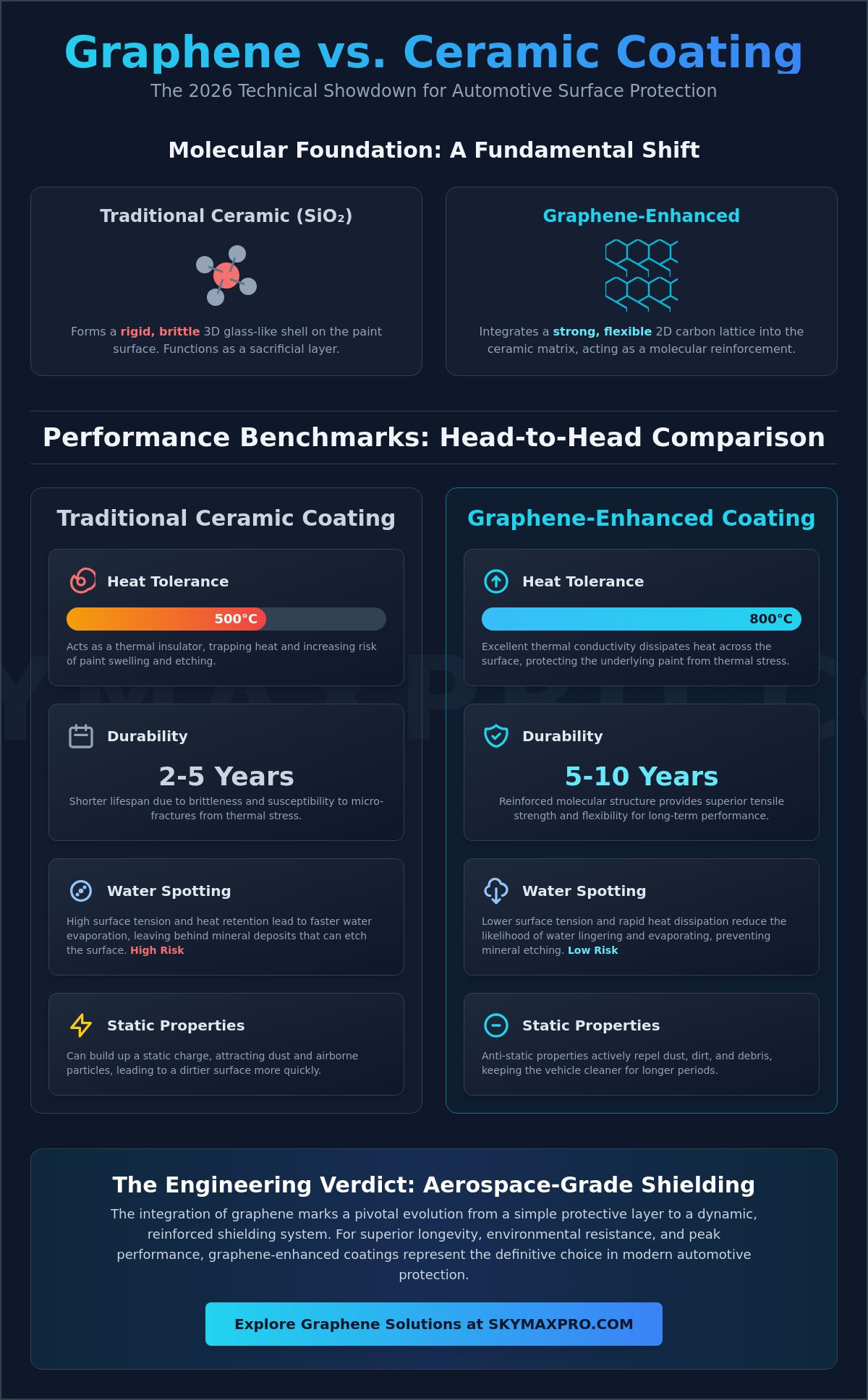
You'll discover the precise technical differences between these technologies to help you choose a definitive surface protection for your vehicle. We'll examine how graphene oxide functions as a molecular reinforcement rather than a mere replacement for silicon dioxide. This analysis covers the shift in heat management, where graphene can tolerate temperatures up to 800°C compared to the 500°C limit of standard ceramics. We provide a structured look at how these advancements deliver superior chemical resistance and a durability range of 5 to 10 years, ensuring your investment maintains peak efficiency.
Key Takeaways
- Analyze the molecular transition from silicon dioxide (SiO2) to hexagonal carbon atom lattices to determine which structure provides superior surface bonding.
- Evaluate the performance benchmarks of graphene vs ceramic coating for cars, focusing on thermal conductivity and the prevention of paint swelling.
- Discover how graphene’s low reactivity and anti-static properties mitigate the water spotting and mineral deposit issues common in traditional ceramic coatings.
- Compare the implementation frameworks, including surface decontamination protocols and the specific "flash time" windows required for a durable 5-year finish.
- Understand the engineering behind aerospace-grade shielding and its application in modern automotive paint protection.
Understanding the Molecular Foundation: Silica vs. Graphene Nanostructures
Every protective solution begins at the atomic level. To evaluate graphene vs ceramic coating for cars, we must first analyze the structural integrity of Silicon Dioxide (SiO2). This inorganic compound serves as the primary backbone for traditional ceramic coatings. It's essentially liquid glass that, upon application, undergoes a chemical reaction to form a semi-permanent bond with the vehicle's clear coat. This process creates a rigid barrier, but the shift toward graphene in 2026 highlights the need for a more resilient molecular architecture.
The Chemistry of SiO2 (Ceramic)
Silica molecules are engineered to cross-link during the curing process, forming a rigid, three-dimensional structure. This creates a dense, sacrificial layer that shields the paint from UV radiation and acidic contaminants. While this glass shield offers exceptional hardness, it possesses inherent physical limitations that engineers must account for. Pure silica layers are often brittle; they lack the flexibility required to withstand the constant thermal expansion and contraction of automotive panels. Without proper elasticity, the coating can develop micro-fractures over time. Achieving a successful, long-term bond requires meticulous surface preparation using professional car detailing supplies to remove industrial fallout, iron particles, and residual oils that inhibit molecular adhesion.
The Graphene Lattice Advantage
Graphene represents a paradigm shift in material science and surface engineering. As a single layer of carbon atoms arranged in a two-dimensional hexagonal lattice, Graphene provides a high surface-to-volume ratio that traditional polymers cannot match. This honeycomb carbon structure is the strongest known material in existence. When integrated into automotive coatings, it doesn't function as a standalone layer but rather as a reinforcing framework. Graphene oxide is infused into the ceramic matrix to act as a reinforcement agent, significantly increasing the tensile strength of the resulting film. This structural enhancement allows the coating to remain flexible while maintaining a higher degree of hardness than silica alone.
The integration of these two technologies creates a hybrid structure known as Ceramic Graphene. This isn't a simple additive process; it's a molecular optimization designed to solve the inherent weaknesses of traditional ceramics. While a standard ceramic coating functions primarily as a hard sacrificial layer, the addition of graphene introduces a flexible, conductive network. This network effectively dissipates heat across the surface, reducing the localized thermal stress that leads to paint swelling. It also lowers the static charge of the vehicle's surface, which repels dust and environmental debris more efficiently. The result is a coating that doesn't just sit on top of the paint but becomes an integral part of the surface architecture. This fundamental shift from a brittle shell to a reinforced lattice explains why the technical comparison of graphene vs ceramic coating for cars favors graphene for high-performance applications.
Performance Benchmarks: Durability, Thermal Conductivity, and Hardness
Measuring the efficacy of surface protection requires more than a visual inspection of gloss. In 2026, performance data confirms that graphene-enhanced matrices significantly outperform traditional silica shields across three critical metrics: thermal dissipation, tensile flexibility, and structural longevity. When evaluating graphene vs ceramic coating for cars, the engineering focus shifts from mere surface hardness to the dynamic response of the coating under environmental stress. These benchmarks provide the technical justification for graphene's position as a premium protective solution.
Heat Dissipation and UV Degradation
Standard ceramic coatings act as thermal insulators. They trap heat within the layer. During prolonged sun exposure, surface temperatures on dark vehicles can exceed 70°C, causing the underlying paint to expand. This expansion creates microscopic openings where contaminants like bird droppings or industrial fallout can etch into the surface. Graphene’s high thermal conductivity allows it to dissipate heat across the entire panel rather than concentrating it in one spot. This reduces the localized surface temperature, which inhibits the chemical bonding of environmental pollutants.
UV radiation remains the primary driver of coating degradation. Silica-based shields eventually oxidize under constant UV-B exposure, leading to a loss of hydrophobicity. Carbon-based graphene lattices are inherently more stable under UV stress. For a deeper analysis of these chemical interactions, review our technical document on the engineering of ceramic coating. This stability ensures that the protective barrier remains functional even in extreme climates, preventing the premature failure of the bond.
Hardness Ratings and Tensile Strength
The industry frequently cites 9H or 10H ratings. These values refer to the Wolff-Wilborn pencil hardness test. This is a measure of resistance to deformation, not a guarantee against all types of mechanical scratches. While both technologies offer high hardness, graphene introduces superior tensile strength. Traditional ceramics are brittle. They can crack if the vehicle panel flexes or vibrates. Graphene acts like a flexible mesh within the coating matrix, providing the elasticity needed to maintain integrity during physical stress.
Analyzing graphene vs ceramic coating for cars reveals that while ceramics offer a hard shield, graphene provides a smarter, more resilient lattice. According to this Graphene Coating Introduction, the material's anti-corrosion and conductive features are central to its superior performance profile. In standard national weather conditions, ceramic coatings typically maintain their properties for 2 to 5 years. Graphene coatings extend this lifespan to 5 to 10 years because of their molecular stability. If you require a balance of high-gloss aesthetics and industrial-grade protection, you can explore a professional-grade Ceramic Graphene Shield Coating to secure your vehicle's finish.
Solving the Water Spotting Dilemma: Surface Tension and Hydrophobicity
Water spotting remains the primary technical failure reported by users of traditional silica coatings. While these coatings provide excellent gloss, their surface physics often creates a paradox where high hydrophobicity leads to increased mineral etching. The engineering comparison of graphene vs ceramic coating for cars reveals that the solution lies not in the bead height, but in how quickly the bead leaves the surface. Graphene's molecular structure addresses this by altering the fundamental interaction between liquid and substrate.
Why Ceramic Coatings Often Suffer from Etching
Ceramic coatings are thermally refractive; they retain significant surface heat during peak UV exposure. When water droplets rest on a hot ceramic-coated panel, the high temperature accelerates evaporation. This process leaves behind concentrated calcium and magnesium deposits. At a microscopic level, some silica-only matrices possess a degree of porosity that allows these minerals to bond chemically with the SiO2 layer. This interaction makes the resulting spots extremely difficult to remove without abrasive polishing, as the minerals become physically integrated into the protective shield.
The Reduced Sliding Angle of Graphene
Sliding angle refers to the specific degree of tilt required for a water droplet to move across a surface. While ceramic coatings focus on a high contact angle to create impressive water beading, graphene optimizes for a low sliding angle. Graphene’s low surface energy creates an environment where water cannot easily "grip" the substrate. This reduced friction allows moisture to roll off the vehicle at much lower inclinations than traditional coatings. This characteristic creates a self-cleaning effect that minimizes the accumulation of environmental contaminants. It significantly reduces the need for frequent mechanical washing, which preserves the coating’s integrity over time.
Beyond mineral deposits, graphene's chemical stability provides a superior defense against organic acids. Bird droppings and acid rain possess pH levels that can penetrate standard silica shields. Graphene oxide acts as a non-reactive barrier that neutralizes these acids before they reach the clear coat. This chemical inertness, combined with anti-static properties that repel dust, ensures the surface remains pristine even in industrial environments. By prioritizing sliding angle over mere bead height, graphene-based formulations solve the inherent weaknesses of the previous generation of paint protection.
Implementation Framework: Application Complexity and Maintenance
Successful integration of advanced surface protection depends entirely on the implementation framework. When analyzing graphene vs ceramic coating for cars, the application process reveals significant differences in operational tolerance and flash times. While the molecular advantages are clear, a failure in the preparation phase renders even the highest grade graphene lattice ineffective. Precision in decontamination and curing is the only way to ensure the long-term durability promised by 2026 engineering standards.
The Critical Pre-Application Phase
Adhesion at a molecular level requires a substrate completely free of organic and inorganic surfactants. You must follow a professional auto detailing checklist to ensure no step is overlooked. Mechanical decontamination using a high-quality clay bar is non-negotiable. This process removes embedded metallic particles that a standard wash cannot reach. Without this step, the graphene oxide sheets cannot lay flat against the clear coat, compromising the structural integrity of the shield.
High-purity degreasers are equally vital. These chemical agents strip away residual waxes and silicone oils that interfere with the cross-linking process. If these contaminants remain, the coating will bond to the wax rather than the paint, leading to premature failure. Using a specialized product like a Heavy Duty Red Power Degreaser ensures a chemically pure surface, providing the ideal foundation for aerospace-grade bonding. When comparing the maintenance requirements of graphene vs ceramic coating for cars, graphene's anti-static properties offer a clear advantage in reducing abrasive contact during subsequent cleaning cycles.
Maintenance Strategy for 2026
Maintenance in 2026 has evolved beyond simple washing. To preserve the integrity of a graphene layer, you must use pH-neutral shampoos that don't contain aggressive stripping agents. While graphene is highly chemical resistant, repeated exposure to high-alkaline cleaners can eventually degrade the top-level hydrophobicity. Incorporating "ceramic-infused" maintenance sprays during the drying process acts as a sacrificial booster. These nanotechnology-based toppers fill in microscopic wear patterns, extending the functional lifespan of the base coating.
A quarterly inspection schedule is the professional standard for maintaining peak performance. During these checks, technicians should evaluate the sliding angle and hydrophobic response of each panel. If a decrease in water sheeting is observed, a deep decontamination wash may be required to remove "clogging" environmental films. For those seeking the highest level of protection, investing in a comprehensive Ceramic Coating Kit provides all the necessary components for both initial application and long-term upkeep. This structured approach ensures that the technical superiority of graphene translates into real-world paint longevity.
The SKY MAXPRO Standard: Aerospace-Grade Graphene Shielding
The evolution of surface protection reaches its peak when industrial-grade science meets automotive refinishing. While the general market continues to debate the merits of graphene vs ceramic coating for cars, our engineering team focuses on the specific requirements of aerospace-grade shielding. This standard isn't merely a marketing designation; it represents a transition from high-altitude environmental protection to the daily rigors of automotive use. By applying the same rigorous testing protocols used in aviation, we've developed a coating system that exceeds conventional performance metrics.
From Aviation to Automotive: Our Formulation
Aviation coatings must withstand extreme UV-C radiation and thermal cycling that ranges from -50°C at altitude to high surface temperatures on the tarmac. These same stressors affect your vehicle’s clear coat, albeit on a different scale. Our formulation utilizes nanotechnology to ensure that the graphene oxide sheets align perfectly within the silica matrix. This precise alignment is what produces the signature "Wet Mirror" shine while maintaining a VOC-free profile. In 2026, environmental compliance and user safety are as critical as performance. Our US-based engineering and local manufacturing allow for strict quality control that mass-produced, offshore alternatives simply cannot match.
Rigorous testing ensures that every batch meets specific hardness and flexibility benchmarks. We don't rely on anecdotal evidence; we use standardized diagnostic tools to measure the refractive index and chemical resistance of our shields. This data-driven approach ensures that the bond between the coating and the paint remains stable under the most demanding conditions.
Why the Ceramic Graphene Shield is the Final Choice
Choosing between graphene vs ceramic coating for cars often feels like a compromise between hardness and flexibility. The Ceramic Graphene Shield Coating eliminates this trade-off by integrating high-purity SiO2 with a reinforced graphene lattice. This creates a single, high-performance layer that offers a documented 5-year durability. It provides the thermal conductivity needed to prevent paint swelling while maintaining the high contact angles required for extreme hydrophobicity.
Maintenance is equally streamlined within our ecosystem. For routine upkeep, the PRO Ceramic Graphene Spray provides a rapid method to replenish the sacrificial top layer without a complex re-application process. This system ensures that your vehicle remains protected against acid rain, industrial fallout, and UV degradation with minimal mechanical effort. If you're ready to move beyond basic paint protection and adopt a professional engineering standard, it's time to Upgrade your vehicle protection with our Graphene Shield.
Securing Long-Term Paint Integrity with Advanced Material Science
The technical transition from traditional silica to graphene-enhanced matrices represents a fundamental advancement in surface engineering. You've seen how the debate regarding graphene vs ceramic coating for cars is resolved through superior thermal conductivity and optimized sliding angles. These specific attributes don't just improve aesthetics; they actively prevent paint swelling and mineral etching. By choosing a solution that prioritizes molecular reinforcement over simple sacrificial layers, you ensure your vehicle maintains peak operational efficiency.
Professional results depend on utilizing the highest industrial standards. You can Shop the Aerospace-Grade Ceramic Graphene Shield Coating to access aerospace-approved nanotechnology engineered for a 5-year professional durability rating. Every formulation is manufactured in the United States to guarantee strict quality control and chemical purity. Don't settle for outdated surface protection when you can implement a jetted carbon lattice today. Your vehicle deserves the stability and security of 2026 engineering.
Frequently Asked Questions
Is graphene better than ceramic coating for cars?
Graphene is technically superior in specific performance metrics such as thermal conductivity and anti-static properties. While traditional ceramic provides a hard glass shield, graphene acts as a reinforcement lattice that increases tensile strength and flexibility. This makes it a more resilient choice for vehicles exposed to extreme heat or high-mineral water environments. When evaluating graphene vs ceramic coating for cars, graphene offers a more comprehensive solution to common paint protection failures.
How long does a graphene ceramic coating actually last?
A high-quality graphene coating typically offers a durability rating of 5 to 10 years. This exceeds the 2 to 5 year lifespan associated with standard silica-based products. The increased longevity is a result of the hexagonal carbon structure's resistance to UV degradation and chemical oxidation over extended periods. Proper maintenance with pH-neutral cleansers is required to reach the upper end of this durability spectrum.
Can I apply a graphene coating over an existing ceramic coating?
No, you shouldn't layer graphene over an existing ceramic shield. For effective molecular bonding, the graphene oxide must interact directly with the vehicle's clear coat. Applying it over another layer prevents proper cross-linking, which leads to premature failure and reduced hydrophobic performance. You must mechanically or chemically remove the previous coating before starting the graphene application process.
Does graphene coating prevent scratches and rock chips?
Graphene coatings provide significant resistance against light wash-induced marring and swirl marks. However, no liquid coating can stop high-velocity rock chips or deep mechanical gouges. For impact protection, you'd need to combine a coating with paint protection film (PPF). The coating's primary role is chemical, UV, and environmental defense rather than impact resistance.
Is graphene coating harder to apply than traditional ceramic?
Graphene formulations are often more forgiving during the application process. They typically feature longer "flash times," allowing the user more time to level the product before it cures. The visible "sweating" effect of graphene also makes it easier to identify where the product has been applied. This makes the debate of graphene vs ceramic coating for cars favor graphene for users concerned about application errors.
Why is graphene coating more expensive than standard ceramic?
The cost reflects the complexity of the manufacturing process and the raw material price of high-purity graphene oxide. Integrating a two-dimensional carbon lattice into a liquid silica matrix requires precise chemical engineering to ensure the particles remain suspended. You're investing in a more advanced material science that provides a longer functional lifespan and better heat management.
Can I use a normal car wash soap on a graphene-coated car?
You should use a pH-neutral car wash soap to maintain the coating's integrity. Avoid "wash and wax" products or soaps with heavy surfactants that can leave a film over the graphene lattice. These films clog the surface, temporarily reducing the hydrophobic properties and the self-cleaning effect. A dedicated ceramic-safe soap ensures the bond remains uncontaminated.
Does graphene coating really reduce water spots?
Yes, it effectively mitigates water spotting by reducing the surface's sliding angle. This allows water beads to roll off the panel at much lower inclinations than traditional ceramics. Additionally, graphene's high thermal conductivity prevents the surface from reaching the extreme temperatures that bake mineral deposits into the finish. This dual-action approach solves the most common complaint associated with previous generation coatings.