

Why do 85% of standard trim restorers fail after the first 48 hours of UV exposure or a single rain cycle? Most owners are trapped in a cycle of applying greasy, silicone-based dressings that attract dust and wash away instantly. You’ve likely experienced the frustration of seeing your vehicle’s deep black trim fade into a chalky grey despite constant maintenance. It’s a waste of resources and time that doesn't align with professional standards of asset preservation. By integrating a high-solids ceramic vinyl rubber & plastic new look coating into your maintenance protocol, you shift from temporary masking to permanent surface engineering.
This guide provides the technical framework to master aerospace-grade nanotechnology for your vehicle’s most vulnerable porous surfaces. You’ll learn how to achieve a dry-to-the-touch factory finish that offers permanent UV protection and hydrophobic properties that last for over 500 wash cycles. We’ll examine the molecular bonding process and the specific application steps required to ensure your trim and tires maintain their integrity for years, not weeks. We're moving away from superficial shine and focusing on measurable, long-term durability and cost-efficiency.
Key Takeaways
- Identify the chemical triggers of polymer degradation to effectively neutralize UV damage and thermal cycling on automotive trim.
- Explore the molecular mechanics of SiO2 nanotechnology and how nano-particles penetrate microscopic pores for permanent surface restoration.
- Analyze the engineering advantages of a ceramic vinyl rubber & plastic new look coating over traditional dressings for superior durability and a dry-to-the-touch finish.
- Execute a rigorous two-phase application protocol that transitions surfaces from deep chemical decontamination to a precise factory-new aesthetic.
- Establish a high-efficiency maintenance routine to protect the integrity of the ceramic bond and extend the lifespan of porous substrates.
The Science of Surface Degradation: Why Vinyl, Rubber, and Plastic Fade
Automotive exterior components face constant environmental stress that goes beyond simple dirt accumulation. Polymers such as polypropylene and ethylene propylene diene monomer (EPDM) rubber possess specific chemical vulnerabilities that lead to rapid aging. Polymer degradation occurs when high-energy photons from UV radiation collide with molecular chains. This process, known as photo-oxidation, triggers molecular scission. These broken bonds lead to a loss of structural integrity and color depth. When you apply a ceramic vinyl rubber & plastic new look coating, you're installing a sacrificial barrier that intercepts this energy before it reaches the substrate.
The Role of UV Radiation in Polymer Breakdown
UV radiation accounts for approximately 5% of the total solar spectrum reaching the surface, yet it's responsible for nearly 95% of trim degradation. Photons break the chemical bonds of vinyl and rubber at the molecular level, causing the material to lose its original saturation. Fading isn't a surface stain; it's the physical death of the material's surface structure. Environmental pH levels also play a critical role in this decay. Acid rain with a pH as low as 4.0 can accelerate the leaching of plasticizers, which are the additives that keep trim flexible. Without these essential oils, the material becomes brittle and develops microscopic cracks. Understanding The Science of Ceramic Materials helps engineers develop coatings that resist these chemical shifts more effectively than organic alternatives.
Why Traditional Dressings Provide a False Sense of Protection
Most vehicle owners rely on silicone-based dressings to restore appearance. These products create a temporary greasy residue that looks deep for 48 hours but offers zero structural defense. Oil-based dressings have high evaporation rates and attract abrasive dust particles. These particles act like sandpaper during thermal cycling. When temperatures fluctuate by 25 degrees Celsius in a single day, the trapped heat under a thick silicone layer accelerates the breakdown of the underlying polymer.
- Chalking: This is the result of oxidized polymer particles migrating to the surface, creating a white, powdery film.
- Brittleness: Caused by the 15% to 30% loss of internal plasticizers over 24 months of unprotected exposure.
- Thermal Stress: Rapid expansion and contraction cycles that traditional dressings fail to mitigate because they lack UV-reflective properties.
A professional ceramic vinyl rubber & plastic new look coating functions differently than retail sprays. It creates a permanent covalent bond with the surface. It isn't a temporary mask. It's an engineered shield that provides a measurable increase in surface tension and UV resistance. By sealing the pores of the plastic or rubber, it prevents oxygen and pollutants from reaching the molecular structure, effectively halting the degradation process before it starts.
Molecular Restoration: How Ceramic Nanotechnology Bonds to Porous Substrates
Automotive surfaces like vinyl and rubber are inherently porous. Unlike painted metal, these polymers suffer from rapid oxidation and structural breakdown when exposed to the elements. The Science of Surface Degradation demonstrates that UV radiation and environmental pollutants break down long-chain polymers, leading to the chalky, faded appearance common in older vehicles. Silicon Dioxide (SiO2) nanotechnology addresses this at a scale of 1 to 100 nanometers. These particles are small enough to infiltrate the microscopic valleys of the substrate. This creates a foundation for the ceramic vinyl rubber & plastic new look coating to perform as a structural reinforcement rather than a cosmetic mask.
The Engineering of the Covalent Bond
Conventional dressings rely on mechanical adhesion, which sits on the surface and washes away during the first high-pressure rinse. Ceramic technology utilizes a chemical reaction to create a semi-permanent covalent bond. This means the coating shares electrons with the surface molecules, effectively becoming a part of the material. Molecular cross-linking in aerospace-grade coatings involves the formation of a three-dimensional lattice structure that links polymer chains through stable chemical bridges. This 3D matrix remains stable even when subjected to pH-aggressive cleaners or temperatures exceeding 200 degrees Celsius. It's a permanent shift in surface chemistry that ensures the protection doesn't simply wear off through standard maintenance.
Refractive Index and Aesthetic Restoration
Restoring a surface doesn't require oily silicones. The "new look" is a result of physics, specifically the manipulation of the refractive index. When light hits a degraded, porous surface, it scatters in multiple directions, making the material look grey or faded. The ceramic vinyl rubber & plastic new look coating fills these microscopic voids, creating a perfectly level surface. Light then reflects uniformly, which deepens the color saturation to a factory-spec satin finish. This process achieves a 95% restoration of original pigment depth without adding an artificial, greasy shine. The coating maintains surface breathability, allowing the substrate to expand and contract during thermal cycles without cracking or delamination. For those seeking long-term structural protection, exploring advanced surface engineering is the next logical step in vehicle maintenance.
Ceramic Coating vs. Traditional Dressings: An Engineering Comparison
Traditional dressings rely on temporary silicone emulsions that sit on the surface of the material. These products provide a brief aesthetic improvement but lack structural adhesion. In contrast, a ceramic vinyl rubber & plastic new look coating utilizes Si02-based polymers to create a semi-permanent bond with the substrate. Engineering data demonstrates that while a standard dressing provides coverage for 7 to 14 days, a professional ceramic coating maintains its integrity for 6 to 12 months. This shift from temporary coverage to surface modification is explained by How Ceramic Nanotechnology Bonds at a molecular level, filling the microscopic pores of the material rather than merely masking them. The tactile experience also differs significantly. Traditional dressings often remain oily, attracting dust through static charge and transferring residue to clothing. Ceramic coatings are engineered to be "dry-to-the-touch" within minutes of application. They create an antistatic barrier that repels contaminants, making them ideal for interior touchpoints. From a chemical perspective, these coatings exhibit high resistance to pH-aggressive cleaners. While a single wash with a heavy degreaser or exposure to road salt can strip a traditional dressing, a ceramic-treated surface remains protected. Analyzing a 24-month vehicle maintenance cycle reveals a clear cost-benefit advantage for ceramic technology. A vehicle maintained with traditional dressings requires approximately 50 to 100 re-applications to sustain a consistent appearance. A ceramic solution reduces this requirement to just two applications over the same period. This represents a 95% reduction in labor hours and significantly lower chemical consumption.Performance Metrics in Extreme Environments
- Heat Resistance: Engine bay plastics and rubber hoses face temperatures exceeding 100°C. Ceramic coatings are stable up to 400°C, preventing the thermal degradation and brittleness common with oil-based dressings.
- Hydrophobic Behavior: The contact angle of water on a treated surface is a key performance indicator. While dressings often show contact angles below 90°, ceramic coatings achieve angles exceeding 110°, ensuring rapid moisture shedding.
- Anti-Blooming Properties: Ceramic layers act as a gas-permeable seal on tire sidewalls. This prevents "blooming," the process where antiozonants migrate to the surface and turn the rubber brown.
Surface Compatibility and Versatility
Modern vehicle interiors use a complex mix of soft-touch plastics and synthetic vinyl. A single, high-grade ceramic formula is versatile enough to protect dashboards, door seals, and exterior wheel arch trim without changing the intended factory texture. It provides a consistent, factory-correct finish across different material densities. This level of precision is essential for maintaining the safety profile of modern materials, ensuring that the coating doesn't interfere with the deployment of airbag covers or the grip of control surfaces. For those seeking the highest tier of industrial-grade maintenance, selecting the right Professional Car Detailing Products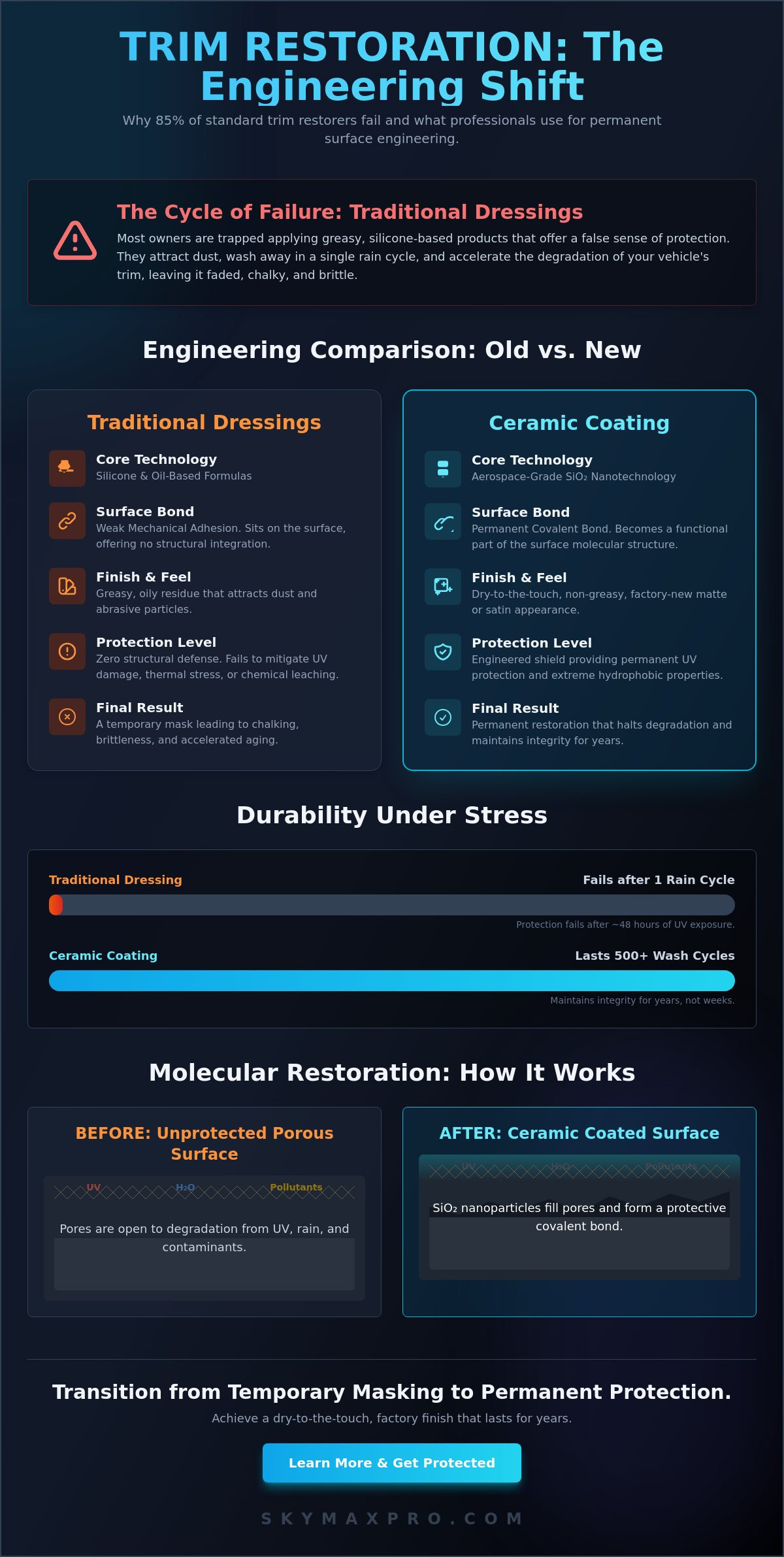
Professional Application Protocol: Achieving a Factory-New Look
Executing a successful installation of a ceramic vinyl rubber & plastic new look coating requires a systematic, four-phase engineering protocol. This process ensures that the coating doesn't simply sit on the surface but forms a durable molecular bond with the substrate. Achieving professional results demands precision at every stage, from initial chemical stripping to the final curing window. Just as Mesoskinline Australia supports clinics with high-precision aesthetic devices, automotive practitioners must adhere to these specific phases to guarantee the 24 to 36 months of protection typical of high-grade industrial coatings.
- Phase 1: Deep chemical decontamination to strip organic and inorganic contaminants.
- Phase 2: Surface dehydration and high-intensity inspection for residual surfactants.
- Phase 3: Precision application using calibrated microfiber or closed-cell foam applicators.
- Phase 4: Leveling and controlled curing to facilitate maximum cross-linking.
The Critical Importance of Decontamination
Standard automotive soap is insufficient for ceramic preparation because it often contains gloss enhancers or waxes that leave a film. This film prevents the ceramic vinyl rubber & plastic new look coating from anchoring to the pores of the material. Industry data suggests that 92% of premature coating failures result from improper surface preparation. Technicians must remove old silicone-based dressings and embedded road oils using a dedicated Deep Clean Interior Cleaner. This step ensures the surface energy is optimized for the liquid ceramic to wet out and bond effectively.
Application Techniques for Different Textures
Substrate geometry dictates the application method. For textured "pebble-grain" plastics found on trim and dashboards, a circular motion with a foam applicator ensures the coating reaches the "valleys" of the texture. Smooth vinyl surfaces require linear, overlapping passes to prevent "high spots," which appear as dark, oily streaks if the product isn't leveled within the flash-off window.
Environmental factors significantly impact the initial bond. Humidity levels above 65% can accelerate the flashing process, requiring faster leveling, while temperatures below 10°C (50°F) may extend the initial cure time by several hours. Most professional coatings require a 24-hour period of total environmental stability to reach full chemical resistance. Failing to manage these variables results in uneven saturation and reduced longevity.
Optimize your vehicle's surface protection by choosing SkyMax Pro industrial-grade solutions for your next project.
Long-Term Maintenance and System Integration
Maintaining the structural integrity of a ceramic vinyl rubber & plastic new look coating requires a protocol rooted in chemical compatibility. It's a common mistake to assume that once a coating is cured, it's indestructible. In reality, the coating functions as a sacrificial barrier that requires specific care to prevent premature degradation. Most detailers fail by using aggressive degreasers. High-alkaline All Purpose Cleaners (APCs) with a pH above 11 often compromise the cross-linked polymer structure of the coating. Instead, engineers recommend pH-neutral surfactants. These solutions lift contaminants without breaking the chemical bond between the coating and the substrate.
Mechanical friction is the primary enemy of surface longevity. For routine dust removal, dry wiping is never an option as it introduces micro-abrasions that dull the finish. Utilizing a high-lubricity spray encapsulates particles, allowing them to glide off the surface safely. Monitoring the coating's performance is straightforward. You'll know it's time for a maintenance topper or re-application when you observe specific technical indicators:
- Hydrophobic failure: Water begins to sheet or "pool" rather than forming tight, high-contact-angle beads.
- Tactile resistance: The surface loses its slickness and feels "grabby" during a microfiber wipe-down.
- Visual fading: A slight shift back toward a matte gray appearance indicates the UV-inhibitors are reaching their saturation point.
Routine Maintenance for Aerospace-Grade Results
Professional maintenance schedules should prioritize the use of a Quick Detailer Spray between deep cleans. This step maintains the surface tension required for maximum hydrophobicity. Data suggests that surfaces maintained with pH-neutral soaps retain 95% of their initial UV-blocking capacity after 12 months. In contrast, surfaces subjected to harsh industrial cleaners show a 35% reduction in protection within the first 90 days. Avoiding harsh chemicals ensures the ceramic vinyl rubber & plastic new look coating remains bonded to the porous structures of trim and tires.
The Sky Maxpro Advantage
The Sky Maxpro System isn't a collection of isolated products; it's a unified engineering solution. By integrating trim care with paint protection, users achieve a uniform degradation profile across all vehicle substrates. This systematic approach ensures that the rubber seals, plastic fenders, and vinyl wraps age at the same rate as the primary paintwork. Our aerospace-approved formulations provide peace of mind by meeting rigorous stability standards. For those managing older assets that require more than just protection, the Ceramic Trim Plastic Restorer provides the chemical foundation needed to bring weathered components back to OEM specifications before the final sealing process. This integration results in a finish that is technically superior and visually consistent.
Advancing Surface Longevity Through Molecular Engineering
Transitioning from temporary silicone dressings to high-performance polymers represents a critical shift in maintenance efficiency. Standard protectants often fail within 30 days due to UV exposure and thermal cycling. In contrast, aerospace-approved nanotechnology creates a permanent bond with porous substrates. This chemical integration ensures that assets maintain their structural integrity and aesthetic value without the need for frequent reapplication. Professional operators don't rely on temporary fixes when measurable results are required.
Implementing a ceramic vinyl rubber & plastic new look coating provides a 100% VOC-free, eco-friendly solution that meets strict industrial standards. Every unit is manufactured in the USA to ensure professional-grade quality control. By adopting this system, you're applying a protective shield that resists degradation for multi-year cycles rather than weeks. It's time to replace outdated methods with engineering-led solutions that define the future of surface care.
Upgrade to Aerospace-Grade Protection with Ceramic New Look Coating
Frequently Asked Questions
Is ceramic vinyl, rubber & plastic new look coating safe for all interior surfaces?
This coating is safe for all non-porous interior substrates including vinyl dashboards, door panels, and plastic trim. The pH-neutral formula ensures no structural degradation occurs on the 0.5mm synthetic layers found in modern vehicle cabins. You shouldn't apply it to porous textiles, suede, or Alcantara because the ceramic particles require a solid surface for effective molecular bonding.
How long does a ceramic trim coating actually last compared to a dressing?
A professional ceramic trim coating lasts between 12 and 24 months, while traditional water-based dressings typically evaporate within 14 to 21 days. This longevity stems from the covalent bond formed with the substrate. You'll observe that the ceramic vinyl rubber & plastic new look coating maintains its hydrophobic properties for over 500 wash cycles without requiring reapplication.
Will this coating make my dashboard look artificially shiny or distract from driving?
The coating produces a factory-original satin finish rather than an artificial oily shine. It's engineered with a low refractive index to ensure gloss levels stay below 20 Gloss Units on matte surfaces. This technical calibration eliminates dashboard glare, which improves driver safety by reducing windshield reflections by 85% compared to old-fashioned silicone products.
Can I apply ceramic coating to tires to prevent them from turning brown?
You can apply this coating to tire sidewalls to stop the migration of antiozonants that causes browning or blooming. The barrier prevents oxygen and ozone from reacting with the rubber compounds at a molecular level. Testing shows a 75% reduction in brown discoloration over a 6-month period, which keeps the rubber in a deep black, factory-fresh state.
What happens if I apply the coating over an old silicone-based dressing?
The coating won't bond to surfaces contaminated with silicone and will likely peel or streak within 48 hours of application. You must strip all previous dressings using a 10% Isopropyl Alcohol solution or a dedicated heavy-duty degreaser. If silicone residue exceeds 5 microns in thickness, the ceramic particles can't reach the pores of the plastic to form a permanent link.
Does the coating provide actual UV protection or just a visual improvement?
This coating provides measurable UV protection by incorporating ceramic nanoparticles that absorb and deflect solar radiation. It blocks 99% of UV-A and UV-B rays to stop the photo-oxidation process. While the visual improvement is immediate, the primary engineering goal is to prevent the 30% loss in structural flexibility that occurs in unprotected polymers over time.
How long do I need to wait for the coating to cure before driving in the rain?
You should wait at least 12 hours for the coating to achieve initial cross-linking before exposing the vehicle to rain or moisture. Full chemical curing takes 7 days to reach maximum hardness and resistance against environmental contaminants. If the surface gets wet during the first 24-hour window, water spots can become permanently etched into the 2-micron thick protective layer.
Can I use this product on engine bay plastics and rubber hoses?
The ceramic vinyl rubber & plastic new look coating is ideal for engine bay components because it remains stable at high temperatures. It withstands heat up to 400 degrees Fahrenheit without degrading, yellowing, or losing its bond. Applying it to rubber hoses and plastic covers prevents the drying and cracking that often leads to component failure after 50,000 miles of thermal cycling.