

Most beginners treat car polishing as a cosmetic chore, but in reality, it's a high-stakes engineering process of controlled clear coat removal where the margin for error is measured in microns. You've likely felt that hesitation before pulling the trigger on a machine polisher, fearing you'll burn through the finish or leave behind a mess of hazy holograms. It's a valid concern because the technical complexity of paint correction often leads to common car polishing mistakes for beginners that can permanently compromise a vehicle's surface integrity.
By understanding the mechanical interactions between abrasive compounds and substrate heat, you can eliminate the guesswork that leads to frustration. This article provides a technical framework to help you master the nuances of surface leveling while preserving the long-term value of your vehicle. We'll analyze critical errors in pad selection, pressure application, and chemical bonding to transform your detailing workflow into a predictable, high-efficiency operation.
Key Takeaways
- Understand the engineering limits of factory clear coats to prevent the irreversible removal of the finite 35-50 micron protective layer.
- Eliminate the "Decontamination Gap" by removing embedded metallic particles to prevent the accidental sandpapering of the vehicle substrate.
- Identify and avoid common car polishing mistakes for beginners by precisely matching abrasive compound grit to specific pad densities for predictable leveling.
- Master thermal management and pressure variables to control friction-induced heat and maintain the structural integrity of the clear coat.
- Implement high-durability shielding strategies to protect newly corrected surfaces from immediate UV degradation and environmental oxidation.
Understanding the Risks: Why Car Polishing is a Precision Operation
Car polishing is a subtractive mechanical process. It involves the precise removal of microscopic layers of the clear coat to create a perfectly level surface. Unlike waxing, which is a non-abrasive protection step, polishing corrects the paint by leveling the topography of the clear coat. Many enthusiasts confuse these terms, which is one of the most common car polishing mistakes for beginners. While wax adds a sacrificial layer of protection, polishing uses abrasives to shave down the existing clear coat to eliminate imperfections.
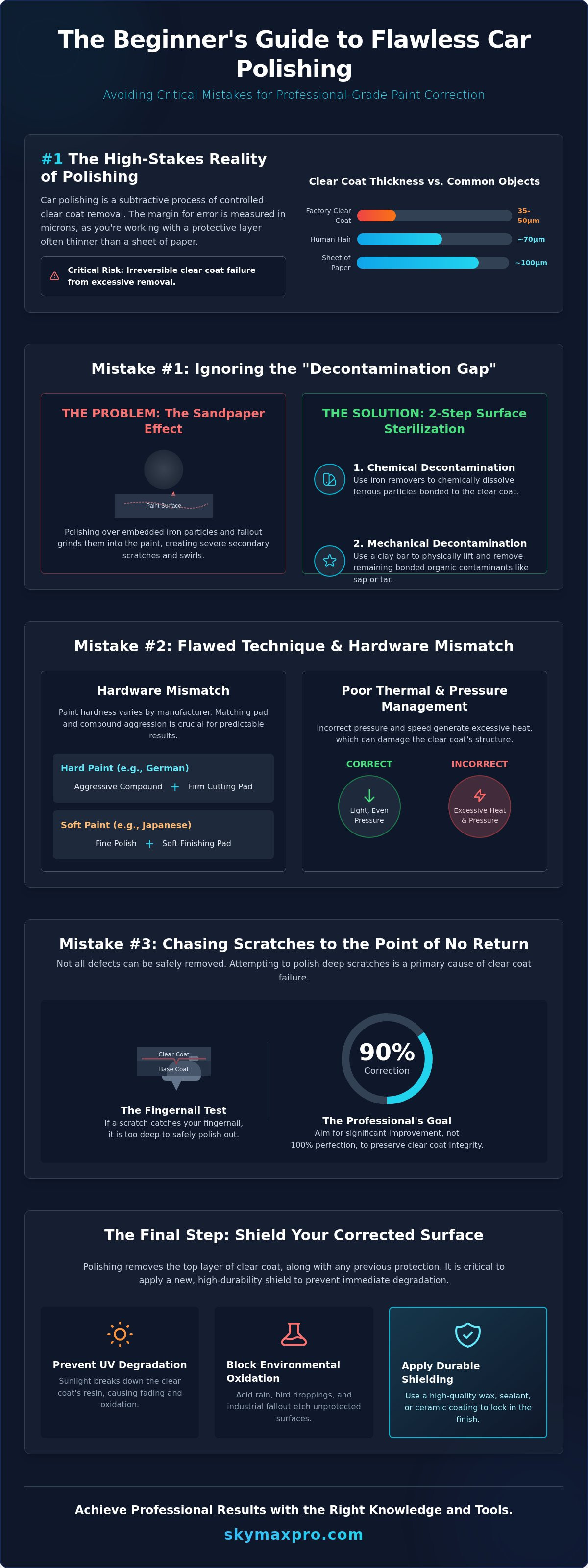
Factory clear coats are surprisingly thin, typically ranging between 35 and 50 microns. To visualize this, consider that a standard sheet of paper is approximately 100 microns thick. You're working with a layer half as thick as a piece of paper. Beginners often underestimate the destructive potential of high-speed dual-action or rotary buffers. These machines generate significant friction, which can deplete that finite clear coat layer in seconds if handled without technical discipline. Understanding this as a core component of the broader automotive detailing process is essential for anyone aiming for professional-grade results.
The Science of Paint Correction
Paint correction works by using suspended abrasives to eliminate surface defects. Swirl marks and light scratches are essentially microscopic valleys in the clear coat that cause light to refract in multiple directions. By leveling the surrounding surface to the depth of the scratch, you restore a flat plane that reflects light uniformly. This uniformity creates the depth and mirror-like finish desired by professionals. It's also vital to recognize that paint hardness varies by manufacturer. German clear coats are often notoriously hard, requiring more aggressive abrasive cycles, while many Japanese finishes are soft and extremely sensitive to thermal friction.
The "Point of No Return" in Detailing
Clear coat failure is an irreversible state where the protective resin has thinned to the point of structural breakdown. Polishing cannot fix oxidation or peeling; it only accelerates the damage. One of the most critical common car polishing mistakes for beginners is chasing deep scratches that have penetrated the primer or base coat. If a scratch catches your fingernail, it's too deep to polish safely. Professional detailers often aim for 90% correction rather than 100% perfection. This conservative approach preserves the clear coat's integrity, ensuring the vehicle maintains its UV resistance and structural stability for the long term.
The Critical Prep Phase: Avoiding the Decontamination Gap
A standard contact wash removes loose debris, but it's insufficient for preparing a surface for mechanical correction. Professional results require closing the "Decontamination Gap," which is the presence of bonded metallic particles and industrial fallout that survive a soap-and-water cycle. Polishing over these embedded contaminants is one of the most destructive common car polishing mistakes for beginners. When your pad picks up a jagged iron particle, it acts like a piece of high-speed abrasive carrier, dragging that particle across the panel at thousands of oscillations per minute. This doesn't just fail to correct the paint; it introduces severe secondary defects that may require aggressive leveling to fix.
Using the right professional car detailing supplies transforms the prep phase from a simple cleaning task into a technical surface sterilization process. You aren't just washing a car; you're creating a pristine substrate that allows the abrasive chemistry to work as engineered. Without this foundation, your efforts will be counterproductive and potentially hazardous to the vehicle's finish. Proper preparation ensures that the energy from your machine is spent leveling the clear coat, not grinding road grit into it.
Mechanical vs. Chemical Decontamination
Chemical decontamination should always precede mechanical steps. Iron removers target ferrous particles embedded in the clear coat through thermal expansion. These particles alter the clear coat scratch properties, making the surface prone to marring. After neutralizing these, use detailing clay to lift remaining organic contaminants like sap or tar. Using Final Touch I PRO Detailing Clay ensures a glass-like finish, providing a smooth path for your polisher to glide across without interference.
The Solvent Wipe: Removing Hidden Oils
Hidden oils are the enemy of precision. Many soaps contain fillers that mask swirls rather than fixing them. These residues clog your pads, preventing abrasives from making direct contact with the clear coat. An Isopropyl Alcohol (IPA) wipe is essential to strip these fillers. This reveals the true paint condition, ensuring you don't stop polishing prematurely because a defect was simply filled with oil. To achieve this surface purity, a high-performance Heavy Duty Red Power Degreaser is a vital tool in your pre-polishing workflow.
Hardware Errors: Choosing Incompatible Pads and Compounds
Successful paint correction depends on the synergy between the abrasive medium and the application pad. One of the most common car polishing mistakes for beginners involves ignoring the "Aggression Scale." This scale measures the combined cutting power of your hardware. Applying a heavy-cut compound to soft paint is a technical error that leads to hazing, as the abrasives gouge deeper than the paint's elastic limit can recover. You must match the compound grit to the pad density to ensure controlled material removal without creating secondary defects.
The choice of machine also dictates your safety margin. Rotary polishers provide direct drive power, which generates heat rapidly and requires expert handling to avoid "burning" the clear coat. Dual Action (DA) polishers are the preferred standard for those learning professional car polishing techniques. These machines use an orbital motion to distribute friction across a wider area, significantly reducing the risk of localized heat damage. Utilizing car detailing products engineered for DA mechanics ensures the chemistry performs optimally under varying oscillation speeds.
Foam vs. Microfiber vs. Wool Pads
Pad material determines how energy is transferred to the surface. Foam pads are the primary choice for finishing due to their open-cell structures, which facilitate heat dissipation and provide a uniform finish. Microfiber pads offer a higher surface area, making them efficient for removing deeper defects, though they require more frequent cleaning to prevent heat saturation. Wool pads possess the highest cutting capacity but often leave behind heavy marring. Beginners should generally avoid wool until they master the art of multi-stage refinement.
Compound "Diminishing" Abrasives
Modern abrasive engineering often employs diminishing abrasive technology. These particles are designed to fracture and break down into smaller, finer polishing agents during the work cycle. Failing to account for abrasive breakdown is another of the common car polishing mistakes for beginners that prevents a mirror-like finish. A frequent error is "short-cycling," where the operator stops the machine before the abrasives have fully refined. You'll know a compound is spent when it "flashes" or turns into a transparent, oily film. Stopping before this point leaves the paint with a cloudy appearance because the large abrasive particles haven't yet transitioned into their finishing state.
Execution Blunders: Thermal Management and Technique Flaws
The mechanical efficiency of paint correction is governed by the laws of thermodynamics. As the polisher oscillates, kinetic energy is converted into thermal energy at the interface between the pad and the clear coat. While some heat is necessary to facilitate the abrasive action, excessive friction creates a "Heat Trap." This localized temperature spike can soften the clear coat beyond its structural limit, leading to paint burn or permanent distortion. Navigating these thermal variables is where most enthusiasts stumble, making heat management one of the most critical common car polishing mistakes for beginners to understand and avoid.
A frequent error in technique is the application of excessive downward pressure. Beginners often believe that leaning into the machine will accelerate defect removal. In reality, too much pressure stalls the rotation of a Dual Action polisher, effectively stopping the correction process. On a rotary machine, this pressure spikes the temperature instantly. You should let the machine's weight and the abrasive chemistry do the work. Maintain a consistent arm speed of approximately one inch per second. Moving too quickly across the panel prevents the abrasives from effectively leveling the surface, resulting in lingering swirl marks despite significant effort.
Precision correction requires a disciplined approach to section size. You should limit your working area to a maximum of 2x2 feet. Attempting to polish an entire hood or door in one pass causes the compound's lubricants to evaporate prematurely. This dry buffing increases friction and leads to dusting, which can scratch the very surface you're trying to refine. To maintain optimal surface conditions throughout the process, consider using a professional-grade Exterior Detailing Kit that provides the necessary lubrication and pad variety for safe execution.
Monitoring Surface Temperature
Metal panels act as heat sinks, dissipating thermal energy across the substrate. However, plastic bumpers and trim pieces are insulators; they retain heat at the point of contact. This makes plastic components much more susceptible to melting or burning. Use a touch test frequently. If the panel feels hot to the touch, you've exceeded the safe operating temperature. Always allow the surface to cool before continuing. Ignoring substrate differences is among the common car polishing mistakes for beginners that results in expensive body shop repairs.
Pad Hygiene and "Caking"
Efficiency drops sharply when your pad becomes saturated with spent polish and removed clear coat residue. This caking creates a hard crust on the pad surface, which acts as a secondary, uncontrolled abrasive. To prevent this, follow the 2-pad rule: switch to a fresh pad or perform a deep clean every two panels. You can clean pads on the fly using a stiff nylon brush or compressed air to dislodge dried residue. Maintaining pad hygiene is the only way to ensure the abrasive particles remain free to rotate and cut as engineered.
The Final Integrity Check: Post-Correction Protection Strategies
Once the mechanical leveling process is complete, the vehicle's clear coat is in its most vulnerable state. The surface is now "naked," meaning it lacks any sacrificial barrier to deflect UV radiation, industrial fallout, or avian acid. Stopping the process immediately after the final buffing cycle is one of the common car polishing mistakes for beginners that leads to rapid finish degradation. Without a high-performance sealant, the refined clear coat will oxidize at an accelerated rate, effectively undoing hours of precision labor. Before applying any protection, a final inspection using high-lumen, multi-spectrum LED lighting is required to verify the total removal of holograms and compounding haze.
Verifying the surface integrity ensures that no defects are "sealed in" under a long-term coating. Modern detailing engineering has shifted away from traditional carnauba waxes, which offer limited thermal stability and minimal chemical resistance. Today's standard involves the application of nanotechnology to create a functional interface with the clear coat substrate. This transition from cosmetic enhancement to structural protection is the logical conclusion of any professional-grade correction workflow.
Ceramic vs. Graphene: The 2026 Standard
The molecular bond formed by a ceramic coating provides a level of surface hardness that traditional polymers cannot replicate. However, Graphene Shield technology represents the current peak of surface engineering. By integrating a hexagonal carbon lattice, graphene coatings offer superior thermal dissipation and reduced water spotting compared to standard ceramic formulas. Utilizing a professional ceramic coating kit allows you to establish a covalent bond that protects the finite clear coat layer from environmental abrasion for years rather than months.
Maintenance After the Polish
Preserving a swirl-free finish requires a disciplined maintenance protocol to avoid re-introducing defects. One of the common car polishing mistakes for beginners is using aggressive contact wash methods on a freshly coated surface. You should utilize pH-neutral solutions and the two-bucket method to minimize mechanical friction. Periodic application of a Quick Detailer Spray with Ceramic High Gloss Finish acts as a "topper," replenishing the hydrophobic efficiency of the primary coating and maintaining the mirror-like depth of the paint.
Protect your hard work with SKY MAXPRO Ceramic Graphene Shield to ensure your vehicle's surface integrity remains uncompromised by the elements.
Mastering the Physics of Surface Refinement
Achieving a professional-grade finish requires more than just effort; it demands a technical understanding of clear coat topography and thermal dynamics. By treating paint correction as a precision engineering task rather than a cosmetic chore, you eliminate the variables that lead to common car polishing mistakes for beginners. Success is defined by your ability to manage surface decontamination, pad friction, and abrasive breakdown while preserving the finite structural integrity of the vehicle's finish.
Once the surface has been leveled to its optimal state, the focus must shift to long-term stability. Maintaining that mirror-like clarity is only possible through advanced chemical barriers that bond at the molecular level. SKY MAXPRO provides the high-performance solutions needed to bridge the gap between correction and preservation. Our aerospace-approved formulations utilize advanced Graphene Nanotechnology to provide superior resistance against UV degradation and chemical oxidation. Every product is manufactured in the USA to meet the most rigorous industrial standards.
Upgrade your detailing arsenal with aerospace-grade SKY MAXPRO supplies and take command of your vehicle's surface integrity today. You have the technical framework; now equip yourself with the tools to execute it with absolute confidence.
Frequently Asked Questions
Can I ruin my car’s paint by polishing it for the first time?
Yes, irreversible damage can occur if you use improper technique or overly aggressive hardware. Using a rotary polisher without experience or ignoring the finite thickness of the clear coat are common car polishing mistakes for beginners. To mitigate this risk, you should utilize a Dual Action (DA) polisher and always begin with the least aggressive pad and compound combination to test the paint's response.
Is it better to polish in the sun or in the shade?
Polishing must be performed in a shaded, temperature-controlled environment to ensure the chemistry performs as engineered. Direct sunlight increases the substrate temperature, which causes the lubricants in the polishing compound to evaporate prematurely. This results in "dry buffing," a condition that spikes friction and can lead to immediate paint burn or heavy dusting that scratches the surface.
How often should I polish my car to keep it looking new?
You should polish your vehicle only when visible defects require correction, typically once or twice a year at most. Because polishing is a subtractive process that removes microns of clear coat, frequent cycles will eventually deplete the protective layer. To maintain a "new" look without constant abrasion, focus on high-durability graphene or ceramic protection to shield the corrected surface from environmental degradation.
What is the difference between a compound and a polish?
The distinction lies in the abrasive grit size and the intended material removal rate. Compounds utilize larger, more aggressive abrasives to level deep scratches and heavy oxidation. Polishes contain finer agents designed to refine the surface and restore optical clarity after the compounding stage. Mistaking a heavy compound for a finishing polish is a technical error that often leaves the paint looking hazy.
Do I really need a clay bar if my car looks clean?
Yes, mechanical decontamination with a clay bar is a non-negotiable step for professional results. Even if the surface appears clean, embedded industrial fallout and metallic particles remain bonded to the clear coat. Polishing over these contaminants will trap them in the pad and drag them across the panel. Using Final Touch I PRO Detailing Clay ensures the substrate is sterile before the machine touches the paint.
How do I know if I have burned through the clear coat?
Clear coat failure is identified by a sudden change in surface texture or a patch of dull, matte paint that no longer reflects light. If you observe the color of the base coat transferring onto your polishing pad, the clear coat has been fully penetrated. This state represents a total loss of surface integrity and can only be corrected by a professional repainting of the affected panel.
Can I polish my car by hand, or do I need a machine?
Hand polishing is possible for minor spot correction, but it is highly inefficient for full-panel refinement. Manual application lacks the consistent oscillation speed and uniform pressure required to level modern, high-solid clear coats effectively. For professional-grade results and uniform abrasive breakdown, a machine polisher is the necessary tool to achieve a perfectly level, swirl-free finish.
What should I do if I see swirl marks still remaining after polishing?
Remaining defects indicate that your current pad and compound combination did not reach the depth of the scratches. You may need to decrease your arm speed or switch to a pad with higher density. Always perform a test spot on a small section to verify that your chosen combination provides the required level of correction before proceeding to the rest of the vehicle.