

The "dry to the touch" surface you feel just a few hours after application is a chemical illusion that often leads to premature coating failure. While the exterior feels solid, the actual ceramic coating curing time is a high-stakes engineering phase where liquid polymers must transition into a permanent, cross-linked crystalline lattice. It's understandable to feel anxious about a sudden rainstorm or the inconvenience of a multi-day lockout from your vehicle. You want the certainty that your investment has reached its peak structural integrity before it faces the elements.
We agree that waiting shouldn't feel like guesswork, so we've developed this guide to help you master the science of chemical hardening. You'll learn exactly how to manage the critical 24-hour dehydration window and the subsequent weeks required for full molecular stabilization. We'll preview the environmental variables that dictate performance and explore how 2026 formulations now achieve 15-year durability through optimized bonding protocols. By the end of this technical breakdown, you'll have a precise timeline for safe vehicle operation and a clear understanding of the microscopic sensors now used to monitor coating health in real time.
Key Takeaways
- Identify curing as a chemical polymerization process where Si02 molecules form a permanent sacrificial layer through complex molecular cross-linking.
- Master the exact ceramic coating curing time by distinguishing between the initial 24-hour hydrophobic set and the 21-day crystalline maturation phase.
- Analyze how environmental variables, specifically thermal energy and humidity, dictate the solvent flash rates and the overall bonding velocity.
- Implement the essential post-application protocol, including the seven-day restriction on high-pressure water to prevent premature surface degradation.
- Discover how graphene-enhanced formulations reinforce the ceramic lattice to provide superior structural integrity during the critical hardening cycle.
The Science of Ceramic Coating Curing Time
Understanding ceramic coating curing time requires a shift from viewing the process as simple drying to recognizing it as a complex chemical polymerization. When a technician applies a high-solids coating, a liquid monomer solution begins to reorganize into a solid, three-dimensional polymer network. This isn't a passive state. It's an active transition where silicon dioxide (SiO2) particles move from a suspended liquid state into a permanent, hardened sacrificial layer. This transformation is rooted in The Science of the Sol-Gel Process, which explains how chemical precursors convert into a solid glass-like material through a sequence of hydrolysis and condensation reactions.
The "dry to the touch" sensation is often a deceptive metric for surface protection. While the coating may feel tack-free within a few hours, the internal chemical architecture remains in a state of flux. Physical adhesion happens almost immediately as the coating anchors into the microscopic pores of the clear coat. However, chemical cross-linking, the phase that provides actual hardness and chemical resistance, requires a much longer duration. Without this completed cross-linking, the coating lacks the structural integrity to withstand environmental contaminants or mechanical abrasion.
Dry Time vs. Cure Time: The Molecular Difference
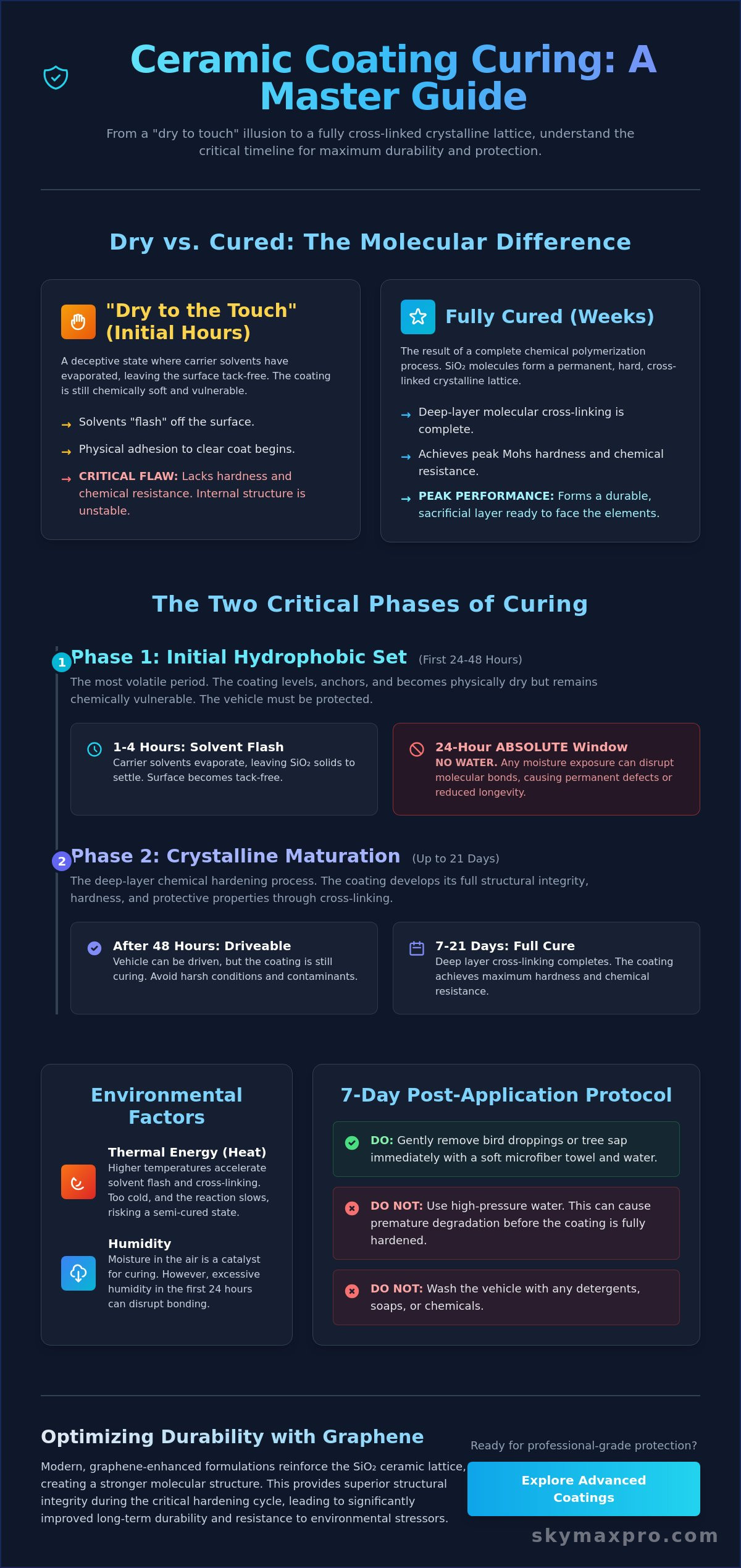
The initial phase of the cycle involves the rapid evaporation of carrier solvents, which typically occurs within the first 1 to 4 hours. These solvents are essential for maintaining the SiO2 in a workable liquid state, but they must "flash" off to allow the solids to settle. Even after the solvents dissipate, the coating remains chemically "soft." It hasn't yet achieved its peak Mohs hardness. This vulnerability makes the 24-hour "no-moisture" window absolute. Any exposure to water or high humidity during this period can disrupt the nascent molecular bonds, leading to permanent surface defects or reduced longevity.
Aerospace-Grade Formulations and Curing Stability
Advanced nanotechnology has brought aerospace-level stability to the automotive sector. High-purity formulations, like those used in a Ceramic Coating Kit, often utilize VOC-free carriers to provide a more consistent evaporation profile. These carriers ensure that the SiO2 and Graphene molecules align with mathematical precision, which minimizes internal stresses during the hardening phase. Professional-grade products require more controlled environments because their high concentration of active solids demands specific thermal ranges for optimal cross-linking. If the environment's too cold or too humid, the chemical reaction slows down, potentially leaving the coating in a semi-cured state that's prone to premature degradation.
The Two Critical Phases of the Chemical Hardening Cycle
The progression of ceramic coating curing time isn't a single event but a bifurcated chemical evolution. Engineers categorize this hardening cycle into two distinct technical windows: the initial hydrophobic set and the subsequent crystalline maturation. During these phases, the coating's physical properties shift from a high-viscosity liquid to a rigid, high-density lattice. Understanding this timeline is essential to prevent "infant mortality" of the coating, where the surface fails prematurely due to external interference before the molecular bonds have stabilized.
Phase 1: Solvent Evaporation and Leveling
The first 24 to 48 hours are the most volatile for the coating's structural integrity. This is the period of solvent flash, where carrier liquids evaporate to leave behind the concentrated SiO2 and graphene solids. As these solvents leave, the coating begins to level and anchor to the substrate. It's imperative the vehicle remains in a controlled, dust-free environment during this transition. Any particulate matter that settles now becomes a permanent inclusion in the finish. At this stage, the coating is a semi-solid polymer; it's physically dry but hasn't reached the hardness required to resist chemical etching or mechanical friction. For those prioritizing a more stable initial set, utilizing a high-solids Ceramic Graphene Shield Coating provides a more robust molecular foundation that resists environmental stressors better during this early phase.
Phase 2: Deep Layer Cross-Linking
While the vehicle is technically driveable after the initial 48-hour window, the chemical hardening continues for 7 to 21 days. This second phase is characterized by deep layer cross-linking. Ambient oxygen reacts with the polymer chains to finalize the bond, slowly driving the coating up the Mohs scale toward its peak hardness. During this crystalline maturation, the coating reaches its full chemical resistance and hydrophobic potential. We strictly restrict the use of pH-neutral soaps or high-pressure water during this window. The lattice is still maturing, and surfactants can interfere with the final bond formation. By the end of this 21-day cycle, the molecular architecture is fully locked. This ensures the coating can deliver the 15-year durability projected for 2026 formulations, provided the maturation wasn't compromised by premature washing or chemical exposure.
Environmental Variables Impacting Curing Velocity
The rate of chemical polymerization is directly proportional to the kinetic energy available in the application environment. Heat acts as a primary catalyst, accelerating molecular agitation and forcing the silicon dioxide and graphene particles to reorganize into their final lattice structure more rapidly. Conversely, humidity acts as a complex regulator of solvent flash rates. Engineering a controlled environment isn't merely a preference; it's a technical requirement to ensure the ceramic coating curing time aligns with the manufacturer's performance specifications. When these variables are mismanaged, the coating may suffer from structural instability or aesthetic defects that cannot be corrected without full abrasion and reapplication.
UV exposure also plays a specific role in the early hardening stages. While modern formulations are designed to be UV-stable, intense direct sunlight during the first few hours can cause the carrier solvents to evaporate too quickly. This leads to "high spots" or uneven thickness across the substrate. A professional approach involves stabilizing the environment to allow for a uniform transition from liquid suspension to solid-state protection.
Temperature and Humidity Thresholds
Data from 2026 field testing confirms that the optimal "Goldilocks" zone for most high-solids formulations exists between 60°F and 80°F, with relative humidity maintained below 70%. If humidity levels exceed this threshold, moisture molecules can become trapped within the polymerizing layer. This phenomenon, known as "blooming," manifests as a persistent cloudiness or haze in the finish. In colder climates, the chemical reaction slows significantly. A coating that typically sets in 24 hours at 75°F may require 48 to 72 hours to reach the same level of stability at 50°F. For enthusiasts using a DIY Ceramic Coating Kit, maintaining a heated garage space is often necessary to avoid these extended periods of vulnerability.
Advanced Curing: Infrared (IR) Lamps
Professional detailing environments utilize Infrared (IR) technology to bypass traditional environmental limitations. The physics of IR curing is distinct from convection heating; IR waves penetrate the transparent coating layer to heat the vehicle's substrate from the bottom up. This ensures the bond at the paint-coating interface hardens first, pushing any remaining solvents outward. Using short-wave IR lamps can reduce the initial 24-hour dehydration window to approximately 15 to 30 minutes per panel. While this technology provides a massive efficiency gain, it requires precise temperature monitoring to prevent overheating the clear coat. DIY users without access to IR arrays must rely on ambient maturation, which prioritizes patience over technological acceleration.
Post-Application Protocol: Protecting the Finish
Maintaining the integrity of the crystalline lattice requires strict adherence to post-application protocols. While the initial 48-hour dehydration phase allows for basic vehicle operation, the ceramic coating curing time extends into a critical maturation period where the surface remains susceptible to chemical and mechanical stress. Failure to protect the finish during this window often results in water spotting or permanent etching that compromises the 15-year durability expected from 2026-grade formulations. Engineers prioritize this phase because the coating's structural density is still increasing through atmospheric cross-linking.
High-speed highway driving should be avoided for the first 72 hours. At these velocities, microscopic debris and insect impacts exert enough force to penetrate the semi-hardened polymer, creating permanent inclusions. If bird droppings or tree sap accumulate, they must be neutralized immediately. These organic acids are aggressive enough to etch through a maturing coating that hasn't yet reached its peak Mohs hardness. Precision in maintenance during these early stages determines whether the coating reaches its full technological potential.
The 7-Day "No-Wash" Directive
The "Golden Rule" of professional detailing is a total restriction on high-pressure water and chemical detergents for at least seven days. Surfactants found in traditional car soaps are designed to break surface tension; however, if introduced too early, they can penetrate the porous, cross-linking layer and disrupt the bonding process. This leads to a loss of hydrophobicity and a reduction in the coating's projected lifespan. The chemical architecture needs this time to reach a state of equilibrium without interference from aggressive cleaning agents.
Mechanical marring is another significant risk. Even with high-purity nanotechnology, the surface is technically "soft" during the first week. Friction from wash mitts or towels can cause micro-scratches that become locked into the finish once the cure is complete. If contamination occurs, a gentle, touchless rinse with low-pressure water is the only recommended intervention. You don't want to compromise the leveling of the SiO2 particles by introducing physical abrasion prematurely.
Emergency Protocol: What to Do If It Rains
Accidental exposure to rain during the first 48 hours is a primary concern for vehicle owners. Rainwater isn't pure; it contains mineral deposits and atmospheric pollutants that can cause permanent spotting if left to evaporate on a curing surface. If your vehicle gets wet, don't use a dry towel to wipe the surface. This creates friction against a vulnerable layer that's still finalizing its ceramic coating curing time.
The correct engineering response is to use a quick detailer spray to safely encapsulate the water minerals and lift them away with a high-GSM microfiber cloth. This protocol neutralizes the acidity of the rain and prevents mineral bonding. In high-risk environments, applying a sacrificial "topper" can provide an extra layer of protection without interfering with the underlying molecular transition. To ensure your vehicle maintains its peak structural integrity, utilizing a Quick Detailer Spray with Ceramic High Gloss Finish can bridge the gap between application and full maturation.
Optimizing Durability with Graphene-Enhanced Formulations
Integrating graphene into a ceramic matrix represents the current apex of surface engineering. While traditional SiO2 coatings rely on a singular crystalline structure, graphene introduces a hexagonal carbon lattice that reinforces the bond at a molecular level. This hybrid approach significantly stabilizes the ceramic coating curing time by reducing internal stresses as the carrier solvents evaporate. Graphene's high thermal conductivity allows for more uniform heat distribution across the panel. This ensures that the chemical hardening occurs at a consistent rate, even in environments with minor temperature fluctuations that might otherwise cause structural inconsistencies.
Confirming a successful chemical bond requires a technical inspection after the maturation window. A correctly cured surface will exhibit a high water contact angle, resulting in immediate hydrophobic beading. The finish should also possess a distinct tactile slickness, indicating that the polymers have successfully cross-linked into a high-density sacrificial layer. This structural integrity is what allows 2026 formulations to reach their projected 15-year lifespan.
The Graphene Advantage in Surface Tension
The molecular architecture of graphene provides a distinct advantage over standard SiO2 during the critical first 48 hours. Its honeycomb structure creates a dense barrier that effectively lowers the surface tension, making the coating less prone to water spotting while it remains in its semi-cured state. This is particularly vital for maintaining aesthetic clarity before the lattice has fully matured. By utilizing SKY MAXPRO Ceramic Graphene Shield, technicians leverage a formulation engineered for maximum stability. The graphene flakes act as a structural scaffolding, preventing the "blooming" effects often seen in lower-purity ceramic products when exposed to high humidity during the ceramic coating curing time.
Long-Term Maintenance After Full Cure
Once the 21-day maturation phase is complete, the coating reaches its peak chemical resistance and peak Mohs hardness. At this point, the vehicle can transition to a standardized auto detailing routine. Maintenance isn't just about aesthetics; it's about preserving the hydrophobic performance of the lattice. We recommend using ceramic-infused shampoos that deposit a microscopic layer of Si02 or graphene to "recharge" the surface. These specialized cleaners help maintain the surface tension without introducing aggressive surfactants that could degrade the finish over time.
Periodic chemical decontaminations are also necessary to remove industrial fallout that might clog the pores of the coating. Even the hardest crystalline structures can accumulate iron particles or environmental film that masks the coating's performance. A systematic decontamination every six months ensures the graphene-ceramic bond remains clear of obstructions, allowing it to provide the high-performance protection it was engineered to deliver.
Mastering the Crystalline Transition for Decadal Durability
Achieving a permanent bond requires a shift from viewing car care as a hobby to treating it as surface engineering. We've established that managing the ceramic coating curing time is the critical bridge between a liquid application and a hardened crystalline lattice. By respecting the 24-hour dehydration window and the 21-day maturation cycle, you ensure that the SiO2 and graphene molecules achieve peak structural density. This technical discipline prevents premature degradation and locks in the hydrophobic performance required for modern longevity standards.
It's time to transition from temporary wax solutions to a formulation designed for molecular stability. Secure Your Finish with Professional Ceramic Graphene Shield to leverage aerospace-grade nanotechnology manufactured in the USA. Our coatings are engineered for extreme chemical resistance, providing a robust sacrificial layer that excels even in high-stress environments. Your vehicle's finish is now ready to face the elements with unmatched resilience and a laboratory-grade shine.
Frequently Asked Questions
Can I drive my car 24 hours after ceramic coating?
Yes, you can typically drive your vehicle 24 hours after application, provided the surface has remained in a dry, controlled environment. By this point, the initial hydrophobic set has concluded, meaning the coating is no longer tacky. However, the total ceramic coating curing time involves a multi-week maturation process. You should avoid high-speed highways where road debris or insect impacts could penetrate the still-maturing polymer layer.
What happens if my ceramic coating gets wet before it cures?
Exposure to moisture before the initial 24-hour window disrupts the molecular cross-linking and leads to permanent mineral spotting. If the surface gets wet, you must neutralize the water immediately using a product like our Quick Detailer Spray with Ceramic High Gloss Finish. Never allow water to evaporate naturally on a curing surface. The minerals will bond into the semi-solid lattice, which often requires abrasive correction to remove.
How long should I wait to wash my car after ceramic coating?
You must wait a minimum of seven days before performing a traditional wash with water and surfactants. While the coating is dry to the touch, the full crystalline maturation takes up to 21 days. Introducing high-pressure water or pH-aggressive soaps too early can interfere with the final chemical hardening. For light dust removal during this period, a ceramic waterless car wash is the only acceptable engineering solution.
Does humidity affect ceramic coating curing time?
Yes, humidity is a primary regulator of solvent evaporation and can significantly extend the ceramic coating curing time. High relative humidity, specifically above 70%, slows the "flash" rate of carrier liquids, which may lead to a hazy finish known as blooming. In contrast, extremely low humidity can cause the coating to set too rapidly. This makes it difficult to level the SiO2 particles properly during the application phase.
Can I use a car cover during the ceramic coating cure period?
No, you shouldn't use a car cover during the initial 21-day maturation phase. The friction between the fabric and the semi-hardened coating can cause mechanical marring or micro-abrasions. Additionally, covers can trap moisture against the surface, which interferes with the atmospheric oxygen required for deep-layer cross-linking. It's safer to leave the vehicle exposed in a clean, indoor environment until the chemical bond has fully stabilized.
How can I make my ceramic coating cure faster?
Utilizing short-wave Infrared (IR) lamps is the most effective method to accelerate the chemical hardening process safely. IR energy heats the substrate from the bottom up, forcing solvents out and finalizing the bond in minutes rather than hours. If professional equipment isn't available, maintaining a consistent ambient temperature between 70°F and 80°F is the best way to ensure the chemical reaction proceeds at its optimal velocity.
Is it safe to park my car in the sun while the coating cures?
Parking in the sun is generally safe only after the initial 24-hour dehydration window has passed. During the first few hours, intense UV radiation and surface heat can cause the coating to flash unevenly, leading to high spots or structural instability. Once the initial set is complete, moderate sun exposure can actually act as a catalyst. It provides the thermal energy needed to advance the cross-linking process more efficiently.
When can I apply a second layer of ceramic coating?
A second layer should be applied within 1 to 2 hours of the first layer to ensure proper chemical bonding between the tiers. If you miss this specific layering window, you must wait until the coating has reached full maturation, which typically takes 21 days. Applying a second layer too late on a partially cured surface results in poor adhesion, as the first layer's hydrophobic properties will repel the new application.