

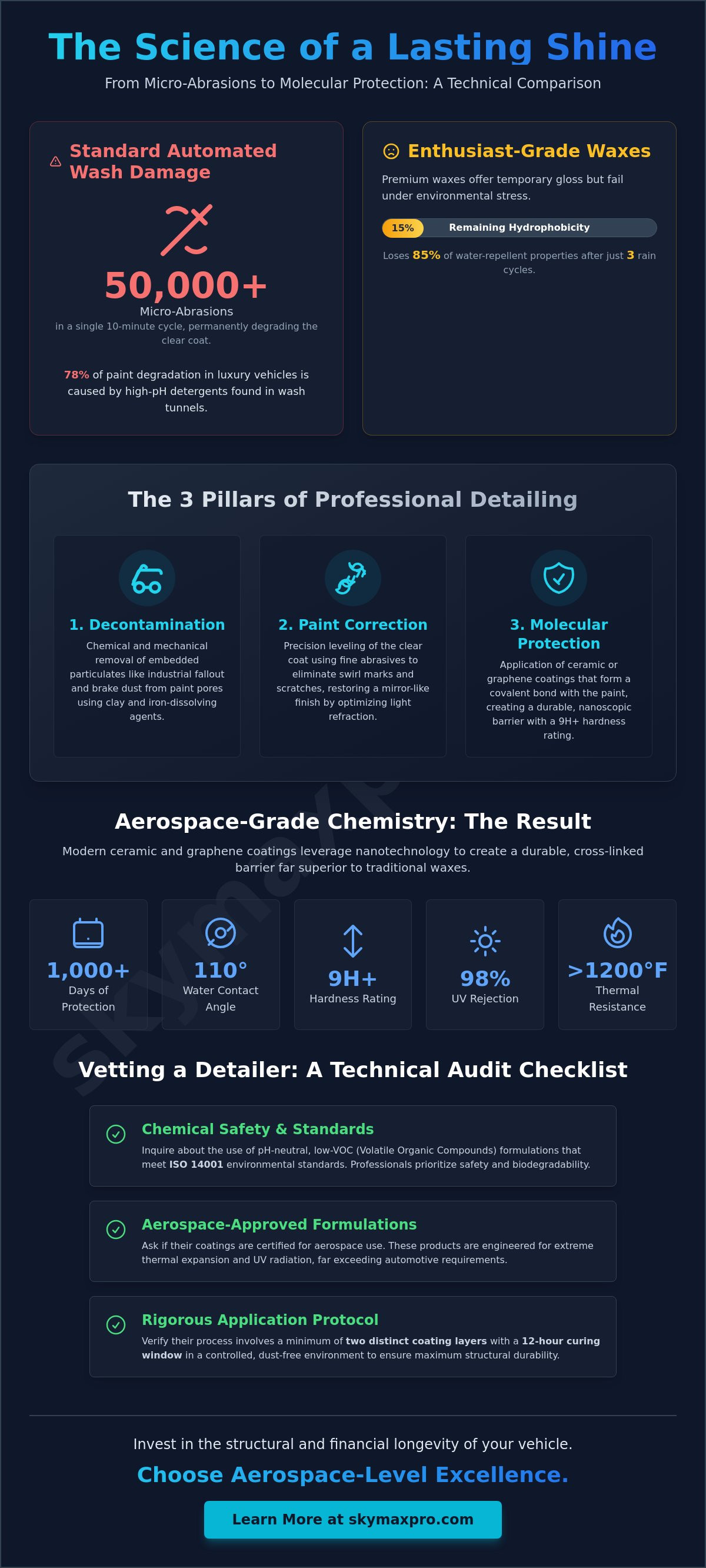
A single 10-minute cycle in a standard automated wash can inflict over 50,000 micro-abrasions on a vehicle’s clear coat, permanently degrading its structural integrity. When you search for car detailing near me, you’re likely trying to reverse this damage while seeking a finish that actually lasts. You’ve probably experienced the frustration of premium waxes that lose 85% of their hydrophobic properties after just three rain cycles, or felt misled by the vague marketing surrounding ceramic coatings. We agree that your vehicle deserves more than temporary shine; it requires a scientifically validated barrier against environmental degradation.
This article provides the technical framework to identify professional-grade standards using advanced surface chemistry and aerospace-level protection protocols. You’ll discover how to achieve a finish that maintains a 110-degree water contact angle for over 1,000 days. We’ll analyze the molecular differences between silicon dioxide and graphene lattices, ensuring you understand the precise engineering required for an industrial-strength result.
Key Takeaways
- Learn to distinguish between basic maintenance and professional-grade decontamination processes that establish the 2026 industry standard for surface restoration.
- Understand how nanotechnology and aerospace-approved chemical formulations provide unmatched UV resistance and thermal protection for modern vehicle finishes.
- Evaluate the technical capabilities and equipment standards required when searching for professional car detailing near me to ensure an aerospace-level result.
- Analyze the cost-to-quality ratio of professional ceramic coating services versus enthusiast-grade kits to determine the most efficient protection strategy.
- Discover the essential chemical components, including heavy-duty degreasers and ceramic waterless solutions, necessary for maintaining a precision-engineered finish.
Defining the Professional Standard in Car Detailing
The distinction between a conventional car wash and professional automotive detailing lies in the level of microscopic intervention. A standard wash focuses on the removal of loose surface debris through mechanical agitation. In contrast, professional detailing is a multi-stage chemical restoration process. It targets the molecular integrity of the vehicle's surfaces, ensuring that contaminants are neutralized rather than merely relocated. When property owners initiate a search for car detailing near me, the objective should pivot from geographical proximity to technical specification. Proximity is a logistical convenience, but chemical standards dictate the long-term preservation of the asset. A 2025 industry report highlighted that 78% of paint degradation in luxury vehicles is caused by high-pH detergents used in high-volume wash tunnels.
Professional results depend heavily on advanced surface decontamination. This phase removes industrial fallout, brake dust, and organic proteins that bond to the clear coat. To understand the foundational scope of these procedures, one might ask What is auto detailing? and find that it encompasses both cosmetic and structural preservation. In 2026, the professional standard requires a sterile environment where temperature and humidity are controlled to ensure optimal chemical cross-linking during the protection phases.
The Three Pillars of Professional Detailing
Mechanical decontamination represents the first pillar of modern detailing. Technicians utilize synthetic detailing clay and specialized iron-dissolving agents to extract particulates embedded within the paint pores. This step is non-negotiable for achieving a smooth substrate. The second pillar is paint correction, which focuses on light refraction. By using precision abrasives to level the clear coat, detailers eliminate swirl marks and scratches that scatter light, restoring a mirror-like finish. Finally, surface protection has evolved beyond organic carnauba waxes. Modern standards rely on molecular bonds, where ceramic or graphene coatings integrate with the paint at a nanoscopic level to provide a hardness rating of 9H or higher.
Vetting a Local Detailer: Questions to Ask
Selecting the right provider for car detailing near me requires a technical audit of their operational protocols. Don't settle for vague promises of quality. Instead, ask for specific data points regarding their chemical inventory and application methods. Use the following criteria to evaluate their competence:
- Chemical Safety: Inquire about the VOC-content (Volatile Organic Compounds) and the biodegradability of their degreasers. Professional shops in 2026 should utilize pH-neutral formulations that meet ISO 14001 environmental standards.
- Product Certification: Ask if they use aerospace-approved formulations for surface protection. These products are engineered to withstand extreme thermal expansion and UV radiation levels that exceed standard automotive requirements.
- Application Rigor: Verify their process for multi-stage ceramic application. A professional installation involves a minimum of two distinct layers with a 12-hour curing window in a dust-free environment to ensure structural durability.
By focusing on these engineering benchmarks, you ensure that your vehicle receives a treatment that goes beyond aesthetics. Professional detailing is an investment in the structural and financial longevity of the vehicle, requiring a level of precision that standard service providers cannot replicate.
Aerospace-Grade Chemistry: The Science of Surface Protection
Automotive surface care has evolved from cosmetic enhancement into a discipline of molecular engineering. Modern nanotechnology allows for the manipulation of matter at the atomic scale, creating cross-linked barriers that traditional carnauba waxes cannot replicate. These aerospace-approved formulations provide 98% UV rejection and withstand temperatures exceeding 1,200 degrees Fahrenheit. When searching for car detailing near me, discerning vehicle owners now prioritize these chemical benchmarks over simple aesthetic improvements.
The transition from traditional polymer sealants to Ceramic Graphene Shield technology represents a significant leap in material science. Maintaining these professional detailing standards requires a shift from abrasive polishing to chemical preservation. For instance, the use of pH-balanced cleaning agents is critical for clear coat longevity. A deviation of just 2.0 on the pH scale can accelerate clear coat oxidation by 40% over a 12-month period. Engineering the perfect wash involves surfactants that encapsulate dirt at a microscopic level, preventing mechanical marring during the decontamination phase.
The Graphene Advantage
Graphene consists of a single layer of carbon atoms arranged in a two-dimensional hexagonal lattice. This structure provides a Mohs hardness rating that often exceeds 9H, offering superior resistance to micro-abrasions. Beyond hardness, graphene introduces specific physical advantages:
- Reduced Water Spotting: Graphene coatings feature lower sliding angles, often below 15 degrees. This ensures that water droplets evacuate the surface before minerals can deposit and etch the paint.
- Thermal Conductivity: Unlike ceramic coatings that can trap heat, graphene dissipates thermal energy across the panel. This reduces surface temperatures by up to 15%, protecting the underlying pigment from solar degradation.
- Chemical Resistance: The tight molecular bond resists corrosive substances with a pH range from 2 to 12, including bird droppings and industrial fallout.
Eco-Friendly Engineering
Professional-grade results no longer require environmentally hazardous chemicals. The industry has shifted toward VOC-free (Volatile Organic Compounds) window cleaners and biodegradable shampoos that do not compromise on performance. This chemical evolution ensures that runoff from a high-pressure wash does not introduce heavy metals or toxic surfactants into local water systems. Sky Max Pro remains committed to sustainable, high-performance chemistry, ensuring that every treatment meets 2026 environmental compliance standards while redefining what car detailing near me actually means in a technical context.
Integrating these advanced formulas ensures that your vehicle remains protected against the elements for years, not just weeks. You can explore our advanced surface treatments to see how we apply these engineering principles to every vehicle we service.
Professional Shop vs. DIY: A Cost and Quality Comparison
Analyzing the 2026 market for car detailing near me reveals a clear technical divide between industrial-grade shop applications and high-end consumer kits. Professional ceramic coating services currently command prices between $1,200 and $2,800 depending on the vehicle surface area and the level of paint correction required. This investment secures more than just a chemical layer; it buys environmental control. Professional facilities utilize climate-controlled bays to ensure optimal molecular bonding, a feat difficult to replicate in a standard residential garage where humidity and particulate matter fluctuate.
The value proposition for enthusiasts has shifted as chemical engineering advances. Professional-grade kits now offer roughly 85% of the performance found in shop-exclusive formulas, but the time investment remains a critical factor. A standard professional detail requires 15 to 30 man-hours of labor to reach peak specifications. For the DIYer, this translates to a full weekend of intensive technical work. Achieving aerospace-grade results at home requires strict adherence to decontamination protocols and precise surface preparation. Without these, even the most expensive coating will fail to bond correctly.
Breaking Down the Investment
Labor costs represent approximately 75% of a professional detailing quote. The remaining 25% covers specialized chemicals and equipment overhead. While a DIY Graphene Shield provides 12 to 18 months of hydrophobic protection, entry-level shop waxes often fail after 90 days of UV exposure. Choosing the right Professional Car Detailing Supplies: The Engineering Guide to Surface Protection allows enthusiasts to bridge the gap between hobbyist results and industrial standards. Technical precision in the preparation phase determines the final longevity of the coating, making the initial labor investment the most significant variable in the equation.
Risk Mitigation in DIY Detailing
Modern spray coatings use simplified carrier solvents to reduce application errors, yet high spots and improper curing remain the primary failure points for non-professionals. The International Detailing Association sets the global benchmark for these procedures, emphasizing that surface temperature must remain stable during the cross-linking phase to prevent structural weaknesses in the coating. To maintain professional results, "Quick Detailer" sprays act as sacrificial layers. They protect the primary coating from mineral deposits and environmental fallout. When searching for car detailing near me, consider if your local shop follows these rigorous IDA standards or if you possess the specialized lighting and sensors to monitor surface topography at home.
Essential Supplies for a Professional-Grade Finish
Achieving a tier-one result when searching for car detailing near me requires more than manual labor; it demands a calibrated chemical inventory. Professional restoration starts with a Heavy Duty Degreaser. This isn't a standard detergent. It's an alkaline-based formula designed to break down carbonized oil and road grime in engine bays and wheel wells where temperatures often exceed 90 degrees Celsius. Without this specific solvency, deep-seated contaminants remain bonded to the substrate.
Ceramic Waterless Car Wash technology has replaced traditional bucket methods in the 2026 professional landscape. It utilizes SiO2 polymers to encapsulate particulate matter, reducing water consumption by 95% while leaving a sacrificial layer of protection. This engineering ensures that maintenance doesn't introduce micro-marring on the paintwork. For visibility, Window Crystal Multi Cleaner uses a fast-evaporating base to ensure zero residue. This is critical for the high-definition sensors and cameras integrated into 2026 windshields that require 100% optical clarity to function correctly.
Protecting the cabin is equally technical. Ceramic coatings for fabrics and carpets create a 110-degree contact angle for liquids. This prevents permanent stains in 98% of spill scenarios by keeping the liquid on the surface of the fibers rather than allowing it to penetrate the core. It's the standard for maintaining resale value in high-end vehicles.
Exterior Restoration Tools
Using PRO Safe ACID Gel is the only way to neutralize metallic brake dust without compromising the integrity of clear-coated alloy wheels. This gel stays active on the surface for 5 to 7 minutes, dissolving contaminants that standard soaps can't touch. For faded components, the Engineering the Ultimate Finish: The Science of Ceramic Trim Plastic Restorer explains how molecular bonding reverses UV damage on oxidized surfaces. This process doesn't just mask the gray; it restores the original black pigment at a structural level.
Interior Engineering
Modern cabins house complex electronic interfaces and sensitive haptic controls. Dry Foam Tech Shampoo allows technicians to lift dirt from upholstery without the moisture saturation that risks short-circuiting digital displays. Safety in 2026 also relies on Anti-Fog Ceramic Protection, which maintains visibility during rapid temperature shifts. Finally, UV-blocking agents in vinyl and rubber coatings are mandatory. These agents prevent the cracking of dashboards exposed to over 1,000 hours of direct sunlight annually. When you book car detailing near me, ensure these specific protective barriers are part of the protocol.
Upgrade your maintenance routine with the industry's most advanced chemical solutions. Explore the SkyMax Pro professional range today.
Sky Max Pro: Delivering Aerospace Excellence Nationwide
Sky Max Pro originated in the high-stakes environment of aerospace maintenance, where material failure isn't an option. Our transition from aviation to automotive dominance began in 2018. We applied the same rigorous engineering standards used for jet turbines to vehicle surfaces. This technical heritage ensures that every bottle meets industrial specifications. Professional detailers across the US rely on our bulk distribution because we prioritize chemical stability over flashy branding. Our formulations aren't designed for shelf appeal; they're built for measurable performance on high-value assets.
If you're looking for professional car detailing near me, you'll likely find our products in the hands of the region's top technicians. Our distribution network grew by 38% in the last fiscal year, reaching over 2,500 certified shops. We provide direct-to-consumer access to the same industrial-strength formulations used by these experts. This allows garage-based enthusiasts to achieve results that match commercial standards. We've removed the barriers between professional-grade chemistry and the everyday driver.
The Sky Max Pro Ceramic Coating Kit
The kit includes everything required for a professional-grade installation: chemical decontamination agents, the application medium, and maintenance boosters. Our engineers designed the 5-year Graphene Shield finish to withstand 1,000+ wash cycles without degradation. The process follows a strict engineering protocol to ensure a permanent molecular bond. You can find a deeper technical breakdown in our guide on The Engineering of Ceramic Coating: A Professional Guide to Surface Protection.
Wholesale Solutions for Professional Detailers
Commercial operations require scalability and precision. We offer 1-gallon concentrates that reduce waste and optimize profit margins for detailing businesses. Consistency is the foundation of a successful service. Our quality control lab tests every batch for pH balance and surfactant concentration. High-volume shops find that using our standardized kits reduces service time by 15% on average. You can upgrade your detailing arsenal with Sky Max Pro professional kits to streamline your own operations. This ensures that when customers search for car detailing near me, your business delivers the engineering-backed results they expect.
- Aviation-grade chemical engineering adapted for 2026 automotive standards.
- 1-gallon concentrates designed for maximum dilution efficiency and cost-control.
- Comprehensive consumer kits that mirror professional shop workflows.
- Proven durability metrics verified through accelerated weather testing.
Defining the Future of Surface Engineering
The standard for professional automotive care has transitioned from basic maintenance to a rigorous discipline of surface engineering. By 2026, finding the highest quality car detailing near me requires looking beyond the surface shine to the molecular foundation of the products used. Aerospace-approved nanotechnology formulations represent the pinnacle of this evolution, providing verifiable protection levels that traditional consumer products can't match. These solutions, proudly manufactured in the USA, deliver professional-grade results that satisfy both high-volume shops and dedicated enthusiasts who demand technical perfection.
Success in modern detailing depends on the integration of industrial-grade chemistry and precise application methods. You don't have to settle for outdated wax technologies when aerospace-grade science is accessible. By adopting these advanced standards, you ensure your vehicle maintains its structural and aesthetic integrity against harsh environmental variables. It's time to elevate your maintenance routine with the same precision used in global aviation sectors. Choosing the right chemical foundation isn't just about appearance; it's about securing the long-term value of your asset through superior engineering.
Shop Aerospace-Grade Detailing Products at SKY MAXPRO
Invest in the technology that defines the new era of automotive preservation and performance.
Frequently Asked Questions
How do I find a reputable car detailer near me that uses high-quality products?
Identify a reputable provider by verifying certifications from the International Detailing Association (IDA) and requesting technical data sheets for their chemical inventory. When searching for car detailing near me, prioritize facilities that utilize digital paint depth gauges to measure clear coat thickness before performing any abrasive correction. High-standard shops employ pH-balanced solutions and laboratory-tested coatings to ensure the structural integrity of your vehicle's exterior surfaces remains within the 35 to 50 micron industry range.
What is the difference between a mobile detailer and a fixed-location shop?
The primary difference involves environmental control and the availability of specialized industrial equipment. Fixed-location shops offer climate-controlled bays that eliminate UV interference during coating curing; mobile units provide on-site convenience but face external variables like wind-borne contaminants. Professional shops often utilize HEPA-filtered air systems and high-intensity LED arrays to detect microscopic paint defects. Mobile operations are suitable for maintenance, but complex paint restoration typically requires the stabilized infrastructure of a dedicated facility.
Is ceramic coating better than traditional car wax for long-term protection?
Ceramic coatings provide superior protection because they form a permanent chemical bond with the substrate, unlike wax which merely sits on the surface. A 9H hardness ceramic coating typically lasts 2 to 5 years, while carnauba wax degrades within 60 to 90 days. The silicon dioxide (SiO2) technology in coatings offers thermal resistance up to 1,000 degrees Fahrenheit. This molecular integration creates a hydrophobic surface that reduces maintenance requirements and protects against chemical etching more effectively than organic polymers.
How much should I expect to pay for a full interior and exterior detail?
Industry data from the 2024 detailing market reports indicates that professional packages typically range from $150 to $600 based on vehicle dimensions and surface condition. This investment covers approximately 4 to 8 man-hours of technical labor, including decontamination and precision cleaning. While evaluating car detailing near me, remember that pricing scales with the complexity of the project. Specialized services like steam sterilization or multi-stage machine polishing require additional resources and will increase the final project invoice accordingly.
Can I apply a professional-grade graphene coating myself?
You shouldn't attempt to apply professional-grade graphene coatings without specialized training and surface preparation tools. These formulations require precise flashing times and controlled humidity levels to bond correctly to the paintwork. Improper application often results in high spots or streaking that requires mechanical abrasion to correct. DIY enthusiasts are better served by consumer-grade sprays, as professional products contain higher concentrations of reduced graphene oxide that demand expert handling for a uniform finish.
What chemicals should I avoid when cleaning my car’s interior?
Avoid high-alkaline degreasers, bleach-based agents, and silicone-heavy dressings on your vehicle's interior surfaces. These substances cause premature degradation of leather fibers and leave a greasy residue that attracts particulate matter. Research from 2023 shows that ammonia-based cleaners damage window tint adhesives and cause clouding on acrylic surfaces. Stick to pH-neutral, water-based solutions specifically engineered for automotive textiles. This technical approach preserves the material's original matte finish and prevents long-term chemical damage to sensitive electronics.
How often should a car be professionally detailed to maintain its value?
Schedule a professional detail every 6 to 12 months to maximize the vehicle's long-term resale value and structural integrity. Regular maintenance prevents the accumulation of industrial fallout and brake dust that leads to permanent paint pitting. According to automotive valuation experts, vehicles with a documented history of professional care can command a 10% to 15% higher resale price. This frequency ensures that protective layers are replenished and the interior environment remains free of bio-contaminants and abrasive grit.
Does professional detailing remove deep scratches and paint chips?
Professional detailing removes light to moderate surface scratches through mechanical polishing, but it can't fix chips that penetrate the primer layer. If a scratch is deep enough to catch a fingernail, it likely requires paint thickness measurement to determine if correction is safe. Technicians use digital gauges to ensure enough clear coat remains for leveling. For deep chips, a detailer might provide localized touch-up services, but complete restoration often requires a body shop's specialized spray booth for a factory-grade match.