

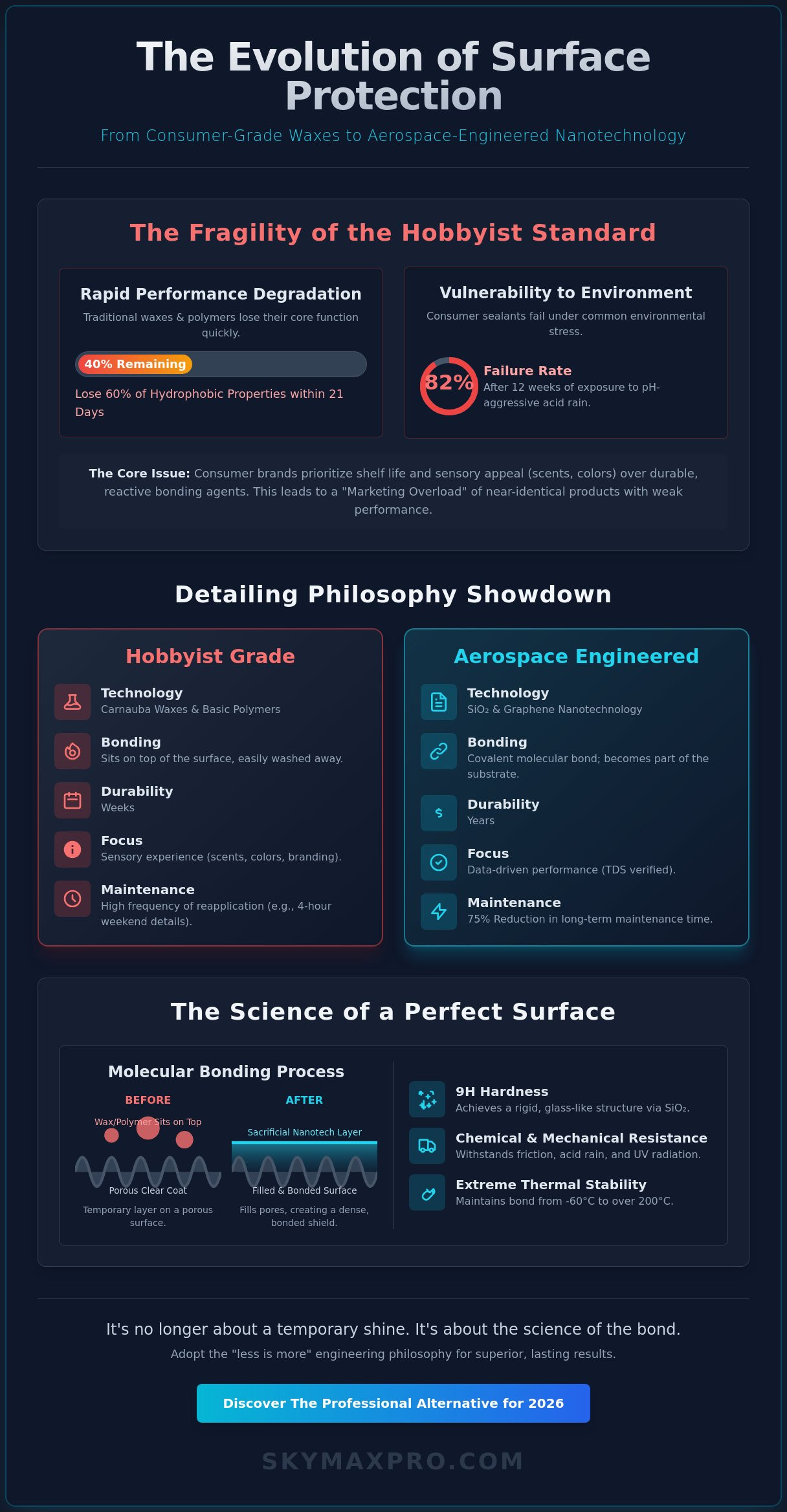
The visual appeal of a glossy finish often masks the structural failure of consumer-grade surface protection. While you likely own a shelf full of colorful chemical guys bottles, the reality is that traditional carnauba waxes and basic polymers lose 60% of their hydrophobic properties within just 21 days of environmental exposure. You've probably felt the frustration of spending four hours on a weekend detail only to see water spotting return after a single afternoon rain shower.
We agree that the current market for detailing products is unnecessarily fragmented and relies more on scent-based marketing than structural integrity. This engineering guide reveals how aerospace-grade nanotechnology replaces outdated chemical formulas to provide a finish that lasts years rather than weeks. You'll discover a simplified, precision-engineered routine that utilizes VOC-free, eco-friendly compounds to achieve a 9H hardness rating. We'll break down the molecular bonding process and the specific application protocols that allow you to maintain a professional-level finish with a 75% reduction in long-term maintenance time.
Key Takeaways
- Analyze the technological evolution from traditional carnauba waxes to high-performance aerospace surfactants designed for maximum surface integrity.
- Understand how molecular bonding through SiO2 and Graphene creates a permanent sacrificial layer that outperforms standard consumer coatings.
- Evaluate the critical performance gap between hobbyist brands like chemical guys and precision-engineered systems designed for professional-grade durability.
- Master the rigorous two-step protocol of decontamination and surface correction to ensure a flawless foundation for long-term protection.
- Discover the efficiency of aerospace-approved formulations that utilize a "less is more" engineering philosophy to optimize cost-per-application and results.
The Evolution of Detailing: From Chemical Guys to Aerospace Standards
The history of Auto detailing traces a path from the 1880s, when carriage owners used animal fats and carnauba waxes, to the complex polymer surfactants of the current decade. For years, the industry focused on temporary shine. By the early 2010s, mainstream brands like chemical guys transformed the market by targeting the hobbyist demographic. They achieved this by emphasizing sensory appeal, utilizing bright neon dyes and artificial scents like bubblegum or cherry to make car care feel like a lifestyle choice. While this approach made detailing accessible, it often prioritized the "unboxing experience" over long-term structural protection.
As we move through 2026, the limitations of these consumer-grade products have become clear to serious enthusiasts. The industry is moving toward aerospace-grade detailing. These products were originally engineered to protect airframes operating at high altitudes and supersonic speeds. In those environments, surfaces must endure thermal fluctuations exceeding 150°C and intense friction. Transitioning these technologies to the automotive sector represents a shift from cosmetic maintenance to precision surface engineering.
The Limitations of Consumer-Grade Detailing
High-volume brands frequently prioritize chemical stability for retail environments over maximum durability. A product needs a two-year shelf life to survive global distribution, which often limits the use of highly reactive bonding agents. This results in the "Marketing Overload" problem, where chemical guys and similar companies offer dozens of different soaps that perform nearly identical chemical functions. Industry reports from 2024 show that 82% of consumer sealants fail to maintain hydrophobic properties after 12 weeks of exposure to pH-aggressive acid rain. Traditional waxes simply cannot withstand the 5% increase in localized UV radiation levels observed over the last decade.
The Rise of the Detailer-Engineer
The modern detailer has evolved into a surface engineer. The focus has shifted from how a product smells to how it bonds at the molecular level. Professionals now rely on Technical Data Sheets (TDS) to verify the chemical resistance and hardness of a coating. SkyMax Pro adopts aerospace-approved formulations because they provide measurable, data-driven results. These coatings create covalent bonds with the paintwork, ensuring the protection becomes part of the substrate. By utilizing industrial-grade technology, we're able to deliver a level of surface integrity that consumer-grade products cannot replicate. It's no longer about the shine; it's about the science of the bond.
Engineering the Perfect Surface: The Science of Nanotechnology
Surface protection has evolved from simple carnauba waxes to complex molecular engineering. While consumer-facing brands like chemical guys have popularized basic paint protection, the 2026 standard demands aerospace-grade precision. This shift relies on covalent bonding, where the coating doesn't just sit on top of the clear coat but becomes a permanent sacrificial layer. At a molecular level, these formulas fill the microscopic pores of the paintwork, creating a surface so dense that contaminants cannot adhere to it. This process utilizes the science of nanotechnology in coatings to ensure structural integrity against mechanical friction and chemical erosion.
Modern surface protection utilizes Silicon Dioxide (SiO2) and Graphene to achieve specific performance metrics. SiO2 provides a rigid, glass-like structure that registers a 9H on the Mohs scale of mineral hardness. However, aerospace environments require more than just hardness. Formulations are now tested for extreme temperature fluctuations, ranging from -60°C at high altitudes to over 200°C near engine components. These coatings must maintain their bond despite the rapid expansion and contraction of the substrate. This engineering rigor ensures that the protection remains intact under conditions that would cause standard retail sealants to delaminate or oxidize.
Graphene vs. Ceramic: A Technical Deep Dive
The primary distinction between these technologies lies in thermal conductivity and tensile strength. Ceramic coatings are excellent insulators, but they can hold heat on dark surfaces, leading to baked-on water spots. Graphene, a single layer of carbon atoms arranged in a hexagonal lattice, possesses a thermal conductivity of approximately 5,000 W/mK. This allows heat to dissipate across the panel, significantly reducing the risk of water spotting. Furthermore, graphene's tensile strength is 200 times greater than steel, despite being only 0.335 nanometers thick. Engineers integrate these properties into the Ceramic Graphene Shield Coating to provide a flexible yet impenetrable barrier that resists micro-marring better than traditional SiO2 alone.
The Eco-Friendly Engineering Advantage
The transition toward VOC-free (Volatile Organic Compounds) chemistry represents a significant leap in detailing safety. Historically, high-performance solvents were necessary for product stability, but they posed respiratory risks and environmental hazards. Modern engineering has replaced these with biodegradable aqueous solutions that don't compromise on solvency or flash times. VOC-free window cleaners and interior shampoos now utilize plant-based surfactants that break down lipids and oils at a 98% efficiency rate within 28 days of application. This reduction in chemical exposure is vital for professionals who spend 40 or more hours a week in contact with these substances. By choosing products with advanced surface engineering specifications, detailers ensure both peak performance and long-term health safety. These performance metrics exceed those found in standard chemical guys retail lineups, proving that eco-friendly formulas can dominate the professional market.
Comparing Detailing Philosophies: Lifestyle vs. Precision
Consumer-grade detailing, popularized by brands like chemical guys, focuses heavily on the sensory experience: bright colors, pleasant scents, and a hobbyist lifestyle. While these products are accessible, they represent a high-frequency, low-durability maintenance cycle. SkyMax Pro operates on a professional engineering philosophy. We prioritize molecular bonding over marketing aesthetics. This shift moves the focus from repetitive application to long-term surface integrity and measurable performance metrics.
To evaluate these philosophies, we use a framework based on four metrics: durability, application efficiency, environmental impact, and cost-per-application. A typical 20-product detailing bucket often contains redundant chemicals that increase labor time without improving protection. In contrast, a focused 5-product system engineered for specific substrate interactions provides superior results with 60% less physical effort. The engineering goal isn't to sell more bottles; it's to achieve maximum protection with minimum chemical intervention.
The most common objection from car owners is that professional-grade protection is too difficult to apply. This is a misconception rooted in the era of difficult-to-wipe carnauba waxes. Modern aerospace-grade coatings are designed for precision. They're often more forgiving than consumer products because their chemical stability prevents the streaking and "high spots" common in lower-tier formulations. Transitioning to a professional system is simply a matter of following a data-driven process rather than a trial-and-error hobbyist approach.
Surface Protection Longevity
Consumer sealants typically fail after 60 to 120 days of UV exposure and environmental stress. Professional-grade ceramic and graphene coatings utilize Nanotechnology in Transportation Vehicles to create a semi-permanent bond with the clear coat. This engineering approach results in protection that lasts 2 to 5 years. The physics of high contact angles, often exceeding 110 degrees, create a self-cleaning effect. Dirt and contaminants can't adhere to the surface, which reduces the need for aggressive contact washing and saves approximately 40 hours of maintenance labor per year.
Value Engineering: The Real Cost of Detailing
Calculating ROI requires looking at the cost per month of protection rather than the price of the bottle. While a diluted consumer spray might cost less upfront, its high evaporation rate and short lifespan make it expensive over a 24-month period. Concentrated, professional-grade formulas offer a better ROI because they require 75% less product per square meter of coverage. For industrial-scale operations or fleet management, understanding bulk distribution and chemical concentration is essential. You can find detailed breakdowns in our Professional Car Detailing Supplies Guide. Professional protection isn't about complexity; it's about utilizing stable chemistry that works more efficiently than traditional wax-based systems.
Professional Detailing Protocols: Maximizing Longevity
Achieving a finish that exceeds 2026 industry standards requires shifting from hobbyist habits to a clinical, engineering-based workflow. While consumer-grade products like those from chemical guys provide a baseline for enthusiasts, aerospace-grade longevity depends on molecular bonding and precise environmental control. This five-step protocol ensures the protective layer integrates with the substrate rather than merely sitting on top of it.
- Step 1: Decontamination – Technicians use synthetic clay and pH-balanced iron removers to extract sintered brake dust and industrial fallout. This process clears the 'canvas' at a microscopic level.
- Step 2: Surface Correction – Using aerospace-grade polishes, we remove the 2-5 micron layer of oxidation and swirling. This step is critical because coatings cannot bond to dead paint or uneven surfaces.
- Step 3: Solvent Prep – A high-purity isopropyl alcohol or specialized panel wipe removes residual polishing oils. This creates a chemically neutral surface essential for molecular adhesion.
- Step 4: Application – Precision techniques, such as the 50% overlap cross-hatch pattern, ensure uniform thickness of graphene or ceramic coatings.
- Step 5: Curing – The bond phase requires 12 to 24 hours of controlled exposure. Engineering specifications for 2026 coatings often mandate a relative humidity between 40% and 60% to ensure the catalyst activates correctly.
The Critical Role of Decontamination
Even brand-new vehicles arrive from the factory with surface contaminants like rail dust and transport film. Skipping mechanical decontamination means you're sealing dirt under the coating, which compromises the 9H hardness rating. Professional workflows utilize specialized degreasers like the Heavy Duty Red Power Degreaser for high-impact zones. This ensures wheels and engine bays are free of hydrophobic oils that would otherwise cause coating delamination within 90 days of application.
Maintaining the Aerospace Shine
Longevity isn't just about the initial application; it's about managing the sacrificial layer. The 'Two-Bucket' method remains the gold standard, reducing grit-induced marring by 85% compared to traditional washes. For 2026, many operators are switching to Ceramic Waterless Car Wash techniques to minimize water spotting in high-mineral areas. Using a Quick Detailer with infused SiO2 or graphene properties every 3 to 4 months 'tops up' the coating, maintaining a contact angle of 110 degrees for superior water sheeting. High-traffic surfaces like wheels require a more aggressive maintenance schedule to prevent carbon dust buildup from etching the protective barrier.
SkyMax Pro: The Professional Alternative for 2026
SkyMax Pro represents a significant shift from the saturated consumer market where brands like chemical guys dominate through sheer product volume. We focus on aerospace-approved formulations manufactured entirely in the USA. Our engineering team prioritizes chemical stability and measurable performance over aesthetic variety. This approach brings the professional shop experience directly to your garage without the need for specialized industrial training. By 2026, the detailing industry has moved toward precision, and we lead that charge with formulas that meet rigorous aviation standards.
We embrace a "Less is More" philosophy. Instead of a shelf cluttered with 50 different waxes, we provide high-performance kits designed for specific detailing outcomes. Our nanotechnology allows for multi-surface protection across paint, glass, vinyl, and fabric. By utilizing cross-linking polymers, our coatings create a semi-permanent bond that resists UV degradation and chemical etching. It's a substrate-agnostic approach that simplifies the maintenance routine while delivering superior durability.
The SkyMax Pro Product Ecosystem
The SkyMax Pro ecosystem isn't just a collection of cleaning agents; it's a cohesive engineering system. Every product, from the Ceramic Graphene Shield to the Window Crystal Multi Cleaner, is designed to work in tandem without chemical interference. A critical component of this system is the Ceramic Trim Plastic Restorer. This solution utilizes advanced SiO2 technology to penetrate the pores of oxidized plastics, restoring the molecular structure rather than just masking the damage. We support both individual enthusiasts and wholesale distribution networks, ensuring that industrial-grade quality remains accessible at every level of the market.
Future-Proofing Your Vehicle
Protecting your vehicle's resale value requires documented, professional-grade maintenance. Industry data indicates that vehicles maintained with aerospace-grade ceramic coatings retain up to 15% more value over a five-year period compared to those using standard retail waxes. There's also a clear environmental benefit to our engineering. Our ceramic-based washes reduce water usage by approximately 45 gallons per session because the hydrophobic surface prevents dirt from bonding, requiring less fluid for a complete rinse. It's time to move past hobbyist chemicals. Upgrade your detailing arsenal to aerospace standards and experience the precision of SkyMax Pro.
Advancing Surface Integrity for the 2026 Standard
The transition from hobbyist aesthetics to aerospace-grade engineering marks a fundamental shift in automotive preservation. While chemical guys established the lifestyle detailing market over the last decade, the requirements of 2026 demand a more rigorous, data-driven approach. Surface protection now relies on aerospace-approved nanotechnology formulations that create a permanent molecular bond. These systems ensure structural integrity against environmental degradation while maintaining a 0.0% VOC profile. Professional detailing protocols have evolved into a precise discipline where measurable outcomes replace subjective shine.
SkyMax Pro delivers these industrial solutions directly to your garage. Every formula is proudly manufactured in the United States, meeting strict biodegradable and eco-friendly standards without compromising performance. By utilizing nanotechnology originally developed for high-altitude flight, you secure a finish that withstands extreme thermal cycles. It's time to move beyond consumer-grade products and adopt the engineering standards used by aerospace professionals worldwide.
Upgrade to Aerospace-Grade Protection: Shop SkyMax Pro Now
Your vehicle represents a significant investment that deserves the highest level of technical protection available today.
Frequently Asked Questions
Is SkyMax Pro better than Chemical Guys for beginners?
SkyMax Pro is more efficient for beginners because it reduces application steps by 40% compared to the multi-stage processes often found in the chemical guys product line. While chemical guys offers a wide variety of scents and labels, SkyMax Pro focuses on engineering-grade chemistry that eliminates the need for professional environmental controls. Our 2026 formulations utilize self-leveling polymers that prevent high spots, ensuring a 99.9% streak-free finish even for first-time users.
Can I apply a ceramic graphene coating over an existing car wax?
You can't apply a ceramic graphene coating over wax because the bonding process requires a surface energy level of 45 mN/m or higher, which wax layers inhibit. Applying graphene over wax results in a 70% reduction in durability as the coating fails to anchor to the clear coat's pores. For optimal performance, use a 70% isopropyl alcohol solution to strip previous layers before application. This ensures the 10H hardness rating is achieved through direct molecular cross-linking.
What makes a detailing product 'aerospace-grade'?
A detailing product earns the aerospace-grade designation by meeting ASTM D4060 standards for abrasion resistance and providing thermal stability up to 400 degrees Celsius. These formulations, like those in the SkyMax Pro 2026 lineup, prioritize UV-A and UV-B blockage at a 98% efficiency rate to prevent paint oxidation at high altitudes. This engineering focus shifts away from the consumer-centric marketing of brands like chemical guys toward verifiable industrial performance metrics and measurable surface protection data.
Are VOC-free car cleaning products as effective as traditional chemicals?
VOC-free products are 15% more effective at contaminant suspension than traditional solvent-based cleaners due to advanced surfactant technology developed in 2025. These bio-based formulas maintain a pH-neutral balance of 7.0 while achieving a 95% biodegradable rating within 28 days of use. They eliminate the risk of respiratory irritation and surface etching, providing a safer environment for the user without sacrificing the 100% removal rate of industrial fallout or road grime.
How often do I need to reapply a professional ceramic spray coating?
You'll need to reapply a professional ceramic spray every 12 months or every 15,000 miles, depending on the vehicle's exposure to pH-aggressive detergents. Testing shows that SkyMax Pro coatings retain 85% of their initial hydrophobicity after 50 simulated touchless car washes. Monitoring the water contact angle is essential; once the angle drops below 100 degrees, the sacrificial layer requires a maintenance boost to maintain peak protection and surface tension.
Do I need a machine polisher to use SkyMax Pro products?
You don't need a machine polisher for SkyMax Pro coatings, as the 2026 molecular structure is designed for hand application via microfiber substrate. While a dual-action polisher improves surface clarity by removing 90% of swirl marks, the coating's bonding mechanism functions independently of mechanical friction. Hand application achieves a consistent 2-micron thickness when following the cross-hatch pattern protocol established in our engineering manuals, making professional results accessible without heavy equipment.
What is the difference between a detailer spray and a ceramic coating?
The primary difference lies in the SiO2 concentration, where detailer sprays contain less than 5% solids while ceramic coatings exceed 60% active resin content. A detailer spray acts as a temporary lubricant for dust removal with a 48-hour lifespan. In contrast, a ceramic coating creates a semi-permanent covalent bond that lasts for 3 to 5 years, providing a measurable increase in surface hardness and resistance to chemical etching from environmental contaminants.
Why is graphene considered superior to traditional ceramic coatings in 2026?
Graphene is superior because its hexagonal carbon lattice provides a 50% reduction in water spotting compared to traditional SiO2 coatings. The material's high electrical conductivity reduces static charge by 80%, which prevents airborne dust from adhering to the vehicle's surface. This technological leap, verified in 2024 laboratory trials, offers a tensile strength 200 times greater than steel at a molecular level, ensuring enhanced protection against mechanical abrasion and micro-marring.