

The most common misconception in automotive maintenance is that chemical potency equals surface destruction. While the fear of permanent etching or white spotting is valid, the reality is that high-precision acidic formulations are often the only way to dissolve heavy oxidation without aggressive mechanical abrasion. You've likely hesitated, asking yourself, will acid wheel cleaner damage my rims after hearing conflicting advice from various detailing brands. The answer isn't a simple yes or no; it's a matter of engineering precision and understanding the chemical tolerance of your wheel's specific substrate.
We understand the frustration of wasting money on ineffective "acid-free" cleaners that fail to move stubborn, baked-on brake dust. This article provides a clear, data-driven protocol for using acid safely while identifying which specific finishes are strict "no-go" zones. You'll learn how to utilize advanced, HF-free gel technology to achieve aerospace-grade results without compromising the structural integrity of your clear coat. We're moving beyond marketing fluff to examine the actual thermal and chemical factors that dictate a successful, damage-free restoration.
Key Takeaways
- Understand the ionic bond-breaking process that allows acid cleaners to dissolve inorganic contaminants like iron oxide more efficiently than alkaline alternatives.
- Identify critical "no-go" zones, such as bare polished aluminum and anodized finishes, where chemical exposure causes irreversible surface clouding.
- Gain a technical understanding of the conditions under which will acid wheel cleaner damage my rims to ensure you only apply these potent tools to compatible finishes.
- Master a professional five-step protocol that includes vital thermal checks and pre-rinsing to ensure surface safety during heavy-duty decontamination.
- Discover the engineering benefits of gel-based formulations that maximize contact time while minimizing the risks associated with traditional liquid acid runoff.
The Chemistry of Acid Wheel Cleaners: How They Remove Grime
In the technical field of Auto detailing, decontamination is a process of molecular separation rather than simple surface scrubbing. Acidic wheel cleaners operate through a specific chemical reaction with inorganic deposits, primarily iron oxide and carbonized brake dust. These contaminants aren't just sitting on the surface; they're often bonded through high-temperature fusion during braking events. While alkaline cleaners utilize surfactants to encapsulate organic grease, acids work by breaking the ionic bond between the metallic contaminant and the wheel surface. This allows the cleaner to dissolve the "root" of the grime, lifting it for easy rinsing without the need for aggressive mechanical agitation that could scratch the finish.
A primary concern for many vehicle owners is the threshold of safety. You've likely wondered, will acid wheel cleaner damage my rims if left on too long? The risk is real when the surface pH balance is ignored. Professional-grade formulations are engineered with controlled acidity and buffering agents designed to target contaminants while sparing the underlying metal substrate. However, if the chemical reaction is left unchecked or applied to an incompatible material, it leads to surface degradation. Acid etching is the permanent microscopic removal of surface material due to uncontrolled chemical reactions.
The Role of pH in Surface Decontamination
The pH scale, ranging from 0 to 14, measures the concentration of hydrogen ions in a solution. Most wheel cleaners fall into three categories: acidic (0-6), neutral (7), or alkaline (8-14). While "pH neutral" products are popular for maintenance, they often lack the chemical energy required to dissolve heavy, baked-on iron deposits found on high-performance vehicles. Professional-grade acids sit lower on the scale to provide rapid results, but they differ from consumer-grade "diluted" products through their advanced delivery systems. A sophisticated formula maintains a low pH to ensure efficiency but includes inhibitors that slow the reaction once the inorganic material is dissolved, providing a safer margin of error for the technician.
Inorganic vs. Organic Contaminants
Effective wheel restoration requires a multi-stage approach because wheels accumulate two distinct types of debris. Acids are highly effective at targeting inorganic contaminants like brake dust, which is a complex mixture of iron particles and carbon fibers. They struggle, however, with organic contaminants such as road oils, rubber particles, and tar. This is why a neglected wheel often requires a degreaser followed by an acidic cleaner. Modern detailing science also utilizes chelation, a process where large molecules surround and "trap" metallic ions, preventing them from re-bonding to the rim during the cleaning cycle. This ensures that once the acid breaks the bond, the grime stays in suspension until it's rinsed away.
Identifying Your Rim Finish: The "No-Go" Zones for Acid
The engineering safety of a chemical application depends entirely on the compatibility of the solvent with the substrate. While clear-coated alloys provide a robust barrier, certain finishes lack this protective layer, making them high-risk zones for chemical decontamination. If you are asking "will acid wheel cleaner damage my rims," the answer is an immediate yes if your wheels are bare polished aluminum. Without a clear coat, the acid reacts instantly with the raw metal, resulting in irreversible clouding and white spotting. Similarly, anodized finishes are extremely susceptible to permanent staining. Anodizing creates a porous surface that, while decorative and hard, allows acidic molecules to penetrate deep into the finish where they cannot be easily neutralized or rinsed away.
Physical Vapor Deposition (PVD) represents another critical "no-go" zone. PVD is a thin, decorative layer designed to mimic the look of chrome, but it lacks the chemical resilience of traditional chrome plating. Aggressive acids can strip this delicate layer, leading to peeling or discoloration. It is also vital to consider user safety during the selection process. Some industrial-strength cleaners utilize hydrofluoric acid, which poses severe health risks including systemic toxicity and deep tissue burns. For those seeking professional results without these extreme risks, utilizing a PRO Safe ACID Gel Wheel & Rim Cleaner provides a controlled alternative for compatible surfaces.
The Clear Coat Integrity Test
Factory clear-coated wheels are the most resilient to acidic cleaners, but this safety is contingent on the coating's integrity. Technicians must inspect for "checking," which appears as microscopic cracks in the finish. If the clear coat is compromised, acid can migrate through chips and scratches to the underlying aluminum. This leads to sub-surface corrosion, often appearing as white, spider-web-like veins beneath the finish. A simple water bead test can indicate the current protection level; if water flat-films on the surface, the coating may be thin or degraded, necessitating a lower-concentration chemical approach.
Aftermarket Finishes: Powder Coating and Vinyl Wraps
Powder coating is generally more durable than traditional paint, but its chemical resistance varies by the resin type used. Gloss powder coats handle mild acidity well, but matte and satin finishes are significantly more sensitive. These textured surfaces can become blotchy or develop permanent shiny spots if the acid reacts unevenly. Vinyl-wrapped or rubber-dipped wheels should never be cleaned with acidic products. The chemical structure of the vinyl can soften or delaminate when exposed to low-pH solutions, causing the wrap to fail prematurely. Always verify the finish type before proceeding with a chemical decontamination.
Acid vs. Acid-Free Cleaners: A Performance Comparison
The choice between acidic and pH-neutral cleaners is a matter of operational efficiency versus risk management. Acid-free "iron removers" utilize thioglycolic acid salts to produce a visual "bleeding" effect, turning purple as they complex with ferrous particles. While visually satisfying, this process requires significant dwell time, often five to ten minutes, and may require multiple applications for heavy accumulation. In contrast, acidic formulations dissolve inorganic oxides on contact. While the question remains, will acid wheel cleaner damage my rims, the answer depends on the technician's ability to manage this higher reactivity. Professional acid concentrates are typically more economical for high-volume detailing facilities, as they offer higher dilution ratios and faster throughput per vehicle.
When dealing with organic road film or grease, an acid-based cleaner is not the optimal tool. Instead, a specialized alkaline solution like the Heavy Duty Red Power Degreaser should be utilized to emulsify oils before the acidic stage begins. This multi-stage approach ensures that the acid can target the bonded brake dust directly without being blocked by a layer of surface grease. By removing the organic barrier first, the acidic stage becomes both safer and more efficient, reducing the required concentration of the low-pH solution.
When "Acid-Free" Isn’t Enough
Neglected wheels or those subjected to the extreme thermal cycles of track days often present "baked-on" brake dust that pH-neutral products cannot penetrate. These inorganic deposits undergo a phase change under high heat, fusing to the substrate. Acid-free removers lack the chemical energy to break these hardened bonds. For heavy restoration projects where wheels haven't been cleaned in years, a low-pH solution is necessary to achieve a professional-grade finish. The aggressive nature of the acid is required to penetrate the thick layers of oxidation that have become part of the wheel's surface texture.
The Environmental and Safety Trade-offs
Modern chemical engineering has shifted toward biodegradable factors and reduced VOC emissions. Technicians must utilize appropriate Personal Protective Equipment (PPE), including acid-resistant gloves and eye protection, regardless of the formula's base. Runoff management is equally critical; all chemical waste must be disposed of according to local environmental regulations to prevent groundwater contamination. Modern gel-based acids, such as the PRO Safe ACID Gel Wheel & Rim Cleaner, help mitigate these risks by reducing liquid runoff and keeping the chemical concentrated on the target surface, which prevents unnecessary environmental exposure and driveway staining.
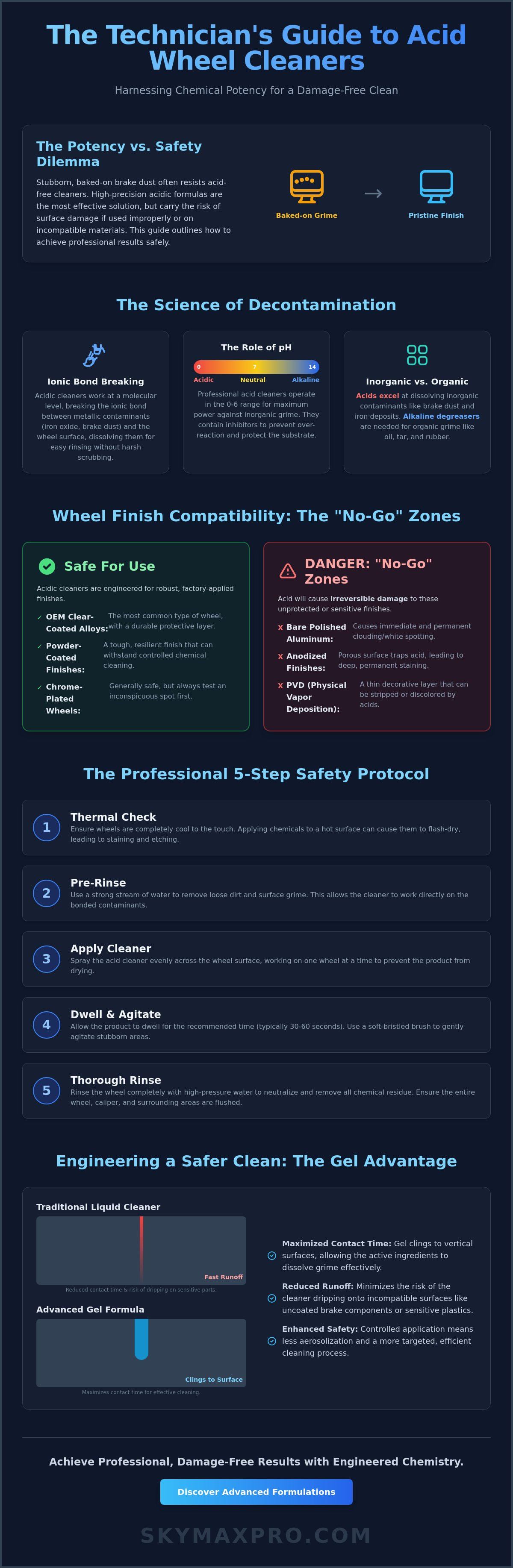
The Professional Protocol: 5 Steps to Safely Using Acid Cleaners
Safety in high-performance detailing is a function of methodology rather than luck. When technicians follow a structured engineering protocol, the risk of surface degradation is virtually eliminated. A frequent concern for those managing high-value assets is, will acid wheel cleaner damage my rims if the application isn't perfect? The answer depends on your adherence to a specific sequence of operations designed to manage chemical reactivity and exposure time. By treating the cleaning process as a technical procedure, you ensure that the acid targets only the contaminants without compromising the substrate.
To achieve professional-grade results, follow this five-step operational framework:
- Thermal Check: Verify that the wheel surface is at ambient temperature. Never apply acidic solutions to a surface that's been recently subjected to braking heat.
- Pre-Rinse: Use high-pressure water to remove loose particulates and organic road film. This allows the acid to focus its chemical energy on the bonded inorganic contaminants.
- Sectional Application: Work one wheel at a time. This prevents the product from reaching its maximum dwell time or drying on the surface before you can neutralize it.
- Agitation Strategy: Use soft-bristled brushes to assist the chemical reaction. The goal is to move the product into intricate areas rather than scrubbing the finish.
- Neutralization: Flush the wheel and surrounding brake components with high-pressure water. This stops the chemical reaction and removes all residual acidity from the surface.
For the safest application on compatible rims, utilize a specialized formula like the PRO Safe ACID Gel Wheel & Rim Cleaner to maintain maximum control over dwell times.
The "Cool to the Touch" Engineering Rule
Heat acts as a catalyst, accelerating chemical reactions exponentially. If an acidic cleaner is applied to a hot wheel, the rate of ion exchange increases to the point where it can bypass the contaminants and begin attacking the clear coat or metal substrate. This leads to "flash drying," a condition where the liquid carrier evaporates, leaving a highly concentrated acidic residue that causes immediate etching. Always ensure the wheels and brake rotors have reached thermal equilibrium with the environment before beginning the decontamination process. If the vehicle was recently driven, use a steady stream of cool water to lower the temperature of the rotors and rims safely.
Agitation Techniques for Intricate Rims
Mechanical agitation should always be secondary to chemical action. When dealing with complex multi-spoke designs, select a brush with flagged-tip bristles to ensure the chemical is distributed into every crevice without marring the finish. Lubrication is vital during this phase; the gel-based cleaner should provide enough slip to prevent the brush from dragging. Technicians must also be mindful of overspray on brake calipers and rotors. While high-quality acids are safe for most factory-finished calipers, keeping the agitation focused on the rim face and barrel prevents unnecessary chemical exposure to sensitive braking components.
Engineering a Safer Clean: The SKY MAXPRO Gel Advantage
A gel formulation, such as the PRO Safe ACID Gel Wheel & Rim Cleaner, utilizes molecular adhesion to remain exactly where it's applied. This controlled interaction ensures that the acid works exclusively on the contaminants rather than pooling in the wheel barrel or dripping onto sensitive substrates. By stabilizing the active ingredients, we bring aerospace grade standards to automotive maintenance, ensuring that the chemical energy is focused where it's needed most without the risks associated with uncontrolled liquid migration.
The Science of Dwell Time vs. Concentration
The efficiency of a chemical reaction is a product of concentration and contact time. Liquid acids require higher concentrations to work quickly before they run off the surface. Gel technology reverses this requirement. By increasing the dwell time through higher viscosity, we can utilize lower acid concentrations to achieve superior results. This reduced concentration significantly widens the safety margin for the wheel's clear coat. Technicians achieve professional results with less product volume, optimizing both operational cost and surface safety. This approach prevents the uneven cleaning patterns often seen with traditional sprays.
Integrating Protection Post-Clean
Deep cleaning with an acidic solution leaves the metal substrate or clear coat perfectly decontaminated but also vulnerable to immediate environmental oxidation. It's essential to seal the surface following the neutralization phase to maintain the restored finish. Following a professional auto detailing checklist ensures that this critical protection step is never overlooked. Applying a ceramic coating post-clean provides a semi-permanent barrier that fills the microscopic pores of the finish. This layer prevents future brake dust from bonding as aggressively; it simplifies future maintenance and reduces the frequency of intensive acidic decontamination cycles.
Optimizing Your Wheel Maintenance Protocol for Maximum Longevity
Achieving a professional-grade clean requires moving beyond anecdotal advice and adopting an engineering perspective. You now understand that the question of will acid wheel cleaner damage my rims depends on finish compatibility and thermal control rather than the chemical's existence alone. By identifying high-risk substrates like bare polished aluminum and following a structured five-step protocol, you eliminate the variables that lead to surface etching. This technical approach transforms wheel cleaning from a high-risk task into a predictable, repeatable process.
Transitioning to gel-based formulations represents the next step in detailing efficiency. These advanced delivery systems stabilize low-pH solutions, allowing for increased dwell time and reduced liquid runoff. This precision ensures that your decontamination efforts are both safe and measurably effective across all compatible factory finishes.
Upgrade to PRO Safe ACID Gel Wheel & Rim Cleaner for an engineering-grade clean. Our aerospace-approved formulations are manufactured in the USA and utilize gel-based technology for maximum control and safety. Start restoring your wheels with the confidence of a professional technician today.
Frequently Asked Questions
Is acid wheel cleaner safe for black wheels?
Acidic cleaners are safe for black wheels provided they have a factory clear coat. Most modern black wheels utilize a standard paint and clear coat system similar to silver alloy wheels. However, if the wheels are anodized or have a matte finish, acid can cause blotchiness or permanent staining. You should always verify the specific coating technology used by the manufacturer before beginning a chemical decontamination process.
Can I use acid wheel cleaner on chrome rims?
Real chrome plating is highly resistant to acidic solutions and can be safely cleaned with professional formulas. The chemical resilience of chrome allows for the effective removal of heavy oxidation without surface degradation. Conversely, PVD (Physical Vapor Deposition) finishes, which mimic the look of chrome, are significantly more delicate. These "chrome-look" wheels can be stripped by low-pH chemicals and should be avoided during acidic cleaning stages.
How long should I leave acid wheel cleaner on before rinsing?
Dwell time should generally range between 30 seconds and two minutes depending on the ambient temperature. When using high-precision gel formulas, you gain more control over the reaction, but the product must never reach the point of evaporation. You might wonder, will acid wheel cleaner damage my rims if I wait too long? The risk increases exponentially once the liquid carrier evaporates, leaving concentrated acid on the substrate.
What happens if acid wheel cleaner dries on the rim?
Drying leads to acid etching, which is the microscopic removal of surface material. As the water in the formula evaporates, the acid concentration reaches a critical level that bypasses the contaminants and begins to dissolve the clear coat or metal. This results in permanent white spotting or clouding. These defects often require mechanical polishing or professional refinishing to correct because the damage is structural to the finish.
Does acid wheel cleaner damage brake rotors or calipers?
Professional acidic cleaners are generally safe for factory-finished calipers but may cause temporary flash rust on iron brake rotors. This oxidation on the rotors is a surface-level reaction and is typically removed during the first braking event. It's critical to neutralize all components with high-pressure water to ensure no residual acidity remains in the caliper crevices or on seal surfaces where it could cause long-term corrosion.
Can I dilute acid wheel cleaner to make it safer?
Dilution is only recommended for specific acid concentrates and should follow the manufacturer's precise mixing ratios. Many modern gel formulations are engineered as ready-to-use (RTU) products to maintain the specific viscosity required for surface adhesion. Attempting to dilute a gel product can break the polymer chain. This leads to liquid runoff and reduced cleaning efficiency, effectively defeating the engineering advantages of the gel delivery system.
Will acid cleaner remove a ceramic coating from my wheels?
Acidic cleaners can accelerate the degradation of a ceramic coating if used frequently. While ceramic coatings are engineered for high chemical resistance, repeated exposure to low-pH solutions will eventually thin the protective layer. It's best to use acidic decontamination only for restorative purposes rather than as a weekly maintenance step. This preserves the hydrophobic properties and structural integrity of the ceramic barrier for as long as possible.
Is it safe to use acid wheel cleaner on powder-coated rims?
Gloss powder-coated rims are generally resilient to acidic cleaners due to their high cross-link density. This durability allows for safe iron removal provided the surface is cool. However, you must ask, will acid wheel cleaner damage my rims if they have a matte powder coat? Matte or satin powder coats are more porous and sensitive to chemical reactions. This sensitivity can lead to permanent gloss shifts or uneven surface textures that cannot be easily repaired.