

Key Takeaways
- Understand how the transition from SiO2 to reduced graphene oxide (rGO) creates a superior hexagonal honeycomb lattice for surface protection.
- Learn how graphene's high thermal conductivity prevents surface heat retention, which effectively eliminates the primary cause of etchings and water spotting.
- Explore the technical benefits of graphene in car coatings through 10H hardness ratings that provide industrial-grade resistance against pH 2 to pH 12 contaminants.
- Master the precise application protocols and leveling techniques required to achieve an aerospace-inspired finish with SKY MAXPRO solutions.
- Discover why VOC-free formulations deliver up to seven years of durability without compromising on structural integrity or surface gloss.
Understanding the Molecular Architecture: What is Graphene Coating?
Graphene is a two-dimensional allotrope of carbon where atoms are arranged in a precise hexagonal honeycomb lattice. This single layer of atoms represents the thinnest material known to man, yet it possesses mechanical properties that defy traditional material science. At the molecular level, graphene is approximately 200 times stronger than steel, providing a level of structural resilience that was previously unattainable in automotive surface care. When integrated into a coating, this material doesn't just sit on top of the paint; it creates a reinforced composite layer that bonds with the substrate.
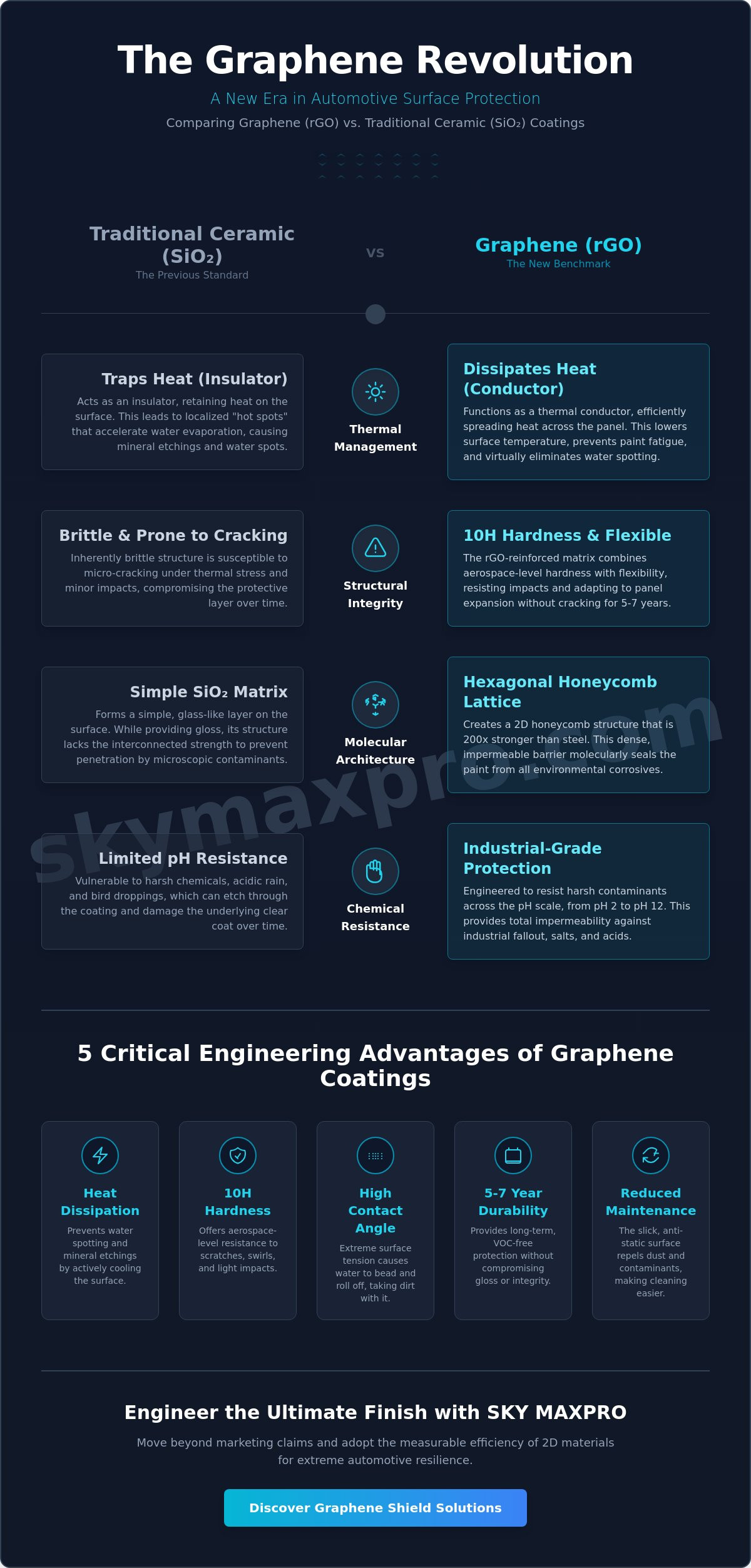
The engineering shift from traditional SiO2 (Silicon Dioxide) ceramic coatings to rGO (Reduced Graphene Oxide) marks a significant evolution in surface protection. While ceramic coatings provide excellent gloss and UV protection, they're inherently brittle and prone to cracking under extreme thermal stress. By utilizing graphene oxide as a reinforcing agent, manufacturers have created a hybrid matrix that combines the hardness of silica with the flexibility of carbon. This atomic thickness allows the coating to remain incredibly pliable, ensuring it can expand and contract with the vehicle's panels during temperature fluctuations without losing its integrity.
The Evolution from Ceramic to Graphene
Traditional ceramic coatings often struggle with high heat retention, which can lead to permanent mineral etchings when water evaporates too quickly on a hot surface. Graphene solves this by acting as a conductive thermal sink, dissipating heat across the panel rather than allowing it to concentrate. One of the standout benefits of graphene in car coatings is this ability to mitigate the brittleness found in pure ceramic formulas. Modern hybrid formulations use the graphene oxide to bridge gaps in the ceramic matrix, resulting in a finish that's both harder and more impact-resistant than its predecessors.
Structural Integrity of the Hexagonal Lattice
The hexagonal honeycomb structure is the defining characteristic of this technology. This arrangement creates an incredibly high surface tension that forces liquids to bead and roll off with minimal friction. The hexagonal lattice serves as the fundamental structural barrier that ensures graphene's total impermeability to environmental corrosive agents. Because the atoms are so tightly packed, microscopic contaminants like industrial fallout, bird droppings, and road salts cannot penetrate the lattice to reach the clear coat. This density is what makes the benefits of graphene in car coatings so pronounced for long-term maintenance, as it effectively seals the paint at a molecular scale that traditional waxes or sealants cannot match.
Advanced Thermal Management and Reduced Water Spotting
One of the most significant technical advantages of graphene over traditional silica-based protection is its high thermal conductivity. While standard ceramic coatings act as insulators that trap heat on the surface of the vehicle, graphene functions as a thermal conductor. This property allows heat to be dissipated across the entire panel rather than concentrating in localized "hot spots." By facilitating rapid thermal transfer across the carbon lattice, the coating prevents the clear coat from undergoing aggressive expansion and contraction cycles that eventually lead to surface fatigue and micro-cracking.
The integration of graphene into anticorrosion layers provides a dual benefit: chemical protection and thermal regulation. In high UV environments, vehicles protected with graphene maintain a lower surface temperature compared to those with traditional ceramic. This temperature reduction is critical for preventing paint oxidation and preserving the structural integrity of the clear coat over several years. Professionals seeking these results often utilize the Ceramic Graphene Shield Coating to achieve optimal surface temperatures during peak solar exposure.
The Science of Heat Dissipation
Graphene moves heat with unparalleled efficiency. When solar radiation hits a treated panel, the energy is distributed through the hexagonal lattice, reducing the peak temperature of the substrate. This process minimizes the absorption of UV radiation and slows the chemical reactions that cause paint to fade. By maintaining a more stable surface temperature, the coating also reduces the risk of bird droppings or tree sap baking into the finish. This thermal management is one of the primary benefits of graphene in car coatings for owners in warmer climates where surface temperatures can easily exceed 60 degrees Celsius.
Solving the Water Spot Dilemma
Traditional ceramic coatings are frequently criticized for their susceptibility to "calcium spotting." This occurs because the high surface energy of ceramic holds heat, causing water droplets to evaporate rapidly and leave behind concentrated mineral deposits. Graphene addresses this through a combination of lower surface temperature and a significantly reduced sliding angle. Water droplets don't just bead; they move off the surface with minimal force.
The benefits of graphene in car coatings include the elimination of the "lens effect." In this scenario, spherical water droplets act as magnifying glasses that focus UV rays onto the paint, causing permanent etching. Graphene's unique surface chemistry ensures that water sheds before it has the opportunity to evaporate and etch the clear coat. This results in a surface that is much easier to maintain, requiring less frequent decontamination washes to remove mineral buildup.
Performance Metrics: Durability, Hardness, and Chemical Resistance
Quantifying the performance of protective layers requires an analysis of molecular stability rather than just layer thickness. While traditional coatings rely on silica volume, the benefits of graphene in car coatings stem from the unmatched tensile strength of the carbon lattice. This allows high-end formulations to achieve a 10H hardness rating on the Pencil Hardness scale. Unlike standard 9H ceramic, which can become brittle and prone to micro-cracking as it thickens, graphene-reinforced matrices maintain structural integrity. This ensures the coating doesn't fail under the mechanical stresses of daily driving or high-frequency structural vibrations.
Chemical resilience is a primary engineering goal for any professional-grade surface treatment. Graphene provides a barrier that's chemically inert across a wide pH spectrum, typically ranging from pH 2 to pH 12. This level of protection is vital for neutralizing acidic contaminants like bird droppings and aggressive alkaline agents found in road salts or industrial degreasers. According to industry research in Graphene in Coatings: Overcoming the Challenges, these materials offer improved abrasion and stain resistance by creating an impermeable shield. This shielding ensures that the underlying clear coat remains isolated from environmental degradation for a performance window often exceeding five years.
Mechanical Hardness vs. Surface Flexibility
A 10H rating represents more than just basic scratch resistance; it indicates a surface that can withstand micro-abrasions during the maintenance wash cycle. One of the unique benefits of graphene in car coatings is the combination of extreme hardness with molecular flexibility. This reduced friction coefficient doesn't just prevent swirl marks; it theoretically impacts aerodynamic drag at high speeds by smoothing the surface at a microscopic level. The resulting finish is exceptionally slick, which significantly reduces the bonding ability of dust and environmental particulates through inherent anti-static properties. Particulates simply don't find the "grip" necessary to accumulate on the panel.
Environmental and Chemical Shielding
Protecting the substrate from industrial fallout requires a surface with a high hydrophobic contact angle. Graphene shields consistently maintain a contact angle greater than 110 degrees, ensuring that water and suspended contaminants are repelled immediately. This prevents iron particles and metallic dust from embedding into the paint, a common issue with softer wax or sealant applications. By maintaining this performance over thousands of wash cycles, the coating provides a measurable return on investment through reduced maintenance requirements and long-term paint preservation. It's a calculated approach to automotive longevity that prioritizes structural resilience over temporary aesthetics.
Application and Maintenance of Graphene Shields
The efficacy of any high-performance protection depends entirely on the quality of the bond at the molecular level. Achieving the full benefits of graphene in car coatings requires a rigorous multi-stage preparation protocol. Unlike simpler waxes or sealants, graphene-infused formulas demand a surface free of microscopic particulates and chemical residues. If the substrate isn't properly prepared, the hexagonal lattice won't cross-link effectively with the clear coat. This results in a compromised layer that fails to provide the engineered durability and chemical resistance promised by the technology.
Professional Preparation Standards
Preparation begins with a thorough mechanical and chemical decontamination process. Professionals use clay bars to extract embedded iron filings and industrial fallout that standard washing cannot remove. Once the surface is mechanically smooth, a solvent wipe is necessary to strip away polishing oils, residual surfactants, or old wax residues. This step ensures that the graphene molecules can bond directly to the paint substrate without interference. It's also vital to monitor the panel temperature during this stage. Applying these coatings to a surface that's outside the engineered application range will disrupt the flash time, making the leveling process significantly more difficult.
The Leveling and Curing Process
During application, the liquid formula undergoes a solvent evaporation process known as flashing. You'll recognize this by a distinct rainbow effect or oil-slick appearance on the panel. This visual indicator signals the exact moment to begin leveling the coating. Using high-gsm microfiber towels, the technician must gently level the high spots to ensure a uniform thickness across the panel. If you wait too long, the coating will become tacky and difficult to smooth, potentially leaving high spots that require mechanical polishing to correct.
After the leveling is complete, the vehicle must remain in a controlled environment for at least 24 hours. This period is critical for the initial chemical cross-linking to occur. During this window, the coating is vulnerable to moisture and chemical exposure, which can compromise the final hardness of the shield. Maintaining the integrity of this layer involves using pH-neutral chemicals and avoiding aggressive mechanical friction. While the base coating is incredibly durable, using a sacrificial layer helps preserve the primary benefits of graphene in car coatings over time. For those seeking industrial-strength results, you can explore the complete Ceramic Coating Kit to secure all necessary components for a professional-grade application.
Engineering the Ultimate Finish with SKY MAXPRO
SKY MAXPRO translates the molecular advantages of carbon nanotechnology into a tangible solution for long-term surface preservation. The Ceramic Graphene Shield Coating represents an aerospace-inspired formulation designed to withstand the most aggressive environmental stressors encountered on the road. While industrial-strength protection historically involved harsh chemical solvents, this system utilizes a VOC-free and eco-friendly approach. This ensures that the application process remains safe for the user and the environment without compromising the structural integrity of the protective layer. This commitment to sustainable engineering provides a high-performance barrier that meets modern regulatory standards.
Aerospace-Grade Nanotechnology
The engineering behind SKY MAXPRO originates from the rigorous requirements of aviation surface protection. High-altitude UV radiation is significantly more intense than sea-level exposure, necessitating coatings that prevent oxidative degradation of specialized composites. By transitioning this technology to automotive clear coats, we've achieved a level of long-term gloss retention that traditional silica formulas cannot replicate. The benefits of graphene in car coatings are most evident in these extreme conditions, where the material maintains its clarity and depth even under severe thermal cycling. This ensures the substrate remains protected from the "chalking" effect often seen in lower-grade coatings after prolonged solar exposure.
The SKY MAXPRO Advantage
The Ceramic Graphene Shield Coating provides five years of engineered resilience. This isn't a temporary aesthetic enhancement; it's a structural upgrade to the vehicle's exterior. To maintain this performance, we've developed a comprehensive ecosystem of car detailing products that work in synergy with the base layer. For routine maintenance, the PRO Ceramic Graphene Spray Coating serves as an effective reinforcement, sustaining the hydrophobic properties and anti-static surface tension established during the initial application. Using a unified chemical ecosystem prevents the unintended degradation that occurs when mixing incompatible surfactants and polymers from different manufacturers.
Direct-to-consumer access to this technology allows enthusiasts and professionals alike to implement industrial-grade solutions without the need for specialized industrial facilities. By following the precise engineering protocols outlined in this guide, you can secure the full benefits of graphene in car coatings for your own vehicle. This systematic approach to surface maintenance ensures that every wash cycle preserves the sacrificial shield rather than eroding it. To begin your transition to aerospace-grade surface protection, Explore the SKY MAXPRO Graphene Collection and experience the next evolution in automotive resilience.
Advancing the Standard of Automotive Surface Resilience
Automotive protection has moved beyond simple sacrificial layers toward integrated molecular engineering. The transition from traditional silica to carbon-reinforced matrices ensures that a vehicle's finish remains resilient against both mechanical abrasion and aggressive chemical degradation. By prioritizing high thermal conductivity over the insulating properties of standard ceramic, these advanced formulations effectively neutralize the root causes of paint etching and persistent mineral deposits. Fully realizing the benefits of graphene in car coatings requires shifting from temporary aesthetic fixes to a permanent structural reinforcement mindset.
SKY MAXPRO provides the essential bridge between aerospace-approved nanotechnology and professional-grade automotive maintenance. Our formulations are manufactured in the USA and carry a verified 5-year durability rating, ensuring your investment withstands extreme environmental cycles without losing structural integrity. This systematic approach to surface care offers the precision and reliability demanded by modern engineering standards. It's time to leave behind the limitations of conventional protection and embrace a more durable future for your vehicle's exterior.
Upgrade to Aerospace-Grade Protection with SKY MAXPRO Graphene Shield
Frequently Asked Questions
Is graphene coating really better than ceramic coating for cars?
Graphene provides superior thermal management and flexibility compared to traditional ceramic protection. While ceramic is inherently brittle, the carbon lattice in graphene-infused formulas allows for natural panel expansion and contraction. This prevents the micro-cracking often associated with thick SiO2 layers. Its high thermal conductivity also reduces the surface temperature, which directly addresses the primary cause of water spotting.
How long does a graphene coating actually last on a vehicle?
A professional-grade graphene shield typically lasts between five and seven years depending on environmental exposure and maintenance. This durability is supported by the high tensile strength of the reduced graphene oxide matrix. Regular maintenance with compatible sprays ensures the sacrificial layer remains intact throughout this performance window. The coating's resilience is significantly higher than that of traditional waxes or silica-based sealants.
Does graphene coating prevent water spots better than traditional wax?
Graphene offers a significantly lower sliding angle than traditional wax, which prevents water from pooling on the panels. One of the key benefits of graphene in car coatings is its ability to shed water before it has the opportunity to evaporate. This process eliminates the "lens effect" that causes permanent mineral etchings on the paint surface during high-heat cycles.
Can I apply a graphene coating over an existing ceramic coating?
You cannot apply graphene directly over an existing ceramic coating because it won't bond effectively to the substrate. The surface must be mechanically decontaminated and stripped of all previous protection. Proper adhesion requires a clean clear coat to ensure the hexagonal lattice can cross-link with the paint molecules. Layering over an old coating will lead to premature failure and uneven surface tension.
What is the difference between a graphene spray and a professional graphene shield?
Graphene sprays are designed for ease of use and routine maintenance, while professional shields offer higher active concentration and structural durability. A shield provides the primary 10H barrier that lasts for several years. In contrast, a spray serves as a maintenance topper to rejuvenate the hydrophobic properties and slickness of the base coating during regular wash cycles.
How do I maintain my car after applying a graphene coating?
Maintenance involves using pH-neutral chemicals and avoiding aggressive mechanical friction during the wash process. You should use a dedicated solution like the Ceramic Waterless Car Wash to remove surface dust safely without marring the finish. Periodically applying a compatible graphene spray helps reinforce the primary layer and maintains the high contact angle required for efficient water shedding.
Is graphene coating scratch-proof or just scratch-resistant?
Graphene coatings are highly scratch-resistant but not entirely scratch-proof. The 10H hardness rating provides a formidable barrier against wash-induced swirl marks and light environmental abrasions. However, high-velocity impacts or deep mechanical gouges can still penetrate the layer. No coating can override the laws of physics, but graphene offers the highest level of resistance currently available in automotive chemistry.
Does graphene coating help with heat dissipation on black cars?
Graphene significantly improves heat dissipation on black cars by distributing thermal energy across the panel rather than letting it concentrate. Unlike ceramic, which can trap heat, the benefits of graphene in car coatings include high thermal conductivity. This reduces the peak surface temperature, which is essential for preventing paint oxidation and the bonding of environmental contaminants.