

That persistent, oily haze on your glass isn't just dust; it is a chemical byproduct of your car's interior materials known as plasticizer migration. For most drivers, finding the best way to clean inside of windshield surfaces feels like a losing battle against reappearing streaks and blinding night-time glare. You've likely tried standard sprays only to find the film returns within days, or worse, noticed that your cleaning attempts have left micro-scratches. A 2024 analysis of professional detailing cases indicates that improper contact is responsible for the majority of surface marring, a risk that extends directly to your interior glass.
We agree that visibility is a critical safety metric, not just a matter of aesthetics. This article moves beyond basic wiping techniques to offer a professional engineering approach to interior glass maintenance. For organizations managing commercial vehicles, maintaining such high standards of visibility is a fundamental aspect of safety, a priority shared by fleet management specialists like Fleetmaxx Solutions. You'll master the technical sequence and chemical selection required to achieve aerospace-grade, streak-free clarity. We will detail the specific engineering-grade 3-towel method and identify which pH-neutral formulas are safe for advanced ceramic coatings and tints, ensuring your results last longer than a typical detailing session.
Key Takeaways
- Identify the chemical mechanisms of plasticizer off-gassing that cause recurring oily films and learn how temperature fluctuations accelerate this process.
- Master the engineering-grade 3-towel method, which serves as the best way to clean inside of windshield areas while eliminating cross-contamination and streaks.
- Determine why VOC-free, professional-grade cleaners are essential for preserving window tint adhesives and rubber seals from chemical degradation.
- Understand the physics of surface tension and how specialized anti-fog coatings provide a durable barrier against interior condensation.
- Apply aerospace-approved detailing protocols to achieve a crystal-clear finish that exceeds standard consumer cleaning results.
The Science of the Haze: Why Interior Windshields Are Difficult to Clean
The persistent, milky film that develops on the interior of your car glass isn't a simple accumulation of atmospheric dust. It is a complex, oily biofilm that bonds tenaciously to the surface. For those seeking the best way to clean inside of windshield glass, the challenge lies in the chemical composition of this layer. Standard cleaning attempts often result in frustration because they fail to address the underlying molecular bond between the contaminants and the laminated glass. Instead of removal, typical consumer-grade products merely redistribute these oils, creating a thinner but equally disruptive layer of residue.
Temperature fluctuations within the vehicle cabin serve as a catalyst for this phenomenon. When your car sits in direct sunlight, interior temperatures can spike, accelerating the degradation of synthetic materials. This thermal energy facilitates the migration of chemicals from the dashboard directly onto the glass surface. The result is a hazy coating that distorts light and compromises safety. Night-time glare is particularly intensified by this microscopic residue, as the uneven film scatters light from oncoming headlights rather than allowing it to pass through cleanly. Without a technical intervention, this film becomes a permanent fixture of your driving experience.
Understanding Plasticizer Off-Gassing
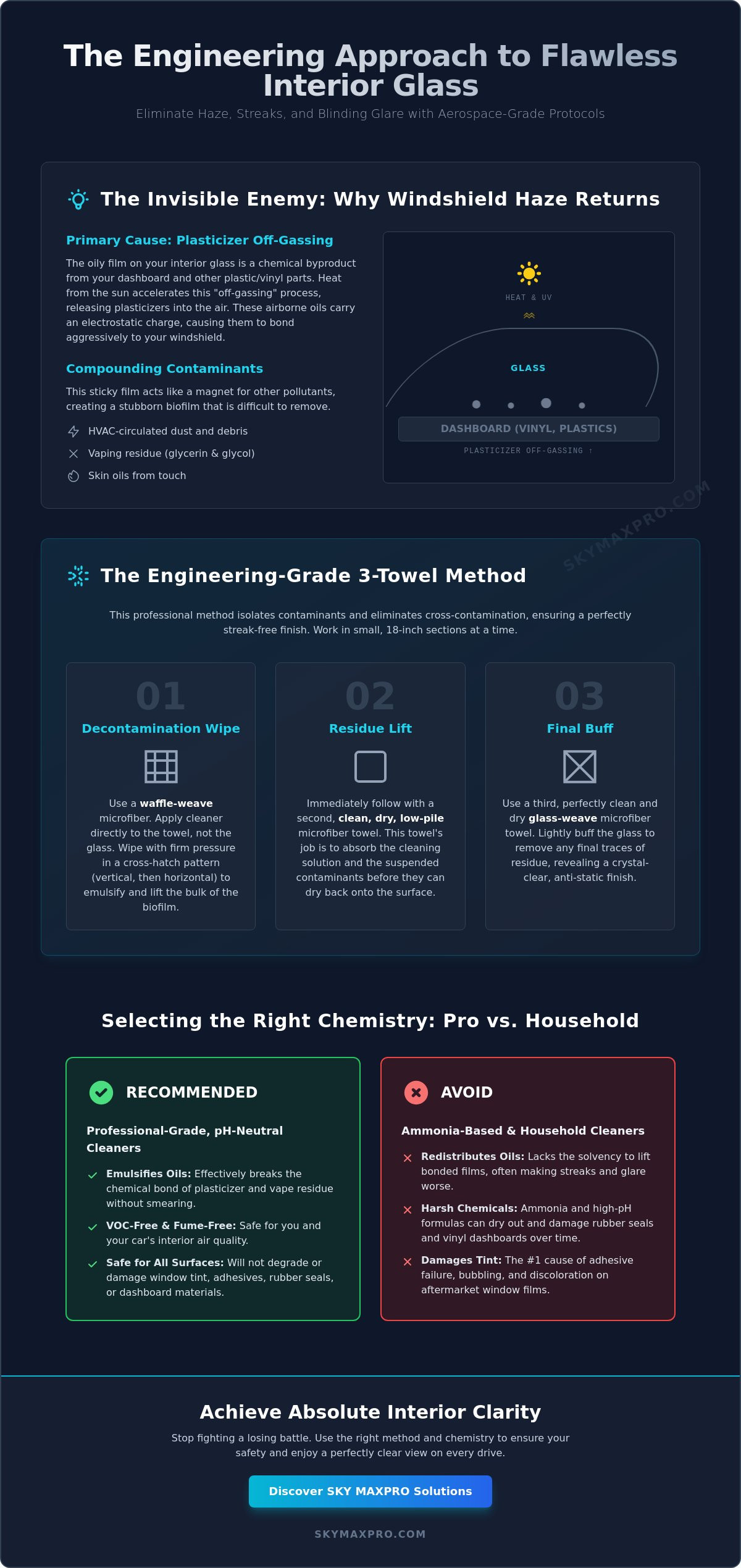
Modern vehicle interiors rely heavily on vinyl, plastics, and various polymers to achieve durability and aesthetic appeal. These materials contain plasticizers, which are chemical additives designed to maintain flexibility and prevent cracking. Under thermal stress, these molecules undergo a phase change and are released into the cabin air. Off-gassing is the primary cause of interior glass haze. Once airborne, these oily particles carry an electrostatic charge that causes them to bond aggressively to the interior glass. This is why a simple dry wipe is ineffective; you're fighting a chemical bond, not just loose debris.
The Role of Environmental Contaminants
The internal environment of a vehicle is a closed loop that traps a variety of secondary pollutants. Your HVAC system acts as a delivery mechanism, blowing fine dust and microscopic debris against the windshield. When these particles meet the sticky plasticizer film, they become embedded, creating a stubborn "biofilm." Human factors also play a significant role. Skin oils from hands touching the glass or residue from cigarette smoke and vaping create unique chemical challenges. Vaping residue, in particular, contains vegetable glycerin and propylene glycol, which form a thick, hygroscopic layer. These contaminants require specific emulsifiers to break the chemical bond, as standard household cleaners lack the solvency power to lift these heavy oils without leaving streaks behind.
The Engineering-Grade 3-Towel Method for Streak-Free Clarity
Most drivers fail to achieve a clear finish because they rely on a single cloth, which merely redistributes emulsified oils across the glass. Professional results require a segmented mechanical approach. The best way to clean inside of windshield surfaces involves a three-stage process designed to isolate contaminants from the final finish. This method eliminates cross-contamination by ensuring that soiled fibers never touch a decontaminated surface. By working in small, 18-inch sections, you prevent the cleaning solution from evaporating before the residue can be lifted, a common cause of persistent hazing.
Engineering precision requires specific tools. Standard plush towels are designed for general absorption but often shed lint or trap debris that causes micro-marring on the glass. Instead, this method utilizes specialized glass-weave and waffle-weave microfibers. These fabrics feature a tight, flat weave that provides the necessary friction to shear off the bonded plasticizer film mentioned in the previous section. For high-performance results, using a specialized Window Crystal Multi Cleaner alongside this method optimizes the chemical breakdown of the biofilm.
Step 1: The Decontamination Wipe
The initial phase focuses on chemical emulsification and bulk removal. Apply your cleaner directly to a low-pile microfiber towel rather than the glass. This prevents overspray from landing on the dashboard or sensitive electronics. Use a strict cross-hatch wiping pattern: move the towel in overlapping vertical lines, followed by horizontal lines. This systematic coverage ensures no section of the oily film remains untouched. This stage is finished once the towel glides smoothly, indicating the heaviest contaminants have been transferred from the glass to the fibers.
Step 2: The Buffing Pass
Immediately follow with a second, clean waffle-weave towel to lift any remaining liquid residue. This specific weave is engineered with a "pocketed" structure that traps emulsified oils before they can dry and leave "ghosting" marks. These marks are often invisible in the garage but become dangerously apparent when direct sunlight hits the glass. Flip the towel to a fresh quadrant frequently to maintain maximum absorption. To reach the difficult corners near the VIN plate, reverse your grip and use the back of your hand to press the towel into the narrow gap where the dashboard meets the glass.
Step 3: The Final Dry Polish
The final stage is a mechanical dry polish using a high-gsm microfiber towel. This cloth must be completely dry and free of any chemical agents. Its purpose is to remove the microscopic streaks that remain after the chemical cleaning phase. These streaks are the primary cause of refractive glare during night driving. Use light pressure and circular motions to ensure total clarity. The final dry buff is the secret to professional results.
Selecting the Right Chemistry: Ammonia vs. Professional Glass Cleaners
Mechanical precision remains ineffective if the chemical agents used are incompatible with automotive surfaces. While the 3-towel method provides the necessary physical framework, your choice of solvent determines the long-term integrity of your vehicle's interior. Finding the best way to clean inside of windshield glass requires a move away from generic household alkalines toward specialized surfactants. Most consumer-grade products rely on aggressive chemicals that, while suitable for residential windows, present significant risks to the complex materials found in a modern vehicle cabin.
Professional formulations prioritize the use of "fast-flash" surfactants. These compounds are engineered to reduce the surface tension of water instantly, allowing the cleaner to encapsulate and lift oils without the need for heavy scrubbing. Because these surfactants are designed to evaporate rapidly, they leave no soapy residue or secondary film behind. This is a critical distinction from household cleaners that often contain soaps and scents, which contribute to the very streaks you're attempting to eliminate. The engineering behind Window Crystal Multi Cleaner focuses on this absolute clarity by utilizing a VOC-free (Volatile Organic Compound) formula. This is essential for enclosed interiors, as it prevents the release of harmful vapors that can degrade air quality and contribute to new film formation.
The Danger of Ammonia in Automotive Detailing
Ammonia, or ammonium hydroxide, is a frequent component in low-cost cleaners due to its degreasing power. However, its chemical profile is destructive to automotive components. When ammonia comes into contact with window tint, it acts as a solvent on the polyester and the adhesive layers. This chemical reaction leads to the "purpling" and bubbling often seen on older vehicles. Beyond the glass, ammonia vapors are highly corrosive. They can prematurely dry out leather upholstery and interfere with the sensitive calibration of dashboard sensors or head-up display units. Professional detailers exclusively use ammonia-free formulations to ensure these high-value components remain protected.
The Advantage of Aerospace-Grade Formulations
Modern glass care has evolved to include nanotechnology-based cleaners that operate at a molecular level. These formulations don't just sit on top of the haze; they penetrate the microscopic pores of the glass to break the bond of the plasticizer film. By emulsifying these oils completely, the residue can be lifted away rather than simply thinned out across the surface. This level of chemical precision is a cornerstone of professional maintenance. You can explore these concepts further in our Engineering the Perfect Shine guide, which details the evolution of car cleaning products. Utilizing biodegradable, eco-friendly ingredients ensures that the best way to clean inside of windshield surfaces is safe for both the technician and the vehicle's occupants.
Beyond Cleaning: Anti-Fog Technology and Long-Term Protection
Achieving a streak-free surface is a critical first step, but it doesn't address the environmental variables that compromise visibility over time. Professional glass maintenance involves a transition from reactive cleaning to proactive surface engineering. The best way to clean inside of windshield glass concludes with the application of a specialized barrier that manages moisture and airborne contaminants. This stage focuses on the manipulation of surface energy, specifically the balance between hydrophobic and hydrophilic properties.
While exterior glass benefits from hydrophobic coatings that bead water for rapid runoff, interior glass requires a different approach. Anti-fog technology often utilizes hydrophilic principles to reduce the surface tension of water. Instead of forming millions of microscopic droplets that scatter light and create fog, moisture is encouraged to spread into a uniform, transparent sheet. Modern ceramic technology has refined this process by incorporating SiO2 (silicon dioxide) particles that bond to the glass at a molecular level. This creates a semi-permanent shield that resists the accumulation of the plasticizer film discussed in earlier sections. Utilizing a dedicated Anti-Fog Spray Ceramic Protection ensures that your visibility remains constant despite rapid temperature shifts or high cabin humidity.
How Anti-Fog Ceramics Function
Ceramic-based anti-fog agents provide a microscopic leveling effect. Automotive glass, though seemingly smooth, contains peaks and valleys that trap moisture and pollutants. The SiO2 particles within the coating fill these voids, creating an ultra-flat surface. This physical change significantly reduces maintenance frequency because contaminants have fewer points of attachment. These coatings also help neutralize the electrostatic charge of the glass. By reducing this charge, you effectively repel the dust and oily particles that would otherwise be drawn to the windshield through static attraction.
Application Tips for Glass Coatings
Successful integration of a ceramic barrier requires a perfectly decontaminated surface. Any residual oils or surfactants from the cleaning phase will prevent the coating from bonding correctly, leading to premature failure or uneven performance. Ensure the glass is cool to the touch and out of direct sunlight during application to manage curing times effectively. This proactive step complements a comprehensive Professional Auto Detailing routine, providing a final layer of security against environmental degradation. Once cured, the coating acts as a durable sacrificial layer, making the best way to clean inside of windshield surfaces even more efficient in future sessions.
The SKY MAXPRO Solution for Absolute Interior Clarity
SKY MAXPRO represents the intersection of industrial chemistry and automotive precision. While the previous sections established the mechanical and chemical requirements for glass maintenance, the execution depends on the quality of the agents used. The best way to clean inside of windshield surfaces is to utilize a system that mirrors the rigorous standards of the aerospace industry. By prioritizing measurable efficiency over marketing trends, we provide solutions that address the root causes of interior contamination rather than simply masking the symptoms.
Why Aerospace-Grade Standards Matter for Your Car
Engineering standards for jet cockpits are among the most stringent in the world, as optical clarity is a non-negotiable safety requirement. SKY MAXPRO translates these aerospace-grade protocols into automotive care. Our formulations are USA-manufactured and meet eco-friendly chemical standards that prioritize both performance and interior air quality. By excluding harsh volatiles and ammonia, we ensure that the cleaning process is safe for all surfaces, including sensitive navigation screens and leather trim. This commitment to durability and safety means you're applying a product designed for high-stress environments to your daily vehicle. It's the most reliable way to maintain the structural and aesthetic integrity of your cabin.
Implementing the Professional System
For total cabin maintenance that extends beyond the glass, we recommend the complete Interior Cleaning Kit. This kit provides a structured approach to decontamination, ensuring that the plastics and vinyls responsible for off-gassing are properly treated to reduce future haze formation. Maintaining a showroom-quality cabin requires a holistic approach where every surface is treated with compatible chemistry.
Follow this final maintenance checklist to preserve your results:
- Perform a dry buff with a high-gsm microfiber every two weeks to remove light dust.
- Avoid using silicone-based dashboard dressings that accelerate off-gassing.
- Ensure your HVAC cabin filter is replaced at 15,000-mile intervals to reduce airborne particulates.
- Apply anti-fog ceramic protection every 90 days for optimal moisture management.
Achieving professional-grade results requires professional-grade equipment. Shop Professional Window Crystal Multi Cleaner today to experience the best way to clean inside of windshield glass with engineering precision.
Precision Maintenance for Sustained Optical Performance
Achieving a streak-free interior windshield requires a transition from basic cleaning to technical surface management. By addressing the root cause of plasticizer off-gassing and utilizing the 3-towel method, you'll eliminate the variables that cause recurring haze. We've established that the best way to clean inside of windshield glass involves a precise combination of mechanical shearing and advanced chemical surfactants. This rigorous process ensures your visibility isn't compromised by night-time glare or environmental contaminants.
SKY MAXPRO provides the industrial-grade tools necessary for this transformation. Our Window Crystal Multi Cleaner utilizes aerospace-approved nanotechnology to lift oils at a molecular level. These formulations are proudly manufactured in the USA and remain completely ammonia-free and VOC-free, ensuring the safety of your vehicle's interior materials and air quality. Upgrade to Professional Clarity with SKY MAXPRO Window Crystal Multi Cleaner and secure your path to safer, clearer driving today.
Frequently Asked Questions
Is it safe to use Windex on the inside of my car windshield?
Using standard Windex is generally discouraged for automotive applications because many versions contain ammonia. Ammonia is chemically incompatible with aftermarket window tints, causing the film to degrade, purple, and bubble. It also poses a risk to leather upholstery and sensitive dashboard electronics. For the best way to clean inside of windshield surfaces, stick to ammonia-free, professional-grade cleaners designed specifically for vehicle environments.
How often should I clean the inside of my windshield to prevent haze?
You should clean the interior glass every 30 to 60 days to maintain optimal optical clarity. The rate of plasticizer off-gassing increases in warmer climates, which may require monthly maintenance. Regular cleaning prevents the buildup of thick oily films that become harder to emulsify over time. Consistent maintenance also reduces the amount of light-scattering residue that contributes to dangerous night-time glare.
Why does my windshield fog up immediately after I clean it?
Fogging immediately after cleaning is usually caused by residual surfactants or moisture left on the glass surface. If the cleaning agent isn't completely buffed away, it leaves a hydrophilic residue that attracts water molecules from the air. This is why the final dry buffing stage is critical. Using a high-gsm, dry microfiber ensures that every microscopic trace of cleaner is removed, preventing premature condensation.
What is the best type of microfiber towel for cleaning glass?
The best type of microfiber for glass is a waffle-weave or a flat-weave glass towel. Standard plush microfibers are designed for absorption and can leave behind lint or trap debris that causes micro-marring. Waffle-weave towels feature a pocketed structure that effectively traps emulsified oils. These specialized weaves provide the necessary mechanical friction to shear through bonded biofilms without shedding fibers on the decontaminated glass.
Can I use a magic eraser to clean the inside of my windshield?
You should avoid using a magic eraser on your interior windshield. These sponges are made of melamine foam, which acts as an extremely fine abrasive. While they might remove surface dirt, they can also cause microscopic scratches in the glass or damage integrated coatings. These scratches scatter light and permanently increase glare, making it much harder to achieve a true streak-free finish.
How do I remove stubborn suction cup marks or sticker residue from the glass?
To remove adhesive residue or suction cup marks, use a specialized degreaser or a high-concentration isopropyl alcohol solution. Apply the solvent to a towel and hold it against the residue for 30 seconds to emulsify the bond. Once the adhesive is softened, use a clean microfiber to lift the material away. Avoid using metal blades, as they can scratch the glass or damage the surrounding trim.
Does cleaning the dashboard help keep the windshield clean?
Cleaning your dashboard is a vital step in maintaining a clear windshield. The HVAC system frequently blows dust and skin oils from the dashboard surface directly onto the glass. By decontaminating the dashboard with a dedicated interior cleaner, you reduce the volume of airborne particulates in the cabin. This proactive approach is the best way to clean inside of windshield areas while extending the time between deep cleans.
What is the best way to reach the bottom edge of the windshield?
Reaching the tight gap where the windshield meets the dashboard requires a reverse-hand grip or a specialized glass cleaning tool. You can wrap a microfiber towel around a reach-and-clean wand to access the bottom two inches of glass easily. If working by hand, use the back of your hand to press the towel into the corner. This technique allows for consistent pressure in areas where your palm cannot fit.