

If you believe a standard wash prepares your vehicle for a high-performance coating, you're effectively sealing microscopic industrial fallout into your clear coat. Surface decontamination isn't a cosmetic choice; it's a rigorous engineering requirement for anyone seeking a glass-smooth, aerospace-grade finish. We recognize the hesitation many feel when learning how to use a clay bar, particularly the fear of marring the paint or selecting the incorrect grade for the specific level of contamination.
This guide eliminates that technical uncertainty by providing a structured framework for automotive decontamination. You'll master the professional process of using the Final Touch I PRO Detailing Clay to extract rail dust and bonded contaminants safely. By following these precise protocols, you ensure your surfaces are chemically optimized for advanced bonding with our Ceramic Graphene Shield Coating. We'll examine the specific lubrication requirements and mechanical movements necessary to achieve a flawless result. With the car detailing product market reaching $6.4 billion in 2026, professional-grade precision is no longer optional for those protecting their automotive investments through advanced nanotechnology.
Key Takeaways
- Understand the molecular mechanism of detailing clay and how a specialized resin mixture shears off bonded contaminants without compromising the substrate.
- Master the systematic, phase-based approach on how to use a clay bar to ensure uniform decontamination and prepare surfaces for high-performance coatings.
- Learn to implement the "Dropped Clay Protocol" and other professional risk-mitigation strategies to prevent clear coat marring during the mechanical cleaning process.
- Identify why paint is most vulnerable immediately after decontamination and how to execute the correct post-claying protocol to secure long-term surface protection.
- Optimize your surface prep to achieve an aerospace-grade finish that ensures maximum bonding efficiency for the Ceramic Graphene Shield Coating.
The Science of Surface Decontamination: What is a Clay Bar?
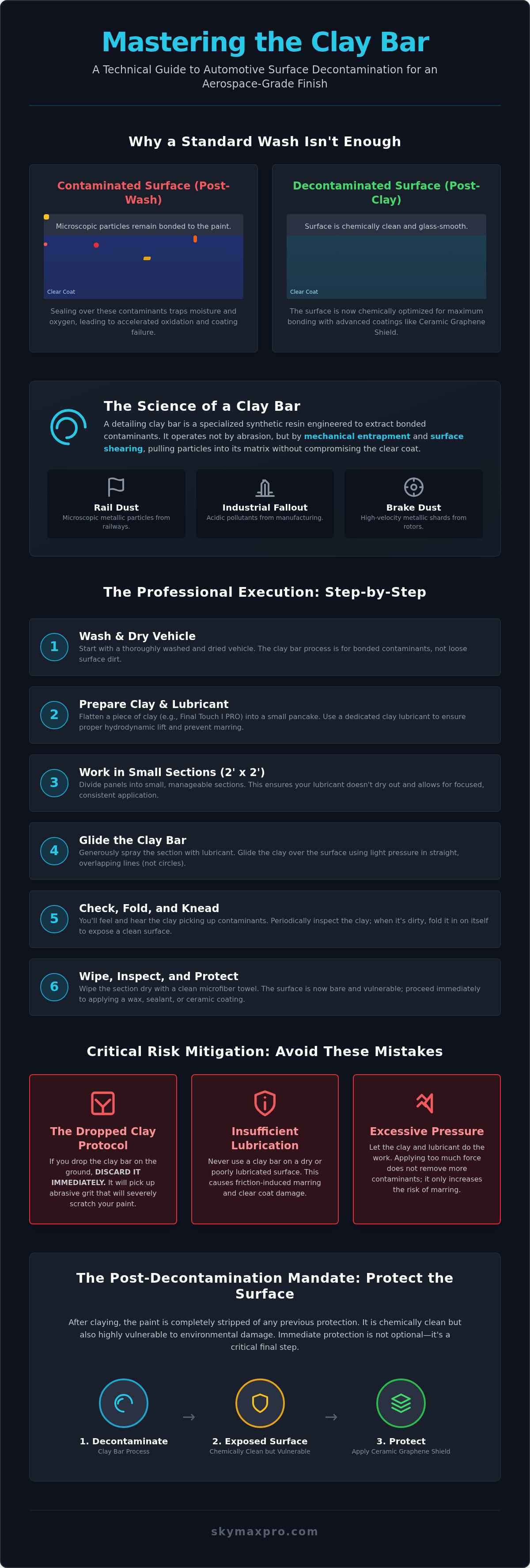
Detailing clay is a specialized synthetic resin mixture engineered to extract bonded contaminants from automotive surfaces. Unlike abrasive compounds that level the clear coat through friction, clay operates via mechanical entrapment. It's designed to snag particles that protrude above the paint's surface, pulling them into the resin matrix without compromising the substrate. This process, known as surface shearing, is a fundamental requirement for achieving a chemically clean surface. When you learn how to use a clay bar, you're transitioning from simple cleaning to true surface engineering.
The molecular mechanism of detailing clay allows it to capture specific environmental pollutants that a standard wash cannot remove. These contaminants bond to the clear coat through heat and kinetic energy, becoming permanent fixtures of the surface. Detailing clay targets three primary categories of debris:
- Rail Dust: Microscopic metallic particles produced by train tracks and transport systems.
- Industrial Fallout: Acidic chemical pollutants and metallic byproducts from manufacturing plants.
- Brake Dust: High-velocity metallic shards shed from brake rotors during deceleration.
If left unaddressed, these particles oxidize and create microscopic pits in the paint. Mastering how to use a clay bar ensures these contaminants are removed before they cause permanent structural damage to the vehicle's finish.
Traditional Clay vs. Synthetic Detailing Clay Formulations
Early detailing clays relied on natural clay bases, which were often inconsistent and prone to rapid degradation. Modern professional standards have shifted toward advanced synthetic resins. This technology was originally developed for aerospace applications to maintain the aerodynamic integrity of high-performance surfaces. The Final Touch I PRO Detailing Clay represents the peak of this evolution. It utilizes a high-density synthetic resin that offers superior durability and efficiency. These professional-grade formulations are more resistant to chemical breakdown, allowing for more consistent results across multiple vehicle panels.
The Role of Lubrication in Surface Dynamics
Lubrication is a critical technical requirement in the decontamination process. Without a dedicated lubricant, the clay's resin would adhere directly to the clear coat, leading to friction-induced marring. Standard water or soap solutions often lack the specific surfactants necessary to maintain a stable boundary layer. Professional lubricants are chemically formulated to reduce surface tension while providing the necessary glide for the resin matrix. Hydrodynamic lift is the pressurized fluid layer created between the clay resin and the clear coat that prevents direct contact while allowing the clay to shear off bonded particles. This fluid dynamic principle ensures the tool remains effective without damaging the paint's optical clarity.
Engineering the Surface: Why Clay Barring is Mandatory for Professional Results
Surface engineering requires more than visual clarity. Even paint that appears clean can harbor thousands of bonded particles per square inch. These contaminants disrupt light refraction, which directly degrades the surface gloss and depth. When light hits a contaminated surface, it scatters in multiple directions instead of reflecting uniformly. This reduction in specular reflection is why a vehicle lacks that "wet" look despite being washed. Understanding how to use a clay bar allows you to restore the optical flat, maximizing light return and depth of image.
If you skip this step, you risk sealing these contaminants under your protection layer. Applying a wax or sealant over fallout creates a barrier that traps moisture and oxygen against the particle, leading to accelerated oxidation. For those applying advanced nanotechnology like our Ceramic Graphene Shield, the stakes are higher. The coating must achieve a covalent bond with the clear coat. If the graphene molecules anchor to a piece of brake dust instead of the paint, the entire section of protection will fail prematurely as that particle eventually dislodges. Utilizing a high-density tool like the Final Touch I PRO Detailing Clay ensures the surface is chemically receptive to these advanced formulas.
The Plastic Bag Test remains the industry standard for diagnostic assessment. By placing your hand inside a thin polyethylene bag and sliding it over a clean, dry surface, you amplify tactile feedback. The plastic acts as a transducer, making microscopic bumps feel like sandpaper. If the surface isn't glass-smooth through the bag, the decontamination phase is incomplete. This diagnostic methodology should be applied to every panel to determine the specific level of mechanical decontamination required.
Identifying Bonded Contaminants and Industrial Fallout
Environmental hazards such as acid rain deposits, tree sap, and road tar create semi-permanent bonds with the clear coat that standard surfactants cannot break. Rail dust is particularly insidious; these metallic particles embed themselves into the paint and begin to oxidize. This process creates "rust blooms," which appear as small orange spots indicating the metal is corroding from within the paint layer. Visual indicators are often subtle on darker colors, making the tactile indicators found during the plastic bag test essential for a complete assessment.
The Necessity of Prep for Ceramic Graphene Coatings
Graphene-based nanotechnology requires a specific surface energy for optimal adhesion. A decontaminated surface extends the life of a ceramic coating by providing a uniform substrate for the cross-linking process. Following a Master Detailing Checklist ensures that every panel meets aerospace-grade standards before the final protection layer is applied. This level of preparation is what separates hobbyist results from professional-grade durability and ensures the coating performs to its maximum technical specification.
The Professional Execution: How to Use a Clay Bar Step-by-Step
Executing a professional decontamination requires a disciplined, phase-based approach to ensure the clear coat remains pristine. The process begins with a rigorous pre-decontamination wash using a high-lubricity car shampoo. This step is non-negotiable; it removes loose abrasive particles that would otherwise be trapped under the clay and dragged across the finish. Once the vehicle is chemically and mechanically washed, the surface must remain wet to facilitate the next phase of the operation. Mastering how to use a clay bar is as much about managing the environment as it is about the physical movement of the resin.
Sectioning and Environmental Control
Systematic coverage is achieved by dividing each body panel into a 2x2 foot grid. Working in these small, controlled sections prevents the lubricant from evaporating or "flashing" before the process is complete. If the lubricant dries, the clay will skip and leave resin deposits on the paint, requiring additional work to remove. Surface temperature management is equally critical. You should always perform this procedure on a cool surface out of direct sunlight. High temperatures increase the clear coat's porosity and cause lubricants to fail, which significantly raises the risk of surface marring. By utilizing an overlapping pass technique, you ensure 100% of the panel is decontaminated, leaving no industrial fallout behind.
The Shearing Technique: Pressure and Movement
The most common error in learning how to use a clay bar is the application of excessive downward force. Professional results require a "zero-pressure" stroke. You should guide the clay across the lubricated surface using only the weight of your hand. The specialized resin in the Final Touch I PRO Detailing Clay is designed to do the mechanical work of shearing off contaminants through its own tackiness and composition. As the clay moves, you can utilize acoustic feedback to monitor progress. A contaminated surface will produce a distinct "hissing" or scratching sound. As the particles are extracted and the surface becomes glass-smooth, this noise will dissipate into total silence. This auditory cue is a reliable indicator that the section is clean.
Maintaining a fresh working surface is vital for safety. After every section, or when the clay face shows visible discoloration, you must implement the folding protocol. Stretch the clay and fold it over itself to bury the captured contaminants deep within the resin matrix. This ensures that you're always presenting a clean, effective surface to the paint. Once a section is complete, perform a final inspection using the diagnostic methods discussed previously. Use a clean, high-GSM microfiber towel to dry the area immediately, preventing water spotting and preparing the substrate for the subsequent protection phase.
Mitigating Risk: Common Clay Bar Mistakes and Marring Prevention
Maintaining technical integrity throughout the decontamination process requires a strict adherence to safety protocols. The primary risk associated with learning how to use a clay bar is surface marring, a phenomenon where the clear coat is microscopically scuffed due to insufficient lubrication. When the boundary layer of fluid fails, the resin makes direct contact with the paint, dragging contaminants across the surface rather than encapsulating them. This error is entirely preventable through the consistent application of high-lubricity surfactants and a disciplined work rhythm.
The Dropped Clay Protocol is a non-negotiable standard in professional detailing. If the clay bar makes contact with the ground, it must be discarded immediately. Professional resin matrices are designed to be extremely tacky to capture fallout, which means they instantly embed microscopic silica and grit from the floor. Attempting to wash the bar or cut off the contaminated section is insufficient; the risk of introducing deep scratches into the clear coat outweighs the cost of a new bar. High-performance surface engineering leaves no room for compromised tools.
Lubrication Failure and Surface Marring
Visual signs of marring typically appear as a light, cloudy haze or fine scuffing on the paint surface. While this is often a byproduct of aggressive decontamination, it's usually rectifiable with a light finishing polish. To minimize this, you must ensure your car detailing supplies are chemically compatible. Some lubricants can actually break down the clay resin, leading to "clay residue" sticking to the paint. Maintain a "wet" surface by misting the panel every three to four passes. This prevents the lubricant from flashing and ensures the hydrodynamic lift remains constant throughout the section.
Clay Grade Selection: Light vs. Medium vs. Heavy
Selecting the correct grade is a matter of grit density and resin firmness. Professional detailing follows the "least aggressive method" principle. You should always begin with a light-grade clay, as it's formulated to remove standard environmental fallout with minimal risk of marring. Medium and heavy grades contain higher concentrations of abrasive particulates designed for severe industrial contamination or overspray. Escalating to a heavier grade should only occur when a light bar fails to achieve a glass-smooth finish. Heavy-grade clays almost always require a subsequent polishing step to restore optical clarity, making them a specialized tool for restoration rather than routine maintenance.
Once the mechanical decontamination is complete, a final rinse is essential. This removes residual lubricant surfactants and loosened particles that may have settled on the surface. For the highest level of surface preparation, ensure you are using the Final Touch I PRO Detailing Clay to guarantee a residue-free finish. This final cleansing step ensures that the substrate is chemically neutral and ready for the final inspection before you apply advanced graphene protection.
Post-Decontamination Protocol: Protecting the Refined Surface
Immediately following the mechanical extraction of contaminants, the automotive clear coat exists in its most vulnerable state. The process of how to use a clay bar effectively strips away all previous waxes, sealants, and environmental films, leaving the substrate completely exposed. This "chemically naked" surface is highly susceptible to rapid oxidation and new contaminant bonding if not stabilized within a narrow operational window. Professional surface engineering dictates that the refinement and protection phase must begin immediately after the final rinse and drying protocol are completed.
The global car detailing service market is valued at $49.8 billion in 2026, reflecting a significant consumer shift toward treating vehicles as long-term investments rather than disposable assets. Protecting that investment requires moving beyond basic cleaning to advanced surface stabilization. Once you've mastered how to use a clay bar to achieve a glass-smooth finish, the next technical objective is to ensure that smoothness is preserved against the elements. This requires a transition from mechanical cleaning to chemical shielding.
Polishing vs. Sealing: The Final Refinement
A critical diagnostic step at this stage is the visual assessment of the paint's optical clarity. Removing the layer of industrial fallout often reveals underlying defects, such as swirl marks or light holograms, that were previously obscured by the "dirt mask." If the objective is a mirror-grade shine, a light finishing polish is required to level these microscopic imperfections. However, if the surface is already optically satisfactory, you can proceed directly to the stabilization phase. The choice between a traditional wax and a high-performance sealant depends on the required durability, but for aerospace-grade results, nanotechnology is the only logical progression for modern clear coats.
Integrating Ceramic Graphene Shield Protection
Integrating the Ceramic Graphene Shield provides the definitive solution for long-term stabilization. Unlike traditional waxes that sit on top of the paint, graphene-based nanotechnology creates a cross-linked barrier that integrates with the clear coat at a molecular level. This creates a high-surface-tension environment that is hydrophobic and oleophobic, resulting in a self-cleaning effect that repels future industrial fallout and rail dust. For a detailed technical breakdown of this application process, refer to our Ceramic Coating Guide.
Maintenance is the final component of the decontamination lifecycle. To prevent the re-accumulation of particles, we recommend a maintenance wash every 10 to 14 days using pH-neutral surfactants. Consistent maintenance ensures you only need to perform aggressive mechanical decontamination once every 6 to 12 months. This systematic approach preserves the integrity of the graphene barrier and ensures the vehicle maintains its peak light refraction and structural protection indefinitely.
Surface Refinement as a Technical Standard
Achieving an aerospace-grade finish is a matter of systematic execution rather than aesthetic preference. You now understand that mechanical decontamination is the critical prerequisite for any high-performance coating. By mastering the technical nuances of how to use a clay bar, you've moved from basic maintenance to precise surface engineering. This process ensures that industrial fallout is extracted without compromising the clear coat's integrity, providing the ideal substrate for molecular bonding. Precision in lubrication and pressure management remains the only way to avoid surface marring and ensure optimal light refraction.
The transition from a contaminated surface to a glass-smooth finish requires the right tools and a disciplined approach. Once the mechanical cleaning is complete, your focus must shift to stabilizing the refined surface with advanced nanotechnology to prevent future accumulation. Upgrade to the Final Touch I PRO Detailing Clay for Aerospace-Grade Results. Our formulations feature aerospace-grade nanotechnology and are engineered in the USA for maximum efficiency. Professional bulk distribution is available for commercial operations seeking to optimize their workflow with the highest industry standards. Your vehicle's finish is now prepared for the ultimate level of protection.
Frequently Asked Questions
Can I use a clay bar on a brand-new car?
Yes, brand-new vehicles frequently require decontamination. Most new cars accumulate rail dust and industrial fallout during transport from the factory to the dealership. Performing a mechanical cleaning ensures the surface is chemically clean before you apply a long-term protection layer. This step is a standard requirement in professional prep protocols to ensure the paint is optimized for maximum gloss and adhesion.
Is it possible to use a clay bar without a lubricant?
No, using a clay bar without a dedicated lubricant will cause immediate friction-induced marring. The lubricant creates a critical boundary layer that allows the resin to shear off contaminants without adhering to the clear coat. Attempting this procedure dry or with plain water will result in resin deposits and surface damage that requires mechanical polishing to correct. Lubrication is the most vital technical component of the process.
How often should I clay bar my vehicle for optimal maintenance?
Most vehicles require mechanical decontamination twice per year, typically following seasonal transitions. However, the frequency depends on environmental exposure and the presence of industrial pollutants. You should perform the Plastic Bag Test after every maintenance wash. If the surface feels abrasive through the polyethylene barrier, it's time to re-evaluate how to use a clay bar for your specific contamination levels to maintain surface integrity.
Does clay barring remove scratches or swirl marks from the paint?
No, detailing clay is not an abrasive leveling agent and cannot remove scratches or swirl marks. It's engineered specifically to extract bonded surface contaminants that protrude above the paint's surface. To remove defects within the clear coat itself, you must use a mechanical polisher and an abrasive compound. Claying simply prepares the substrate for this refinement process by ensuring no debris is dragged across the finish.
What happens if I drop my clay bar on the ground?
You must discard the clay bar immediately if it touches the ground. The resin's high tackiness instantly captures sand, grit, and microscopic silica from the floor. These particles cannot be washed away or picked out effectively. Reusing a dropped bar will cause severe scratching and permanent clear coat damage. This is a non-negotiable professional risk-management standard for automotive surface care.
Can I use a clay bar on glass, chrome, or plastic trim?
Clay bars are highly effective on glass and chrome for removing mineral deposits and road film. However, you should avoid using them on textured plastic trim. The resin can leave white residue in the plastic grain that's difficult to extract. For smooth, non-porous surfaces, ensure you maintain high lubricity to achieve an aerospace-grade finish across all exterior components without leaving behind resin streaks.
Do I need to wash my car again after using a clay bar?
A final rinse or a quick wash is recommended to remove residual lubricant surfactants. These chemicals can interfere with the covalent bonding of a ceramic coating if they aren't neutralized. A thorough wipe-down with a clean microfiber towel and a dedicated surface prep spray ensures the clear coat is chemically pure. This final cleansing step prepares the vehicle for the subsequent protection phase.
Will a clay bar remove my existing wax or ceramic coating?
Detailing clay will strip traditional waxes and sealants due to its mechanical shearing action. While it won't instantly remove a fully cured ceramic coating, it can degrade the top layer and reduce hydrophobic performance. Understanding how to use a clay bar correctly involves knowing that this step acts as a reset button for your paint's protection, typically performed before reapplying a new protective shield.