

Could your attempt to remove stubborn industrial fallout actually be the very thing that compromises your vehicle's clear coat? Many enthusiasts and professionals understand the frustration of finding heavy grease or road film that standard soaps simply cannot touch. It's a high-stakes scenario where the fear of chemical staining or permanent etching often prevents the deep cleaning necessary for proper paint protection.
We agree that the boundary between effective decontamination and surface damage is dangerously thin. This guide teaches you how to safely use a degreaser on car paint by applying engineering-grade protocols to your detailing workflow. You'll master the technical balance of chemical strength and dwell time to ensure a surgically clean surface ready for ceramic application.
We'll examine the impact of 2026 EPA regulations on solvent availability, including the critical restrictions on Trichloroethylene (TCE) and Methylene Chloride. You'll also learn the precise dilution ratios and neutralization techniques required to achieve professional results with zero risk to your automotive finish. By following these data-driven steps, you can eliminate industrial contaminants while maintaining the long-term integrity of your vehicle's exterior.
Key Takeaways
- Identify the molecular interaction between high-alkaline surfactants and clear coat polymers to prevent chemical etching and structural degradation.
- Master how to safely use a degreaser on car paint by strictly managing surface temperatures and thermodynamic drying risks during application.
- Apply technical protocols for pre-washing and fine-mist distribution to ensure uniform decontamination without introducing abrasive grit to the surface.
- Execute a pH-balanced neutralization phase using professional car shampoo to halt residual chemical reactions that standard water rinsing cannot stop.
- Leverage aerospace-grade engineering with Heavy Duty Red Power Degreaser to achieve industrial-strength cleaning with professional-grade safety margins.
Understanding the Chemistry of Automotive Degreasers and Paint Safety
Automotive degreasers are high-performance surfactants engineered to disrupt the molecular bonds of stubborn hydrocarbons. Unlike standard car wash soaps that rely on surface tension reduction to lift loose dirt, degreasers use alkaline or solvent-based chemistry to emulsify lipids, oils, and bonded resins. Understanding how to safely use a degreaser on car paint requires a technical appreciation for the composition of modern car paint. While the clear coat is a resilient polymer layer designed to protect the basecoat, it remains a porous structure. If aggressive chemicals dwell too long or reach extreme temperatures, they can penetrate these pores, leading to permanent structural failure or clouding.
Standard maintenance shampoos often fail to remove specific industrial contaminants. Bonded road tar, silicone-based tire dressings, and heavy grease from suspension components create a hydrophobic barrier that resists traditional washing. A professional-grade degreaser is necessary to break these bonds without mechanical abrasion, which could otherwise introduce swirl marks into the finish.
Alkaline vs. Solvent Formulations
Alkaline degreasers utilize a high pH level to initiate saponification, a process that converts fats and oils into water-soluble salts. These are highly effective for organic contaminants but carry risks for sensitive surfaces. High-pH solutions can quickly oxidize bare aluminum trim or cause stress cracking in certain automotive plastics if not properly diluted.
Solvent-based degreasers are technically superior for inorganic, petroleum-based contaminants like bitumen and heavy oils. As of 2026, the regulatory landscape has shifted significantly. EPA enforcement of the Toxic Substances Control Act (TSCA) Section 6 now prohibits or strictly limits traditional solvents like Trichloroethylene (TCE) and Methylene Chloride. Modern engineering has replaced these with safer, bio-based alternatives that offer high solvency without the extreme health or environmental risks associated with legacy chlorinated solvents.
When is Paint Degreasing Technically Necessary?
Deep decontamination is a prerequisite for any professional-grade protection application. You must remove all sacrificial layers, including old carnauba waxes and polymer sealants, to ensure that a new ceramic coating can form a direct covalent bond with the clear coat. Standard washing is insufficient for this level of surface preparation.
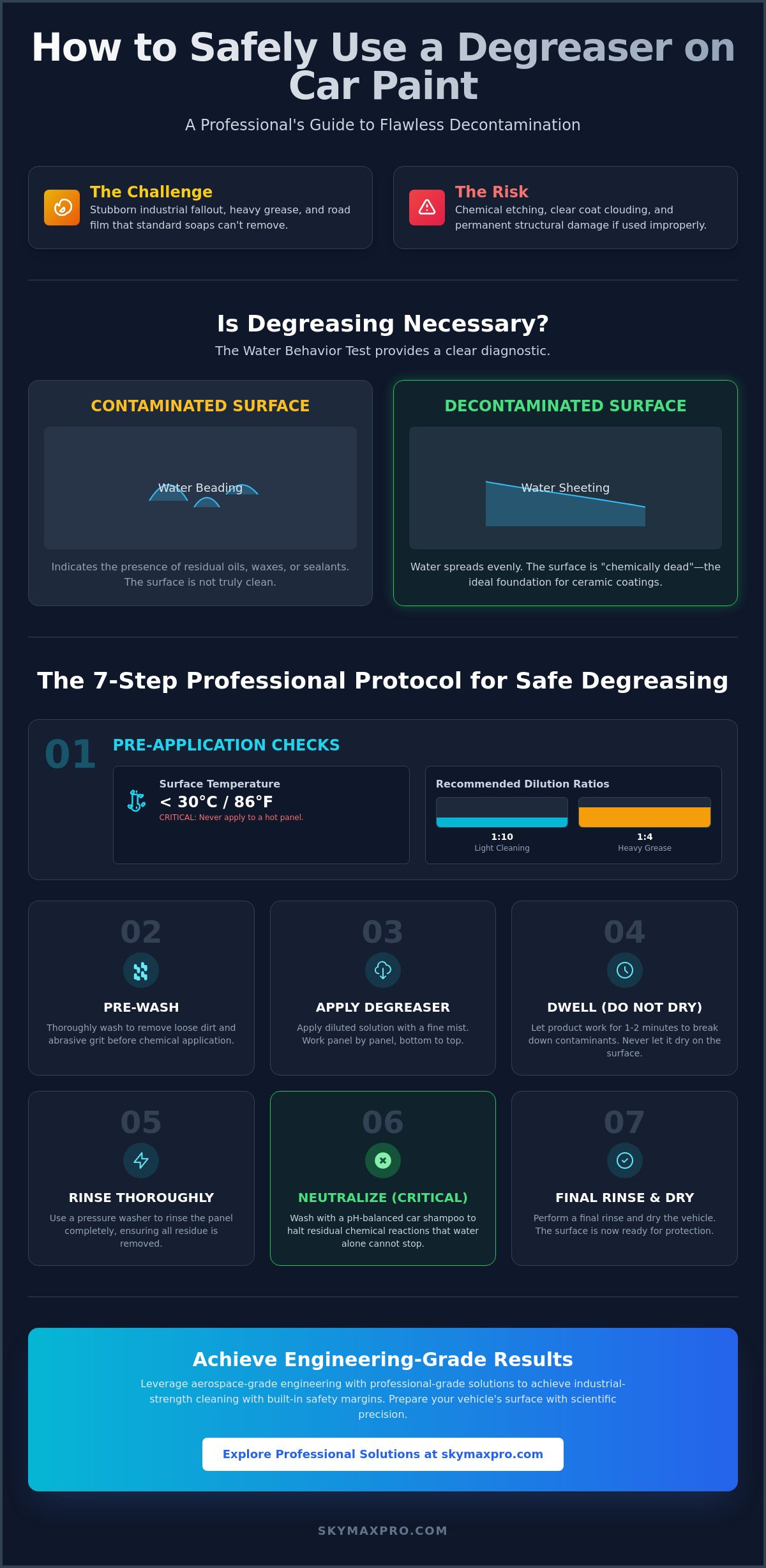
The "water behavior test" serves as a reliable diagnostic tool for identifying when degreasing is required. After a thorough wash, observe how water interacts with the panel. If water beads or sheets slowly on a supposedly clean surface, it indicates the presence of residual oils or waxes. A successful degreasing process will leave the paint "chemically dead," where water flat-sheets across the surface, confirming that all hydrophobic contaminants have been neutralized. This state is the ideal foundation for applying advanced protection like Ceramic Graphene Shield Coating.
Pre-Application Protocol: Assessing Surface Temperature and Dilution
Successful decontamination begins with thermal management. You must ensure the vehicle surface is cool to the touch before introducing any concentrated cleaners. Applying high-alkaline chemicals to a sun-heated panel triggers rapid evaporation of the aqueous carrier. This process leaves behind a highly concentrated chemical residue that can cause irreversible paint etching within seconds. Understanding how to safely use a degreaser on car paint requires you to control these thermodynamic variables before the first spray hits the panel. If the surface temperature exceeds 30°C (86°F), the risk of chemical flash-drying increases exponentially.
Before proceeding with full coverage, you must establish a hierarchy of dilution based on the specific contamination level. Engineering a custom solution prevents over-exposure to aggressive surfactants. We recommend the following ratios for professional applications:
- 1:10 Dilution: Ideal for light cleaning, removing fresh road film, or stripping weak sacrificial waxes.
- 1:4 Dilution: The standard for heavy grease, bonded exhaust soot, and petroleum-based road grime.
- 1:1 Dilution: Reserved for industrial-grade decontamination on non-sensitive surfaces, such as engine bays or heavy equipment.
Always perform a test spot on an inconspicuous area, such as the lower rocker panel or the inner door jamb. This diagnostic step confirms that the chemical concentration is effective without compromising the clear coat's finish. It's a simple protocol that prevents costly restoration work later.
The Impact of Surface Heat on Chemical Reactivity
Heat acts as a catalyst for chemical reactions. When paint is hot, the pores in the polymer structure expand, making it easier for chemicals to penetrate deeper than intended. If the water carrier evaporates too quickly, the remaining surfactants reach their flash point. This is the temperature at which the chemical can no longer remain stable on the surface. Working in a controlled, shaded environment or during low-UV hours is essential to maintain the necessary dwell time for emulsification. Without moisture, the degreaser cannot lift the grease; it simply bakes onto the finish.
Calculating Optimal Dilution Ratios
Precision in mixing is the hallmark of a professional detailer. Use deionized water for your dilutions to prevent mineral spotting, which occurs when "hard" water evaporates and leaves calcium deposits behind. When preparing your solution, follow the primary safety rule: always add the chemical to the water, not the water to the chemical. This prevents concentrated surfactants from splashing back toward your eyes or skin. For those seeking a high-performance concentrate, utilizing a professional-grade formula like Heavy Duty Red Power Degreaser allows you to adjust your cleaning power with surgical precision based on the task at hand. Once mixed, ensure the solution is thoroughly agitated to create a homogenous surfactant blend.
Step-by-Step Execution: Professional Application Techniques
Precision in application is as critical as the chemical composition itself. Before you begin, a thorough pre-wash is non-negotiable. You must remove loose abrasive grit and surface debris using a dedicated snow foam or high-pressure rinse. Introducing a degreaser to a surface contaminated with loose sand or dirt creates a high risk of mechanical scratching during the agitation phase. Once the surface is clear of particulate matter, you can proceed with the chemical decontamination process.
Apply the solution using a fine-mist sprayer to ensure uniform distribution across the panel. Avoid using a direct stream, which leads to excessive runoff and wasted product. The goal is to achieve a consistent thin film that stays in contact with the contaminants. This controlled approach is fundamental to how to safely use a degreaser on car paint, as it prevents localized chemical hotspots that could lead to uneven cleaning or staining.
The Section-by-Section Methodology
Divide the vehicle into manageable zones, typically one panel at a time. This strategy prevents the chemical from drying prematurely, which is a primary cause of clear coat damage. We recommend a "bottom-up" application technique. By starting at the lower rockers and moving upward, you ensure that any chemical runoff flows over surfaces already saturated with the solution. This prevents "dry streaking," where concentrated chemicals run down a dry panel and etch the paint before they can be agitated. Use overlapping horizontal strokes to guarantee that every square centimeter receives equal chemical exposure.
Managing Dwell Time to Prevent Etching
Dwell time is the specific window where the chemistry interacts with the contaminants without compromising the underlying substrate. For most automotive applications, this window spans 60 to 120 seconds, though ambient humidity will dictate the exact timing. In high-humidity environments, you may have the full two minutes; however, in drier conditions, you must act faster.
Monitor the surface for visual cues such as hazing or a "rainbow" effect, which indicate the aqueous carrier is evaporating. If you observe these signs, rinse the area immediately. For stubborn grease deposits, agitate the surface gently with a soft-bristled detailing brush or a high-GSM microfiber towel to break the bond. It's vital to remember that in chemical detailing, "more time" does not result in "more clean." Extended dwell times only increase the probability of polymer degradation and etching. Efficiency and timing are the keys to a safe, professional result.
Post-Process Neutralization and Surface Stabilization
Rinsing with pressurized water is an essential mechanical step, but it doesn't address the chemical imbalance left on the paint. High-alkaline degreasers contain surfactants and builders that can linger in the porous structure of the clear coat even after a visual rinse. These residues maintain a high pH level, which can lead to staining or "white spotting" if the vehicle is allowed to dry. Completing the protocol for how to safely use a degreaser on car paint requires a deliberate neutralization phase to stabilize the surface.
We utilize a "flood rinse" technique to ensure chemical purging from panel gaps, window seals, and trim. Unlike a high-pressure spray that can atomize chemicals and push them deeper into crevices, a low-pressure flood rinse uses the weight of the water to pull residue out of hidden areas. Once the bulk of the degreaser is removed, the surface enters a "squeaky clean" state. While this indicates successful decontamination, it also means the clear coat is entirely unprotected and highly vulnerable to environmental stressors.
Neutralizing Alkaline Residue
Neutralization is a fundamental chemical process where a pH-neutral agent counteracts an alkaline substance to reach an equilibrium of pH 7.0. In detailing, this is achieved by performing a secondary wash with a pH-balanced shampoo. This step ensures that no residual surfactants continue to react with the paint polymers. For final surface stabilization and to ensure a streak-free finish, we recommend using Ceramic Waterless Car wash. This product provides the necessary lubricity and stabilization to safely transition the paint to its next phase. You must pay special attention to door jambs and rubber seals. Failure to neutralize chemicals in these areas can lead to long-term corrosion or the drying out of essential weather stripping.
Restoring the Sacrificial Layer
A degreased surface is "naked." The removal of grease, oils, and old waxes leaves the clear coat exposed to UV radiation and rapid oxidation. However, this state is also the ideal foundation for advanced protection. Because there's no longer a barrier between the paint and the protection product, nanotechnology-based solutions can form a superior bond. Your roadmap for restoration should focus on high-durability options. Applying a ceramic graphene coating on a freshly stabilized surface ensures maximum longevity and chemical resistance. This engineering approach transforms a vulnerable surface into a reinforced barrier.
To maintain this level of precision in your detailing workflow, explore the full range of professional solutions at skymaxpro.com.
Professional-Grade Solutions: Engineering Excellence with SKY MAXPRO
Heavy Duty Red Power Degreaser represents the pinnacle of chemical engineering for surface decontamination. It's not a generic industrial solvent; it's a safe but aggressive blend of grease-cutting surfactants and biodegradable solvents. This formula aligns with 2026 EPA standards, ensuring high operational efficiency without the environmental liabilities of restricted chlorinated solvents like TCE or PCE. When you understand how to safely use a degreaser on car paint, you realize that the product's chemistry is just as important as the application protocol. Using a concentrated formula allows for the precise dilution ratios discussed earlier, providing the flexibility needed for everything from light road film to heavy industrial grease.
Why Aerospace-Grade Standards Matter for Your Car
SKY MAXPRO products are developed with an aerospace-approved heritage. Chemicals used in the aviation industry undergo rigorous testing on aircraft aluminum and advanced composites where material failure is not an option. These same standards translate directly to automotive surface safety. Our precision manufacturing process, based entirely in the United States, ensures that every batch meets strict quality control metrics. By using aerospace-grade formulations, you eliminate the risk of the chemical staining or polymer degradation often seen with lower-tier industrial cleaners. It's about providing a margin of safety that exceeds standard automotive requirements.
The Full Decontamination Kit
Achieving a surgically clean surface is a multi-stage process. Integrating a degreaser into your auto detailing routine is the first step in deep decontamination. For a glass-smooth finish, we recommend pairing the degreasing phase with Final Touch I PRO Detailing Clay. This removes any remaining embedded particulate matter that chemical surfactants alone cannot lift. The degreaser acts as the primary chemical cleaner, while the clay bar provides the final mechanical decontamination.
Once the surface is stabilized and neutralized, it's ready for long-term protection. We suggest following up with PRO Ceramic Graphene Spray Coating. This provides 2026-level protection, creating a high-gloss, hydrophobic barrier that resists the very contaminants you just removed. Mastering how to safely use a degreaser on car paint is the foundation of this professional-grade workflow. By following an engineering-led approach, you ensure your vehicle's finish remains pristine and protected against the harshest environments.
Shop professional car detailing supplies at SKY MAXPRO today.
Precision Engineering for Long-Term Surface Integrity
Mastering the technical protocols for chemical decontamination ensures that your vehicle's clear coat remains structurally sound while removing the most aggressive industrial pollutants. You've learned how critical it is to manage surface thermodynamics and execute a precise pH-neutralization phase to prevent chemical etching. Implementing these engineering-grade steps is the only way to guarantee a "chemically dead" surface that is truly prepared for advanced ceramic or graphene protection.
By understanding how to safely use a degreaser on car paint, you shift from basic maintenance to high-performance surface management. Our Heavy Duty Red Power Degreaser offers a professional-grade concentration that maximizes your ROI. It utilizes aerospace-approved nanotechnology for unmatched safety margins. Manufactured in the United States, this formulation provides the aggressive cleaning power required for 2026 standards. It does this without compromising the delicate polymer structure of your finish.
Upgrade to Aerospace-Grade Cleaning with Heavy Duty Red Power Degreaser and ensure your vehicle receives the technical care it deserves.
Frequently Asked Questions
Is it safe to use an engine degreaser on my car’s exterior paint?
Standard engine degreasers are typically too aggressive for automotive clear coats because they often contain high concentrations of sodium hydroxide or raw solvents. These caustic elements can cause immediate staining or permanent clouding on exterior finishes. It's essential to use an aerospace-grade degreaser specifically formulated for painted surfaces. These professional products provide the necessary grease-cutting surfactants while maintaining a safe chemical margin for your vehicle's delicate polymer layers.
Will degreaser remove my car’s wax or ceramic coating?
A high-alkaline degreaser will effectively strip organic carnauba waxes and most polymer sealants. This is why degreasing is a mandatory step in professional surface preparation before applying new protection. While high-quality ceramic coatings like Ceramic Graphene Shield Coating are engineered for chemical resistance, frequent exposure to concentrated degreasers can eventually degrade the coating's hydrophobic properties. Always follow a degreasing session with a pH-balanced wash to stabilize the surface.
How long can I leave a degreaser on the paint before it causes damage?
To understand how to safely use a degreaser on car paint, you must respect a dwell time of 60 to 120 seconds. This window allows the chemistry to emulsify contaminants without compromising the clear coat. Damage occurs when the liquid carrier evaporates, leaving behind concentrated chemical salts that etch the paint. In high-temperature environments, this window shrinks rapidly. You must monitor the surface constantly and rinse before any visual drying or hazing begins.
Do I need to dilute my degreaser before applying it to the bodywork?
Yes, professional-grade concentrates like Heavy Duty Red Power Degreaser require precise dilution for exterior paintwork. Applying undiluted concentrate to clear coats increases the risk of chemical burns and uneven stripping. We recommend a 1:10 ratio for routine decontamination and a 1:4 ratio for heavy industrial fallout. Using deionized water for your dilution prevents mineral spotting during the process. This technical approach ensures you're applying the exact chemical strength required for the specific contamination level.
Can I use a degreaser to remove bird droppings or tree sap?
Degreasers are highly effective for tree sap because they emulsify the sticky hydrocarbons and resins that standard soaps cannot dissolve. For bird droppings, the degreaser helps break down the organic lipids. However, because bird droppings are highly acidic, you must focus on neutralizing the area with a pH-balanced shampoo immediately after the degreasing step. This two-stage process prevents the acidic enzymes from continuing to eat into your clear coat after the visible debris is gone.
What should I do if the degreaser dries on my car paint?
If a degreaser dries on the surface, don't attempt to buff or scrub it off. Instead, re-wet the affected area with a fresh application of the same degreaser or a high-lubricity car shampoo. The fresh liquid helps re-emulsify the dried surfactants so they can be safely rinsed away. Once the residue is lifted, perform a thorough flood rinse. You may need to follow up with a light polish if any minor chemical hazing remains on the panel.
Is a solvent-based or water-based degreaser better for road tar?
Solvent-based formulations are technically superior for road tar and bitumen due to the "like dissolves like" principle. Modern engineering has produced biodegradable solvents that comply with the 2026 EPA restrictions on chlorinated compounds. These solvents break the molecular bonds of petroleum-based contaminants more efficiently than alkaline water-based cleaners. This ensures a thorough decontamination without the need for aggressive mechanical scrubbing that could introduce swirl marks or marring to the finish.
Does degreasing a car cause the paint to fade over time?
Correct degreasing doesn't cause fading, but it does leave the paint "naked" and vulnerable. Fading is typically the result of UV radiation and oxidation acting on a surface that has been degreased but not re-protected. Because degreasing removes all sacrificial layers, it's vital to apply a ceramic spray or graphene coating immediately after the decontamination process. This restores the UV barrier and ensures the paint remains vibrant and protected against environmental degradation.