

What if the persistent "ghosting" on your windshield isn't a surface contaminant, but a chemical bond that household cleaners are physically incapable of breaking? Most drivers find that standard soaps and abrasive pads fail to address the underlying mineral carbonates, often leading to the frustration of micro-scratching or permanently reduced visibility during night driving. You understand that maintaining a vehicle's safety systems, including ADAS sensors that rely on clear glass, requires more than a casual wash.
Learning how to remove hard water spots from car glass effectively involves a transition from mechanical friction to precise chemical neutralization. This article provides a professional engineering protocol for deconstructing mineral deposits at the molecular level and restoring absolute optical clarity. We'll examine the technical process of using specialized acids to dissolve calcium ions; this is followed by the integration of graphene-based protection to ensure a long-term, hydrophobic barrier against recurring environmental etching.
Key Takeaways
- Understand the chemical composition of mineral carbonates and how thermal energy "bakes" these deposits into the glass substrate.
- Identify the critical distinction between Stage 1 topical deposits and Stage 2 substrate etching to select the appropriate restoration protocol.
- Master the precise technical sequence of how to remove hard water spots from car glass through professional decontamination and pH-balanced neutralization.
- Discover why engineering-grade surfactants and specialized acid blends provide superior mineral penetration compared to standard household solutions.
- Implement a preventative engineering strategy using Ceramic Graphene Shield Coating to establish a permanent hydrophobic barrier against future mineral bonding.
The Chemistry of Mineral Etching: Why Hard Water Spots Bond to Glass
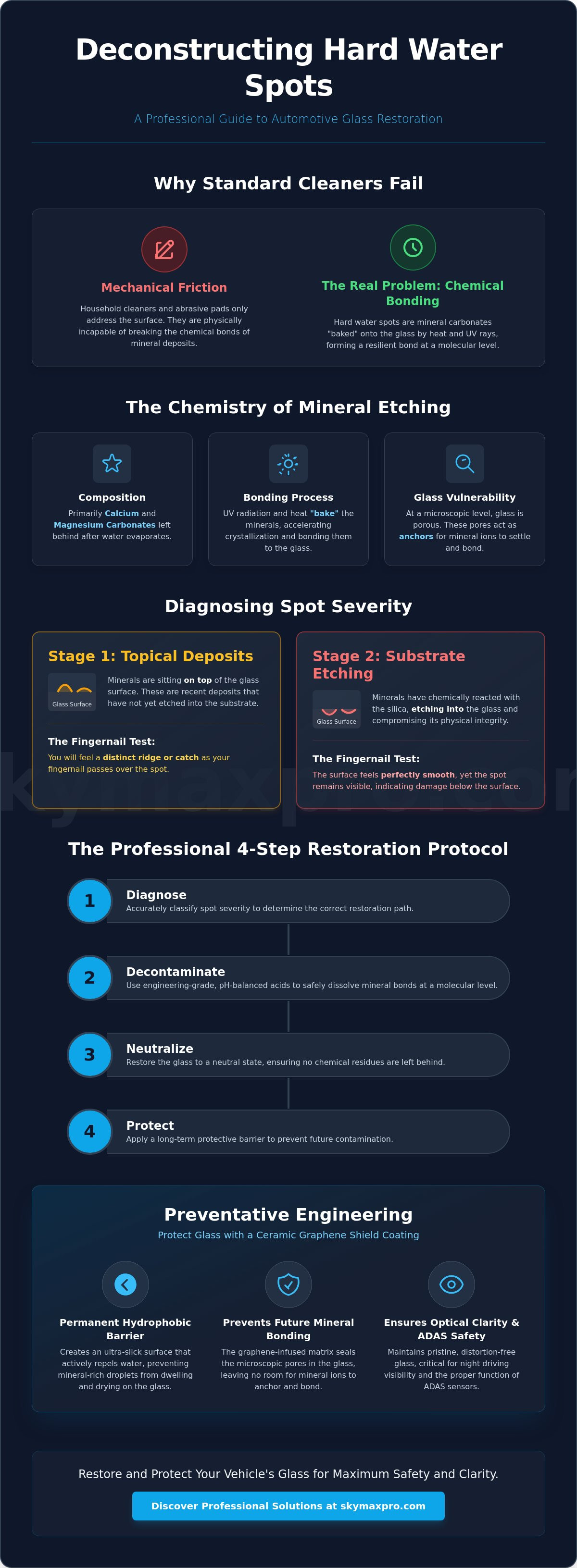
Hard water spots are not merely aesthetic blemishes; they represent a concentrated accumulation of calcium and magnesium carbonates that have reached a state of chemical stability on the glass surface. To understand how to remove hard water spots from car glass, one must first analyze the transition from liquid suspension to solid deposition. When water containing high mineral content evaporates, it leaves behind these inorganic compounds. Under the influence of intense UV radiation and thermal energy from the sun, these minerals undergo a "baking" process. This heat accelerates the crystallization of the minerals, causing them to bond more aggressively to the substrate. This physical and chemical adherence is the foundation of The Chemistry of Mineral Etching.
Automotive glass appears perfectly smooth to the naked eye, yet at a microscopic level, it possesses a porous, irregular structure. These microscopic peaks and valleys, inherent to the silica composition of the glass, provide an ideal mechanical anchor for mineral ions. As water evaporates, the minerals settle into these pores. Over time, these deposits don't just sit on the surface; they begin to interact with the glass itself. This progression leads to a phenomenon where the minerals react with the silica, potentially leading to permanent damage if not addressed through professional-grade neutralization. Understanding these chemical interactions is essential for anyone looking for how to remove hard water spots from car glass without causing surface damage.
The Role of pH in Mineral Deposition
The chemical nature of mineral deposits is fundamentally alkaline. Because these carbonates sit on the high end of the pH scale, they require a precisely formulated acidic counterpart for effective neutralization. The interaction between these deposits and the environment is complex. For instance, environmental pollutants like acid rain can exacerbate the bonding process by introducing additional chemical stressors that "soften" the surface of the mineral layer, allowing it to fuse more deeply with the glass. Mineral etching is a chemical reaction that alters the glass surface profile.
Common Sources of Automotive Glass Contamination
Municipal tap water and automated sprinkler systems are the primary vectors for mineral contamination. These sources often contain high concentrations of dissolved solids that crystalize rapidly when they come into contact with a heated windshield. The following factors contribute significantly to the severity of the bonding:
- Municipal Water: High concentrations of calcium and magnesium ions that form rigid structures upon drying.
- Industrial Fallout: Metallic particulates that interact with moisture to create resilient, complex bonds.
- Thermal Stress: High-heat environments that increase the rate of mineral crystallization and "lock" the spots into the glass pores.
When these minerals reach a state of advanced bonding, simple cleaning is no longer sufficient, as the physical integrity of the glass surface has been compromised by the reactive nature of the deposits.
Categorizing Spot Severity: Stage 1 vs. Stage 2 Mineral Deposits
Professional glass restoration begins with an accurate diagnostic phase. Without categorizing the severity of the contamination, you risk applying insufficient chemical treatments to permanent damage or, conversely, using aggressive mechanical methods on simple surface deposits. This classification system relies on understanding the chemistry of hard water and how its constituent ions interact with the glass substrate over time. Knowing how to remove hard water spots from car glass requires identifying whether the mineral bond is purely topical or if it's progressed to structural etching.
The "Fingernail Test" serves as the primary field diagnostic. By dragging a clean fingernail across a dry spot, you can determine its physical profile. If you feel a distinct ridge or catch, the deposit is likely Stage 1. If the glass feels perfectly smooth yet the spot remains visible under a light source, the minerals have etched into the surface, reaching Stage 2. Misidentifying these stages results in inefficient labor and potential surface marring. For instance, attempting to scrub away Stage 2 spots with a coarse pad without understanding the depth of the etching will only create more micro-scratches, further reducing optical clarity.
Stage 1: Surface Contamination Characteristics
Stage 1 deposits are categorized as topical mineral accumulations that haven't yet compromised the glass structure. These appear as white, chalky rings with defined perimeters. Because these minerals are still sitting on top of the silica, they can be neutralized using pH-balanced chemical agents. These mild acids work by breaking the ionic bonds of the calcium and magnesium. To ensure a clean surface before chemical treatment, using a high-quality lubricant and Final Touch I PRO Detailing Clay helps remove non-mineral bonded contaminants, such as industrial fallout or organic debris, that might otherwise interfere with the acid's penetration. This step is vital for ensuring the chemical agent makes direct contact with the mineral deposit.
Stage 2: Understanding Glass Etching
Stage 2 deposits represent a failure of timely maintenance. At this level, the alkaline minerals have reacted with the glass at a molecular level, creating microscopic craters or "pits." These "ghost" spots are visible because they scatter light differently than the surrounding smooth glass. Chemical cleaners, regardless of their potency, can't "fill" or "reverse" these physical alterations. Learning how to remove hard water spots from car glass at this severity level involves a more intensive, multi-step engineering process that combines chemical softening with mechanical leveling. Restoration requires mechanical leveling of the glass surface using specialized abrasive compounds. If you encounter this level of damage, incorporating a high-potency Water Spot Remover as a pre-treatment can soften the remaining mineral cores before polishing begins.
The Professional Protocol for Safe Glass Restoration
Effective glass restoration requires a systematic approach to ensure the substrate remains undamaged while the contaminants are fully eradicated. When investigating how to remove hard water spots from car glass, the sequence of operations is as critical as the chemistry involved. This protocol prioritizes the preservation of optical clarity by utilizing a multi-stage decontamination process. By following a structured engineering workflow, you ensure that each layer of contamination is addressed with the appropriate level of force and chemical potency.
The restoration process is divided into five distinct phases:
- Surface Decontamination: Removing loose particulates and oils with Window Crystal Multi Cleaner.
- Mechanical Decontamination: Using a clay bar to extract bonded contaminants.
- Chemical Neutralization: Applying an acidic agent to break mineral bonds.
- Active Agitation: Working the solution into the mineral pores with a microfiber applicator.
- Rinsing and Neutralization: Halting the chemical reaction to prevent surface damage.
Pre-Treatment: Cleaning and Claying
You must begin by removing loose dirt and topical films. Attempting to address water spots while abrasive grit remains on the glass is a primary cause of micro-scratching. Start with a thorough application of Window Crystal Multi Cleaner to strip away road film and surfactants. Once the glass is clean, implement a mechanical decontamination using Final Touch I PRO Detailing Clay.
Apply ample lubricant and glide the clay across the glass using light linear motions. The "slidability" of the clay serves as a diagnostic tool. When the clay moves across the surface with zero resistance, you've successfully removed bonded industrial fallout and organic debris. This creates a "pure" surface, allowing the subsequent chemical treatments to make direct contact with the mineral deposits without interference from organic contaminants.
Chemical Neutralization with Water Spot Remover
With the surface prepped, you can now address the mineral carbonates. Apply Water Spot Remover to a microfiber applicator pad. This formula is specifically engineered to dissolve the ionic bonds of calcium and magnesium that have bonded to the silica. Work in small sections, typically no larger than 2x2 feet, to maintain control over the product's evaporation rate.
It's vital to prioritize dwell time over physical pressure. Allow the product to sit on the glass for 30 to 60 seconds; this allows the acid to penetrate the mineral layers. Agitate the area in a cross-hatch pattern to ensure even distribution. Safety is paramount during this stage. You must avoid contact with rubber seals and plastic trim, as acidic solutions can cause permanent discoloration or structural degradation of porous materials. Finish the protocol by rinsing the glass thoroughly with water to neutralize the pH and ensure no residual chemistry remains to affect visibility or wiper performance. This structured method is the most reliable way to master how to remove hard water spots from car glass while maintaining long-term safety.
Beyond Vinegar: Why Engineering-Grade Formulas Outperform DIY
The reliance on household remedies for automotive maintenance often stems from a misunderstanding of the chemical bonds involved in mineral deposition. While common vinegar is frequently cited as a primary solution, its chemical profile is fundamentally insufficient for professional glass restoration. Vinegar typically consists of a 5% concentration of acetic acid with a pH level hovering around 2.5. While this may address light, topical calcium, it lacks the necessary potency to destabilize complex magnesium silicates or deeply embedded carbonates. Learning how to remove hard water spots from car glass effectively requires a transition from these weak, single-acid solutions to multi-acid blends engineered for industrial applications.
Professional formulas integrate advanced surfactant technology that vinegar lacks. These surfactants serve a critical function: they reduce the surface tension of the liquid, allowing the acidic components to penetrate the microscopic pores of the glass. Household vinegar often beads on the surface of road films or organic contaminants, failing to make direct contact with the mineral core. Engineering-grade removers bypass these lipid layers, ensuring the acid reaches the substrate. This chemical leverage translates directly to operational efficiency. A professional protocol typically achieves neutralization in under 60 seconds, whereas DIY methods often involve repetitive, high-friction scrubbing that yields inconsistent results.
The Limitations of Acetic Acid
Acetic acid is a weak organic acid that often leaves a secondary residual film behind, which can interfere with the bonding of future protective coatings. It lacks the molecular complexity required to break down the resilient crystalline structures found in industrial-grade hard water. Engineering-grade acid blends possess a targeted molecular bite that household acetic acid simply cannot replicate. Without this specific chemical interaction, the "ghosting" effect of Stage 2 etching remains visible even after the surface feels smooth.
Mechanical Risks: Steel Wool and Razor Blades
Many amateur guides suggest using "0000" steel wool or razor blades to scrape away deposits. From an engineering perspective, this is a high-risk strategy. Even the finest steel wool can trap microscopic grit, leading to micro-marring that permanently degrades the glass profile. Razor blades pose a significant threat to modern vehicles equipped with ADAS sensors or specialized hydrophobic factory coatings. Mechanical abrasion should never be the primary method for mineral removal. You can find more details on safe surface preparation in our professional auto detailing checklist. For those seeking to eliminate mineral deposits with laboratory-grade precision, the Water Spot Remover provides the necessary chemical leverage to restore clarity without the risks of mechanical damage.
Preventative Engineering: Protecting Glass with Ceramic Graphene
Successful restoration is only the first phase of a comprehensive glass management strategy. Once you've mastered how to remove hard water spots from car glass, the objective shifts toward modifying the surface energy of the substrate. Untreated glass is naturally hydrophilic, meaning it encourages water to sheet across the surface. This sheeting increases the surface area for evaporation, which directly facilitates the deposition of mineral carbonates. By engineering a hydrophobic barrier, you force water into high-contact-angle beads that roll off the surface before evaporation can occur. This physical change prevents the chemical bonding process from ever beginning.
Nanotechnology provides the most resilient solution for this challenge. Utilizing aerospace-grade chemistry creates a semi-permanent bond with the silica. This layer effectively "seals" the microscopic pores discussed in previous sections, leaving no room for mineral ions to anchor or react with the glass. This preventative approach is the only way to ensure that the labor-intensive process of mineral removal doesn't become a recurring monthly requirement. It shifts the maintenance burden from reactive restoration to proactive preservation, ensuring long-term optical clarity.
The Science of Graphene on Glass
Graphene is a carbon allotrope that offers significant technical advantages over traditional silica-based sealants. Its hexagonal lattice structure provides exceptional slickness, which drastically reduces surface friction. This low friction coefficient encourages water bead runoff at lower speeds, significantly improving driver safety and visibility during inclement weather. When comparing traditional glass sealants to Ceramic Graphene Shield Coating, the graphene variant demonstrates superior chemical resistance and thermal stability. It won't break down under the high heat that typically "bakes" minerals into the glass, providing a consistent barrier against environmental etching. This durability is essential for maintaining the structural integrity of the glass profile over thousands of miles of operation.
Establishing a Maintenance Routine
Even the most advanced coatings require a structured maintenance protocol to maintain their hydrophobic efficiency. Environmental contaminants like road film, salt, and industrial fallout can eventually "mask" the coating, reducing its ability to shed water effectively. Regular decontamination with Window Crystal Multi Cleaner is essential. This formula acts as a booster, removing topical surfactants and oils without degrading the underlying graphene layer.
In regions with high-mineral water content, we recommend a secondary inspection every three to four months to ensure the barrier remains intact. For a broader understanding of how these specialized formulas integrate into a complete vehicle care system, consult our engineering guide to car cleaning products. This proactive routine ensures that you won't have to repeat the intensive process of learning how to remove hard water spots from car glass due to neglected protection. Consistent maintenance preserves the aerospace-grade finish and extends the functional lifespan of the glass coating.
Achieving Permanent Optical Clarity
Restoring your vehicle's glass to its original factory condition is a matter of precise chemistry rather than physical friction. You now understand that successful restoration depends on accurately identifying the severity of mineral bonding and applying a structured protocol to neutralize those deposits at the molecular level. By moving beyond ineffective household remedies and implementing a graphene-based preventative barrier, you ensure that optical clarity is maintained even in the most challenging environmental conditions.
Mastering how to remove hard water spots from car glass requires a definitive shift from manual scrubbing to targeted chemical intervention. Our solutions utilize aerospace-approved chemical formulations and advanced nanotechnology to deliver superior surface protection. This technology is trusted by professional detailers nationwide for its ability to restore visibility without compromising the structural integrity of the glass substrate. Using these engineering-grade tools allows you to achieve measurable results with professional efficiency.
Restore your glass with SKY MAXPRO Water Spot Remover and experience the performance of laboratory-validated restoration. You're now equipped with the technical knowledge to maintain a safe, crystal-clear view on every drive.
Frequently Asked Questions
Can I use vinegar to remove hard water spots from my windshield?
Vinegar is effective only for very light, topical mineral deposits. It contains a low concentration of acetic acid, which lacks the chemical potency to destabilize complex magnesium silicates or deeply embedded carbonates. For professional results, you need an engineering-grade acid blend that penetrates the microscopic pores of the glass. Relying on vinegar often leads to repetitive scrubbing without achieving full optical clarity.
Will a dedicated water spot remover damage my car’s paint or trim?
Professional water spot removers are acidic and can cause permanent damage to sensitive surfaces if they aren't handled correctly. You must protect rubber seals and plastic trim during the application process to prevent discoloration. Always rinse the glass thoroughly with water after the recommended dwell time. This neutralizes the pH and ensures that no residual chemistry remains to affect the surrounding materials.
Is it safe to use steel wool on automotive glass to remove spots?
Using steel wool on automotive glass is a high-risk procedure that can lead to micro-marring. Even "0000" grade steel wool can trap microscopic grit, which acts as an abrasive against the silica surface. This mechanical method often degrades the glass profile and can damage modern hydrophobic coatings or ADAS sensor windows. Chemical neutralization is the safer, more precise alternative for maintaining surface integrity.
How do I tell if a water spot is etched into the glass or just on the surface?
Perform the "Fingernail Test" by dragging a clean nail across the dry spot to determine its physical profile. If you feel a distinct ridge or catch, the deposit is Stage 1 and sits on the surface. If the glass feels perfectly smooth but a "ghost" spot remains visible under light, the minerals have etched into the substrate. This requires mechanical leveling rather than just chemical cleaning.
Does a ceramic coating prevent water spots from forming on glass?
A ceramic coating significantly reduces the likelihood of mineral bonding by establishing a hydrophobic barrier. This technology prevents water from "sheeting" and drying on the glass, which is the primary cause of mineral deposition. However, if water with high mineral content is allowed to evaporate on the coating, spots can still form. These deposits will be much easier to remove than on unprotected glass.
Can I use a clay bar to remove water spots?
A clay bar is designed to remove non-mineral bonded contaminants but cannot dissolve the ionic bonds of calcium or magnesium. While it helps clear industrial fallout and organic debris from the surface, it won't solve the underlying chemical problem of how to remove hard water spots from car glass. Use a clay bar as a critical pre-treatment step to ensure the glass is pure before applying chemical neutralizers.
What is the best way to prevent water spots after washing my car?
The most effective preventative measure is to dry the vehicle immediately using a high-quality microfiber towel or filtered forced air. This prevents the evaporation process that leaves mineral carbonates behind. For long-term protection, applying a Ceramic Graphene Shield Coating creates a low-friction surface that encourages water bead runoff. This minimizes the amount of residual water left to dry on the glass surface.
Are hard water spots permanent on car windows?
Hard water spots are rarely permanent if you follow a professional restoration protocol. Stage 1 deposits are easily neutralized with specialized acids. Stage 2 etching, which physically alters the glass substrate, requires mechanical polishing to level the surface. Unless the etching is exceptionally deep, most glass can be restored through a professional protocol focused on how to remove hard water spots from car glass using chemical and mechanical engineering.