

Your vehicle's clear coat is likely harboring microscopic industrial fallout and brake dust that a standard wash cannot touch; these bonded contaminants compromise the molecular bond of any protective layer. Many enthusiasts hesitate to perform mechanical decontamination due to the fear of marring the finish or uncertainty regarding which grade to select. This engineering-focused guide demonstrates how to properly use a clay bar kit to achieve an aerospace-grade, surgically clean surface. By implementing these precise protocols, you ensure the substrate is prepared for maximum adhesion of advanced protections like our Ceramic Graphene Shield Coating.
We agree that the risk of scratching a clear coat is a valid concern for any professional. However, with the global car detailing market projected to reach 62.9 billion USD by 2034, the demand for high-precision surface preparation is a technical necessity rather than an option. This article provides a structured breakdown of the decontamination process. You'll learn to identify bonded particulates, master the lubrication requirements, and execute the protocol using Final Touch I PRO Detailing Clay. We'll show you how to transform a gritty surface into a glass-smooth foundation for professional-grade results.
Key Takeaways
- Understand the technical distinction between surface debris and bonded contaminants that require specialized resin compounds for effective removal.
- Learn how to properly use a clay bar kit by selecting the correct grade of clay to match your vehicle's specific contamination level.
- Master the sectional grid protocol and lubrication matrix to ensure a safe, mar-free mechanical decontamination process.
- Implement professional inspection techniques to verify a surgically clean surface before applying advanced ceramic or graphene coatings.
- Optimize the molecular adhesion of protective layers by integrating engineering-grade solutions like Final Touch I PRO Detailing Clay into your workflow.
The Science of Mechanical Decontamination: Why Washing Isn't Enough
Standard chemical surfactants perform adequately for removing loose organic debris and surface dust. However, they're physically incapable of addressing particulates that have undergone thermal bonding or chemical fusion with the vehicle's clear coat. A clay bar is a specialized resin compound engineered specifically for mechanical decontamination. This material functions as a high-tack medium that shears off and encapsulates particulates that have embedded themselves into the microscopic pores of the paint. Learning how to properly use a clay bar kit begins with recognizing that a "visually clean" surface is rarely a chemically clean one. Even after a thorough wash, the paint often remains a landscape of microscopic obstructions.
To verify the presence of these contaminants, professionals utilize the Baggie Test. This engineering logic relies on amplifying tactile feedback by placing a thin plastic film between the hand and the paint surface. Sliding your fingers over the panel through the plastic reveals a gritty texture that's otherwise imperceptible to the naked eye. If the surface doesn't feel as smooth as glass, the substrate isn't ready for advanced protection. The Science of Mechanical Decontamination dictates that these obstructions must be removed to prevent premature coating failure.
Understanding Bonded Contaminants
Industrial fallout consists of acidic or metallic particulates from manufacturing plants and railways that settle on the surface. These contaminants often etch into the clear coat, compromising its structural integrity over time. Brake dust is particularly aggressive; these ferrous fragments are hot when they strike the vehicle, allowing them to melt into the paint. Once embedded, they oxidize and expand, creating microscopic "volcanoes" on the surface. Organic proteins from tree sap and bird droppings also resist standard detergents, requiring the mechanical leverage of Final Touch I PRO Detailing Clay for complete extraction.
The Impact on Surface Adhesion
Embedded particulates act as physical barriers that prevent advanced coatings from making direct contact with the paint. If you apply a Ceramic Graphene Shield Coating over a contaminated surface, the coating bonds to the dirt rather than the clear coat. This leads to poor durability and uneven surface tension, which significantly degrades the hydrophobic performance of the finish. Mechanical decontamination is the physical extraction of embedded particulates to ensure an optically clear and chemically receptive surface. By removing these peaks and valleys, you optimize the surface energy of the substrate, allowing for the superior molecular bonding required for professional-grade results. Understanding this technical foundation is vital when learning how to properly use a clay bar kit for long-term paint protection.
Selecting the Correct Clay Grade and Lubrication Matrix
Selecting the correct clay grade is a critical engineering decision that dictates the balance between extraction efficiency and clear coat integrity. When determining how to properly use a clay bar kit, you must first assess the substrate's condition to avoid unnecessary abrasive wear. Using a grade that's too aggressive for the contamination level results in micro-marring, which then requires additional corrective polishing stages. This process follows the established principles of The Science of Mechanical Decontamination, which prioritizes surface safety while achieving a surgically clean finish.
Clay Grade Comparison Framework
Fine grade clay is the industry standard for well-maintained vehicles. It offers a low-abrasion profile that's safe for frequent use, making it ideal for annual maintenance or removing light overspray without clouding the finish. Medium grade clay possesses significantly higher extraction power; it's reserved for neglected surfaces or vehicles exposed to heavy industrial environments. Because medium grade resins are stiffer, they often leave light marring on softer clear coats, necessitating a follow-up with a fine-cut polish. Heavy grade clay is a specialized restoration tool. It's designed for significant overspray removal and extreme environmental fallout, and it should only be utilized by professionals prepared for a full multi-stage paint correction afterward.
The Chemistry of Lubrication
The lubrication matrix is not merely a wetting agent; it's a sophisticated chemical barrier designed to reduce kinetic friction. Professional lubricants utilize specific surfactants that create a hydrodynamic layer between the clay resin and the paint. This barrier allows the clay to glide across the clear coat while still permitting the particulates to be sheared off and encapsulated. We've found that many enthusiasts mistakenly use soap and water as a lubricant. This is a technical error. High-pH soaps or detergents can chemically degrade the synthetic resins in a clay bar, causing it to crumble and lose its particulate-trapping capabilities.
Maintaining a consistent "wet zone" is vital. If the lubricant evaporates or is spread too thin, "dry spots" occur, leading to resin transfer where the clay sticks to the paint. This creates more work and risks scratching the surface. For those seeking a professional-grade solution, our Final Touch I PRO Detailing Clay provides the ideal balance of elasticity and particulate capture when paired with a dedicated lubricant. Mastering how to properly use a clay bar kit requires this disciplined approach to chemical compatibility, ensuring the clay remains effective and the clear coat remains pristine.
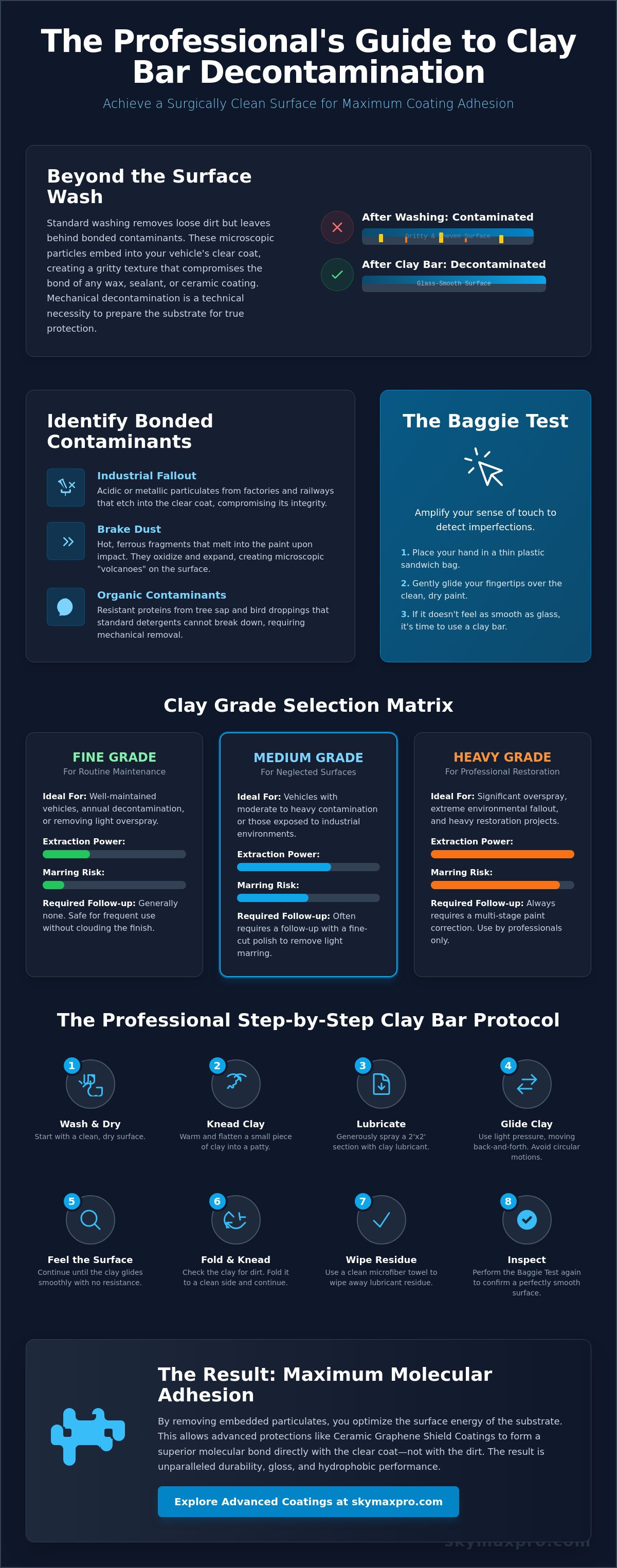
The Professional Step-by-Step Clay Bar Protocol
Before any mechanical contact occurs, the substrate must be completely free of loose particulates. A thorough strip wash is the first technical requirement. Using a high-alkaline detergent ensures that existing waxes, sealants, and road films are stripped away, exposing the true state of the clear coat. Once the vehicle is clean and dry, perform a sectional analysis by dividing the surface into manageable 2x2 foot grids. This systematic approach prevents the lubricant from drying prematurely and ensures 100% coverage across every panel without missing critical transition areas.
Mastering how to properly use a clay bar kit requires a disciplined approach to surface saturation. Apply the lubricant generously to the first grid section. "Dry spots" are the primary cause of resin transfer and surface marring. Once the area is saturated, utilize the 'sliding' technique. You shouldn't apply downward pressure. The resin's engineered tack is designed to grab and encapsulate contaminants naturally. Your hand should simply guide the clay's path, letting the medium do the mechanical work. If the clay stops sliding freely, immediately reapply lubricant to restore the hydrodynamic barrier.
Execution and Technique
Break off a small piece of Final Touch I PRO Detailing Clay and flatten it into a disc approximately two inches in diameter. This shape provides optimal surface contact and allows for better tactile feedback. Always use linear motions, moving the clay either strictly horizontally or strictly vertically. Circular motions are a technical error; they create complex swirl patterns that are significantly more difficult to correct during the polishing stage. Listen closely for acoustic feedback. You'll hear a distinct grit-like sound as the clay encounters bonded particulates. As the extraction process nears completion, this sound will dissipate until the clay glides in total silence, signaling that the grid is surgically clean.
Safety Protocols and Error Management
Maintaining the integrity of the clay medium is essential for a safe decontamination process. After completing each grid, knead the clay thoroughly to fold captured contaminants into the center, exposing a fresh, uncontaminated surface. The "Dropped Clay Rule" is a non-negotiable safety standard. If the clay bar touches the ground, it will instantly pick up abrasive floor grit that cannot be washed off. You must discard it immediately. Using a dropped bar will cause severe, deep-seated scratches in the clear coat. Additionally, monitor the clay's temperature. It should remain pliable and elastic. If the resin becomes too soft or sticky, it may leave residue on the paint; if it's too cold, it loses its ability to safely encapsulate particulates. This same rigorous protocol should be applied to glass surfaces to remove stubborn environmental film and industrial fallout. Understanding how to properly use a clay bar kit in this controlled manner ensures the highest level of surface safety.
Post-Decontamination: Surface Neutralization and Inspection
Once the mechanical extraction is complete, the vehicle's surface isn't yet prepared for its final protective layer. The lubricant used during the process leaves behind surfactants and synthetic oils that can interfere with the chemical bonding of advanced coatings. Mastering how to properly use a clay bar kit involves a meticulous neutralization phase where these residues are completely eliminated. You must perform a secondary wipe-down or rinse to reveal the clear coat's actual condition, ensuring that no detailing spray remains to mask potential defects.
The 'Squeak Test' serves as a reliable tactile verification method for professional detailers. By drying a section and sliding a clean microfiber towel across it, a distinct high-pitched "squeak" confirms the absence of surface oils and the presence of a truly bare substrate. However, tactile feedback must be paired with a visual audit. We utilize high-CRI (Color Rendering Index) lighting to check for any missed particulates or instances of micro-marring that the naked eye might overlook in standard garage lighting. Post-clay inspection is the final quality control gate before permanent surface protection is applied.
Surface Preparation for Protection
Wiping the panels with a high-purity Isopropyl Alcohol (IPA) solution is a non-negotiable requirement in our engineering protocol. This step ensures the total removal of residual oils that can survive a standard wash. This level of chemical purity is essential before applying our Ceramic Graphene Shield Coating. The graphene molecules require an unobstructed substrate to achieve maximum cross-linking and durability. Skipping this neutralization phase means the coating bonds to a microscopic layer of oil rather than the paint itself, which leads to premature failure and degraded hydrophobic performance.
Assessing Paint Integrity
Even when you understand how to properly use a clay bar kit, 'clay marring' can occur, especially on softer clear coats or when utilizing more aggressive clay grades. This appears as a light haze or microscopic abrasions on the surface. If inspection under high-CRI light reveals marring, you must refine the finish with a light polish before proceeding. It's also vital to ensure the surface is cool to the touch. Applying polishes or coatings to a heat-soaked panel can cause the solvents to flash too quickly, resulting in an uneven finish. For a comprehensive solution to your decontamination needs, consider our Exterior Detailing Kit to ensure every stage of the process meets professional standards.
Maximizing Results with SKY MAXPRO Advanced Solutions
Achieving a professional finish requires more than just technique; it necessitates the use of high-purity materials designed for specific chemical interactions. Integrating Final Touch I PRO Detailing Clay into your workflow ensures that the mechanical decontamination process is both safe and efficient. This product leverages aerospace-approved formulations, which provide a higher degree of elasticity and particulate encapsulation than standard consumer-grade resins. When you understand how to properly use a clay bar kit in conjunction with these specialized tools, the result is a surface that meets industrial standards for cleanliness and reflectivity. Our engineering focus ensures that every pass removes contaminants without compromising the clear coat's structural integrity.
The SKY MAXPRO Ecosystem
Standardizing your inventory with professional-grade kits ensures consistency across every detailing session. Our clay bar solutions are a fundamental component of the Professional Auto Detailing Master Checklist, providing the necessary foundation for all subsequent protection layers. By utilizing Professional Car Detailing Supplies, technicians achieve a higher return on investment through concentrated formulas that offer superior durability and lower cost-per-application. These kits aren't just collections of products; they're engineered systems where the lubricant chemistry and clay resin density are perfectly matched for optimal glide and extraction. This systematic approach eliminates the variables that often lead to inconsistent results in high-volume detailing environments.
Next Steps: Coating and Maintenance
The ultimate objective of surface decontamination is to prepare the substrate for long-term protection. Applying the Ceramic Graphene Shield immediately after the neutralization phase locks in the glass-smooth finish and provides a molecular barrier against future environmental fallout. This coating technology represents the pinnacle of surface science, offering heat resistance and hydrophobicity that traditional waxes can't match. Maintenance between major sessions remains vital for preserving these results. Using a ceramic-infused quick detailer helps maintain low surface energy, which prevents contaminants from bonding as aggressively. To ensure your vehicle receives the highest level of care, upgrade your detailing arsenal with the Final Touch I PRO Clay Bar Kit today. Mastering how to properly use a clay bar kit is the critical first step toward achieving a truly resilient finish that withstands the most demanding environmental conditions.
Standardizing Surface Purity for Professional Results
Mechanical decontamination isn't a cosmetic choice; it's a technical requirement for ensuring the longevity of advanced surface protections. By mastering the sectional grid protocol and prioritizing proper lubrication, you eliminate the particulates that standard washing cannot touch. This process ensures your clear coat is chemically receptive and optically clear, providing the ideal foundation for molecular cross-linking. We've established that removing these microscopic obstructions is the only way to achieve maximum adhesion for graphene and ceramic layers.
Mastering how to properly use a clay bar kit is the defining factor between a standard detail and a professional restoration. SKY MAXPRO has provided professional-grade results for over 15 years by utilizing aerospace-approved nanotechnology formulations. Our products are manufactured locally in the USA to meet the highest industrial standards for efficiency and safety. You've now gained the engineering insights necessary to transform any vehicle's finish into a glass-smooth substrate ready for long-term protection.
Secure Your Aerospace-Grade Clay Bar Kit Now and begin your journey toward a surgically clean surface today. You'll see the difference that professional-grade decontamination makes on every panel you treat.
Frequently Asked Questions
How often should I use a clay bar kit on my vehicle?
Mechanical decontamination should be performed based on environmental exposure rather than a fixed calendar schedule. For vehicles stored outdoors or driven in industrial areas, a bi-annual protocol is standard to prevent particulate buildup. You should always perform the tactile "Baggie Test" to determine if the substrate requires intervention. If the surface feels gritty after a thorough wash, it's time for a professional decontamination session.
Will a clay bar remove scratches or swirl marks from my paint?
A clay bar is an extraction tool, not an abrasive leveling agent. It's designed to remove bonded contaminants that sit on top of the clear coat, such as rail dust and tar. It won't remove scratches, swirl marks, or etching that exists within the paint itself. Correcting these physical defects requires machine polishing to level the surrounding clear coat after the decontamination process is complete.
Can I use a clay bar on glass, wheels, or plastic trim?
Clay is highly effective for removing environmental film from glass and bonded brake dust from smooth, clear-coated wheels. However, you should avoid using it on textured plastic or rubber trim. The resin compound can embed itself into the microscopic pores of the texture, leaving behind a white residue that's difficult to remove. Stick to smooth, non-porous surfaces for the best engineering results.
Is it necessary to polish the car after using a clay bar?
Polishing is technically recommended to achieve an optically clear finish. Even when you understand how to properly use a clay bar kit, light micro-marring can occur on softer clear coats during the extraction process. While not always mandatory for every vehicle, a light polishing stage refines the surface and ensures maximum gloss before you apply a permanent ceramic or graphene protection layer.
What happens if I use a clay bar without enough lubricant?
Using insufficient lubrication leads to high kinetic friction and immediate resin transfer. This causes the clay to stick to the paint, leaving behind streaks that require chemical removal. More critically, a dry surface prevents the clay from safely gliding over the clear coat. This increases the risk of dragging captured particulates across the finish, which causes the very scratches you're trying to avoid when learning how to properly use a clay bar kit.
Can I reuse a clay bar if I drop it on the ground?
You must discard any piece of clay that touches the ground immediately. The resin's engineered tackiness causes it to instantly pick up abrasive floor grit, sand, and minerals. These particulates cannot be washed off or kneaded out of the bar. Reusing a contaminated piece of clay will cause deep, permanent scratches in your clear coat that will require extensive and costly paint correction to repair.
How do I know when it's time to throw away my clay bar?
Discard the clay once it becomes saturated with particulates and can no longer be kneaded to reveal a fresh, clean surface. If the clay appears dark or feels gritty even after you've folded it multiple times, its encapsulation capacity is exhausted. Using a saturated bar is inefficient and increases the risk of marring the finish as there's no longer enough clean resin to trap new contaminants.
Does a clay bar remove existing wax or ceramic coatings?
A clay bar will effectively strip traditional carnauba waxes and synthetic sealants because they lack the strong molecular bond of advanced coatings. However, it won't typically remove a properly cured ceramic coating. Professionals often clay ceramic-coated vehicles to remove bonded environmental film and restore the coating's original hydrophobic performance. If your goal is to remove a ceramic coating, you'll need to use mechanical abrasion through machine polishing.