

Most car owners believe that a heavy layer of wax is the secret to a deep shine, but the reality of optical engineering suggests that traditional carnauba actually mutes the vibrant sparkle of your finish. If you've struggled with oxidation clouding your clear coat or swirl marks that act like a diffusion filter, you're fighting a battle of light refraction. Learning how to enhance metallic flake in car paint is fundamentally a task of maximizing transparency so that photons can strike and reflect off the metallic particles without distortion. By May 2026, the detailing industry has shifted toward hybrid graphene-ceramic technologies that offer significantly higher optical clarity than legacy products.
You probably recognize that a dull finish isn't just a cleaning issue; it's a failure of the surface to manage light effectively. This guide provides the professional engineering methods and aerospace-grade products, such as Ceramic Graphene Shield, required to achieve a deep mirror-like finish with unparalleled depth. We'll detail the precise decontamination protocols and the surface correction techniques needed to maintain a 100% transparent barrier. You'll gain a technical understanding of how to protect your investment while ensuring every metallic flake pops with maximum intensity.
Key Takeaways
- Identify how surface defects like Random Isolated Deep Scratches (RIDS) scatter light and learn the engineering principles behind how to enhance metallic flake in car paint.
- Execute a multi-stage decontamination protocol to remove embedded ferrous particles, preventing the "orange staining" that mutes metallic brilliance.
- Utilize precision paint correction to level the clear coat to a mirror finish, ensuring light reaches the metallic particles without optical distortion.
- Evaluate the superior refractive properties of graphene and ceramic shields compared to traditional waxes for maintaining long-term transparency and depth.
- Implement a technical maintenance routine using pH-balanced solutions to prevent coating degradation and preserve maximum light reflection.
The Science of Optical Clarity: Why Metallic Flake Loses Its Pop
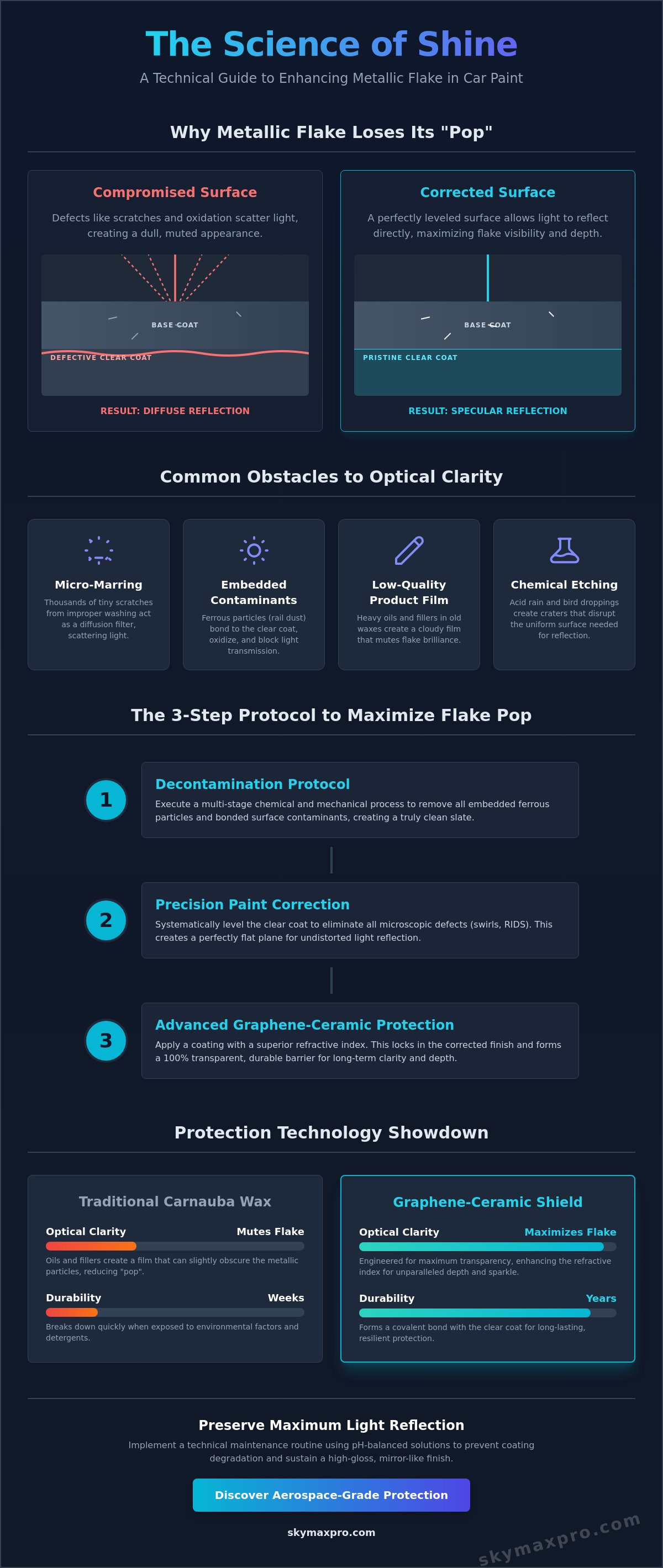
Understanding how to enhance metallic flake in car paint requires a rigorous analysis of optical physics. What enthusiasts call "flake pop" is the measurable result of unobstructed light refraction. In an ideal scenario, light photons pass through the clear coat, strike the suspended metallic particles, and reflect back to the observer with minimal energy loss. When this path is clear, the paint exhibits depth and brilliance. However, when the clear coat is compromised by Random Isolated Deep Scratches (RIDS) or industrial fallout, this light path is disrupted. These defects act as microscopic prisms that scatter light in multiple directions, a phenomenon known as light diffusion, which results in a muted and dull appearance.
The Refractive Index (RI) of the automotive clear coat plays a critical role in this process. Clear coats are engineered for high transparency, but environmental factors like oxidation and UV degradation break down the polymer structure at the surface. This degradation creates a "clouding" effect, essentially turning the clear coat into a semi-opaque filter. Instead of a crisp reflection, the light is absorbed or scattered before it ever reaches the metallic substrate. Achieving maximum clarity involves restoring the surface to a state where the RI remains consistent across the entire panel.
How Light Interacts with Metallic Particles
A photon's journey begins at the outermost boundary of the clear coat. In a high-clarity finish, specular reflection occurs, where light bounces off a perfectly smooth surface at a consistent angle. According to The Science of Metallic Paint, these finishes utilize tiny flakes of aluminum or synthetic mica to create their characteristic sparkle. If the clear coat surface is rough at a microscopic level, diffuse reflection takes over. This scattering prevents the human eye from perceiving the sharp, distinct "sparkle" of the flake. True optical depth is only possible when the surface is leveled to a tolerance that eliminates these microscopic interference patterns.
Common Obstacles to Maximum Flake Visibility
Several variables actively degrade optical transparency over time. Industrial contaminants and poor maintenance habits are the primary drivers of a "muted" finish. To restore the original engineering intent of the paint, you must address these specific obstacles:
- Micro-Marring: Improper washing techniques create thousands of tiny scratches. These act as a diffusion filter, preventing light from reaching the flakes below.
- Embedded Contaminants: Rail dust and metallic fallout bond to the clear coat. These particles oxidize and create a physical barrier that blocks light transmission.
- Product Film: Many low-quality waxes use heavy oils and fillers with a different refractive index than the clear coat. This creates a cloudy "film" that reduces the brilliance of the flakes.
- Chemical Etching: Acid rain and bird droppings create localized craters in the finish, which disrupt the flat plane required for uniform reflection.
Maximizing the visual output of metallic paint isn't about adding layers; it's about removing the barriers to light. By focusing on surface leveling and the removal of embedded contaminants, you ensure that the metallic particles can perform their intended optical function.
The Decontamination Protocol: Clearing the Path for Light
Executing a rigorous decontamination protocol is the first technical step in learning how to enhance metallic flake in car paint. A surface that appears clean to the naked eye often remains saturated with bonded contaminants that obstruct light transmission. These microscopic barriers prevent photons from reaching the aluminum or mica particles in the paint's base coat. By May 2026, professional standards require a two-stage approach to ensure the clear coat is optically transparent and physically smooth. Without this phase, any subsequent polishing or coating will simply seal in the defects that mute the finish.
Chemical Decontamination: Dissolving Embedded Ferrous Particles
Ferrous contamination, primarily from brake dust and rail travel, represents a significant threat to optical clarity. These iron particles embed themselves into the clear coat and begin to oxidize, creating "orange staining" that clouds the metallic effect. Specialized chemical decontaminants react with these particles, turning them into a water-soluble complex that you can safely rinse away. It's vital to use pH-neutral formulas to maintain the structural integrity of the clear coat. These iron particles act like microscopic umbrellas, casting shadows over the flakes and reducing the intensity of light that reaches the metallic substrate. For high-performance results, the 2026 industry benchmark suggests a chemical soak time of 3 to 5 minutes to ensure total dissolution of inorganic fallout.
Mechanical Decontamination: The Professional Clay Bar Step
Chemical treatments alone cannot remove non-ferrous bonded contaminants like tree sap, overspray, or industrial films. This requires mechanical intervention using detailing clay. Selecting the correct grade of clay is essential; for metallic finishes, a fine or medium grade is preferred to minimize the risk of marring. Proper lubrication is the most critical variable in this process. You must maintain a constant hydrodynamic barrier between the clay and the paint to prevent friction-induced haze.
Professional detailers use the "plastic bag test" to verify surface purity. By placing your hand inside a thin plastic sandwich bag and sliding it over the paint, you can feel even the smallest remaining imperfections. A truly decontaminated surface should feel as smooth as polished glass. For those seeking industrial-grade purity, the SKY MAXPRO exterior detailing kit provides the necessary tools to achieve this refractive baseline. This level of preparation ensures that the paint correction phase can proceed without the risk of dragging contaminants across the surface, which would further degrade the metallic pop.
Once the surface is chemically and mechanically pure, the clear coat is ready for leveling. This preparation is the only way to guarantee that the light path remains unobstructed, allowing for the maximum refraction required to make metallic paint truly stand out.
Precision Paint Correction: Leveling the Surface for Reflection
Precision paint correction is the mechanical process of leveling the clear coat to achieve a perfectly planar surface. When considering how to enhance metallic flake in car paint, this phase is non-negotiable. While the decontamination protocol removed surface obstructions, correction addresses the physical topography of the clear coat itself. Scratches and swirl marks act as microscopic troughs that trap light, preventing it from reaching the metallic substrate. By removing a microscopic layer of clear coat, you eliminate these troughs and allow light to reflect off the flakes with mathematical precision. You must distinguish between "filling" and "removing" defects; fillers are temporary oils that eventually evaporate, while correction provides a permanent increase in optical clarity.
Metallic finishes are more sensitive to finishing techniques than solid colors. A solid black finish might look acceptable with minor micro-marring, but on a metallic surface, these tiny defects create a "haze" that masks the flake's brilliance. Most professional engineers prefer Dual Action (DA) polishers for this task. The random orbital motion of a DA polisher generates less heat and provides a more uniform finish compared to a rotary polisher, which can easily leave holograms or buffer trails that disrupt the flake's visual output.
Choosing the Right Abrasive Grade
The goal is to use the least aggressive method necessary to achieve the desired result. Starting with a heavy cutting compound on a metallic finish often creates more work by leaving behind deep "pig-tails" or micro-marring. Instead, professionals often utilize a two-stage approach: an initial correction pass to remove deeper defects, followed by a "jeweling" pass with an ultra-fine finishing polish. This final step is what delivers the last 10% of clarity. It refines the surface to such a degree that light can pass through the clear coat with near-zero diffusion, making the metallic particles appear as if they're floating in deep water.
Monitoring Clear Coat Thickness
Engineering a high-gloss finish requires a constant awareness of the material limits. Modern automotive clear coats typically measure between 35 and 50 microns in thickness; for context, a standard sticky note is approximately 100 microns thick. Using an ultrasonic paint thickness gauge is the only way to ensure you don't remove too much material. If you thin the clear coat excessively, you risk "strike-through," where you polish completely through the clear layer into the base coat. This damage is irreversible and destroys the metallic flake permanently. Maintaining a healthy clear coat thickness is also essential for UV protection, as the UV inhibitors are concentrated in the top half of the clear layer. Precision correction ensures maximum pop while preserving the long-term structural integrity of the finish.
Advanced Protection: Ceramic vs. Graphene for Flake Enhancement
Once the clear coat has been leveled through precision correction, the final phase of optical engineering involves selecting a protective barrier that maximizes light transmission. When determining how to enhance metallic flake in car paint, the choice of protection chemistry is critical. Traditional carnauba waxes, while popular for their warm "wet look," are organic compounds that eventually yellow and degrade, creating a cloudy film that obscures the metal particles. Synthetic sealants provide better UV resistance but often lack the refractive depth required for true flake pop. Modern ceramic coating technology, specifically SiO2-based formulations, creates a permanent bond that mimics the optical properties of glass. By May 2026, graphene-infused coatings have emerged as the industry standard, offering superior heat dissipation and a "mirror look" that emphasizes the sharp edges of metallic flakes.
The distinction between the "wet look" and the "mirror look" is found in the product's refractive index. Waxes tend to absorb some light, giving a deep, dark glow. In contrast, ceramic and graphene coatings are designed for maximum reflection and transparency. This ensures that the light reaching the metallic substrate is not filtered or dimmed. Graphene, a single layer of carbon atoms, is particularly effective because it reduces the static charge of the surface, which prevents dust from settling and masking the brilliance of the paint finish.
The Refractive Benefits of Ceramic Graphene Shield
Nanotechnology allows modern coatings to fill the microscopic voids that remain even after the finest polishing. This creates a perfectly flat top layer at a molecular level. The result is a "lens effect" where the coating acts as a magnifying glass, increasing the perceived size and brilliance of the aluminum or mica particles. Ceramic Graphene Shield also introduces extreme hydrophobicity. This self-cleaning property ensures that environmental contaminants don't bond to the surface during daily use, keeping the metallic flake visible even in harsh conditions. For those ready to implement this technology, the Ceramic Graphene Shield Coating provides the industrial-grade clarity required for professional results.
Application Techniques for Maximum Gloss
Precision in application is as vital as the product chemistry itself. Engineers utilize the "cross-hatch" method, applying the coating in overlapping horizontal and vertical strokes to ensure 100% coverage without thinning. Monitoring flash times, the period it takes for the carrier solvents to evaporate, is essential. Leveling the coating at the precise moment prevents "high spots," which are concentrated areas of product that create optical distortion. A full 24-hour curing period is typically required to allow the molecular lattice to harden into a transparent, permanent barrier. This curing process ensures that the bond is chemically resistant to the pH-swings encountered during maintenance washes, preserving the flake pop for years rather than months.
SKY MAXPRO Engineering: Sustaining the High-Gloss Finish
Achieving a mirror-like finish is a significant technical milestone, but the true engineering challenge lies in sustaining that optical clarity over the long term. The SKY MAXPRO 2026 product line is specifically formulated to preserve the refractive properties of your clear coat against environmental degradation. Understanding how to enhance metallic flake in car paint is a continuous process that involves preventing the accumulation of micro-scratches and chemical etching. By utilizing aerospace-grade ingredients, these solutions provide a level of UV protection and thermal stability that traditional consumer products cannot match. This ensures that the metallic particles remain the focal point of the finish, rather than being obscured by a hazy or oxidized surface.
Maintenance is not merely about cleaning; it is about managing the surface energy of the coating. High-quality graphene and ceramic barriers reduce the static attraction of dust and road grime, making the decontamination process safer and more efficient. When you maintain the integrity of the protective layer, you ensure that light transmission remains at its peak, allowing the metallic flakes to pop with consistent intensity regardless of lighting conditions.
The Maintenance Routine for Professionals
A disciplined washing technique is essential to prevent the reintroduction of swirl marks. Engineers recommend the two-bucket method equipped with grit guards, which significantly reduces the risk of wash-induced marring. Using a pH-balanced shampoo, such as the Ceramic Waterless Car wash for light maintenance, ensures that the hydrophobic lattice of the coating isn't stripped away by aggressive surfactants. For those seeking to maximize brilliance, we recommend a monthly top-up with a ceramic spray to maintain the surface's Refractive Index and ensure the metallic particles remain visible through a crystal-clear barrier. Utilizing the Quick Detailer Spray with Ceramic High Gloss Finish between deep cleans acts as a sacrificial layer, absorbing environmental impacts before they reach the primary coating.
Long-Term Protection and Resale Value
Maintaining metallic brilliance isn't just an aesthetic preference; it's a strategic investment in the vehicle's market value. Data from 2025 automotive auctions indicates that vehicles with documented professional paint protection and high optical clarity command a significantly higher premium in the secondary market. By protecting the clear coat from permanent environmental etching with SKY MAXPRO shields, you prevent the structural damage that leads to clear coat failure. This proactive approach ensures that the paint remains in a like-new state for years. Precision engineering and consistent maintenance are the only ways to guarantee that your metallic finish retains its deep, multi-dimensional sparkle.
Optimize your finish with SKY MAXPRO Ceramic Graphene Shield and ensure your vehicle's paint performs at its highest optical potential.
Maximizing Your Paint's Optical Potential through Precision Engineering
Achieving professional results requires shifting from basic car care to a disciplined engineering mindset. As discussed, the secret to how to enhance metallic flake in car paint is found in the removal of light-diffusing defects and the application of high-RI protective barriers. By following the systematic protocols of decontamination and leveling, you ensure that photons interact with the metallic substrate without interference. This technical approach transforms the finish into a high-performance optical surface rather than a mere aesthetic feature.
SKY MAXPRO provides the industrial-grade formulas required to maintain this standard at home. Our solutions are manufactured in the USA and utilize aerospace-approved nanotechnology to protect your investment from environmental etching. These professional-grade formulas for enthusiasts offer measurable improvements in clarity and durability. Engineered for Excellence: Shop SKY MAXPRO Detailing Kits Now. Commit to a higher standard of surface protection and let your paint's true potential shine.
Frequently Asked Questions
Does ceramic coating hide metallic flake?
No, professional-grade ceramic coatings do not hide metallic flakes; they actually enhance them by providing a transparent top layer with a high refractive index. This "lens effect" magnifies the aluminum or mica particles suspended in the paint's base coat. It ensures that light transmission is not filtered or dimmed by the organic oils found in traditional waxes.
Can I use a clay bar on metallic paint without scratching it?
You can safely use a clay bar on metallic paint if you maintain a constant hydrodynamic barrier with a dedicated lubricant. Mechanical decontamination is a prerequisite for how to enhance metallic flake in car paint because it removes bonded pollutants that block light. Using a product like Final Touch I PRO Detailing Clay ensures the surface is physically smooth for maximum reflection.
What is the best type of wax for metallic car paint?
The best type of wax for metallic paint is a ceramic-infused synthetic sealant rather than a traditional carnauba paste. Organic waxes often contain heavy fillers that create a cloudy film, which reduces the brilliance of the flakes. Ceramic Deep Wet Mirror Shine Wax Sealant provides the necessary optical clarity and UV protection without the yellowing associated with natural carnauba.
How often should I polish my car to keep the metallic pop?
You should only polish your metallic paint when visual inspections reveal swirl marks or micro-marring that obscure the flake pop. Since modern clear coats are only 35 to 50 microns thick, excessive polishing can lead to irreversible thinning. Using an ultrasonic gauge to monitor thickness ensures you maintain enough clear coat to protect the metallic layers from UV damage.
Will a graphene coating make my car shinier than a ceramic coating?
Graphene coatings provide a sharper, mirror-like gloss compared to the warm, wet look of standard ceramic coatings. Graphene's molecular structure reduces the static charge on the paint surface by up to 90 percent, which prevents dust accumulation. This keeps the metallic flake visible for longer periods between maintenance washes by reducing surface contamination.
Can I enhance the flake on a matte or satin metallic finish?
You cannot enhance the pop on matte or satin metallic finishes using traditional gloss-enhancing methods. Polishing or applying gloss coatings to a matte surface will permanently change its texture and convert it into a semi-gloss finish. Maintenance for matte metallics requires specialized, non-polishing cleaners that preserve the original light-diffusing properties of the clear coat.
Why does my metallic paint look cloudy after waxing?
Cloudiness after waxing is typically caused by the accumulation of organic oils or improper product removal. These oils have a different refractive index than the clear coat, which creates an optical barrier that scatters light. To fix this, you must strip the old wax using a product like Heavy Duty Red Power Degreaser and transition to a high-clarity ceramic shield.
How do I remove water spots from metallic paint without ruining the flakes?
Chemical removal is the safest method for removing water spots without damaging the metallic flake. Abrasive polishing removes clear coat material, while a dedicated Water Spot Remover dissolves the mineral deposits through a controlled chemical reaction. This process preserves the thickness of the clear coat and ensures the light path to the flakes remains unobstructed.