

Every time you apply mechanical pressure to your vehicle’s clear coat, you are essentially conducting a microscopic abrasive procedure. While most enthusiasts believe more agitation equals a cleaner surface, the reality is that friction is the primary architect of the swirl marks and marring that degrade your paint's reflective quality. You likely feel a sense of hesitation before every wash, fearing that a single trapped particle of grit will compromise a finish that requires hundreds of dollars in professional correction to fix. It's a valid concern, as traditional high-volume wash systems often prioritize speed over the delicate physics of paint preservation.
It's time to replace guesswork with engineering precision. This guide provides a technical framework for frictionless maintenance, teaching you exactly how to detail a car without scratching it using aerospace-inspired protocols. We will move beyond basic cleaning to explore the science of particle suspension and molecular lubrication. You'll gain the expertise to use professional-grade tools like Ceramic Graphene Shields and high-lubricity surfactants with total confidence. We will analyze the specific sequence of chemical decontamination and contact-free drying methods that ensure a mirror-like finish while maintaining the structural integrity of your paint protection layers.
Key Takeaways
- Identify the structural vulnerabilities of polyurethane clear coats and how abrasive particles induce micro-marring during standard maintenance cycles.
- Master the technical protocols for how to detail a car without scratching it by prioritizing chemical decontamination over aggressive mechanical agitation.
- Execute high-cling foam cannon strategies and multi-bucket filtration to maintain maximum lubrication during the suspension of inorganic debris.
- Adopt contact-minimizing drying techniques, such as aerospace-inspired blotting, to prevent surface marring at the most critical stage of the detailing process.
- Integrate Ceramic Graphene nanotechnology to create a durable sacrificial layer that optimizes surface hardness and long-term maintenance efficiency.
The Science of Paint Damage: Why Standard Washing Fails
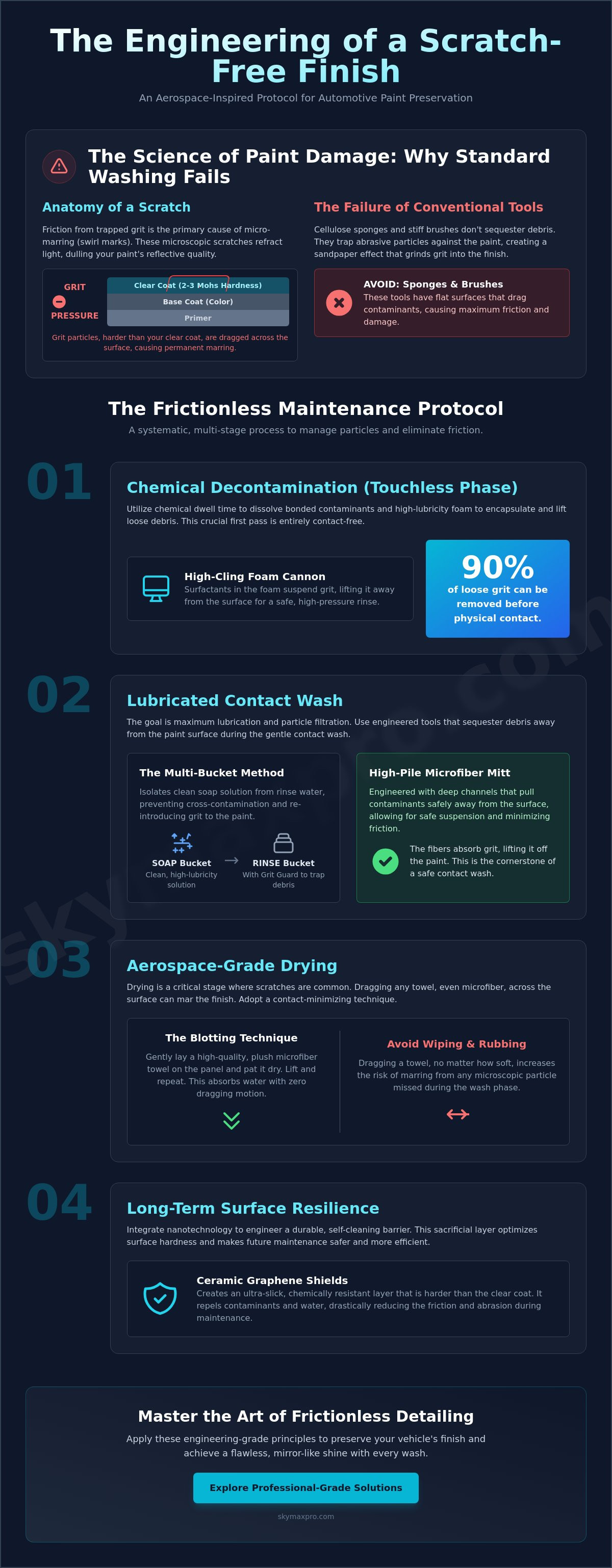
Automotive exterior finishes are engineered for aesthetic depth and environmental resistance, yet the outermost layer remains remarkably vulnerable to mechanical stress. The clear coat is a porous polyurethane resin designed to protect the pigment layers beneath it. Despite its protective function, this layer is susceptible to micro-marring, a form of surface degradation caused by the physical displacement of clear coat material. To understand how to detail a car without scratching it, you must first recognize that surface tension acts as a bonding force for inorganic contaminants like silica, brake dust, and industrial fallout. When these particles aren't properly suspended in a lubricant, any physical contact results in localized abrasions. Standard washing fails because it lacks the chemical complexity required to break the bond between the substrate and the debris without aggressive mechanical force.
Effective maintenance is fundamentally an exercise in particle management. According to this comprehensive guide to auto detailing, the process requires a systematic approach to decontamination to avoid permanent paint damage. The primary objective of safe detailing is particle suspension. This involves using surfactants to encapsulate grit, lifting it away from the surface so it can be rinsed away without contact. Without this suspension, you're simply grinding road salt and minerals into your paint.
Anatomy of a Scratch: Micro-Marring vs. Deep Abrasions
Micro-marring, often referred to as "swirl marks," consists of thousands of microscopic, multi-directional scratches that disrupt the flat plane of the clear coat. These defects become visible because light refracts off the jagged edges of the scratches rather than reflecting cleanly off a smooth surface. While deep abrasions penetrate the base coat or primer, micro-marring remains within the upper microns of the polyurethane. Most automotive clear coats possess a hardness rating of approximately 2 to 3 on the Mohs scale. This makes them significantly softer than the mineral-based grit found on typical road surfaces.
The Failure of Conventional Sponges and Brushes
Standard cleaning equipment, such as cellulose sponges or stiff-bristled brushes, features flat or non-absorbent surfaces that are incapable of sequestering debris. When a sponge moves across a panel, it traps abrasive particles between the tool and the paint. This creates a "sandpaper effect" that grinds grit into the finish. Professional protocols require high-pile microfiber or specialized foam technology. These materials are engineered with deep channels that pull contaminants away from the surface, allowing for safe suspension. This technical shift from friction-based cleaning to suspension-based decontamination is the cornerstone of maintaining a flawless finish.
The Frictionless Preparation Phase: Decontamination & Lubrication
Before any physical contact occurs, the maintenance protocol must prioritize a touchless first pass. This stage utilizes chemical dwell time to loosen inorganic debris that has bonded to the clear coat. By applying a high-lubricity agent, you can remove up to 90% of loose grit, significantly reducing the risk of surface abrasions. Understanding the science of scratch-resistant coatings reveals that even the most advanced finishes depend on proper maintenance to avoid structural degradation. Lubrication science is the foundation of this phase; it minimizes the drag coefficient between the contaminant and the paint, allowing particles to slide off the substrate rather than being ground into it.
Chemical Decontamination: Dissolving Iron and Tar
Industrial fallout and metallic brake dust aren't simply sitting on the surface. These particles are often embedded within the pores of the polyurethane layer. They're jagged, microscopic, and highly abrasive. A crucial step in how to detail a car without scratching it involves the use of specialized chemical agents that dissolve these bonds without mechanical agitation. For instance, using a PRO Safe ACID Gel Wheel & Rim Cleaner allows for the safe suspension of iron particles on wheels, preventing them from being transferred to the paintwork during the wash cycle. This chemical reaction lifts metallic contaminants safely, turning them into a water-soluble state that can be rinsed away with zero friction.
Detailing Clay: The Precision Leveling Tool
Once chemical decontamination is complete, remaining bonded contaminants require mechanical removal. This is where the engineering role of Final Touch I PRO Detailing Clay becomes critical. Unlike aggressive abrasives, detailing clay is designed to shear off surface-level contaminants while leaving the clear coat intact. To execute this safely, follow these technical steps:
- Apply a generous amount of lubricant to a 2x2 foot section to ensure the clay glides without resistance.
- Move the clay in linear motions; avoid circular patterns that can trap grit and create swirls.
- Frequently fold the clay to encapsulate captured debris and expose a fresh, uncontaminated surface.
- Continue until the clay moves across the panel with zero audible or tactile resistance.
To verify the efficacy of this process, perform the plastic bag test. Place your hand inside a thin plastic bag and run it over the dried paint. The plastic magnifies any remaining grit that your nerve endings might miss, indicating where further precision leveling is required. For heavy-duty cleaning of the lower panels before claying, a Heavy Duty Red Power Degreaser can effectively strip away stubborn organic matter, ensuring the clay remains focused on inorganic bonding.
The Master Methodology: Advanced Multi-Bucket and Foam Techniques
Mechanical agitation is the stage where most surface defects are introduced. To mitigate this risk, you must transition from a cleaning mindset to one of sediment isolation. Mastering the mechanics of the contact wash is the most critical stage in learning how to detail a car without scratching it. By implementing a structured multi-bucket system and utilizing high-cling foam technology, you create a fail-safe environment where abrasive particles are sequestered rather than redistributed across the clear coat. This methodology relies on the physics of fluid dynamics to ensure that every pass of the wash mitt is as frictionless as possible.
The Two-Bucket System vs. Traditional Washing
Traditional washing methods rely on a single source of water. This approach inevitably leads to the re-introduction of abrasive particles, as the wash mitt continuously picks up debris from the panel and deposits it back into the same solution used for cleaning. A two-bucket system eliminates this feedback loop. One bucket contains your pH-neutral soap solution, while the second serves as a dedicated rinse station. Grit guards are essential components here; these radial inserts sit at the base of each bucket, creating a baffle system that traps sediment at the bottom. This prevents the turbulence of your hand from swirling grit back into the upper water column. It's a simple but effective engineering solution for maintaining a clean wash media.
| Methodology | Contamination Level | Abrasive Risk | Efficiency Rating |
|---|---|---|---|
| Single Bucket Wash | Low (Indoor Dust) | High | High |
| Two-Bucket Method | Moderate (Daily Use) | Low | Moderate |
| Foam Cannon + Two-Bucket | High (Heavy Soiling) | Minimal | High |
Foam Agitation: Maximum Lubrication for Minimal Pressure
Foam cannon engineering has revolutionized the pre-agitation phase. By aerating a concentrated shampoo, you produce a "shaving cream" consistency that clings to vertical surfaces. This isn't for visual effect; it's designed to provide a secondary layer of lubrication between the mitt and the paint. When you begin the contact wash, you don't apply downward force. Instead, let the weight of the high-pile microfiber mitt do the work. Gravity is your primary asset in this process. Starting from the roof and working downward ensures that contaminated runoff never traverses a previously cleaned section. This top-down approach prevents cross-contamination from the high-impact zones, such as rocker panels and bumpers, where grit accumulation is most dense. Integrating these tools into a comprehensive Exterior Detailing Kit ensures that every component of your maintenance routine meets professional engineering standards.
Aerospace-Grade Drying: Avoiding the Final Scratch Trap
Drying is the most dangerous phase of the maintenance cycle. Most enthusiasts successfully navigate the wash process only to introduce defects during the dehydration stage. It's the most common stage for scratch introduction because any microscopic residue missed during the wash is now dragged across the surface under the pressure of a towel. To implement a technical strategy for how to detail a car without scratching it, you must minimize lateral mechanical contact. The blotting technique represents a significant safety upgrade over traditional wiping. By laying a high-pile towel flat across a panel and applying light, vertical pressure, you allow capillary action to draw moisture into the fibers. This removes the lateral shear stress that typically results in micro-marring and swirl marks.
For those seeking the highest level of surface protection, forced air is the only true touchless drying method. High-velocity, filtered air displacement removes water from complex geometries like emblems, grilles, and mirror housings where towels cannot reach. This process eliminates the risk of drip lines, which often contain concentrated minerals that cause water spotting on the clear coat. By removing moisture before it can evaporate, you prevent the chemical etching associated with hard water deposits.
The Physics of Microfiber: Capillary Action and Grit Trapping
Microfiber performance is defined by its GSM (Grams per Square Meter) and fiber geometry. Split-fiber technology creates a star-shaped cross-section in the synthetic strands, allowing the material to lift water and trap microscopic debris within the weave. High-pile towels with a GSM of 500 or higher are the professional standard for paint safety. Unlike a chamois, which has a flat surface that grinds trapped grit into the paint, high-pile microfiber sequesters particles deep within its structure. Proper maintenance is essential to preserve these properties. You shouldn't use fabric softeners, as they coat the fibers in oils that repel water; you must also avoid high-heat drying cycles that can melt the synthetic tips into hard, abrasive points.
Frictionless Drying Aids
A drying aid acts as a secondary lubricant during the final stages of moisture removal. Applying a Quick Detailer Spray with Ceramic High Gloss Finish to a wet panel reduces the coefficient of friction significantly. This surfactant layer ensures that even if a towel makes contact with the surface, the risk of marring is minimized. These aids are particularly valuable in regions with high mineral content in the water supply, as they encapsulate minerals and prevent etching. To ensure you have the correct sequence of operations, consult our Professional Auto Detailing checklist. For a complete solution that includes these specialized lubricants, our Exterior Detailing Kit provides the necessary tools for aerospace-grade drying.
Long-Term Surface Resilience: Engineering a Self-Cleaning Barrier
The final phase of a frictionless maintenance protocol involves the transition from temporary organic protection to semi-permanent inorganic barriers. Traditional Carnauba waxes, while providing aesthetic depth, possess low melting points and minimal structural hardness. They offer negligible resistance against the mechanical stress of washing. Modern surface engineering has shifted toward nanotechnology, specifically ceramic and graphene-based coatings. These solutions create a sacrificial layer that bonds at a molecular level with the polyurethane clear coat, filling its microscopic pores to create a cross-linked shield. Understanding the chemical composition of these barriers is the final step in mastering how to detail a car without scratching it, as a harder surface is inherently more resistant to micro-marring.
A primary benefit of these advanced coatings is the high contact angle they create, leading to extreme hydrophobicity. This isn't merely for visual effect; it facilitates a "self-cleaning" mechanism. When water sheets off the surface, it carries encapsulated inorganic debris with it, preventing contaminants from bonding to the paint. This reduces the frequency of necessary contact washes. By minimizing the number of times you must physically touch the paint, you statistically decrease the opportunity for scratch introduction over the vehicle's lifecycle.
Ceramic vs. Graphene: The Next Generation of Hardness
While standard ceramic coatings utilize Silicon Dioxide (SiO2) to provide a glass-like finish, graphene integration represents a significant leap in material science. Graphene consists of a single layer of carbon atoms arranged in a hexagonal lattice structure. This configuration provides exceptional tensile strength and thermal conductivity. A Ceramic Graphene Shield Coating offers superior durability and a lower sliding angle for water droplets compared to traditional ceramics. This reduces the risk of water spotting and environmental etching. For a deeper technical analysis of these molecular structures, consult our Ceramic Coating Engineering Guide.
Maintenance for the Modern Detailer
Maintaining a professional-grade coating requires a specific chemical approach. For light dust accumulation, you don't always need a full multi-bucket wash. Utilizing a Ceramic Waterless Car wash allows you to safely encapsulate light surface dust and wipe it away with zero-drag lubricants. However, periodic "decon washes" remain essential. Over time, environmental fallout can clog the coating's pores, reducing its hydrophobic properties. Using a maintenance spray like the Quick Detailer Spray with Ceramic High Gloss Finish restores the surface energy of the coating, ensuring the self-cleaning effect remains optimal. To equip yourself with these aerospace-grade solutions, you can Shop Professional Detailing Supplies to ensure your maintenance routine remains truly frictionless.
Advancing Your Maintenance Protocol to Engineering Standards
Mastering the technical sequence of frictionless maintenance shifts your approach from basic cleaning to professional-grade surface preservation. By understanding the physics of clear coat vulnerability and implementing a multi-bucket system with high-lubricity surfactants, you've gained the expertise needed for how to detail a car without scratching it. You now possess the methodology to manage particle suspension during the wash phase and utilize capillary action for contact-free drying. This transition from mechanical friction to chemical suspension is what defines a truly flawless finish.
Maintaining a swirl-free finish requires more than just technique; it demands the right chemical foundations. SKY MAXPRO formulations are manufactured in the USA using aerospace-approved nanotechnology. These professional-grade solutions provide the durability required by elite detailers to maintain a mirror-like finish under any environmental stress. By integrating these engineered barriers into your routine, you eliminate the risks associated with traditional maintenance and ensure long-term paint resilience. It's time to apply these precision-engineered protocols to your own vehicle.
Upgrade to Aerospace-Grade Protection with SKY MAXPRO and secure your vehicle's long-term surface resilience. You can now approach every detailing session with the confidence of a professional engineer.
Frequently Asked Questions
Can a pressure washer scratch my car paint?
A pressure washer can damage paint if the kinetic energy exceeds the structural integrity of the clear coat. Using a nozzle with a narrow spray pattern or holding the wand less than 12 inches from the surface can lead to delamination or localized stripping. Maintain a distance of at least 18 inches and use a 25 or 40 degree nozzle to ensure safe particle displacement without compromising the polyurethane layer.
Is it safer to wash a car in the sun or the shade?
Washing in the shade is the professional standard to prevent premature evaporation and thermal stress. Direct sunlight increases surface temperatures, causing water and chemical surfactants to dry before they can be safely rinsed. This leads to mineral deposits and chemical etching that are difficult to remove without abrasive polishing. Maintaining a cool substrate ensures that cleaning agents remain in a liquid state for proper particle suspension.
How do I tell the difference between a scratch and a swirl mark?
Swirl marks are a specific subset of micro-marring that appear as circular patterns under concentrated light sources. They are typically uniform in depth and result from improper contact during wash or dry cycles. Deeper scratches are often linear and can penetrate multiple layers of the finish. If you can feel the defect with a fingernail, it has likely surpassed the clear coat's upper microns and requires mechanical correction.
Can I use dish soap if I don’t have car shampoo?
Dish soap is an aggressive degreaser that should never be used for maintenance washes. It lacks the essential polymers and lubricants required for a frictionless wash. While it effectively removes organic oils, it also strips away existing waxes and sealants, leaving the clear coat vulnerable. Professional car shampoos are pH-neutral and engineered specifically to encapsulate grit while preserving the integrity of your protective coatings.
How often should I clay bar my vehicle to prevent scratches?
You should only use a clay bar when tactile inspection reveals bonded contaminants that a standard wash cannot remove. For most vehicles, this occurs once or twice per year. Over-using mechanical decontamination increases the risk of marring. When learning how to detail a car without scratching it, prioritize chemical decontamination first to minimize the amount of physical claying required to achieve a smooth surface.
What is the best type of microfiber towel for drying?
The most efficient tool for moisture removal is a high-GSM microfiber towel, specifically those with a twisted loop or waffle weave design. Towels with a GSM of 500 or higher provide the necessary density to absorb several times their weight in water. This density allows for the blotting technique, which utilizes capillary action to lift moisture without the need for abrasive lateral wiping across the paintwork.
Do ceramic coatings make a car scratch-proof?
Ceramic coatings are scratch-resistant but not scratch-proof. They function as a sacrificial layer that is harder than the factory clear coat, providing a higher level of protection against micro-marring. However, they can still be damaged by improper wash techniques or heavy mechanical abrasion. Their primary value lies in their hydrophobicity, which makes the surface easier to clean and reduces the frequency of aggressive agitation.