

Detailing in direct sunlight isn't a logistical failure; it's a complex challenge of thermodynamics that traditional carnauba waxes aren't engineered to handle. For most, the prospect of working on a surface exceeding 100°F means battling rapid product evaporation and the immediate risk of permanent water spot etching. You've likely felt the physical exhaustion of chasing "flashing" chemicals that bond to the clear coat before you can even begin removal. If you've been told a garage is a prerequisite for a flawless finish, you're working with outdated constraints.
This technical guide will teach you how to detail a car in direct sunlight by leveraging high-heat chemical stability and specialized application protocols. We'll move beyond basic washing to explore a systematic workflow that produces aerospace-grade results in high-UV environments. You'll learn which SiO2 and graphene formulations maintain molecular integrity under thermal stress and how to implement a section-based cooling strategy. By the end of this analysis, you'll possess the engineering-grade knowledge required to achieve a streak-free, professional-grade finish even in the peak of a 90°F summer day.
Key Takeaways
- Understand the critical distinction between ambient temperature and surface temperature to predict chemical flash times accurately.
- Learn why graphene-based coatings offer superior thermal management compared to traditional SiO2 formulas in high-UV environments.
- Master the 5-step protocol for how to detail a car in direct sunlight, utilizing surface cooling and heat-stable decontamination gels.
- Discover how to prevent polish dusting and product flashing by adjusting your workflow for rapid solvent evaporation.
- Adopt aerospace-grade nanotechnology protocols to create a uniform barrier that resists permanent water spot etching and UV degradation.
The Thermal Dynamics of Direct Sunlight Detailing
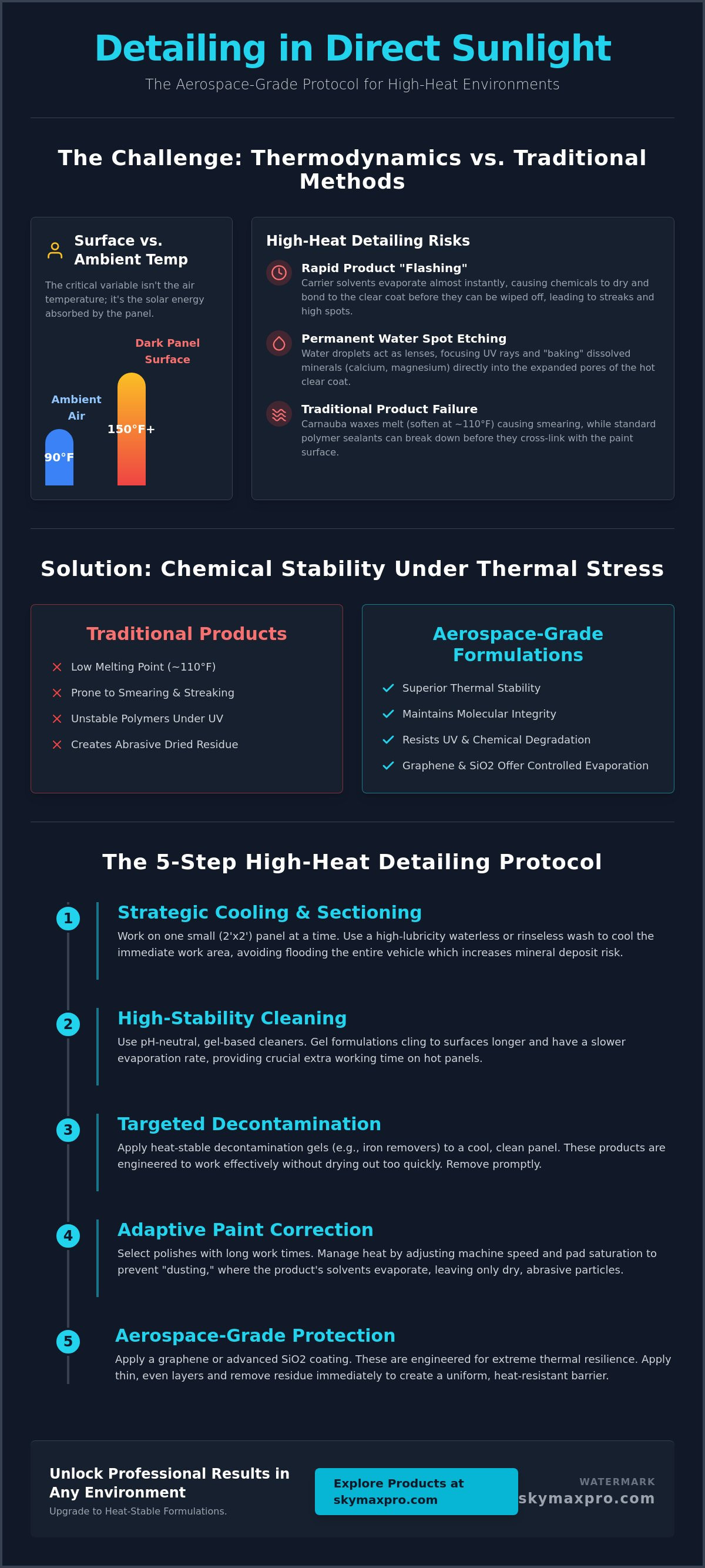
Understanding how to detail a car in direct sunlight requires a shift from aesthetic observation to thermodynamic analysis. Most enthusiasts monitor ambient temperature, yet the critical variable is surface temperature. While the air might register at 90°F, a dark automotive panel can easily exceed 150°F due to solar absorption. This thermal energy dictates the "Flash Time," which is the specific window of time available before a product's carrier solvents evaporate. When UV radiation accelerates this process, it causes chemicals to "flash" prematurely, preventing them from leveling or bonding correctly.
Successful high-heat detailing depends on the use of high-stability surfactants. These engineered molecules are designed to remain active and lubricated even as moisture levels drop. A comprehensive guide to auto detailing should emphasize that chemical stability is the only way to bypass traditional shade-only requirements. Without these stabilizers, the detailing process becomes a cycle of applying and immediately fighting to remove dried, concentrated residues that have bonded to the clear coat.
Why Traditional Products Fail on Hot Panels
Traditional carnauba waxes possess a relatively low melting point, typically beginning to soften at temperatures as low as 110°F. On a sun-drenched panel, these waxes lose their structural integrity, resulting in "smearing" rather than a clean buff-off. Beyond natural waxes, standard polymer sealants also struggle. High heat can cause long-chain polymers to break down before they achieve cross-linking with the paint. This rapid evaporation doesn't just stop the product from working; it leaves behind a high concentration of chemical solids that can be abrasive if handled incorrectly during the removal phase.
The Physics of Water Spot Etching
Automotive clear coats are not solid barriers but semi-porous structures. As surface temperatures rise, these pores expand, making the substrate more receptive to contaminants. When water droplets sit on a hot panel, they act as miniature magnifying glasses, focusing UV radiation into a concentrated point of heat. This accelerates the evaporation of the water while simultaneously "baking" the remaining minerals into the expanded pores. Mineral calcification on automotive clear coats is the process where dissolved calcium and magnesium ions bond chemically to the paint surface as water evaporates under high thermal stress. This process creates permanent etching that requires abrasive correction to resolve, as the minerals become physically embedded within the paint structure itself.
Strategic Surface Management and Chemical Selection
Strategic surface management requires moving away from reactive rinsing toward proactive chemical stability. Many detailing enthusiasts attempt to counter heat by constantly wetting the car with a hose. This approach is flawed. Frequent rinsing introduces fresh minerals to a hot surface, increasing the saturation of calcium and magnesium that leads to permanent etching. Instead, professional protocols for how to detail a car in direct sunlight prioritize waterless technology. Utilizing a Ceramic Waterless Car Wash allows for high-lubricity polymers to encapsulate dirt while providing a controlled evaporation rate, preventing the rapid mineral dump associated with hard water drying on paint.
Evaluating the thermal threshold of your protection layer is a prerequisite for success. While traditional waxes lose structural integrity at temperatures as low as 110°F, aerospace-grade formulations are engineered to withstand the extreme temperature fluctuations found in aviation. These products utilize advanced polymers that don't lose their molecular structure when exposed to intense UV radiation. Maintaining a pH-neutral environment is equally vital. When a cleaning solution dries on a sun-baked panel, its pH level becomes more concentrated as the water content evaporates. A neutral solution ensures that even if minor flashing occurs, the residue remains non-corrosive to the clear coat.
Choosing High-Stability Cleaners
Thermal stress increases the volatility of detailing chemicals. It's essential to select VOC-free formulations to ensure safety, as heat accelerates the release of these compounds into your breathing zone. For technical details on these risks, consult the EPA information on chemical safety regarding volatile organic compounds. Gel-based solutions, such as PRO Safe ACID Gel Wheel & Rim Cleaner, are superior in high-heat scenarios. Their viscous nature resists rapid runoff and evaporation, allowing for extended dwell times on hot wheels where liquid cleaners would flash instantly. These surfactants maintain lubricity even as the panel temperature climbs, preventing dry-wiping scratches. Implementing a Ceramic Waterless Car Wash protocol provides the necessary lubrication to manage heat safely.
The Role of Water Spot Removers
Before applying any protection, the surface must be chemically decontaminated. A specialized water spot remover serves as a critical diagnostic tool. It identifies existing mineral deposits that might be invisible to the naked eye but would otherwise cause bonding failures for ceramic coatings. By neutralizing these alkaline deposits, you create a pristine, high-energy surface ready for molecular cross-linking. This step is non-negotiable when determining how to detail a car in direct sunlight, as it ensures that the heat doesn't trap existing minerals under a new layer of sealant.
The 5-Step Process for Washing and Decontaminating in Heat
Executing a successful wash in high-UV conditions requires a departure from traditional bucket methods. When determining how to detail a car in direct sunlight, you must transition to a workflow that prioritizes moisture retention and chemical encapsulation. The following 5-step engineering protocol minimizes the risk of mineral etching and product flashing.
- Step 1: Substrate Cooling: Do not use a high-pressure rinse as your first step, as the rapid evaporation of hard water will immediately deposit minerals. Instead, saturate the panel with Ceramic Waterless Car Wash. This provides a high-lubricity barrier that cools the surface through evaporation while encapsulating surface particulates.
- Step 2: Wheel and Tire Decontamination: Wheels often reach the highest temperatures due to braking friction. Apply PRO Safe ACID Gel Wheel & Rim Cleaner. Its gel-based structure ensures the cleaner stays in place and remains active even on heated alloys, whereas liquid cleaners would dry instantly.
- Step 3: Sectional Wash Implementation: Move to the body panels using the sectional wash method detailed below. This ensures no chemical residue stays on the paint for longer than its calculated flash time.
- Step 4: Lubricated Mechanical Decontamination: Use Final Touch I PRO Detailing Clay paired with Ceramic Waterless Car Wash as a lubricant. The goal is to maintain a thick film of lubrication to prevent the clay from sticking to the sun-softened clear coat.
- Step 5: Final Technical Wipe: Perform a final pass with a damp, high-GSM microfiber towel and a mist of Ceramic Waterless Car Wash to remove any remaining surfactants before they can calcify.
The Sectional Wash Technique
The core of sun-safe detailing is managing the work area. Divide every panel into 2x2 foot sections. This small footprint allows you to complete the agitation and removal phases before the solar load can cause the product to flash. While traditional washing starts from the top, how to detail a car in direct sunlight often involves a bottom-up approach for the soap application. This prevents cleaning agents from running down onto lower, hot panels where they would dry and leave streaks before you could reach them. Once agitated, dry each section immediately with a dedicated drying towel rather than waiting for the entire vehicle to be finished.
Decontamination Without Marring
Decontaminating a hot panel is high-risk because the clear coat is at its most vulnerable state. Using Final Touch I PRO Detailing Clay requires an abundance of lubrication to ensure the clay glides over the surface. If the lubricant evaporates too quickly, the clay will drag and mar the softened paint. To prevent this, work only on sections that have been cooled by the initial waterless wash saturation. If you feel any resistance from the clay, stop immediately and re-saturate the area. Maintaining a cool interface between the clay and the substrate is the only way to ensure a smooth, contaminant-free surface without creating additional work through heavy polishing.
Paint Correction and Ceramic Application in High-UV Environments
Mastering how to detail a car in direct sunlight culminates in the protection phase, where thermodynamics play a decisive role in the final finish. Paint correction on a hot panel is notoriously difficult because high surface temperatures cause rapid solvent loss. This leads to polish "dusting," a state where the compound dries out before the abrasives can fully break down and level the clear coat. To mitigate this, practitioners must reduce their work area to 1x1 foot sections and use polishes with higher lubrication ratios. This smaller footprint ensures the machine's friction doesn't compound with solar heat to bake the residue onto the paint.
High spots are another significant risk when applying protection in the sun. These occur when the coating's carrier solvent evaporates too quickly, leaving a thick, un-leveled layer of resin that becomes semi-permanent. On a 100°F panel, this can happen in seconds. You must utilize a two-towel leveling method. Use the first towel to remove the bulk of the product immediately after application, followed by a second, clean microfiber for the final buff. This process ensures the resin is distributed uniformly before it can bond unevenly.
Graphene vs. Ceramic in Direct Sunlight
Traditional SiO2 (silicon dioxide) coatings are effective but can be sensitive to heat during the initial flash period. In contrast, graphene-based technology offers superior thermal management. Graphene is characterized by its high thermal conductivity, which allows the coating to dissipate heat across the surface rather than letting it concentrate in one area. A Ceramic Graphene Shield Coating is less prone to water spotting during the curing phase because it reduces the surface tension and heat absorption of the panel. In 90-degree weather, the flash time of graphene is often more predictable, giving the detailer a more manageable window for leveling than standard ceramic formulas.
Applying Spray Coatings for Rapid Protection
For those requiring a faster workflow, a Ceramic Spray Coating serves as an excellent high-UV solution. When applying these in the sun, the "Spray onto Towel" method is mandatory. Spraying directly onto a hot panel causes the atomized particles to dry instantly, leading to streaks and uneven bonding. By loading the microfiber towel first, you maintain a wet edge and control the distribution of the product. This ensures a streak-free finish even on glass and trim. High-quality microfiber towels with a minimum of 350 GSM are required to safely buff away any remaining residue without marring the heat-softened clear coat. For professional-grade results in extreme conditions, integrate the Ceramic Graphene Shield Coating into your high-heat protocol.
Engineering Resilience: Why Aerospace-Grade Formulations Excel
The protocols for how to detail a car in direct sunlight are only as effective as the chemical stability of the products used. SKY MAXPRO originated from the rigorous requirements of aerospace surface protection, where airframes face UV radiation and thermal fluctuations far more extreme than any automotive environment. While consumer-grade soaps and waxes fail at high temperatures, aerospace-approved formulations utilize nanotechnology to create a more uniform molecular barrier. These smaller particles fill the microscopic peaks and valleys of the clear coat more densely, providing a tighter cross-linked shield that resists UV degradation and prevents contaminants from bonding to the substrate.
Safety in high-heat environments extends beyond the vehicle to the detailer. Many traditional chemicals release harmful vapors when they hit a 150°F panel. Transitioning to VOC-free and biodegradable ingredients is a functional requirement for outdoor detailing, ensuring that rapid evaporation doesn't compromise the air quality in your immediate workspace. Integrating a Quick Detailer Spray with Ceramic High Gloss Finish into your post-wash routine provides a sacrificial layer of protection that maintains this engineering-grade resilience between deep cleaning cycles.
The SKY MAXPRO Advantage
Professional detailers prioritize concentrated, high-yield formulas to maximize operational efficiency. The Ceramic Waterless Car wash is specifically engineered for sun-exposed maintenance, providing the necessary lubrication to lift dirt without the water-spotting risks of a traditional hose. This efficiency is complemented by the durability of the Ceramic Graphene Shield Coating. In high-UV climates, the graphene lattice structure acts as a thermal heat sink, dissipating solar energy across the surface to prevent localized clear coat failure. This technological superiority ensures that the finish remains stable long after the initial application, even under constant solar load.
Final Checklist for Sun Detailing Success
Achieving a professional result in the heat requires a final verification of both technique and equipment. Before concluding your session, execute a systematic inspection to ensure no high spots or residues remain. Use the following engineering checklist to verify your results:
- Personal Safety: Maintain hydration and use UV-rated clothing; detailing in 90°F+ heat is a high-exertion task.
- Microfiber Integrity: Use only high-GSM towels for the final buff to ensure complete product leveling on heat-softened paint.
- Multi-Angle Inspection: Check every panel from at least three different lighting angles to identify any "flashed" product residue.
- Maintenance Protocol: Apply a Quick Detailer Spray with Ceramic High Gloss Finish to ensure the surface remains slick and hydrophobic.
For a complete breakdown of professional standards, refer to the Professional Auto Detailing Master Checklist. Understanding how to detail a car in direct sunlight is a matter of respecting the physics of heat and choosing the chemistry designed to withstand it. By following these aerospace-grade protocols, you can achieve a streak-free, high-gloss finish regardless of the ambient temperature or UV exposure levels.
Mastering High-Heat Surface Engineering
Mastering the technical protocols for how to detail a car in direct sunlight shifts the detailing process from a battle against the elements to a controlled engineering exercise. By prioritizing high-thermal-stability chemicals and a sectional workflow, you can bypass the traditional constraints of shade and ambient cooling. Success depends on the transition from organic waxes to advanced graphene and ceramic formulations that maintain molecular integrity under extreme UV stress; this shift eliminates the risk of product flashing. These professional-grade solutions provide the resilience needed to prevent mineral calcification and clear coat degradation in high-heat climates.
The integration of aerospace-approved nanotechnology ensures that your vehicle's clear coat remains protected by a uniform, high-density barrier. Professional-grade results are no longer limited by your environment, but by the precision of your methodology and the stability of your chemistry. Shop Aerospace-Grade Detailing Supplies at SKY MAXPRO to access graphene and ceramic formulations that are locally manufactured in the USA. You're now equipped with the technical framework to achieve a streak-free, professional finish in any environment.
Frequently Asked Questions
Can I use a ceramic coating in direct sunlight?
Yes, applying a ceramic coating in direct sunlight is feasible if you utilize graphene-based technology. Products like Ceramic Graphene Shield Coating are engineered with high thermal conductivity, which allows heat to dissipate across the panel rather than concentrating in one area. This stabilizes the flash time, though you must still work in small 1x1 foot sections and employ a two-towel leveling technique to prevent permanent high spots.
How do I remove water spots that dried in the sun?
Removing sun-baked mineral deposits requires a specialized chemical neutralizer rather than aggressive mechanical scrubbing. You should use a dedicated Water Spot Remover to break the ionic bond between the minerals and the clear coat. This chemical approach is safer for the paint's structural integrity, especially when learning how to detail a car in direct sunlight where the clear coat is thermally expanded and vulnerable to marring.
What is the best time of day to detail a car if I don't have shade?
The most efficient time for detailing without shade is during the early morning hours when surface temperatures are at their lowest. However, the engineering protocols in this guide allow for successful detailing at any hour. Success depends on managing the panel's thermal load through saturation with Ceramic Waterless Car wash and using heat-stable surfactants that don't evaporate instantly upon contact with the heated substrate.
Is it safe to use a clay bar on a hot car surface?
It's safe to use Final Touch I PRO Detailing Clay on a warm panel only if you maintain a high-lubricity interface. A hot clear coat is softer and more susceptible to marring, so you must keep the surface saturated with a lubricant that doesn't flash. If the lubricant evaporates too quickly, the clay will drag and stick, which can induce deep scratches that require heavy paint correction to resolve.
Why does my car soap keep drying before I can rinse it off?
Car soap dries prematurely because high surface temperatures and UV radiation accelerate the evaporation of the product's carrier solvents. This rapid flashing leaves behind concentrated chemical residues that can streak or etch the finish. To counter this, you must switch to a sectional wash method and use pH-neutral, high-stability cleaners that are specifically formulated to remain active and lubricated in high-heat environments.
Does graphene coating protect better against sun damage than wax?
Graphene coatings offer superior protection against UV degradation compared to traditional carnauba waxes. While natural waxes begin to soften and lose their structural integrity at temperatures as low as 110°F, graphene creates a dense, cross-linked molecular lattice. This structure provides a higher melting point and better thermal management, ensuring the protection layer doesn't smear or dissipate under the intense solar load of a summer day.
How do I prevent my microfiber towels from scratching a hot car?
Preventing scratches on a heated panel requires the use of high-GSM microfiber towels and a high-lubricity spray. Heat causes the clear coat to expand, making it more prone to mechanical damage from friction. By misting the surface with Ceramic Waterless Car wash before every wipe, you create a protective hydraulic barrier that allows the towel to lift contaminants without making direct, abrasive contact with the paint.
Can I use a waterless wash on a very hot car?
Using a Ceramic Waterless Car wash is often safer than a traditional hose wash on a hot vehicle. Traditional tap water contains dissolved minerals that flash into hard spots the moment they hit a heated surface. Waterless technology uses advanced polymers to encapsulate dirt and cool the panel through controlled evaporation, making it a primary tool for how to detail a car in direct sunlight without risking mineral etching.